December 30, 2025 at 13:47
Introduction to BRICS: A New Era in Global Economic Power
Authored by MyEyze Finance Desk
BRICS — representing nearly half the world’s population and over 40% of global GDP — is reshaping trade, finance, and global economic power. From local currency settlements to the New Development Bank and gold-backed financial initiatives, the bloc is forging a multipolar world and redefining the role of emerging economies in global commerce.
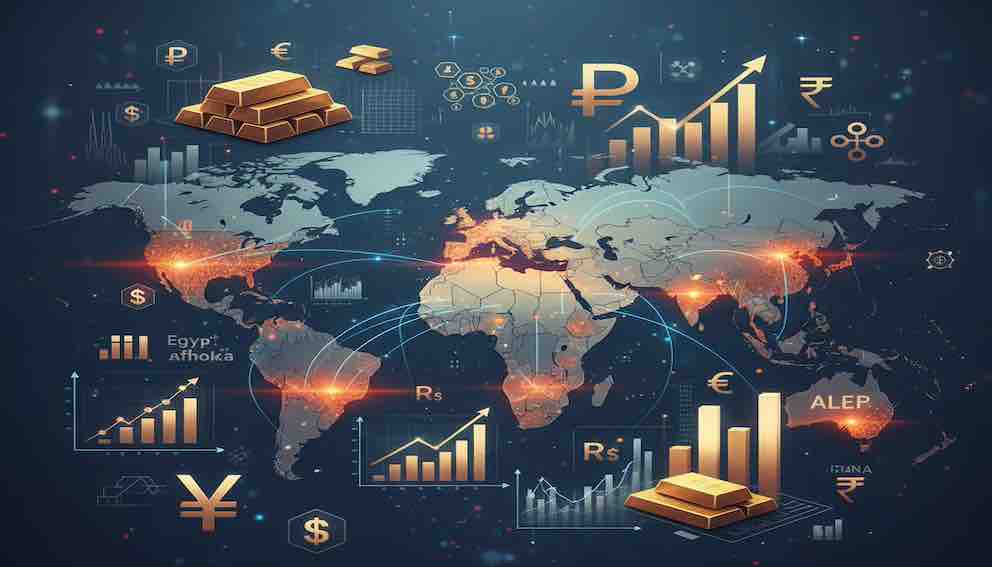
In the first decades of the 21st century, the center of global economic power has been quietly shifting. What was once dominated by a handful of Western economies is now seeing emerging markets play an increasingly influential role. At the heart of this transformation lies BRICS — a coalition of major emerging economies whose reach spans population, trade, finance, and even global governance debates.
From funding infrastructure projects in Africa to helping countries bypass the US dollar in trade, BRICS is not just an abstract geopolitical bloc — it’s already shaping real-world economic lives.
What Is BRICS? — Origins, Formation & Members
BRICS began as BRIC — an acronym for Brazil, Russia, India, and China — a term coined in 2001 by economist Jim O’Neill of Goldman Sachs to describe four fast-growing economies poised to reshape the global economy. The first formal summit took place in June 2009 in Yekaterinburg, Russia, bringing these countries together as a cooperative forum. South Africa joined in 2010, completing the classic BRICS lineup.
Between 2024 and 2025, the bloc expanded to include Egypt, Ethiopia, Iran, and the United Arab Emirates. Additionally, BRICS continues to engage a growing number of partner countries, such as Nigeria, that participate in certain initiatives without full membership.
Unlike institutions with rigid structures, BRICS operates as a flexible, consensus-based forum, where leaders coordinate on economic, political, and developmental policies without a permanent secretariat.
Why BRICS Was Formed: Objectives & Vision
BRICS serves several overlapping goals:
- Amplifying the Voice of Emerging Markets: The bloc champions a multipolar global order, advocating reforms in Western-led institutions like the IMF and World Bank.
- Economic Cooperation & Development: BRICS promotes trade, investment, technology sharing, and infrastructure projects among its members and beyond.
- Global Governance Reform: The bloc pushes for a more equitable voice for developing nations in international financial institutions.
- South-South Cooperation: Supporting development, poverty reduction, and connectivity across Africa, Asia, and Latin America is central to its mission.
- Financial Sovereignty: BRICS seeks to reduce reliance on the US dollar, encouraging trade and finance in local currencies.
The Scale of BRICS: Population and Economic Footprint
BRICS’s reach is staggering. In 2025, its members and partner countries account for 45–56% of the world’s population — roughly 3.5–4.5 billion people. Economically, on a purchasing power parity (PPP) basis, they represent around 40–41% of global GDP, rivaling traditional Western blocs like the G7.
For perspective, the original BRICS members’ combined GDP grew more than 350% between 1990 and 2019, a testament to the bloc’s transformative economic trajectory.
What Has BRICS Achieved So Far?
BRICS has delivered both institutional milestones and practical economic benefits:
1. New Development Bank (NDB)
Founded in 2014, the New Development Bank finances infrastructure and sustainable development projects in member countries. The NDB has approved dozens of projects across renewable energy, transport, water infrastructure and digital networks, often with fewer policy conditions than traditional lenders — a key factor for many Global South governments.
2. Contingent Reserve Arrangement (CRA)
This $100 billion reserve pool was designed as a financial safety net to support members facing balance‑of‑payments pressures — a parallel to the IMF’s backstop but tailored for BRICS economies.
3. Rising Local Currency Trade
Trade in national currencies has grown rapidly. Recent data suggests that about 90% of Russia’s trade with BRICS partners is settled in local currencies rather than US dollars, and numerous bilateral trade agreements (e.g., China‑Brazil in yuan and real; India‑UAE in rupees and dirhams) are bypassing traditional dollar settlements.
4. Growth in Cross‑Border Settlement Infrastructure
Initiatives such as BRICS Pay and new settlement bridges aim to reduce reliance on legacy systems like SWIFT and cut transaction costs by using national currencies and interoperable digital rails.
5. Expanding Financial Connectivity
Brazil, India and other BRICS members have seen significant rises in investment flows from within the bloc. For example, Brazil’s trade with BRICS partners has increased more than 120% since 2015, a sign that deeper integration is paying economic dividends.
What’s in the Pipeline
- Finalizing BRICS Pay and expanding its utilities in retail and corporate payments.
- Piloting new settlement rails connecting central bank digital currencies (CBDCs) via the so‑called BRICS Bridge systems.
- Dialogue on a common reserve or unit of account, like The Unit, though full implementation remains distant.
- Expanding financial guarantee facilities to catalyze capital flows into the Global South.
- Continued push for global institution reforms, including IMF and World Bank representation.
Commitment Levels Across Members
Not all BRICS members show equal enthusiasm for every goal:
- China and Russia are strong advocates of dedollarization and new payment systems.
- India often prefers pragmatic engagement and local currency settlements rather than radical systemic breaks.
- Brazil, South Africa and newer members balance cooperation with maintaining ties to Western financial systems, sometimes reinforcing moderation.
Trade and Dedollarization: Changing Patterns in Global Commerce
One of the most consequential shifts associated with BRICS is the use of national currencies in trade:
- China has significantly internationalized the yuan (renminbi), which now accounts for increasing proportions of trade invoicing and settlement — and is increasingly used in trade corridors involving Russia, India, Brazil and the UAE.
- Russia and China have reported bilateral trade exceeding $240 billion in recent years, largely settled in rubles and yuan, particularly for energy and industrial goods.
- India has completed rupee‑denominated oil purchases from the UAE and expanded rupee trade with Russia and other partners, reducing dependence on the dollar.
While broad global trade remains dollar‑centric, these trends show concrete shifts among BRICS economies toward local currency settlements, which reduce exchange risk and often cut transaction costs. However, dollar‑denominated transactions continue to dominate global and even intra‑BRICS trade — local currency settlements remain a rising but still modest share of total volumes.
Project mBridge — A Paradigm for Cross‑Border Payments
mBridge is not a BRICS initiative, though it aligns with BRICS goals. mBridge (Multiple CBDC Bridge) is a cross‑border wholesale central bank digital currency (CBDC) platform originally developed by the Bank for International Settlements (BIS Innovation Hub) with several central banks (China’s central bank via the Digital Currency Research Institute, Hong Kong Monetary Authority, Bank of Thailand, Central Bank of the United Arab Emirates, and later the Saudi Central Bank) to explore faster, cheaper, interoperable cross‑border payments using CBDCs.
While several mBridge participants also happen to be BRICS members (e.g., China and the UAE), mBridge itself was not created to serve BRICS, and BIS leadership has explicitly stated that mBridge is not the “BRICS Bridge.”.
Gold, Reserve Diversification and Financial Sovereignty
Beyond digital rails, precious metals like gold have gained new strategic importance in BRICS financial thinking. Several central banks in the bloc have increased their gold reserves in recent years — seen as a hedge against currency volatility and sanctions risk, and as a store of value that supports financial sovereignty in a volatile geopolitical context.
Some BRICS members have also explored gold vaults and settlement mechanisms that could facilitate cross‑border trade and lending by anchoring financial instruments in tangible assets, although such arrangements remain at relatively early stages of development.
BRICS Loans and Development Financing Outside the West
BRICS’s financing mechanisms have helped some members to diversify away from dollar‑denominated debt. For countries constrained by access to Western credit markets — for example due to geopolitical tensions or high interest rates — loans from the NDB and other BRICS‑linked facilities provide alternative funding for infrastructure, energy and development projects, often with more favorable terms or in local currencies.
Implications for the Global South and Western World
For the Global South
BRICS offers a platform where emerging economies can:
- Influence global policy debates without being locked into Western financial models.
- Access development finance with fewer conditional policy strings.
- Deepen regional and intercontinental trade and investment ties.
These factors are particularly appealing to Global South nations looking for alternatives to IMF‑ or World Bank‑led financing.
For the Western World
BRICS’s rise presents both challenges and opportunities:
- It challenges the unipolar dominance of the US dollar and Western financial institutions.
- New payment and settlement systems could chip away at dollar reliance — though the dollar remains dominant globally for now.
- Western countries are watching closely, with many joining CBDC research and digital finance initiatives in response to this broader shift.
Why BRICS Is One of the Biggest Global Developments
BRICS is not just “another international club.” It represents:
- A demographic majority of humanity.
- A dramatically rising share of global economic output.
- A growing alternative financial architecture that challenges old norms.
- A reshaping of trade and finance that prizes local currencies and new digital rails.
These shifts are accelerating a multipolar global order, where economic power is more widely distributed and where the Global South can pursue diverse development paths without being tethered exclusively to Western financial systems.
This article is the first in our series on BRICS. We will continue to keep our readers informed on the bloc’s latest initiatives and developments.
Disclaimer
This article is for educational purposes only and should not be interpreted as financial advice. Readers should consult a qualified financial professional before making investment decisions. Part of this content was created with formatting and assistance from AI-powered generative tools. The final editorial review and oversight were conducted by humans. While we strive for accuracy, this content may contain errors or omissions and should be independently verified.