December 28, 2025 at 17:59
The Fight for Warner Bros: How Two Giants Are Reshaping the Future of Streaming
Authored by MyEyze Finance Desk
Netflix’s $72bn offer for Warner Bros ignited one of Hollywood’s biggest takeover battles in decades. When Paramount fired back with a hostile $108bn all-cash bid, the drama escalated into a test of strategy, regulatory appetite, and the future structure of global media. This article explains the offer specifics, the strategic logic behind each bid, the risks involved, the earlier suitors who explored deals, and the short-to-medium-term shifts now looming over the industry.
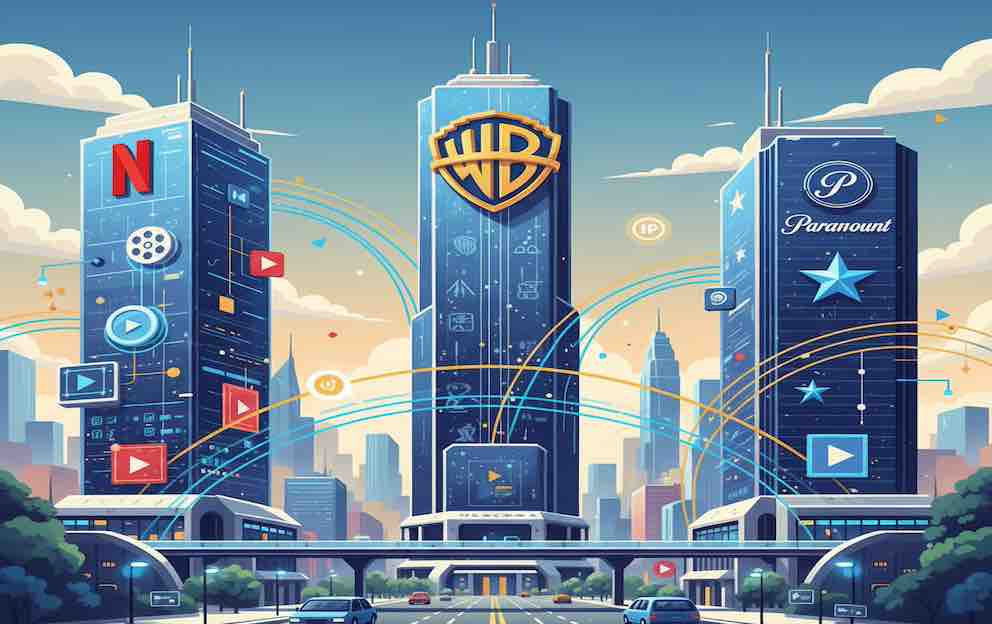
Netflix’s proposal to acquire Warner Bros. Discovery’s prized studio and streaming assets — a package reportedly valuing the business at roughly $72 billion in equity and about $82.7 billion including debt — was always going to be the sort of transformational, headline-grabbing play that forces a strategic rethink across the media landscape. Under the terms disclosed, Warner shareholders would receive about $23.25 in cash plus roughly $4.50 in Netflix stock per share, an offer Netflix paired with an unusually large reverse breakup fee should regulators block the transaction.
What turned the story into an all-out contest was Paramount’s swift response: a hostile, all-cash tender offer at $30 per share — valuing Warner at around $108 billion — that explicitly challenges Netflix’s plan on price and speed. Paramount’s bid is positioned as a faster, “more certain” alternative for Warner shareholders who might prefer cash today to a longer regulatory slog and stock consideration.
Comcast was widely cited as a possible suitor for a piece of Warner Bros. Discovery (WBD) — specifically the studio + streaming arms, rather than the entire company.
The offer specifics — numbers that matter
The stark differences in structure drive much of the strategic calculus. Netflix’s transaction blends cash and equity, signalling a desire to marry Warner’s IP with Netflix’s global streaming scale and to preserve a stake for WBD shareholders in a combined streaming future — but it also exposes Netflix to regulatory risk and financing complexity. The deal reportedly carries a Netflix termination exposure of roughly $5.8 billion if regulators block the deal, while Warner would owe Netflix a reverse fee of roughly $2.8 billion if it walks to a superior bidder — terms that underline how much Netflix wants to close and how much Warner wanted a credible protection for Netflix’s commitment.
Paramount’s $30-per-share cash tender has two immediate attractions: it is higher on the board-level headline metric and it offers shareholders immediate liquidity without stock price execution risk. It also removes some political/regulatory uncertainty from the bidder side — cash plus strong financing commitments is a conventional route to speed and certainty, even if antitrust review may still be required.
Why this matters for Netflix
For Netflix, the strategic case is straightforward: content is the moat. Acquiring Warner’s deep library — from HBO’s prestige catalogue to blockbuster theatrical franchises — materially enlarges Netflix’s owned IP, reduces dependence on costly licensing arrangements, and gives it a theatrical and production backbone that pure-play streamers historically lacked. Ownership could unlock more flexible windows, greater merchandising and franchise exploitation, and a powerful advantage in advertiser and affiliate negotiations if Netflix pushes further into ad-supported tiers and hybrid monetization strategies.
But the risks are equally palpable. Paying up for legacy studio assets that have structural challenges (linear TV decline, fragmented ad markets and heavy legacy fixed costs) is expensive. Netflix would inherit integration complexity, unionized workforces, and a regulatory headache: critics have already flagged potential antitrust concerns, arguing the combined firm would possess unprecedented control over marquee content. Those concerns have moved from op-eds to political statements, and regulatory scrutiny could stretch for many months, if not longer.
Why Paramount jumped in — and what it gains
Paramount’s counter is both defensive and opportunistic. An all-cash $30 bid seizes on the value of Warner’s studio catalog while arguing that Paramount — with outside backers and debt commitments lined up — can close faster and with fewer execution risks. For Paramount, which has been rebuilding its streaming footprint via Paramount+ and Showtime and seeking scale to compete with Disney and Netflix, swallowing Warner would deliver immediate content heft and franchise depth. The playbook here is consolidation: use scale to defend subscriber economics, bolster advertising inventory, and sharpen negotiating power with creators and distribution partners.
Paramount’s calculus, though, presumes it can successfully finance and integrate a much larger enterprise and that regulatory authorities will be as comfortable with its structure as they are wary of Netflix’s combined market share. The presence of sovereign or large private backers can also complicate political optics — bidders have made public concessions about governance and control to defuse national-security or political concerns.
Products and platforms — what’s on the table
The jockeying is fundamentally about distribution rights and consumer-facing platforms. Netflix brings a global subscription base, an ad-lite/ad-present business in select markets, and a tight digital-first distribution engine. Warner offers HBO/HBO Max (the premium streamer and its library of prestige shows), a major theatrical studio with a pipeline of tentpole films, and legacy linear channels (cable networks and international networks) — though the current bids focus on studios & streaming rather than all linear assets. Paramount contributes Paramount+, Showtime, and a roster of IP anchored by legacy franchises and theatrical distribution know-how. Each bidder’s product mix shapes how they would monetise franchises, balance direct-to-consumer vs. theatrical releases, and sell advertising.
The Stakes are high
Many analysts have called these bids a “high-stakes gamble,” but the truth is more nuanced. It’s both a gamble and a calculated strategic move — depending on how one looks at the risk-reward equation.
Any takeover of a major Hollywood studio brings enormous stakes, with regulators almost certain to launch aggressive antitrust reviews that could expose Netflix or Paramount to billions in termination liabilities and significant reputational damage if a deal is blocked. Beyond regulatory risk, both bids target legacy-heavy assets in a structurally challenged segment: theatrical performance is volatile, cable and linear revenues continue to decline, talent contracts remain expensive, and any buyer must absorb substantial fixed costs, long-term licensing commitments, and additional debt. The broader industry has also shifted away from the old “growth at all costs” ethos toward a strict profitability-first model, meaning large-scale acquisitions now pressure margins rather than support them—especially for Netflix, whose lean operating structure could be disrupted by the complexity of integrating a giant studio. And while Warner’s world-class IP portfolio—DC, Harry Potter, and HBO among others—remains highly valuable, turning those franchises into sustained profit requires flawless creative execution and strategic renewal. In sum, these deals represent a high-risk, high-reward calculus where regulatory, financial, operational, and creative risks all converge.
This isn’t a reckless gamble so much as a calculated bid for long-term strategic dominance: premium IP reliably pays for itself across decades through streaming, theatrical releases, licensing, and merchandise; scale has become essential as mid-sized players get squeezed; consolidation is no longer optional but inevitable; and owning both production and distribution is the surest path to sustained margin expansion. That logic underpins what’s at stake in this contest. Netflix brings a global streaming engine, a fast-growing ad tier, strong personalization technology, and rising ambitions in gaming and live content. Warner Bros. Discovery offers HBO/HBO Max, a world-class studio, beloved franchises, broad production capabilities, and valuable international distribution rights. Paramount contributes Paramount+, Showtime, a robust theatrical pipeline, and a deep legacy television portfolio. For either Netflix or Paramount, acquiring Warner would create a fully integrated content and distribution empire with the scale and IP depth required to compete in a consolidating industry.
Recent media deals — lessons and cautionary tales
Large media M&A is instructive. Disney’s acquisition of 21st Century Fox expanded Disney’s content library and global footprint but also left it with heavy integration demands and a long debt-servicing horizon; the Disney-Fox playbook shows scale is powerful but costly and complex, and anticipated synergies often take years to crystallise. Similarly, AT&T’s earlier acquisition of WarnerMedia — and the later marriage with Discovery to form Warner Bros. Discovery in 2022 — illustrated how legacy bundle rationales and consulting-led restructurings can produce volatile results for shareholders and employees alike. The bottom line: marquee content deals can create dominant scale, but they also amplify execution, regulatory and cultural risks — and they are expensive to unwind when synergies underperform.
Short-to-medium-term market changes
If either bidder succeeds, expect three immediate, material shifts. First, consolidation will accelerate: rivals will either pursue scale deals of their own or seek deep partnerships to match content breadth, compressing the independent studio model. Second, distribution economics will bifurcate: marquee streaming services with owned studios can control windows and packaging far more aggressively, tightening creators’ leverage in negotiating rights and residuals. That will pressure licensing-dependent streamers and might push them toward more exclusive output deals or deeper ad-supported strategies. Third, advertising and theatrical dynamics will shift: a combined studio-plus-streamer can coordinate release windows to maximise overall lifetime value (theatrical, PVOD, streaming, merch), forcing advertisers and exhibitors to recalibrate pricing and timing. In short, successful consolidation will raise barriers to entry, centralise premium content control, and give winning platforms outsized influence over pricing, creator economics, and international distribution choices. These changes will play out over the next 12–36 months and will determine whether consumers face fewer but larger platforms, or whether regulators and rival strategies restore balance.
Critical analysis — the balanced verdict
Both bids are credible but imperfect answers to the same strategic problem: how to scale content ownership in a fragmented market. Netflix’s offer is transformative for a digital-native streamer that has long preferred licensing to owning big studios; it’s a bet on vertical ownership improving margins and creative reach. Paramount’s bid is a classic leverage-and-scale play — immediate cash for shareholders and a pledge of faster execution. But both options face the same nemeses: regulatory pushback, the messy economics of legacy linear TV, and the recurring risk that content synergies fail to offset integration costs.
Investors and policymakers will watch three indicators closely: regulatory stances (do authorities prioritise competition or cultural/consumer harms?), shareholder preferences (cash today vs. equity exposure to a merged streaming future), and execution proofs (how quickly acquirers can rationalise production and distribution assets). Until those answers arrive, the market will price in both the upside of scale and the downside of regulatory and cultural friction.
What to watch next
Key near-term milestones include formal tender outcomes, stakeholder statements (unions, studios, foreign governments), and any conditionality regulators impose. Wall Street will also watch subscriber and ad-revenue trajectories for incumbents: if ad markets hold or theatrical windows rebound, the case for consolidation strengthens; if not, buyers may find they overpaid for uncertain cash flows.
Disclaimer
This article is for educational purposes only and should not be interpreted as financial advice. Readers should consult a qualified financial professional before making investment decisions. Part of this content was created with formatting and assistance from AI-powered generative tools. The final editorial review and oversight were conducted by humans. While we strive for accuracy, this content may contain errors or omissions and should be independently verified.