
Tutorial Categories
Last Updated: January 16, 2026 at 08:30
Markets Are Emotional, Not Just Mathematical - Behavioral Finance Series
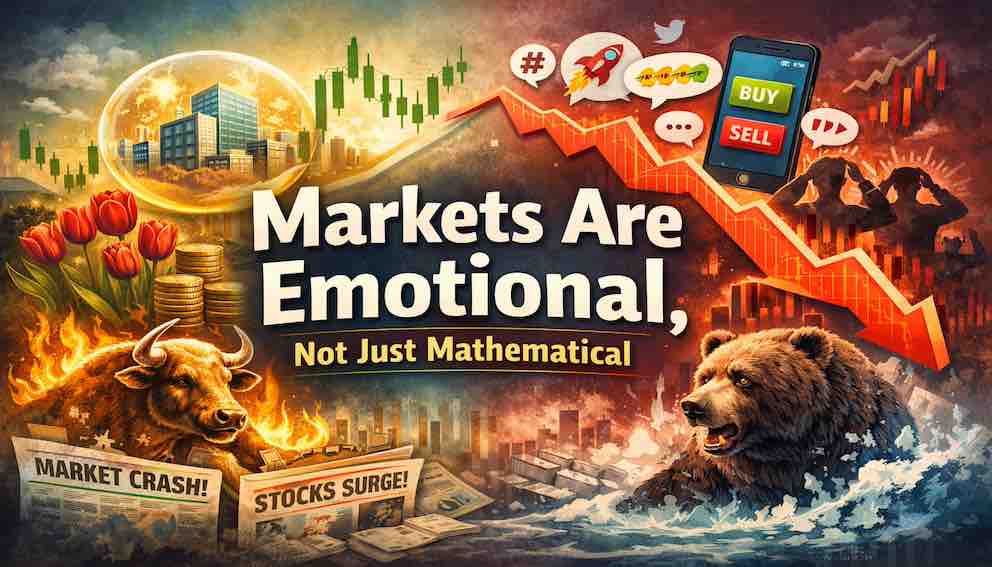
While traditional finance often assumes rational pricing, history tells a different story: from Tulip Mania to the dot-com bubble, markets are shaped by fear, greed, and collective narratives. Individual biases—overconfidence, herd behavior, and recency—scale up to influence entire markets, creating bubbles, crashes, and dramatic swings. Today, social media, 24/7 news, and gamified trading platforms amplify these emotions faster than ever. Experts don’t ignore emotion—they anticipate it, using sentiment indicators, risk limits, and rules-based processes to navigate the chaos. Key insight from this tutorial is - When market sentiment feels extreme—euphoric or terrified—check your financial plan. Don’t follow the crowd; let process, not panic, guide your decisions.
If you’ve read the previous tutorials, you’ve explored how individual investors—novices and even seasoned professionals—fall prey to biases like loss aversion, overconfidence, herd behavior, and regret. So far, the focus has been on personal mistakes: how your own mind, emotions, and heuristics can quietly sabotage your financial decisions.
In this tutorial, we zoom out. Instead of the individual, we look at the market itself—a collective organism made up of millions of investors, each with their own emotions, stories, and mistakes. Markets are not purely mathematical constructs of supply, demand, and fundamentals; they are aggregated human psychology in motion. Understanding this shift—from individual behavior to market-level dynamics—is crucial for long-term investing and for anyone seeking to navigate financial cycles wisely.
The Paradox of Rational Markets
Consider the dot-com bubble around 2000. Tech stocks soared even for companies with minimal revenue. Many investors thought the market was rational, pricing in future growth. Yet the Nasdaq peaked in March 2000 and lost nearly 80% of its value within two years.
How could this happen if markets are supposed to reflect “rational” valuations?
The answer lies in collective emotion. Individually, investors may have been overconfident, chasing gains, or following narratives. Collectively, these behaviors amplified into bubbles, fueled by the “Greater Fool Theory”—the idea that one buys overvalued assets believing someone else will pay even more later. Markets, in essence, mirror our collective psychology, often moving far beyond what fundamentals would justify.
Strengthening the Theoretical Foundation
Traditional finance often assumes markets are rational. The Efficient Market Hypothesis (EMH) claims that prices always reflect all available information. Yet historical bubbles and crashes challenge this view.
Behavioral finance offers a richer lens:
- Adaptive Markets Hypothesis (AMH) – Andrew Lo proposes that markets are evolutionary systems. Investors compete, adapt, and make mistakes. Periods of apparent efficiency are punctuated by inefficiencies driven by fear, greed, and innovation. In other words, markets are never perfectly rational—they evolve like living systems.
- Reflexivity means that investors’ beliefs don’t just reflect reality—they can change it. When many people believe a story about a company and act on it, their actions (buying, investing, funding) can actually improve the company’s prospects, making the story seem true for a while. This creates a feedback loop where beliefs drive prices and investment, and those prices and investments appear to confirm the beliefs.
- Example: Belief that “this tech will change the world” leads to heavy investment in a company, fueling the company’s growth, temporarily justifying the original belief.
These frameworks explain why narratives, emotion, and psychology can dominate prices for long periods, creating cycles of boom and bust.
Core Theory: How Emotion Drives Markets
Markets aggregate the emotional behaviors of individuals. Several key mechanisms explain this:
1. Fear and Greed Scale Up
- Individual fear may cause panic selling; greed may drive overbidding.
- When millions act similarly, these behaviors amplify into trends or bubbles.
Example: In 2008, fear of bank collapses caused a liquidity freeze that worsened the financial crisis.
2. Herding
- Investors follow others due to reputational or informational pressures, even when individually they know better.
Example: During the 2017 Bitcoin rally, retail investors piled in because others were buying, driving a self-reinforcing loop.
3. Narratives Influence Prices
- Humans are storytelling creatures; markets react to stories, not just numbers.
Example: The “dot-coms are the future” story justified extreme tech valuations, even when profits were absent.
4. Bias Aggregation
- Individual biases like overconfidence, recency, and confirmation bias scale up in markets.
Example: After a rally, overconfidence drives more buying, pushing prices beyond fundamentals.
5. Overreaction and Mean Reversion
- Markets often overshoot in both directions. Emotion drives prices above or below intrinsic value.
Example: After panic selling, a stock may fall far below fair value, creating buying opportunities once rational assessment returns.
Modern Amplifiers of Market Emotion
Historical bubbles teach us a lot, but today market emotions spread much faster because of digital tools and media:
Social Media and Online Echo Chambers: Platforms like Reddit or Twitter/X can quickly turn a small group’s excitement or fear into a market-moving trend. For example, meme stocks like GameStop and AMC surged because online communities encouraged each other to buy. Social media algorithms often show people more of what they already agree with, creating a one-sided, overly optimistic or pessimistic view.
24/7 Financial News: News channels and websites constantly need attention, so normal market ups and downs are often presented as “breaking news,” crises, or big opportunities. This can make investors feel rushed and push them to follow the crowd.
Easy-to-Use Trading Apps: Many trading apps use alerts, bright graphics, and instant trading to make investing feel exciting and game-like. These features encourage quick, emotional decisions. For example, a beginner may panic-buy after a price alert or sell during a drop without thinking through the long-term impact.
Financial Consequences: Bubbles, Crashes, and Sentiment Swings
Markets have repeatedly shown that collective emotion can overpower fundamentals:
- Tulip Mania (1637): Tulip bulb prices soared irrationally before collapsing.
- South Sea Bubble (1720): Investors bought fantastical company promises, fueled by herd behavior.
- Dot-com Bubble (1995–2000): Tech stock valuations skyrocketed on hype.
- 2008 Global Financial Crisis: Fear of counterparty risk froze markets.
- Cryptocurrency Volatility (2017–2021): Price swings mirrored social media sentiment, not intrinsic value.
These episodes highlight that markets are human systems, influenced by emotion, stories, and collective bias.
Expert vs Novice Behavior
| Novice | Expert |
| Reacts to headlines, rumors, or short-term price moves | Understands market psychology but does not blindly follow it |
| Follows the herd: “Everyone is buying, so I should too” | Uses structured processes: valuations, risk limits, portfolio diversification |
| Buys high out of greed, sells low out of fear | Anticipates emotional extremes and positions accordingly |
Experts also leverage advanced tools to understand and even exploit market emotion:
| Concept | Core Idea | Practical Application |
| Sentiment Indicators | Quantify the market’s emotional temperature | Track VIX (Fear Index), put/call ratios, AAII surveys, or fund flows to identify extreme greed or fear |
| Behavioral Alpha | Profit from predictable behavioral errors | Buy when a stock is irrationally hated; sell when the herd chases a euphoric rally |
| Regime Recognition | Markets’ “rules” change depending on dominant sentiment | Momentum works in greed-driven bull markets; contrarian strategies may work in fear-driven crises |
Expert investors do not fight market emotion too early. In the early stages of a trend, emotions like optimism or fear often contain information—they reflect real changes, innovation, or improving fundamentals. Riding the trend during this phase can be rational and profitable.
However, expert thinking changes when emotion becomes dominant rather than informative. When enthusiasm turns into euphoria (or caution into panic), prices start moving mainly because of crowd psychology, not new information. That is the point where contrarian thinking emerges—not as blind opposition to the trend, but as a disciplined response to emotional extremes.
In other words, skilled investors often move with the trend at first, when emotions reflect genuine change. But when excitement or fear becomes overwhelming and one-sided, they step back, reassess fundamentals, and often do the opposite of the crowd.
Rule of Thumb: When market emotion feels overwhelmingly one-sided—either euphoric or terrified—it’s usually a signal to check your financial plan and rebalance, not to follow the crowd.
Practical Mitigation Strategies
While you cannot control the market, you can control your response:
- Rules-Based Investing: Automate contributions and rebalancing to prevent reactive trading (e.g., dollar-cost averaging).
- Sentiment Awareness: Monitor indicators and ask: “Am I being swept up by excitement or fear?”
- Cooling-Off Periods: Wait 24–48 hours before major trades to avoid impulsive decisions.
- Predefined Risk Limits: Set maximum exposure to volatile assets; don’t chase the herd.
- Narrative Analysis: Ask: “Is this story already priced in?” Even true narratives (e.g., AI is transformative) may already be reflected in high valuations, leaving little margin for error.
- Automation and Pre-Commitment: Use automatic rebalancing, limit orders, and pre-planned contributions to reduce emotional interference.
Nuance: When Emotion Helps
Emotion isn’t purely destructive:
- Fear can highlight overvaluation or systemic risk.
- Optimism can signal buying opportunities during undervaluation.
The challenge is separating adaptive signals from amplified irrationality.
- Example: Some quantitative funds exploit sentiment as a contrarian signal.
- Trade-off: Acting on sentiment can be profitable, but timing and discipline are critical.
Reflective Prompt
- When was the last time you made an investment influenced more by hype, fear, or social proof than by careful analysis?
- Could your portfolio benefit from rules, cooling-off periods, or automation to guard against the next wave of market emotion?
Key Takeaways
- Markets are collective reflections of human psychology, not purely mathematical constructs.
- Individual biases—fear, greed, herd behavior, overconfidence—scale up to shape entire markets.
- Bubbles, crashes, and dramatic swings are natural outcomes of collective emotion.
- Experts anticipate emotional extremes and respond with structured processes, not reflexive reactions.
- You cannot control the market, but you can control your response: automation, pre-commitment, rules, risk limits, and sentiment awareness are essential.
- Historical and modern examples—from Tulip Mania to GameStop—show that emotional amplification is timeless, only faster today due to digital media.
This tutorial bridged individual psychology and market-level dynamics, integrates EMH, AMH, reflexivity, and modern amplification factors, and equips you with expert strategies and practical tools.
About Swati Sharma
Lead Editor at MyEyze, Economist & Finance Research WriterSwati Sharma is an economist with a Bachelor’s degree in Economics (Honours), CIPD Level 5 certification, and an MBA, and over 18 years of experience across management consulting, investment, and technology organizations. She specializes in research-driven financial education, focusing on economics, markets, and investor behavior, with a passion for making complex financial concepts clear, accurate, and accessible to a broad audience.
Disclaimer
This article is for educational purposes only and should not be interpreted as financial advice. Readers should consult a qualified financial professional before making investment decisions. Assistance from AI-powered generative tools was taken to format and improve language flow. While we strive for accuracy, this content may contain errors or omissions and should be independently verified.