
Tutorial Categories
Last Updated: January 16, 2026 at 14:30
Why Markets Crash Faster Than They Rise - Behavioral Finance Series
Markets climb slowly, but when they fall, they can collapse in days. Fear spreads faster than greed, leverage magnifies losses, and liquidity evaporates in a self-reinforcing spiral. Behavioral biases like the Disposition Effect, structural fragility described by Minsky, and collapsing narratives turn gradual declines into sudden crashes. Understanding these dynamics helps investors survive crises: pre-commitment rules, scenario planning, liquidity management, and advanced strategies like dynamic hedging and providing liquidity at the peak of panic can make the difference between panic-selling and disciplined opportunity. Learn why declines accelerate, how experts navigate chaos, and what systems you can put in place to stay resilient in volatile markets.
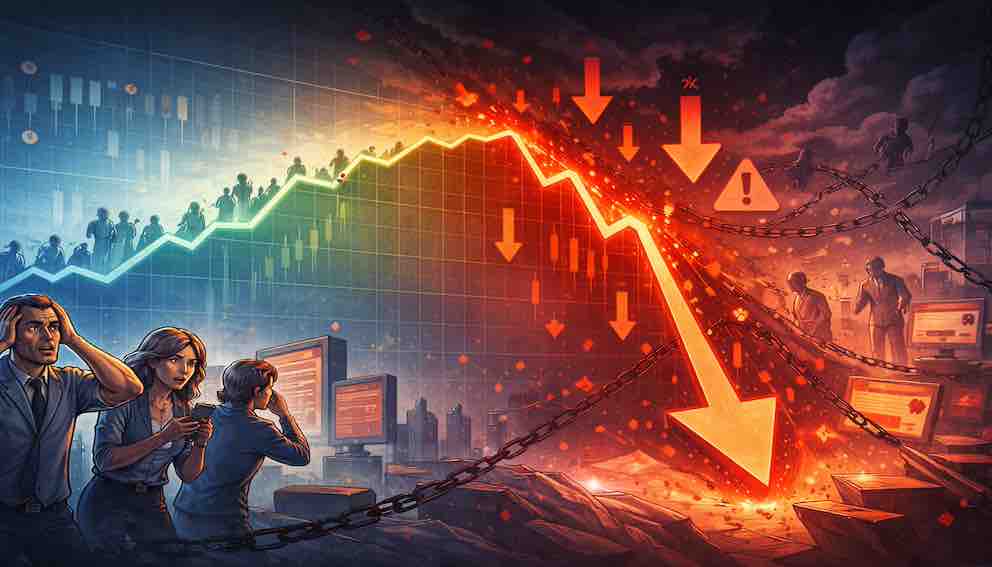
"The stock you loved yesterday is plunging today, and everyone seems to be panicking—but why do markets fall faster than they climb?"
If you’ve watched a market rally slowly for months only to see it collapse in days—or even hours—you’ve witnessed a fundamental truth of financial markets: declines are faster, sharper, and more painful than rises. Understanding why isn’t just interesting—it’s critical to surviving and thriving as an investor.
The Paradox of Asymmetry
Markets rise like a steady tide but fall like a sudden storm. Some examples:
- 1929 Crash: The Dow climbed gradually during the Roaring Twenties, then fell nearly 25% in just four days.
- 1987 Black Monday: The Dow lost 22% in a single day after years of steady growth.
- 2008 Financial Crisis: The S&P 500 fell about 50% from peak to trough in under a year.
- Crypto collapses: Bitcoin slowly climbed to $20,000 in 2017, only to drop to $3,200 within a year.
Notice the pattern? Rallies are patient; crashes are urgent.
Core Mechanics: Why Crashes Accelerate
The speed of declines comes from a mix of behavioral, structural, and liquidity-driven forces:
1. Fear Moves Faster Than Greed
Humans are wired for loss aversion: losing hurts about twice as much as winning feels good.
- During rallies, greed encourages incremental buying. Decisions are slow and deliberate.
- During crashes, fear spreads instantly. Panic selling triggers a cascade of losses, as everyone rushes to avoid further pain.
Example: After Lehman Brothers collapsed in 2008, even fundamentally solid banks were sold off rapidly. Fear traveled faster than facts.
2. Leverage and Reflexive De-Leveraging
Borrowing amplifies returns—but also losses:
- Rising markets: leverage nudges prices higher gradually.
- Falling markets: margin calls force liquidation, triggering reflexive de-leveraging, where hedge funds and institutions voluntarily reduce risk, further pushing prices down.
Example: Crypto markets in May 2022: leveraged positions were liquidated en masse, amplifying the 20% drop into even larger declines.
3. Liquidity Spirals: How the Market Feeds on Itself
Liquidity doesn’t just vanish—it collapses in a self-reinforcing spiral:
- Initial Shock: Prices drop, causing losses for leveraged traders.
- Margin Spiral: Margin calls force forced selling.
- Loss Spiral: Selling pushes prices down further, triggering more margin calls.
- Funding Liquidity Dries Up: Lenders pull back credit amid volatility.
- Market Liquidity Vanishes: Only forced sellers remain; bid-ask spreads widen, and selling even small amounts requires steep discounts.
Result: A 10% drop can easily become a 30%+ crash in days. The spiral is mechanical, fast, and self-feeding.
4. Narrative Collapse
Markets are stories as much as numbers. Positive narratives grow slowly, while negative narratives collapse instantly:
- Overnight, “sure thing” becomes “disaster waiting to happen.”
- Herd behavior amplifies the panic.
Example: The Dot-Com crash: “tech will change everything” soon turned into “these stocks are worthless overnight.”
5. Behavioral Dynamics: Disposition Effect on a Macro Scale
The Disposition Effect explains why selling accelerates in crashes:
- Normally, investors sell winners to lock gains but hold losers to avoid realizing pain.
- During a crash, this inverts catastrophically: as prices fall below purchase prices, holding becomes painful.
- Once enough investors reach their “pain threshold,” mass selling erupts suddenly, unlike the gradual, fragmented buying during a rally.
6. Structural Dynamics: Minsky’s Financial Instability Hypothesis: Why Crashes Aren’t Just “Mirror Images” of Rallies
Hyman Minsky, a renowned economist, explained that financial markets are inherently unstable—especially after long periods of stability. His Financial Instability Hypothesis helps us understand why market declines can be faster and sharper than the rises that preceded them.
Stability Breeds Risk-Taking
When markets grow steadily, investors and institutions start to assume that “good times will continue forever.” This optimism gradually encourages riskier financial behavior, which unfolds in three stages:
- Hedge Finance: Early in a cycle, loans and leverage used to purchase assets (homes, businesses, stocks, or other investments) are conservative. Borrowers can repay both interest and principal using ongoing income or cash flows, without needing refinancing or higher prices. Risk is low.
- Speculative Finance: As confidence grows, borrowing used to acquire assets becomes more aggressive. Cash flows are still enough to cover interest payments, but the principal must be refinanced or rolled over when it comes due. Risk rises, but the system continues to function as long as credit remains available and markets stay calm.
- Ponzi Finance: In this phase, asset financing loses any connection to cash flows. Servicing and repayment depend solely on capital gains and continued market optimism. When price appreciation slows, widespread insolvency emerges.
The “Minsky Moment”
A Minsky Moment happens when these Ponzi units can no longer find new buyers or financing to sustain their positions. Suddenly, the fragile structure built during the long rise unravels almost all at once, triggering a cascade of forced selling.
- Market declines aren’t just rallies running backward. Because so many investments are connected and depend on rising prices, even a small drop can trigger a chain reaction of massive losses.
- In other words, the market doesn’t fall gradually—it plummets like an avalanche, much faster than the slow, incremental gains of the preceding rally.
- If you examine the market crashes of 2000, 2008, 2020, and 2022, you’ll notice that the same structural and behavioral dynamics drive each collapse.
Why This Matters for Investors
Understanding Minsky’s framework shows that crashes aren’t random—they’re often the predictable outcome of a cycle of increasing leverage and risk-taking. This explains why:
- Declines are faster than rallies.
- Market panics cause damage, but the underlying structure of the system determines how severe that damage becomes.
- Systems built on rising prices alone are extremely vulnerable to sudden collapse.
Example:
- 2008 Financial Crisis: Years of “speculative” and “Ponzi” lending in housing markets meant that when defaults began, the entire financial system experienced a sudden, systemic crash. Prices didn’t just drift down—they collapsed rapidly as interconnected positions unwound.
Historical Case Studies
| Event | Rise | Crash | Key Amplifiers |
| 1929 | Slow gains during 1920s | Dow -25% in 4 days | Margin buying, panic selling, loss aversion |
| 1987 | Gradual growth | Dow -22% in 1 day | Portfolio insurance (mechanical selling), herd behavior |
| 2008 | Housing/credit expansion | S&P -50% | Lehman collapse, leverage, liquidity spiral, narrative collapse |
| Crypto 2017–2018 | Slow climb to $20k | Fall to $3.2k | Margin liquidations, thin liquidity, herd panic |
Expert vs Novice Behavior
| Aspect | Experts | Novices |
| Emotional Response | Recognize panic; measured response | Panic, sell indiscriminately |
| Decision Framework | Pre-planned rules, stress-testing | Reactive, narrative-driven |
| Opportunity | Experts look for assets that are temporarily mispriced, due to the crash which has taken place, but avoid overextending themselves. They plan entry points, size positions carefully, and ensure enough liquidity to survive further market stress. | Miss opportunities; paralyzed by fear |
| Positioning | Reduce leverage, hedge, phased entry | Often forced sellers |
Example: After March 2020 COVID crash:
- Experts rebalanced and selectively bought distressed assets.
- Many retail investors sold at market bottoms out of fear.
Practical Mitigation Strategies for Investors
Pre-Commitment Rules
- Set risk limits, stop-losses, and allocation boundaries before a crisis.
Scenario Planning & Correlation Stress Testing
- Simulate extreme drawdowns (20–50%) and assume all assets may fall together.
Liquidity Management
- Maintain cash buffers.
- Avoid illiquid assets that cannot be sold in a panic.
Reflective Journaling
- Record decisions and emotions during rallies and declines.
- Learn from patterns, not just outcomes.
Advanced Expert Tools: How Professionals Prepare for Market Breakdowns
Experienced investors know that rules alone are not enough during extreme market stress. When panic, leverage, and forced selling take over, experts rely on additional tools designed specifically for breakdown scenarios—not just normal volatility.
1. Dynamic Hedging: Owning Protection That Rises When Markets Panic
Dynamic hedging means holding assets or strategies that gain value when fear explodes.
- Long-volatility strategies (such as VIX options or tail-risk funds) are designed to benefit when volatility spikes.
- These positions often lose small amounts of money during calm markets, which is why many investors avoid them.
- Experts think of this cost not as a loss, but as an insurance premium—similar to paying for home insurance you hope never to use.
Why it matters:
During a crash, volatility rises sharply. While most assets are falling together, long-volatility positions can offset losses, provide psychological stability, and—most importantly—create liquidity when it is needed most.
Example:
In March 2020, volatility-linked strategies surged while equities collapsed, giving prepared investors cash and flexibility when others were forced to sell.
2. Being the Liquidity Provider: Buying When Others Are Forced to Sell
In a true panic, prices don’t fall because everyone believes assets are worthless—they fall because many investors must sell at any price.
Experts aim to be the opposite side of that trade.
- They pre-define what “extreme” looks like before a crisis occurs.
- Common signals include: VIX above 40 (extreme fear), multiple 4–10% down days, widespread forced liquidations and margin calls
- Capital is deployed gradually and in phases, not all at once.
Why it matters:
Markets often overshoot on the downside during liquidity spirals. Investors who can provide liquidity at these moments are compensated with higher long-term returns, not because they predicted the bottom, but because they had preparation, patience, and emotional control.
Key insight:
In bull markets, you are paid for taking risk.
In crashes, you are paid for providing liquidity and courage.
3. Stress-Testing Correlations: Planning for When Diversification Fails
Many portfolios look diversified on paper—but during crises, diversification often breaks down.
- In panics, investors sell whatever they can sell to raise cash.
- Stocks, bonds, commodities, and even “defensive” assets may fall together.
- Assets that usually move independently start moving in the same direction during market stress.
Experts therefore stress-test portfolios under a harsh assumption:
What if everything drops at the same time?
They ask:
- How much could the portfolio fall if correlations spike?
- Which assets might become illiquid?
- Where does emergency liquidity come from?
Why it matters:
This prevents false confidence. Investors who understand correlation breakdowns are less likely to panic, because they’ve already imagined—and accepted—the worst-case scenario.
Why These Tools Matter Together
These strategies work as a system:
- Dynamic hedging provides protection and liquidity.
- Liquidity provision turns panic into opportunity.
- Correlation stress-testing prevents unpleasant surprises.
Together, they help experts stay solvent, rational, and opportunistic when markets are at their most emotional.
Nuance & Trade-Offs
No prediction is perfect
Even experts can’t time crashes.
Participation vs Preservation: Balancing Growth and Safety
Investing is always a trade-off between two goals: growing your wealth (participation) and protecting it from large losses (preservation). Minsky-style crises, tail-risk events, and liquidity spirals show why this balance is critical.
Avoiding All Risk → Sacrifices Growth
- If you only focus on safety, avoiding stocks or risk assets entirely, your portfolio may survive every crash—but it also misses the long-term gains that come from exposure to growth assets.
- Example: Sitting entirely in cash from 2000–2020 would have avoided market crashes—but you would have missed the massive recoveries in equities and tech.
Embracing Risk Without Discipline → Invites Ruin
- On the other extreme, taking high-risk positions without rules—over-leveraging, chasing momentum, ignoring valuations—can destroy capital in a single crash.
- Example: Investors heavily leveraged in housing or tech bubbles during 2000 or 2008 lost significant portions of their wealth very quickly.
The Balance
- The goal isn’t to eliminate risk or chase every opportunity—it’s to participate in growth while managing vulnerability.
Tools for balance include:
- Position sizing and risk limits
- Scenario planning for tail events
- Pre-commitment rules for exits
- Stress-testing portfolios for correlation spikes
Key Insight:
Successful investing is like walking a tightrope: leaning too far toward safety slows your progress, but leaning too far into risk can make you fall. The art is knowing when to take risk, how much, and under what conditions.
Behavioral Discipline > Prediction
Having systems and plans in place is more effective than trying to guess what markets will do in a crisis.
Key Takeaways
- Crashes are faster than rallies because fear is faster than greed, leverage amplifies declines, liquidity spirals, narratives collapse, and investor behavior flips.
- Behavioral effects like the Disposition Effect and structural dynamics like Minsky’s Hypothesis explain sudden, non-linear declines.
- Experts survive and even profit by planning for breakdowns: hedging, liquidity provisioning, stress-testing correlations.
- Practical strategies—pre-commitment, scenario planning, liquidity management, reflective journaling—help turn knowledge into resilience.
Reflective Prompt:
- Recall a market decline you’ve experienced. Which behaviors dominated: fear or discipline?
- How can you design rules and systems to prevent panic from hijacking your decisions next time?
About Swati Sharma
Lead Editor at MyEyze, Economist & Finance Research WriterSwati Sharma is an economist with a Bachelor’s degree in Economics (Honours), CIPD Level 5 certification, and an MBA, and over 18 years of experience across management consulting, investment, and technology organizations. She specializes in research-driven financial education, focusing on economics, markets, and investor behavior, with a passion for making complex financial concepts clear, accurate, and accessible to a broad audience.
Disclaimer
This article is for educational purposes only and should not be interpreted as financial advice. Readers should consult a qualified financial professional before making investment decisions. Assistance from AI-powered generative tools was taken to format and improve language flow. While we strive for accuracy, this content may contain errors or omissions and should be independently verified.