
Tutorial Categories
Last Updated: January 20, 2026 at 08:30
Contrarian Thinking: Acting Calm When Others Panic - Behavioral Finance Series
Markets often swing violently when fear or greed takes over, pushing prices far beyond what fundamentals justify. Most investors react instinctively, following the crowd, while contrarians step back, pause, and engage deliberate, analytical thinking. Acting calm in panic is not bravado—it is a skill that combines emotional self-control, probabilistic reasoning, and patience. By maintaining optionality, managing risk through barbell strategies, and exploiting long-term market corrections, disciplined investors can turn collective overreactions into opportunity. True contrarian investing is process-driven, not reflexive, rewarding those who observe carefully, resist social pressure, and act thoughtfully when others panic.
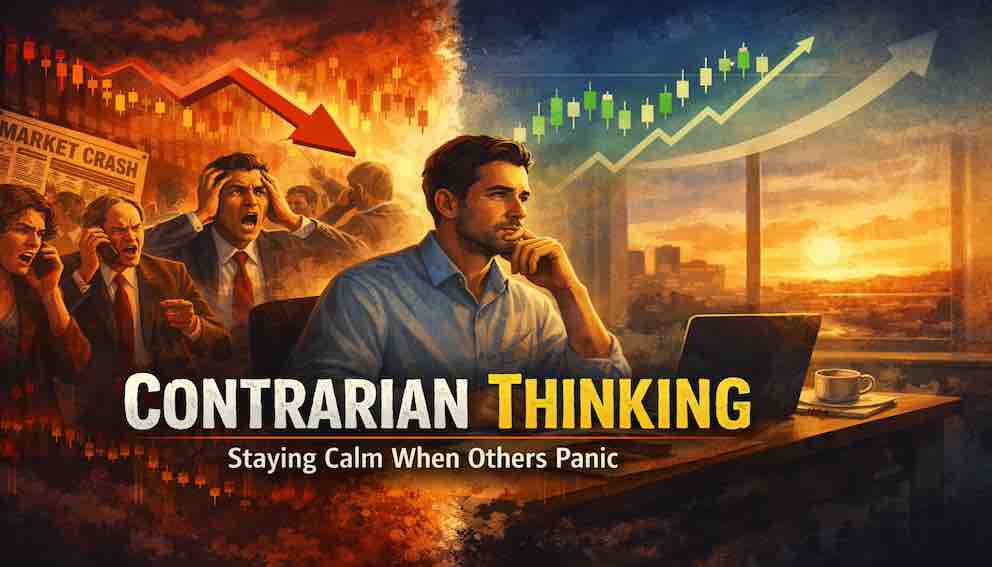
Calm in the Eye of the Storm
Imagine it’s October 1929. Headlines scream of collapsing banks, frantic brokers are shouting on the trading floor, and investors are rushing to liquidate their holdings. Prices are dropping by the hour, and the crowd seems certain the end of the market is here. If you were standing there, would you sell like everyone else—or pause and think?
Markets can swing violently when fear or greed takes over. In these moments, most people act instinctively: they panic-sell when prices fall or chase gains when prices rise. But the most successful investors often do the opposite—they remain calm, observe, and act carefully.
Contrarian thinking is the ability to move against the emotional crowd in a rational and disciplined way. It is not bravado or a desire to be different—it is a cognitive skill that combines emotional self-control, probabilistic reasoning, and a long-term perspective.
The key idea is simple, but powerful: when most investors are panicking, prices often swing far beyond what the underlying businesses or assets are truly worth. Panic amplifies small problems into large, visible crises, and fear spreads faster than facts. In these moments, the market price is driven less by fundamentals—like earnings, cash flow, or long-term growth potential—and more by emotions, leverage, and social pressure. This creates a disconnect between price and value, sometimes lasting days, weeks, or even months.
Recognizing these extremes requires patience and discipline. A contrarian investor does not react to the noise or follow the crowd; instead, they step back, assess what is happening beneath the headlines, and ask: Does this price reflect reality, or is it being distorted by fear? By calmly navigating these periods, contrarians can position themselves to buy undervalued assets or avoid overvalued ones, taking advantage of the market’s overreaction. In essence, opportunity often lies where panic has pushed prices to unjustified extremes, and the ability to wait and act thoughtfully is what separates disciplined investors from the herd.
Why Panic Begets Panic
Understanding why the crowd panics is essential. Panic is not just about individual fear—it is amplified by human psychology, market structure, and social dynamics.
System 1 vs. System 2 thinking
Humans have two modes of thinking, as described by Kahneman’s dual-process theory:
- System 1: Fast, intuitive, automatic, and emotional. It reacts quickly to fear, rumors, or social proof.
- System 2: Slow, deliberate, analytical, and effortful. It requires attention and self-control.
During a panic, most people operate on System 1—they follow the crowd, respond to headlines, or mimic others’ trades. Contrarian investors engage System 2, stepping back, analyzing the situation, and making reasoned decisions.
Emotional amplification in crowds
- Fear and greed are contagious. Social proof (“everyone is selling, so I must sell too”) magnifies panic. Media coverage and online chatter accelerate the effect.
Leverage and liquidity as accelerators
- Investors or funds using borrowed money may be forced to sell during a decline. This forced selling can cause prices to drop faster than fundamentals would suggest.
Narrative contagion
- Stories simplify complex events. When a fear-based story dominates, people tend to accept it as truth without examining the underlying facts. For instance, during the dot-com bubble burst in 2000, the narrative that “all technology companies are worthless” swept through investors and the media. Even fundamentally strong companies saw their stock prices plummet because the story was easier to believe than the nuanced reality. In such moments, panic spreads faster than careful analysis, and contrarian investors who separate the story from the facts often find opportunities.
Key takeaway: Panic is rarely proportional to actual economic or business fundamentals. It is an emotional and structural phenomenon.
The Psychology of Contrarian Calm
Being contrarian is psychologically challenging. It requires resisting a deep human need for social validation, which is strongest in uncertain situations. Acting calmly when everyone else panics is emotionally costly and requires practice.
- Self-awareness: Recognize when fear or excitement is driving your decisions rather than rational analysis.
- Probabilistic thinking: Evaluate outcomes as a range of possibilities rather than certainties. Even during panic, extremes are usually temporary.
- Separating signal from noise: Headlines and viral stories are often amplified versions of small truths. Focus on underlying facts, not the story.
- Deliberate pause: Before acting, ask: Am I reacting to emotion or to reasoned analysis?
Contrarian calm is not passive. It is an active mental skill, developed by observing one’s own emotions and consistently choosing reason over reaction.
Frameworks for Contrarian Positioning
Contrarian investing is not about being different for the sake of it. It is methodical, disciplined, and process-driven. Rather than reacting to every headline or short-term market movement, contrarians rely on structured approaches that manage risk, exploit emotional overreactions, and take advantage of the market’s long-term tendency to revert to fair value. The following four pillars provide a practical framework for disciplined contrarian positioning:
1. Optionality Mindset
Core Principle: Focus on investments where the potential upside far outweighs the downside.
Explanation: Optionality is like holding a financial “option”: a small cost or allocation gives you the right to a large payoff if the market moves in your favor. This approach allows you to participate in potentially high-reward opportunities without risking your entire portfolio.
Practical Application: For example, during a market panic, some quality companies may be sold indiscriminately and appear undervalued. Allocating a small portion of your portfolio to these misunderstood or undervalued assets gives you the chance to benefit if prices recover, while the limited size of your position prevents catastrophic loss if the situation worsens. Optionality allows you to take advantage of extreme market moves while controlling emotional and financial risk.
2. Barbell Strategy
Core Principle: Avoid the “messy middle” by splitting capital between ultra-safe and high-risk, high-reward assets.
Explanation: Most investors cluster in moderate-risk investments, thinking it’s the safest path. The barbell strategy challenges this by minimizing exposure to middle-risk positions, which are neither safe nor truly optional. Instead, your portfolio is anchored with extremely safe assets while keeping a portion allocated to high-potential opportunities.
Practical Application: A simple example is allocating 90% of your capital to ultra-safe investments such as treasury bonds or cash equivalents, while 10% goes to speculative, undervalued, or misunderstood ventures. This approach protects survival in downturns while maintaining upside optionality. The key is discipline: the safe portion provides resilience, and the high-risk portion allows you to profit from market overreactions.
3. Convexity Awareness
Core Principle: Structure investments so they benefit from volatility and disorder rather than merely surviving it.
Explanation: Convexity is related to antifragility: instead of simply weathering stress, your portfolio gains from it. Markets are inherently unpredictable, and volatility is a natural part of investing. By designing positions that have asymmetric payoffs—where losses are limited but gains increase in turbulent conditions—you turn uncertainty into opportunity.
Practical Application: Consider distressed or overlooked assets that could rebound sharply in a market recovery. Small, well-sized positions in these assets allow you to benefit from disorder. Another example is writing strategies or options that profit when volatility spikes. Convexity awareness ensures that market turbulence can strengthen, rather than weaken, your long-term results.
4. Time Arbitrage
Core Principle: Take advantage of the market’s long-term tendency to revert toward fundamental value.
Explanation: Market prices often swing far above or below intrinsic value because of emotional extremes. Time arbitrage is the practice of using a long-term perspective to profit from short-term mispricing, letting temporary noise work in your favor. This requires patience and a strong understanding of fundamental value.
Practical Application: A contrarian may buy undervalued assets during periods of panic and systematically rebalance over time, selling overvalued assets and adding to discounted positions. Unlike short-term speculation, this approach relies on discipline, probabilistic reasoning, and the natural corrective tendencies of markets. Over time, emotional overreactions reverse, rewarding those who remained patient.
Critical Nuance
True contrarian investing is not simply “doing the opposite of the crowd.” It is rational, structured, and emotionally disciplined. By understanding human biases—like herd behavior, loss aversion, and fear-driven selling—contrarians can identify temporary market dislocations and position themselves to profit from them over the long term. Each of these four pillars—optionality, barbell strategy, convexity, and time arbitrage—provides a practical way to act thoughtfully in extreme market conditions, balancing opportunity with survival.
When to Apply Contrarian Frameworks
The frameworks for contrarian positioning are not tools you use all the time—they are most valuable in moments of market stress, extreme sentiment, or collective overreaction. Specifically, they should be applied when:
Markets are in panic or euphoria
- Prices swing far beyond what fundamentals justify, driven by fear or greed.
- Headlines, social proof, and narratives dominate rational analysis.
Sentiment indicators or narratives reach extremes
- Surveys, valuation metrics, or media coverage show unusually high optimism or pessimism.
- Stories become unquestioned dogma, e.g., “the market is collapsing” or “tech stocks can only go up.”
Volatility spikes or clustering is visible
- Sudden, sharp price movements create opportunities for convex, optional, or mispriced positions.
- Calm markets can hide fragility, but visible volatility signals temporary mispricing driven by emotion.
Long-term perspective is possible
- You can afford patience, allowing market overreactions to revert to fundamental value.
- Time arbitrage works only when you are positioned to wait through short-term noise.
Emotional clarity is present
- You are able to pause, engage System 2 thinking, and act deliberately rather than reflexively.
- This reduces the risk of following the crowd during extremes or acting prematurely.
In essence: The frameworks are applied not for every market movement, but when human behavior, leverage, and narratives create temporary mispricing and opportunity. They guide disciplined action in moments where most investors are reacting emotionally, helping you turn collective overreaction into a structured, probabilistic advantage.
Execution and Pitfalls
Even with a strong framework, contrarian investing is not easy. There are key practical challenges:
The Peril of Being Early
- Being early can feel like being wrong. Prices may remain irrational longer than you can remain solvent. Proper position sizing and the barbell strategy are essential to survive until the thesis plays out.
Avoiding Stubbornness
- Contrarian bets must be based on reasoned assessment, not a desire to be different. Continually scrutinize your thesis and be willing to adjust or admit mistakes.
Practical triggers for action
- Quantitative extremes: Sentiment surveys or valuation metrics reaching unusual levels.
- Narrative saturation: When a story becomes unquestioned dogma.
- Systematic rules: Calendar-based or threshold-based portfolio rebalancing can help avoid impulsive decisions.
Execution is as much about rules and discipline as it is about analysis.
Historical Illustrations
- 1929 Crash / Great Depression: Panic selling, margin calls, and herd behavior created massive overshoots. Investors who stayed calm and bought selectively captured significant gains over time.
- 2008 Financial Crisis: Emotional selling, herd behavior, and the disposition effect (holding losers, selling winners) created extreme price dislocations. Contrarian investors who maintained optionality and disciplined patience profited when markets normalized.
Key insight: Calm, disciplined investors can benefit from collective overreaction, not because they “predict” the market, but because they manage emotions, leverage, and time horizons effectively.
Practical Reflections for Today’s Investor
- Recognize panic is contagious; calm is rare and therefore valuable.
- Contrarian thinking is a skill, not a reflex—it requires emotional control, patience, and systematic reasoning.
- Even small contrarian actions—pausing, avoiding forced trades, maintaining optionality—help you survive and potentially profit in extreme conditions.
- Calmness is antifragile: the less your decisions are dictated by panic, the more resilient your portfolio and outcomes become.
Key Takeaways
- Markets overshoot in panic: Fear is amplified by leverage, liquidity, and social proof.
- Calm is a competitive advantage: Most participants act emotionally, making extreme dislocations temporary.
- Contrarian investing is process-driven: Emotional self-control, optionality, and patience are more important than prediction.
- Observe, don’t react reflexively: Diagnose panic, identify structural stress, and maintain antifragility.
- Execution matters: Position sizing, systematic rules, and continuous scrutiny are critical to surviving early or prolonged irrationality.
Academic References
- Kahneman, D., & Tversky, A. (1979). Prospect Theory: Explains why investors overreact or underreact to gains and losses.
- Thaler, R. H. (1993). Behavioral finance and loss aversion, highlighting why emotional biases distort markets.
- DALBAR studies: Show the performance gap caused by emotional decision-making in real investors.
- Black, F. (1986). Noise Trader Theory: Markets are inefficient enough for disciplined contrarian strategies to work.
About Swati Sharma
Lead Editor at MyEyze, Economist & Finance Research WriterSwati Sharma is an economist with a Bachelor’s degree in Economics (Honours), CIPD Level 5 certification, and an MBA, and over 18 years of experience across management consulting, investment, and technology organizations. She specializes in research-driven financial education, focusing on economics, markets, and investor behavior, with a passion for making complex financial concepts clear, accurate, and accessible to a broad audience.
Disclaimer
This article is for educational purposes only and should not be interpreted as financial advice. Readers should consult a qualified financial professional before making investment decisions. Assistance from AI-powered generative tools was taken to format and improve language flow. While we strive for accuracy, this content may contain errors or omissions and should be independently verified.