December 30, 2025 at 11:11
Why Nvidia Is Moving on Groq — and What It Says About the Next Phase of AI
Authored by MyEyze Finance Desk
Nvidia’s reported $20 billion Groq deal is not a traditional acquisition, but its strategic impact may be even larger. By licensing Groq’s inference technology and hiring its top engineers without buying the company outright, Nvidia secures critical AI architecture, neutralizes a potential rival, and tightens its grip on the future of AI inference — all while sidestepping regulatory scrutiny.
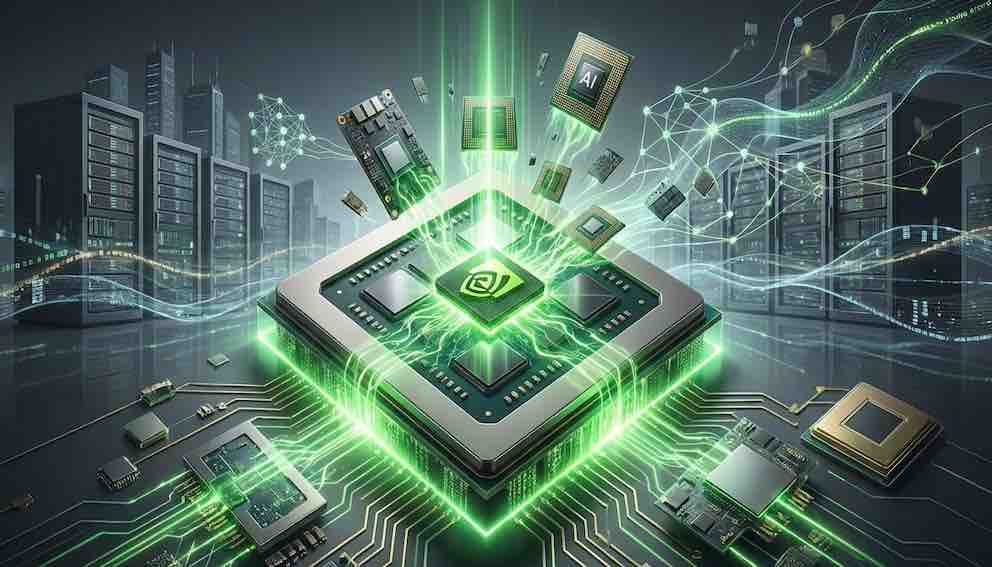
Nvidia’s reported $20 billion agreement involving AI startup Groq is not a conventional acquisition. There is no press release announcing a takeover, no shareholder vote, and no full consolidation of assets. Yet the strategic importance of the deal rivals — and in some respects exceeds — a traditional buyout.
Instead, Nvidia has chosen a subtler route: license the technology, hire the people who built it, and neutralize a potential competitor — all without owning the company outright.
It is about protecting margins, shaping how AI compute is priced, and ensuring Nvidia remains central as artificial intelligence moves from eye-catching demos to everyday, large-scale use.
For investors, the significance of the deal lies less in Groq’s current revenues — which are modest — and more in what it reveals about where AI spending is headed, and where Nvidia sees potential pressure points in its dominance.
What Is Groq, and Why Nvidia Paid Attention
Groq is a Silicon Valley chip startup founded in 2016 by Jonathan Ross and other former Google engineers involved in the early development of Google’s Tensor Processing Units. Rather than competing head-on with GPUs, Groq built a specialized processor called a Language Processing Unit (LPU), designed primarily for AI inference — the stage where trained models generate answers, text, images, or decisions in response to user requests.
For a general reader, the distinction is straightforward:
- GPUs are best at training AI models — large, flexible workloads that consume enormous computing power but happen intermittently.
- Groq’s LPUs are designed for inference — fast, repeatable tasks that must respond almost instantly, often millions of times per day.
This matters because training a model is a large but infrequent capital expense. Inference, by contrast, is a recurring operating cost incurred every time someone interacts with AI. As AI use scales into millions or billions of daily queries, long-term economics increasingly shift from training hardware to inference efficiency.
Groq’s pitch was that its chips could deliver very fast, predictable responses with lower power consumption for certain inference workloads — particularly real-time, single-query tasks where GPUs can be relatively inefficient.
Profitability Was Not the Appeal
Groq was not a profitability story, and it was not expected to be one in the near term.
Like most advanced semiconductor startups, it invested heavily in chip design, software, and developer tools, while operating its own cloud-based inference service. Public information points to a company still firmly in investment mode, with high research spending and limited revenue relative to valuation.
From Nvidia’s perspective, that was beside the point.
What mattered was:
- A differentiated approach to AI inference that could, over time, pressure GPU-based economics.
- A team with rare expertise spanning chip design, compilers, and data-center-scale systems.
- Intellectual property that could become strategically important if adopted widely by cloud providers or rival chipmakers.
Seen this way, Nvidia was not buying earnings. It was buying insurance — against a future where inference costs, not training performance, become the main battleground. It is buying time, talent, and architectural advantage.
Clarifying the Deal Structure: What Nvidia Is (and Isn’t) Buying
This is where confusion has emerged — and where clarity is essential.
What the deal is:
- Nvidia receives a non-exclusive license to Groq’s inference technology
Nvidia hires: Founder Jonathan Ross, President Sunny Madra, A group of key engineers
- Reported total transaction value: ~$20 billion
- Groq remains an independent company
In effect, Nvidia has executed a talent-and-technology absorption without formally buying the firm.
What Happens to the Remaining Groq Company?
Groq continues to operate — but in a different role.
Post-deal, Groq:
- Retains its cloud inference business
- Operates under new leadership
- Continues serving customers
- May license its technology to others (subject to the agreement)
However, strategically:
- Its most influential architects now work for Nvidia
- Nvidia gains early and deep access to the core innovation
- Groq’s ability to challenge Nvidia directly is significantly reduced
For investors, the implication is clear:
Groq survives — but no longer threatens Nvidia’s dominance.
Why This Matters to Nvidia’s Strategy
Nvidia already dominates AI accelerators. So why engage with a niche inference specialist?
Because the nature of AI demand is changing.
Inference Is Where the Next Margin Battle Will Be Fought
As companies move AI from pilot projects into production, the conversation shifts. Instead of asking “Can this model do it?”, buyers ask:
- How fast is the response?
- How predictable is performance under load?
- How much does each query actually cost?
Specialized inference chips threaten GPUs not by being more versatile, but by being more predictable and, in some cases, more efficient for narrow tasks. If customers can deliver the same user experience at a lower cost per query, pricing pressure follows.
From that perspective, Nvidia’s move is about maintaining influence over the underlying compute layer for inference — before alternatives mature enough to reset customer expectations.
Containing a Future Competitive Risk
Groq was not a revenue-scale competitor to Nvidia. But it had begun to represent a potential bargaining chip for large customers looking to reduce dependence on GPUs for inference workloads.
In technology markets, disruption often starts in narrow use cases before spreading more widely. By licensing Groq’s technology and bringing key engineers in-house, Nvidia reduces the risk that such an alternative develops entirely outside its orbit.
Importantly, public reporting describes this as a non-exclusive license and talent move, not a full acquisition — allowing Nvidia access to the technology without formally absorbing the entire company.
Optionality, Not Replacement
Nvidia does not need to abandon GPUs to benefit from Groq’s work. Instead, it gains options:
- Concepts from Groq’s deterministic execution model could influence future Nvidia designs.
- Hybrid systems could emerge, with GPUs handling training and large batches, and Groq-style accelerators handling ultra-low-latency inference.
- Nvidia can keep these capabilities tied to its software ecosystem, rather than allowing a standalone alternative to gain traction.
For Nvidia, flexibility itself is a strategic asset.
Why the Timing Makes Sense
The timing reflects where AI is in its cycle.
Early investment focused on model breakthroughs and scale. Now, many companies are discovering that deploying AI at scale is constrained less by model quality and more by infrastructure cost, power consumption, and reliability.
The incremental gains from ever-larger models are becoming harder to justify economically. The bottleneck is shifting toward inference efficiency.
Nvidia appears to be acting before that shift shows up clearly in its financials — broadening its toolkit rather than reacting under pressure later.
The Capital Markets Angle
The reported structure of the deal — estimated by market sources at roughly $20 billion in value — highlights Nvidia’s financial advantage.
Fueled by strong cash flows from AI training demand, Nvidia can afford to make large, strategic bets that would be out of reach for most competitors. What might be an existential risk for a smaller chipmaker is manageable for Nvidia.
In effect, Nvidia is using today’s profits to protect tomorrow’s margins — a luxury few rivals share.
What This Signals for the AI Industry
The deal points to AI entering a more mature phase, where:
- Cost per query matters as much as raw performance.
- Reliability and predictability trump benchmark leadership.
- Infrastructure decisions increasingly resemble utilities rather than experiments.
For independent AI chip startups, the message is sobering. Even strong technical differentiation may not be enough to ensure long-term independence without massive capital or deep partnerships.
For cloud providers, the balance of power remains fluid. Many will continue investing in in-house silicon to preserve leverage, even as Nvidia works to keep its ecosystem indispensable.
What Investors Should Watch
Key signals to monitor include:
- Whether Nvidia begins explicitly positioning products around inference-specific use cases.
- How hyperscalers adjust their own chip strategies.
- Any sustained pressure on Nvidia’s gross margins tied to inference pricing.
- Regulatory attention to talent-and-IP deals in AI infrastructure.
Risks to Keep in Mind
The main risks are not technological failure, but execution and oversight:
- Integrating Groq’s compiler-driven, deterministic approach with Nvidia’s CUDA-centric ecosystem will not be trivial.
- As Nvidia’s role in AI infrastructure grows, similar deals may attract closer regulatory scrutiny.
These risks appear manageable, but they are real.
The Bottom Line
Nvidia’s move involving Groq is not about buying revenue. It is about buying time, control, and flexibility in the part of AI that will matter most for long-term economics: inference.
For investors, the key question is not whether Groq moves next quarter’s earnings, but whether it helps Nvidia defend margins and influence as AI becomes everyday infrastructure — always on, always priced, and increasingly cost-sensitive.
Disclaimer
This article is for educational purposes only and should not be interpreted as financial advice. Readers should consult a qualified financial professional before making investment decisions. Part of this content was created with formatting and assistance from AI-powered generative tools. The final editorial review and oversight were conducted by humans. While we strive for accuracy, this content may contain errors or omissions and should be independently verified.