
Tutorial Categories
Last Updated: January 14, 2026 at 13:30
Fear and Greed: The Two Emotions That Drive Most Decisions - Behavioral Finance Series
Fear and greed silently drive almost every investment decision. Fear can make you sell in panic during a market dip, while greed pushes you to chase soaring stocks or trendy assets. These emotions aren’t just psychological—they have measurable effects on your portfolio and the market. Learn how loss aversion, FOMO(fear of missing out), and reflexivity shape investor behavior, and discover actionable strategies that experts use to stay disciplined, make rational decisions, and turn emotions from liabilities into tools for smarter investing.
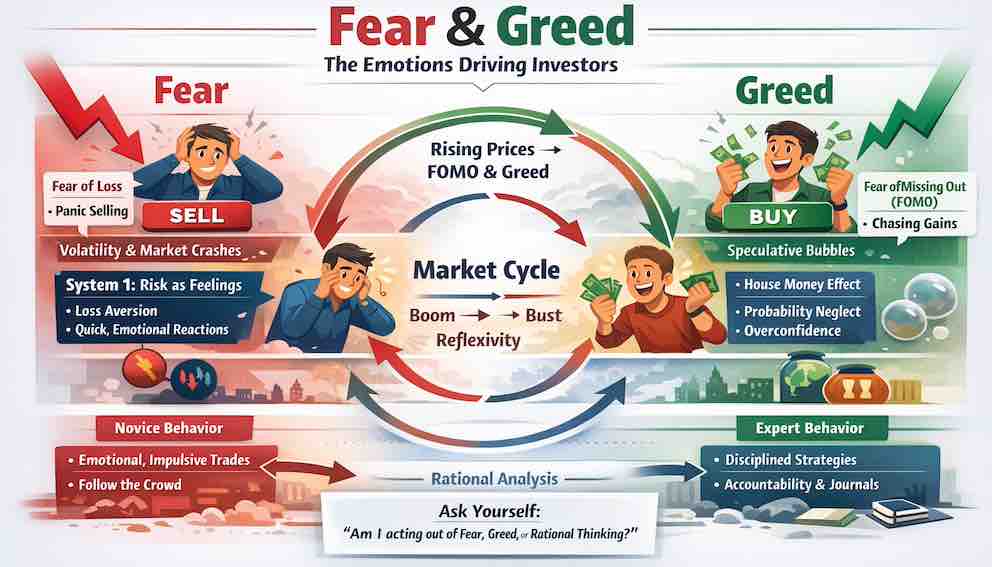
Picture this: You’ve been following a stock that’s climbing steadily. Headlines are glowing, and friends are bragging about their gains. Greed whispers: “Buy more! You don’t want to miss out!” Suddenly, the market dips. Panic sets in. Fear shouts: “Sell now before it collapses!”
This emotional rollercoaster is not unusual. Almost every investor, from beginners to pros, experiences fear and greed. Unlike spreadsheets or valuation models, these emotions quietly drive decisions—sometimes leading to big gains, sometimes costly mistakes. Understanding them is not just academic—it’s essential for smarter investing.
Core Theory
Fear and greed are powerful forces in investing because they operate deep in our brains, often without us realizing it. Understanding how they work helps explain why investors make decisions that sometimes seem irrational.
Fear is triggered by the possibility of losses. It activates our instinctive “fight or flight” response, making us want to act quickly—often by selling assets at a loss. Fear’s impact is amplified by loss aversion, a concept from Prospect Theory: losing $100 feels about twice as painful as gaining $100 feels good. That’s why a small market dip can feel terrifying and lead to panic selling.
Greed is the desire for reward, but it is not just about wanting profits—it also involves probability neglect. We tend to overestimate the chance of a big win and underestimate the risk of loss. Greed is also fueled by the house money effect, where investors take bigger risks with profits they mentally treat as “play money.”
Prospect Theory further explains how both fear and greed are intensified. People judge gains and losses relative to a reference point, such as the price they paid for an investment or what they expected to earn:
- A gain feels smaller if it’s close to expectations.
- A loss feels much worse if it falls below expectations.
- Fear spikes when losses exceed your reference point, often causing panic selling.
- Greed spikes when gains exceed your reference point, encouraging risk-taking or chasing further returns.
FOMO (Fear of Missing Out) is a hybrid emotion. It’s fear of missing a big opportunity that drives greed-fueled buying. When everyone else seems to be making money, even cautious investors can be tempted to chase trends.
Finally, Paul Slovic’s Dual-Process Theory of Risk helps explain how fear and greed hijack our decision-making:
- Risk as feelings: Fast, automatic, emotional reactions dominated by fear or greed.
- Risk as analysis: Slow, deliberate, rational evaluation of probabilities and outcomes.
- In investing, the challenge is that emotional, System 1 thinking often overrides rational, System 2 thinking, leading to impulsive decisions. Recognizing these mechanisms is the first step toward managing emotional investing effectively.
Financial Consequences
Fear and greed affect both individual investors and markets.
Individual Investors:
- Fear-driven selling: Market dips trigger panic. During the March 2020 COVID-19 crash, many retail investors sold equities, locking in losses and missing the fast rebound.
- Greed-driven buying: Booming markets and hype push investors to chase returns. The 2000 dot-com bubble is a classic example—people bought unprofitable tech companies driven by FOMO and greed.
- Hybrid effects: FOMO is a critical emotion—it can make fear and greed operate together. Investors fear missing out while chasing gains, often paying high prices at market peaks.
- Emotional whiplash: Switching constantly between fear and greed increases transaction costs, taxes, and stress, reducing net returns.
Market-Level Effects:
Types of fear and greed:
- Fear of loss → selling a dip
- FOMO → greed-driven buying
- Greed for social proof/status → investing in trendy assets to signal skill or knowledge
Feedback loops: Fear and greed are self-reinforcing. Greed leads to buying → rising prices → more greed and FOMO. Then fear triggers selling → falling prices → more panic. This cycle, called reflexivity , drives many booms and busts.
Volatility spikes: Emotional trading can decouple prices from fundamentals, creating short-term swings.
Bubbles and crashes: Herding amplified by fear and greed fuels large market cycles—from tulip mania to the 2008 housing crisis.
Expert vs Novice Behavior
Novice Investors:
- React emotionally to news, market dips, or hype
- Trade impulsively based on headlines, social media, or recent gains/losses
- Overestimate their ability to time the market
Expert Investors:
- Recognize the emotional drivers behind moves
- Follow rules-based strategies and maintain accountability: decisions are justified to a committee or documented process, which forces reasoning beyond emotions
- Use decision journals to review past trades, noting emotional influences
- Employ pre-commitment tools, like automatic investments (dollar-cost averaging) or stop-loss rules
- Instead of reacting instinctively to market news, expert investors think in terms of probabilities and updating their beliefs with new information—a process known as Bayesian thinking.
Example: Warren Buffett says, “Be fearful when others are greedy and greedy when others are fearful.” He uses the emotions of the market, rather than being controlled by his own, to make rational decisions.
Practical Mitigation Strategies
- Pre-define your investment plan: Set clear rules for buying, selling, allocation, and risk tolerance.
- Automate decisions: Use automatic contributions, rebalancing, and withdrawals to avoid emotional overrides.
- Reflective tools: Maintain a trade journal. Note emotional state, rationale, and outcome. Patterns emerge over time.
- Perspective framing: Treat market dips as opportunities rather than threats—buying quality assets at a discount can feel less emotional if framed as strategic.
- Stress-test scenarios: Understand how your portfolio reacts under extreme conditions to reduce anxiety during real swings.
- Diversification and hedging: Reduces the emotional impact of individual losses or market moves.
- Pause before acting: Even a 24-hour cooling-off period allows System 2 thinking to override impulsive System 1 reactions.
Nuance & Debate
Fear and greed are not always irrational:
- Rational fear/greed: Sometimes what looks like an emotional response is actually a correct reaction to fundamentals. Example: selling over-leveraged positions in 2008 was survival, not panic.
- Cultural and temporal differences: Generations exposed to crises (e.g., hyperinflation) may have permanently heightened fear responses, while bull-market generations may lean greedy.
- The role of narrative: Media stories can amplify emotions—“This time is different” or “Tech will never fail” can drive herd behavior. Experts often discount hype and focus on fundamentals.
- Adaptive function: Fear prevents catastrophic losses; greed can motivate calculated risk-taking. The skill is distinguishing emotion-driven overreaction from reasoned reassessment.
Clear Takeaway
Fear and greed dominate financial decision-making, often more than logic or analysis. Recognizing them, understanding their psychological roots, and using structured, rules-based strategies can turn these emotions into tools rather than liabilities.
Reflective Prompt:
Next time you feel the urge to sell in a dip or chase a soaring stock, pause. Ask yourself: “Is this decision driven by fear, greed, or reasoned analysis?” This awareness is the first step toward emotional mastery in investing.
About Swati Sharma
Lead Editor at MyEyze, Economist & Finance Research WriterSwati Sharma is an economist with a Bachelor’s degree in Economics (Honours), CIPD Level 5 certification, and an MBA, and over 18 years of experience across management consulting, investment, and technology organizations. She specializes in research-driven financial education, focusing on economics, markets, and investor behavior, with a passion for making complex financial concepts clear, accurate, and accessible to a broad audience.
Disclaimer
This article is for educational purposes only and should not be interpreted as financial advice. Readers should consult a qualified financial professional before making investment decisions. Assistance from AI-powered generative tools was taken to format and improve language flow. While we strive for accuracy, this content may contain errors or omissions and should be independently verified.