
Tutorial Categories
Last Updated: January 18, 2026 at 14:30
Behavioral Finance Works Best When Combined with Other Lenses — and Fails When Used Alone
Behavioral finance explains fear, greed, and bias—but it’s not enough. Learn when bias-based explanations fail or do not work, why markets stay irrational, and how smart investors combine behavioral, fundamental, structural, and narrative lenses.
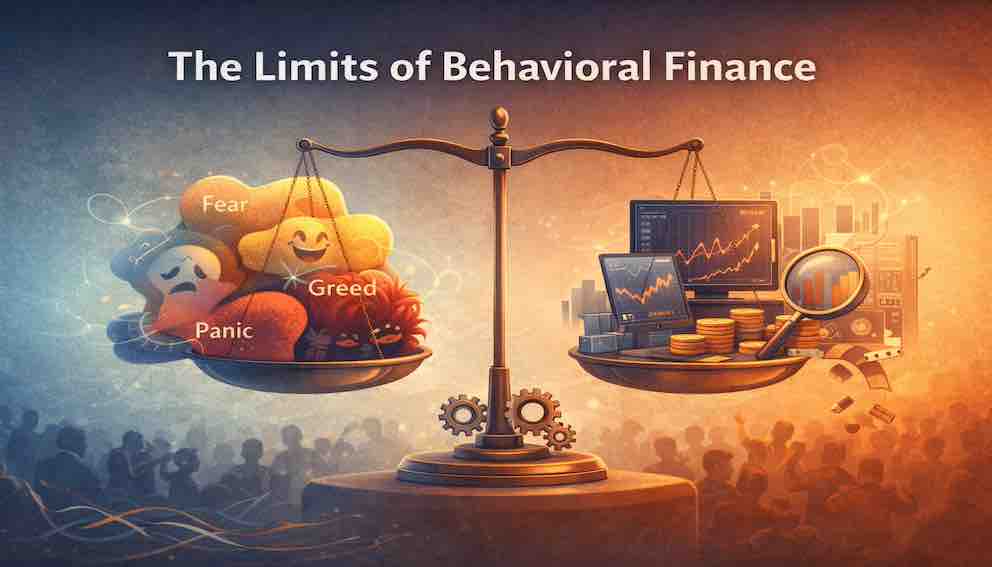
The Danger of a Single Lens
“When all you have is a hammer, everything looks like a nail.”
Learning behavioral finance is often a turning point for investors. It explains why markets don’t behave like neat textbooks and why smart people still make poor decisions under pressure.
But there is a paradox.
The more fluent investors become in behavioral language — bias, fear, herding, narratives — the easier it becomes to overuse it. Every fall becomes “panic.” Every rally becomes “irrational exuberance.” Every disagreement becomes “bias.”
At that point, behavioral finance stops improving judgment and starts replacing it.
This tutorial is about where behavioral finance is strongest, where it breaks down, and how to use it wisely. Not as a standalone explanation, but as one lens among several.
What Behavioral Finance Is Excellent At (A Reaffirmation)
Behavioral finance is exceptionally good at:
- Explaining why markets deviate from perfectly rational models
- Understanding how people behave under uncertainty, stress, and ambiguity
- Making sense of bubbles, crashes, and emotional overshooting
- Helping investors design rules and systems to reduce predictable mistakes
This makes it one of the most powerful descriptive tools in finance.
But there is a boundary that matters:
Explanation is not prediction.
Behavioral finance can explain why something happened. It is far less reliable at telling you when it will reverse, how far it will go, or what happens next.
Confusing these roles is where problems begin.
Breakdown #1: When Prices Move Because Fundamentals Actually Changed
Not every sell-off is fear. Not every rally is delusion.
Sometimes prices move because the underlying economics changed:
- Earnings collapse
- Interest rates reset valuations
- Regulation alters business models
- Technology destroys existing advantages
A Concrete Example: Meta (2022)
Meta’s stock fell roughly 65% in 2022. This was often described as market panic. But the core driver was fundamental:
- Apple’s iOS privacy changes damaged Meta’s ad-targeting model
- Growth expectations were permanently revised downward
- Capital spending surged while returns became less certain
This was not primarily emotional overreaction. It was a reassessment of cash flows.
The Deeper Trap: Ex Post Behavioral Labeling
After prices move, it is easy to say “investors overreacted.”
The harder — and more honest — question is:
Given what was known at the time, was the reaction unreasonable?
Behavioral explanations often sneak in after outcomes are known, which creates false confidence.
Lens Needed Here
- Fundamental analysis
- Macro conditions
- Industry structure
Behavioral finance should sit on top of fundamentals, not replace them.
Breakdown #2: When Herding Is Rational, Not Emotional
Herding is usually framed as irrational crowd behavior.
But in many situations, following others is the least-bad option.
Examples
- Bank runs
- Liquidity freezes
- Crisis-driven flight to safety
If you believe others will withdraw funds, withdrawing early can be rational, even if everyone doing so creates a worse outcome.
This is not panic — it is strategic behavior under uncertainty.
Information Cascades
Economists describe this as an information cascade: when it becomes rational to ignore your own limited information and follow others because you assume they know more.
Individually, this can make sense — you’re relying on the wisdom of the crowd. Collectively, it can create problems — everyone following the same signals can amplify mistakes, like a domino effect, even if the initial move was wrong.
Lens Needed Here
- Game theory
- Information asymmetry
- Coordination problems
Behavioral finance explains how fear spreads. Game theory explains why following can be logical.
Breakdown #3: When Valuations Stay Extreme for Long Periods
Markets often stay expensive — or cheap — far longer than expected.
Being early feels identical to being wrong.
Shiller CAPE as a Warning — and a Trap
The Shiller CAPE ratio showed U.S. equities in “bubble territory” for much of the period after 2013. Investors relying only on that valuation signal would have missed one of the strongest bull markets in history.
The mispricing may have existed — but it did not correct quickly.
Why This Happens: Limits to Arbitrage
Even when an asset looks clearly mispriced, profitable opportunities are not always easy to exploit. Academic research calls this the problem of limits to arbitrage, and it explains why markets can stay “irrational” far longer than investors expect.
There are several reasons:
- Betting against mispricing is risky : Just because you believe a stock is overvalued doesn’t mean it will fall immediately. Prices can stay extreme for months or years. If the market moves further against you before correcting, you can lose significant money before the “rational” price emerges.
- Capital can be constrained : Professional investors often have limits on how much money they can deploy. Even if a mispricing exists, there may not be enough capital to take a large enough position to profit. Small positions might not matter, leaving the mispricing uncorrected.
- Career and reputational risk discourages action : Betting against popular sentiment or widely followed narratives can be career-threatening. If a fund manager is too early in shorting a hype stock, their firm or clients may react poorly, even if they are ultimately right. Losses in the short term can outweigh being “right in the long term.”
In short: mispricing alone doesn’t guarantee easy profits. Market structure, risk, and human incentives often prevent even savvy investors from correcting extremes quickly. This is why Keynes famously said:
“The market can stay irrational longer than you can stay solvent.”
Low interest rates, global liquidity, and institutional incentives can keep valuations extreme for years.
This is why the saying “the market can stay irrational longer than you can stay solvent” reflects a structural reality, not just a witty remark.
Lens Needed Here
- Market structure
- Institutional incentives
- Capital constraints
Behavioral mispricing does not guarantee timely correction.
Breakdown #4: When Narratives Become Fundamentals
Some narratives fade. Others harden into reality.
Contrast: Blockchain vs Cloud Computing
- Blockchain (2017): Promised to transform nearly every industry. Much of the narrative remains speculative.
- Cloud Computing (late 2000s): Began as a story, but became the cash-generating infrastructure behind AWS, Azure, and Google Cloud.
The difference is visible in audited financial statements, not excitement levels.
The Real Risk
Dismissing all narratives as hype can be as costly as believing all of them.
Behavioral finance explains how stories spread.
It does not tell you which stories will become durable economic engines.
Lens Needed Here
- Innovation cycles
- Competitive advantage
- Adaptive Markets thinking
Markets evolve. What looks like irrational enthusiasm in one phase may become rational pricing later.
Breakdown #5: When Rules and Checklists Create False Safety
Rules are essential. They reduce emotional errors.
But they also carry model risk — the danger that simplified rules break down in environments they were never designed for.
Examples
- Stop-losses triggering during flash crashes
- Mechanical valuation screens missing regime shifts
- Quantitative risk models failing during the 2008 crisis
In 2008, widely used models like Value-at-Risk created an illusion of safety — until extreme conditions rendered them useless.
Key Insight
Rules manage behavior. They do not eliminate uncertainty.
Lens Needed Here
- Context awareness
- Flexibility
- Scenario thinking
The goal is disciplined judgment, not blind automation.
Breakdown #6: The Meta-Bias — Overusing Behavioral Finance
The hardest-to-spot failure is mental: sometimes knowing about biases makes investors overconfident, causing them to see irrationality everywhere — including where it doesn’t exist.
Once investors learn behavioral finance, they often assume:
- Others are biased
- They themselves are objective
- Disagreement signals irrationality
This is known as the bias blind spot and naive realism — the belief that we see the world clearly while others are distorted.
Ironically, understanding behavioral finance can create a new form of overconfidence.
“I know about biases, therefore I am less biased.”
That belief is itself a bias.
Breakdown #7: When Markets Move Sideways and Emotions Are Muted
Behavioral finance is most visible during extremes — bubbles, crashes, and panics.
But a large portion of market history looks very different.
Sometimes, markets simply go sideways.
Prices drift within a range. Headlines feel repetitive. Gains are modest, losses are modest. Volatility is low. There is no dominant emotion in the system.
And that matters.
Why Sideways Markets Don’t Fit the Usual Behavioral Story
In sideways markets:
- There is no widespread euphoria to fuel bubbles
- There is no panic to trigger forced selling
- Narratives lose urgency and emotional charge
- Investors are neither fearful nor greedy — they are indifferent or bored
This environment doesn’t produce dramatic behavioral mistakes. Instead, it produces inaction, frustration, and slow erosion of discipline.
Behavioral finance often focuses on emotional extremes. But the absence of emotion is itself a regime.
The Hidden Behavioral Risks of Calm Markets
Even without strong emotions, investors still make mistakes — just quieter ones.
Common patterns include:
- Impatience: Abandoning long-term strategies because “nothing is happening”
- Overtrading: Searching for action to relieve boredom
- Style drifting: Chasing whatever recently moved, even without conviction
- Narrative fatigue: Losing interest in sound ideas because they lack excitement
These are not fear-driven errors. They are attention-driven errors.
The Integrated Investor: A Decision Matrix
Advanced investing means combining lenses, not choosing one.
Before dismissing a move as “just behavioral,” run through this checklist:
Fundamental Lens
- Have earnings, margins, or growth prospects materially changed?
- If yes: the move is likely fundamental.
Structural Lens
- Are leverage constraints, ETF flows, or derivatives forcing action?
- If yes: structure may be amplifying prices.
Behavioral Lens
- Are sentiment indicators at extremes? Is there a simple, emotional narrative?
- If yes: behavioral forces are likely present.
Narrative Lens
- Is the story changing, or is the asset’s economic role changing?
- The former suggests hype; the latter may signal a real shift.
The Rule
If you cannot build a plausible fundamental or structural explanation, then — and only then — should a primary behavioral explanation dominate.
Practical Guardrails for Using Behavioral Finance Correctly
Ask yourself:
- What would invalidate this explanation?
- Am I explaining the past or predicting the future?
- What would a well-informed believer in the opposite view argue?
- Am I labeling disagreement as bias instead of engaging with evidence?
Combine:
- Rules and judgment
- Skepticism and openness
- Conviction and humility
Clear Takeaway
Behavioral finance is not a replacement for thinking.
It is not a shortcut to market timing.
It is not proof of superiority.
It is a discipline of humility — not dominance.
Used well, it sharpens decision-making in an uncertain world.
Used alone, it becomes another source of overconfidence.
Reflective Prompt
Am I using behavioral finance to understand markets — or to feel smarter than them?
About Swati Sharma
Lead Editor at MyEyze, Economist & Finance Research WriterSwati Sharma is an economist with a Bachelor’s degree in Economics (Honours), CIPD Level 5 certification, and an MBA, and over 18 years of experience across management consulting, investment, and technology organizations. She specializes in research-driven financial education, focusing on economics, markets, and investor behavior, with a passion for making complex financial concepts clear, accurate, and accessible to a broad audience.
Disclaimer
This article is for educational purposes only and should not be interpreted as financial advice. Readers should consult a qualified financial professional before making investment decisions. Assistance from AI-powered generative tools was taken to format and improve language flow. While we strive for accuracy, this content may contain errors or omissions and should be independently verified.