
Tutorial Categories
Last Updated: January 20, 2026 at 08:30
Process Over Predictions: How to Think in Probabilities - Behavioral Finance Series
Investing is not about predicting the market—it’s about preparing for uncertainty. Short-term price movements are highly unpredictable, and emotional reactions to headlines or popular stories often erode returns, as shown by the DALBAR 2025 report where the average equity investor earned 848 basis points less than the S&P 500. Probabilistic thinking shifts the focus from guessing outcomes to assessing likelihoods, expected value, and scenarios. By using decision trees, pre-mortems, kill criteria, and structured inaction, investors can make disciplined, process-driven decisions. Goal-based rebalancing, optionality, and barbell strategies allow portfolios to survive crises while capturing asymmetric opportunities. Ultimately, success comes from a consistent, reflective process that is resilient to volatility—not from trying to predict the future.
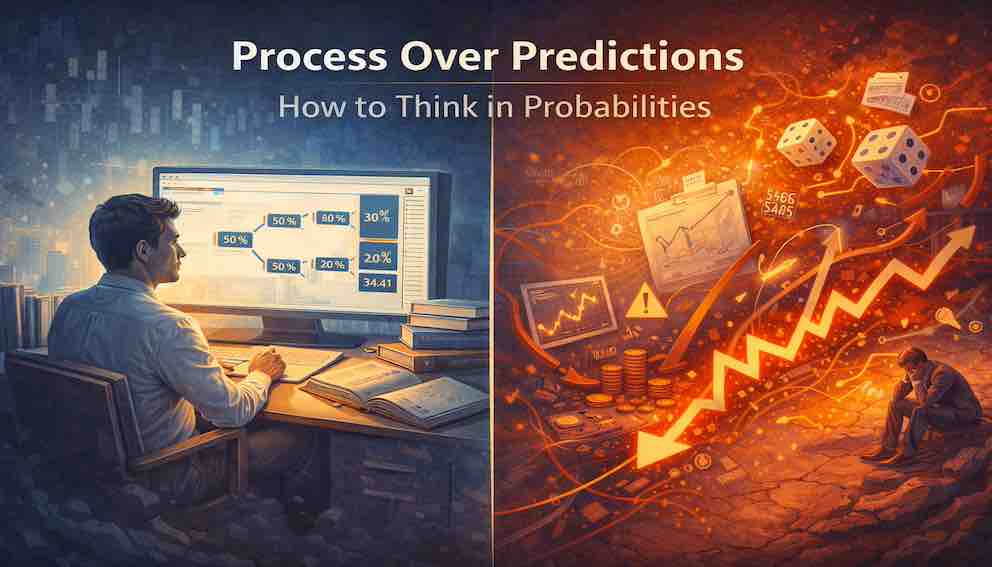
Imagine watching your portfolio drop 30% in a matter of weeks. Panic rises, headlines scream doom, and every “expert” seems certain that worse is coming. Many investors respond by abandoning their strategy, selling at exactly the wrong moment, and locking in losses that could have been avoided. This is the single biggest mistake an investor can make: changing strategy at the worst possible time.
The reality is harsh but liberating: markets are unpredictable, and reacting emotionally to short-term noise almost always harms long-term outcomes. The most successful investors don’t chase certainty—they focus on process, structured thinking, and probabilistic decision-making. In this tutorial, we’ll explore why abandoning strategies during crises is so damaging, uncover the behavioral traps that drive it, and outline practical, evidence-backed ways to stay disciplined and antifragile when uncertainty strikes.
Why Prediction Is Overrated
Many investors think the key to success is “knowing what will happen next.” But markets are complex adaptive systems—made up of countless interacting factors like investor psychology, liquidity, leverage, and global events. Even small changes can create large, unpredictable market swings.
Evidence from Behavior: The 2025 DALBAR report shows the dramatic consequences of relying on prediction and poor process. In 2024, the average equity fund investor earned 16.54%, while the S&P 500 returned 25.02%. This is an 848 basis point gap, the second-largest in a decade.
What caused this gap? Behavioral errors:
- Herding: Following the crowd into or out of markets at the wrong time.
- Loss aversion: Selling winners too early, holding losers too long.
- Media reaction: Reacting emotionally to headlines without examining the underlying data.
Randomness of Short-Term Prices:
- Research consistently shows that short-term stock price movements are highly unpredictable, often described as “random.” One famous study even concluded that a monkey throwing darts at a stock list would perform about as well as professional analysts trying to pick short-term winners.
Key Takeaway: Prediction is not just difficult—it’s often misleading. Emotional reactions to headlines, stories, or short-term trends systematically reduce returns. Process, not prediction, is what makes long-term investors successful.
Probabilistic Thinking: The Core Concept
Probabilistic thinking is a way of making decisions that acknowledges uncertainty. Instead of expecting a single outcome to happen, it asks: “How likely is each possible outcome, and how much does it matter if it happens?”
What Probability Means
Probability is simply a measure of how likely something is to occur. It doesn’t guarantee a result, but it helps us weigh different possibilities and make smarter choices. Thinking in probabilities allows investors to avoid overreacting to any one scenario and focus on the bigger picture.
Why Small Chances Can Matter
Even when a positive outcome is unlikely, its potential impact can make it worth considering. For example, imagine a speculative startup: there’s a small chance it could multiply your investment tenfold, but a much larger chance you could lose half. While most outcomes might result in a loss, the rare big win can more than compensate for smaller setbacks. This is why investors talk about expected value—the idea that decisions should balance both the probability and the size of possible outcomes.
Why This Matters
Many investors make mistakes because they focus on a single story, a gut feeling, or the most visible outcome. Probabilistic thinking forces you to consider a range of possibilities and their relative importance. By doing so, you reduce emotional mistakes, avoid overcommitting to unlikely events, and allocate capital in a way that improves your chances of long-term success.
Historical Lessons in Probabilities
A. 1929 Crash
- Confidence in perpetual growth was near its peak.
- Investors ignored low-probability but catastrophic scenarios.
- Those who applied probabilistic thinking—considering downside risks and exit plans—survived or at least limited losses.
B. 2008 Financial Crisis
- Complex derivatives and subprime lending created hidden tail risks.
- Investors who relied on confident forecasts lost heavily.
- Probabilistic thinkers who mapped multiple scenarios and stressed tail-risk preparation were better positioned.
C. Long-Term Index Investing
- While short-term stock returns are volatile, broad indices tend to grow over decades.
- Historical data shows that a patient, diversified approach has high expected returns, even if individual years are unpredictable.
Takeaway: Probabilistic thinking works both to survive crises and to capture long-term compounding. Prediction is not required to make rational, effective investment decisions.
Clarifying the Role of Active Selection
While thinking in probabilities and following a disciplined process can make inaction powerful, this does not mean that simply buying a broad index fund is enough. Good stock picking and thoughtful selection of high-quality investments remain essential. Probabilistic thinking helps you identify opportunities where the potential upside justifies the risk, while avoiding emotionally-driven mistakes.
Example: Imagine two companies: one with strong fundamentals, innovative products, and a history of steady growth, and another with a flashy story but shaky financials. A disciplined, patient investor will recognize the higher probability of long-term success in the first company, rather than blindly allocating to an index that includes both.
In short, structured inaction is about resisting impulsive moves and trusting process, but the underlying choice of what assets you own—stocks, sectors, or funds—still matters enormously. Patience and probabilistic thinking amplify your returns only if you are holding quality investments.
Cognitive Traps That Derail Probabilistic Thinking
Even intelligent investors are prone to biases that make prediction feel easier than it is.
- Overconfidence Bias: Believing you can predict market movements better than others.
- Outcome Bias: Judging decisions solely by their results, rather than the quality of the reasoning behind them.
- Narrative Bias: Favoring compelling stories over objective assessment.
- Anchoring: Relying too heavily on past prices or prior information.
- Herding: Following the crowd into or out of markets, often at the wrong time.
Reflection Exercise: Think of your last investment—did you act based on story, peer behavior, or short-term trends rather than probabilities? Recognizing these biases is the first step to building a process-driven approach.
Practical Frameworks for Process-Based Investing
Here’s how to translate probabilistic thinking into a real-world, actionable process:
A. Decision Trees
- Map out possible outcomes and assign probabilities.
- Evaluate expected value for each branch before acting.
Example: Evaluating a speculative stock:
- 10% chance of 10x return
- 60% chance of doubling
- 30% chance of losing everything
A decision tree makes risks and rewards explicit.
B. Kill Criteria (Pre-Mortem & Strategic Quitting)
- Define conditions that force an exit before investing.
- Exit if your original investment thesis is broken—not because of short-term price swings.
Benefit: Avoids “thesis creep,” where emotional attachment keeps you in failing positions.
Example: You buy a stock believing revenue growth will double in two years. If quarterly reports show sustained stagnation, your kill criteria trigger a sale—regardless of market noise.
C. Goal-Based Rebalancing
- Don’t blindly sell winners or buy losers mechanically.
- Rebalance to achieve long-term financial goals, considering macro trends and structural shifts.
Example: If tech stocks keep growing because of long-term trends, sticking strictly to past allocation rules when rebalancing could mean selling shares in the very sector that’s driving future growth.
D. Scenario Planning & Managing Blind Spots
- Construct best-case, worst-case, and most-likely scenarios.
- Conduct a pre-mortem: imagine the investment fails and work backward to understand why.
- Actively seek disconfirming evidence to challenge assumptions.
Outcome: You identify blind spots and reduce the risk of emotional, reactive decisions.
E. Optionality & Barbell Strategies
- Combine very safe positions with high-upside, low-probability bets.
- Survives crises while allowing asymmetric opportunities.
Example: Hold broad market index funds for safety and small allocations to high-potential startups.
F. Structured Inaction
- Accept that sometimes the best decision is to do nothing.
- Avoid reacting to daily news or market “noise.”
- Emotional patience protects your portfolio from rash, low-probability bets.
Measuring Success by Process, Not Outcomes
Good investing is judged by decision quality, not luck-driven results.
- Resulting Trap: Avoid evaluating decisions solely by outcomes. A poor result can come from a sound process; a good result can occur from a flawed process.
- Conduct outcome-blind reviews to refine your process.
Example: If you invested in a stock based on a solid thesis and probabilities but it fell due to unforeseen events, the decision was still high-quality. The process matters more than a single outcome.
Evidence That Process Works
- DALBAR 2025: Emotional, prediction-driven behavior causes investors to systematically underperform indices by hundreds of basis points.
- Morningstar “Do Nothing Portfolio” studies: Steady, process-driven investing outperforms active trading over decades.
- Behavioral Finance Research: Kahneman and Tversky show how biases—loss aversion, overconfidence, herding—erode returns.
- Antifragility Principle: Taleb explains how positions designed to benefit from volatility and disorder outperform fragile, prediction-based strategies over time.
Key Takeaways for Thoughtful Investors
- Markets are uncertain and complex—prediction rarely works.
- Focus on decision quality, probabilities, and expected value.
- Use decision trees, pre-mortems, kill criteria, and scenario planning to make your process explicit.
- Apply goal-based rebalancing and optionality to manage risk and seize upside.
- Embrace structured inaction; patience is a strategic advantage.
- Be aware of cognitive biases—they are often the true cost of lost returns.
- Probabilistic thinking cultivates resilience, patience, and antifragility, preparing you to thrive through uncertainty and volatility.
Closing Thought
Thinking probabilistically transforms investing from a game of guessing to a disciplined, reflective process. It reduces emotional mistakes, helps you survive crises, and allows you to benefit from rare opportunities.
Your goal is not to predict the future—it’s to prepare for it. A strong, process-based framework, anchored in probabilities and evidence, is your most reliable path to long-term investing success.
About Swati Sharma
Lead Editor at MyEyze, Economist & Finance Research WriterSwati Sharma is an economist with a Bachelor’s degree in Economics (Honours), CIPD Level 5 certification, and an MBA, and over 18 years of experience across management consulting, investment, and technology organizations. She specializes in research-driven financial education, focusing on economics, markets, and investor behavior, with a passion for making complex financial concepts clear, accurate, and accessible to a broad audience.
Disclaimer
This article is for educational purposes only and should not be interpreted as financial advice. Readers should consult a qualified financial professional before making investment decisions. Assistance from AI-powered generative tools was taken to format and improve language flow. While we strive for accuracy, this content may contain errors or omissions and should be independently verified.