
Tutorial Categories
Last Updated: January 20, 2026 at 08:30
Avoiding the Biggest Mistake: Changing Strategy at the Worst Time - Behavioral Finance Series
The single most costly mistake investors make is abandoning their long-term strategy during market downturns. Fear, social pressure, and recent losses can overwhelm rational thinking, prompting reactive decisions that often destroy wealth. Historical examples—from the 1929 crash to COVID-19—show that those who panic-sell lock in losses, while disciplined investors recover and thrive. Research confirms this: in 2024, equity fund investors earned 16.54%, far below the S&P 500’s 25.02%, highlighting the cost of emotional trading. By setting clear guardrails, planning for volatility, and practicing structured inaction, investors can resist panic, stay aligned with long-term goals, and even benefit from market opportunities. Ultimately, patience, process, and discipline—not timing the market—build enduring wealth.
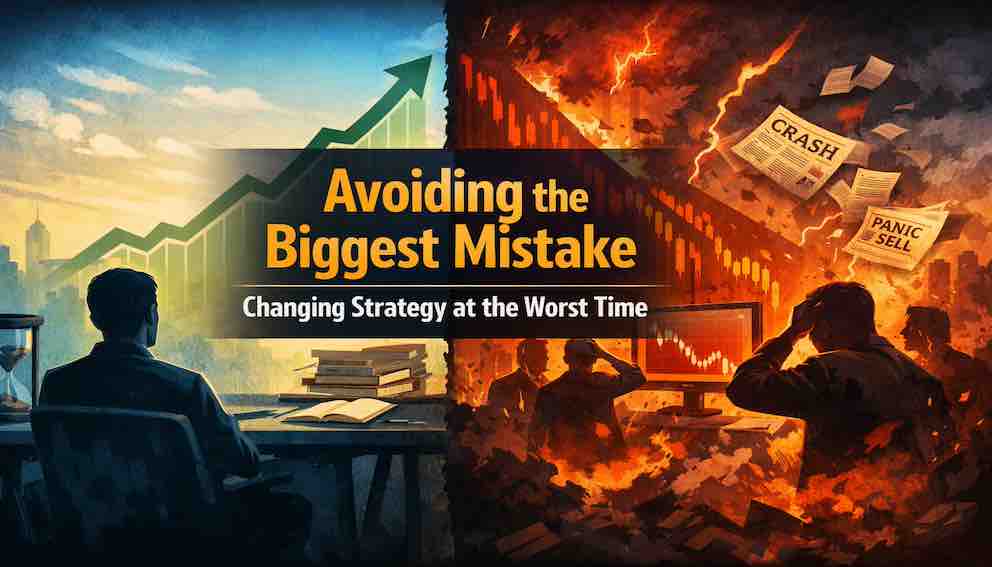
Imagine this: the market drops 30% in just a few weeks. Your portfolio feels like it’s vanishing, the news is full of panic, and friends and colleagues are all talking about selling. You feel that familiar knot of anxiety—the urge to act, to “do something.” But here’s the catch: most of the damage doesn’t come from the market itself—it comes from what you do in response.
Investing often feels like a numbers game, full of charts, reports, and predictions. Yet the biggest losses rarely come from analysis—they come from ourselves. Specifically, the single most costly mistake investors make is abandoning a long-term strategy during a downturn. Acting on fear, panic, or social pressure can undo decades of careful planning in weeks.
This tutorial explores why investors make this mistake, how it costs money, and what practical frameworks can help you avoid it. By the end, you’ll understand how to maintain discipline, manage your emotions, and design a process that protects your long-term wealth.
The Costly Temptation of Reactivity
Imagine this: your portfolio loses 30% in a few months. Headlines scream “Markets Collapse!”, friends are selling, and your phone is full of notifications about falling prices. The instinct is to do something—anything—to stop the pain. But research shows this instinct is usually the wrong choice.
- DALBAR’s 2025 QAIB report: Investors in equity funds earned only 16.54% in 2024, compared to the S&P 500’s 25.02%—a gap of 848 basis points. That is the cost of emotional trading.
- Morningstar behavior gap: Over a 10-year period, investors’ reactions to fear and euphoria reduced returns by around 1.1% per year, eroding roughly 15% of potential growth.
Put simply: acting on panic or euphoria destroys wealth. Staying disciplined—even when uncomfortable—is what builds long-term returns.
Why Investors Abandon Strategy: The Psychology Behind the Mistake
Several psychological forces explain why people react at exactly the wrong time. Understanding these is key to preventing costly mistakes.
a. Fear Dominates Reason
When markets drop sharply, our System 1 thinking—fast, emotional, and instinctive—takes over. Evolution programmed our brains to respond to danger immediately. A portfolio loss feels like a real threat, and the instinct to act is strong.
- Loss Aversion: Pain from losses feels twice as strong as pleasure from equivalent gains. Losing $1,000 hurts more than gaining $1,000 feels good. This drives panic selling and the disposition effect—selling winners too early and holding losers too long.
- Example: During the March 2020 COVID-19 crash, investors flooded brokerages to sell equities. Those who held saw the S&P 500 rebound over 70% in the next year. Fear triggered action, but patience preserved wealth.
b. Herding and Social Pressure
Humans are social. When friends, colleagues, or media panic, it’s hard not to follow the crowd. Shared mistakes feel emotionally safer than standing alone.
- Example: In 2008, many retail investors sold mutual funds during the financial crisis. Data shows those who panicked underperformed by 10%+ over the following decade compared to disciplined investors.
- Practical mitigation: Limit exposure to financial news during crises. Turn off apps and notifications, and avoid social comparisons. Environmental control reduces emotional triggers.
c. Recency Bias and Short-Term Focus
Recent events dominate our perception. A 20% loss feels catastrophic—even when historically similar drawdowns have been normal and recoverable. This short-term focus causes investors to abandon strategies just when history suggests patience pays off.
- Example: After the 1987 “Black Monday” crash, investors sold en masse. Yet the market recovered fully within two years. Recency bias made the downturn feel like the end of growth, even though it was a temporary shock.
d. Outcome Illusion
When a strategy produces a negative short-term result, it feels “wrong,” even if the decision process was sound. This is called outcome bias. Evaluating a decision solely by its immediate result rather than by the quality of the process leads to poor reactions.
- Example: Investors who abandoned growth funds after the 2000 tech crash believed they were being prudent. Those who held, however, recovered far more wealth over the next decade. The decision process was correct; the painful outcome was temporary.
Historical Lessons: When Strategy Abandonment Costs the Most
1929 Crash
Investors who sold in panic rarely recovered. Those who stayed through the Great Depression eventually captured market recovery. Emotional reactions amplified financial loss.
2008 Financial Crisis
Retirement accounts and mutual funds fell sharply. Morningstar analysis shows investors who held steady outperformed those who reacted by double-digit percentages over the next decade.
COVID-19 Crash (2020)
The S&P 500 dropped nearly 35% in weeks. By March 2021, it had fully recovered and continued higher. Investors who sold at the bottom locked in losses; disciplined holders gained.
Evidence-Based Consequences
- DALBAR Behavior Gap: Investors’ actual returns lag benchmarks due to fear-driven sales and euphoria-driven purchases.
- Morningstar “Do Nothing Portfolio”: Portfolios held through crises outperform actively traded, reactive portfolios.
- Behavioral Insight: Reacting rarely improves outcomes—it usually increases exposure to volatility without increasing expected returns.
Concrete Numbers for Context:
- DALBAR 2024: Equity investors earned 16.54% vs. 25.02% for S&P 500, losing 848 bps to emotional trading.
- Morningstar: Investor behavior gaps cost 1.1% annualized, erasing 15% of potential wealth over a decade.
Frameworks to Avoid the Mistake
Preventing reactive mistakes requires pre-planning, process, and discipline. Here are actionable frameworks:
a. Decision Guardrails & Design by Default
- Set rules in advance about when and how you review your portfolio. Avoid spontaneous reactions.
- Design your portfolio upfront: diversify sensibly, commit to disciplined rebalancing, and automate contributions (e.g., dollar-cost averaging).
- Example: Only adjust allocations if they deviate more than 10% from targets, not in response to short-term news.
b. Kill Criteria & Scenario Planning
- Decide beforehand the circumstances that warrant strategy changes.
- Plan responses to worst-case scenarios rather than reacting in panic.
- Example: “If equities drop 40% AND my income needs are threatened, I will review allocations.”
c. Pre-Mortems
- Before investing, imagine the worst possible outcomes. Plan for them.
- Example: For emerging markets, plan for political upheaval, currency crashes, or liquidity issues. Knowing your response reduces panic-driven action.
d. Goal-Based Review
- Focus on long-term objectives, not short-term volatility.
- Example: Retirement planning is multi-decade. A 20% drawdown today does not alter your 30-year plan.
e. Structured Inaction & Expectation Setting
- Doing nothing can be the most powerful action.
- Set realistic expectations: “Equity markets may lose 40% at some point; this is normal and expected.” Pre-habituation reduces emotional stress.
- Reframe downturns as the price of admission to higher long-term returns or opportunities to invest at better valuations.
f. Advanced Strategies: Antifragility & Barbell Approach
- Barbell Portfolio: Allocate most capital to ultra-safe assets (like T-bills) and a smaller portion to high-risk, asymmetric opportunities. Avoid “medium-risk” exposures.
- This design thrives in volatile markets rather than just surviving them.
g. Implementation Intentions
Use specific “if-then” plans to guide behavior:
- If markets fall by 20%, invest an additional pre-set amount.
- If allocations deviate by more than 10%, rebalance according to plan.
Clear, pre-defined actions reduce the risk of panic-driven mistakes.
Key Takeaways
- Reactivity is costly: Selling in panic or chasing euphoria destroys long-term wealth.
- Emotional pressure peaks during crises: Fear, herd instincts, and recency bias distort judgment.
- History rewards patience: 1929, 1987, 2000, 2008, and 2020 all show that disciplined holding beats reactive action.
- Frameworks protect long-term returns: Decision guardrails, scenario planning, pre-mortems, expectation setting, reframing, barbell portfolios, and implementation intentions turn emotion into structured action.
- Doing nothing is a skill: Strategic inaction, when planned and disciplined, is often more profitable than any tactical decision.
Final Thought
Investing is not about predicting markets; it’s about positioning for the long-term. Crises will come, losses will occur, and emotions will test your patience. The difference between lasting wealth and regret often comes down to whether you act on fear or follow a disciplined process.
By understanding the psychology behind panic, learning from historical patterns, and applying structured frameworks, you can protect your portfolio, make better decisions under stress, and harness the long-term power of compounding.
About Swati Sharma
Lead Editor at MyEyze, Economist & Finance Research WriterSwati Sharma is an economist with a Bachelor’s degree in Economics (Honours), CIPD Level 5 certification, and an MBA, and over 18 years of experience across management consulting, investment, and technology organizations. She specializes in research-driven financial education, focusing on economics, markets, and investor behavior, with a passion for making complex financial concepts clear, accurate, and accessible to a broad audience.
Disclaimer
This article is for educational purposes only and should not be interpreted as financial advice. Readers should consult a qualified financial professional before making investment decisions. Assistance from AI-powered generative tools was taken to format and improve language flow. While we strive for accuracy, this content may contain errors or omissions and should be independently verified.