
Tutorial Categories
Last Updated: January 13, 2026 at 11:45
Loss Aversion in Investing: Why Investors Hold Losers and Sell Winners – Behavioral Finance Series
Why does a $100 loss feel far worse than the thrill of a $100 gain? This tutorial dives into the psychology of loss aversion, a key concept in behavioral finance. You’ll discover how this bias leads investors to hold losing stocks too long, sell winners too early, under-insure against risks, and make costly financial decisions. Drawing on Prospect Theory and decades of research, we explain how experts handle losses differently and provide practical, evidence-based strategies to manage your emotions, protect your portfolio, and make smarter investment choices.
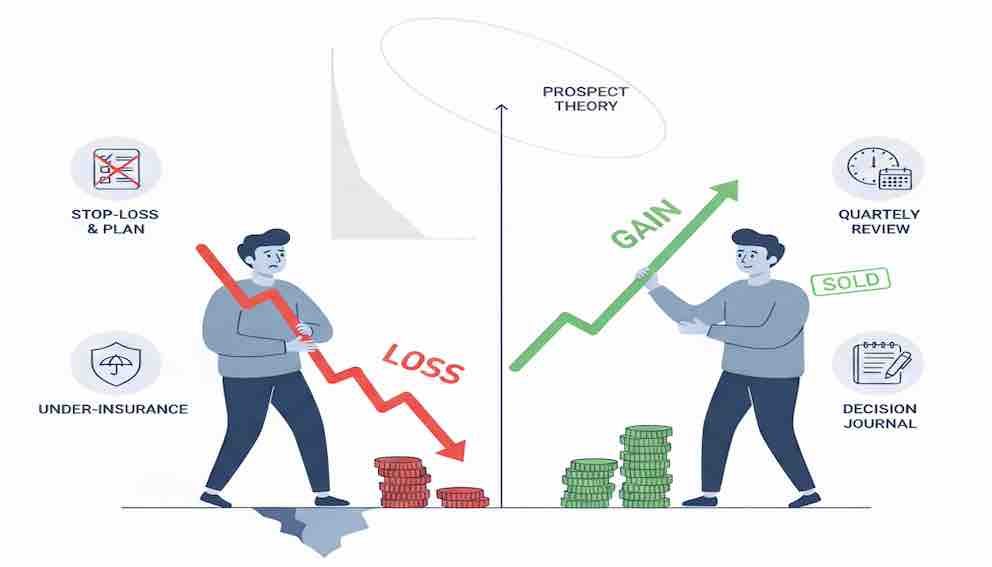
Imagine Joe bought 100 shares of a company at $50 per share. Over the next few months, the stock falls to $35. Joe knows the fundamentals have changed—the company’s growth has slowed, and competitors are taking market share—but he can’t bring himself to sell. Every time he looks at the portfolio, the loss stings. He tells himself, “Maybe it will bounce back.” Months later, the stock drops further.
Have you ever held onto a losing investment far longer than you should have—or sold a winning investment too early for fear of losing those gains? If so, you’ve experienced loss aversion, one of the most powerful behavioral biases in finance.
Everyday example: You buy a new phone for $800 and feel satisfied with the purchase. A week later, you see the exact same model on sale for $700. Even though nothing about the phone has changed, the discovery bothers you. The $100 difference feels like a real loss—something taken away—rather than a neutral pricing change. Now imagine the opposite scenario: you planned to buy the phone for $800, but unexpectedly find it for $700. The pleasure from saving $100 is real, but noticeably weaker than the frustration you would feel in the first situation.
This asymmetry—where the pain of a perceived loss outweighs the pleasure of an equivalent gain—is the essence of loss aversion.
Theoretical Foundation: Prospect Theory and the Psychology of Loss
Prospect Theory and the Value Function
Loss aversion comes from Prospect Theory, a framework developed by psychologists Daniel Kahneman and Amos Tversky. The theory explains how people actually experience gains and losses—not how they should behave in theory.
At the center of Prospect Theory is the value function, which describes how we feel about money:
- We enjoy gains, but each additional gain feels a little less exciting than the last.
- We dislike losses, and each additional loss hurts more than the one before.
- Most importantly, losses hurt more than gains feel good.
In fact, research shows that losing $100 feels about twice as painful as gaining $100 feels pleasurable. This is not a figure of speech—it’s a consistent finding across many experiments.
Everyday example:
Winning $50 in a lottery feels nice. Losing $50 feels much worse than the happiness you get from winning. Because of this imbalance, people often avoid small losses—even when doing so increases the risk of much larger losses later.
Why Reference Points Matter
Another key idea is reference dependence. We don’t judge gains and losses in absolute terms—we judge them relative to a reference point, usually what we paid or the most recent value.
For example, if you buy a stock at $50 and it falls to $40, it feels like a loss—even if $40 is still a reasonable price based on the company’s fundamentals. The pain comes from falling below your reference point, not from the objective value itself.
This simple idea explains many investor behaviors, including why people struggle to sell losing investments and why losses feel so emotionally powerful.
Real-World Financial Impacts
Loss aversion isn’t just an abstract idea—it shapes real financial decisions and often leads to costly, predictable mistakes.
The Disposition Effect
One of the clearest manifestations is the Disposition Effect: investors sell winners too early (to “lock in gains”) and hold losers too long (to avoid realizing losses). This violates the rational principle of “cut your losses and let your profits run.”
- Example: Suppose John buys shares of a tech stock at $100. The stock rises to $120, and he sells immediately to secure the gain. Meanwhile, a healthcare stock purchased at $100 falls to $85, but he holds, hoping it will bounce back. Over time, this behavior reduces overall portfolio returns.
Studies (Odean, 1998) show this is a persistent pattern among individual investors and even some institutional traders.
The Under-Insurance Puzzle
Loss aversion can also lead to under-insurance. Paying an insurance premium is perceived as a sure loss, whereas the benefit—avoiding a potential disaster—is uncertain. Even when the risk of catastrophic loss is high, people often under-insure because the psychological pain of a guaranteed loss outweighs the potential benefit.
- Example: Many homeowners in flood-prone areas do not buy flood insurance because paying the annual premium feels like a loss—even though the financial protection far outweighs the cost if a flood occurs.
- Behavioral insight: The reference point (“wealth without insurance”) makes the premium feel like a guaranteed loss, reinforcing risk-averse behavior.
Other Related Biases
Loss aversion is connected to several well-documented biases:
- Endowment Effect: Overvaluing what we own, leading to reluctance to sell assets.
Example: An investor keeps a stock purchased many years ago despite declining fundamentals, because the long holding period creates a sense of attachment that outweighs objective analysis.
- Status Quo Bias: Preferring current conditions over change, even when change is beneficial.
Example: An individual keeps their savings in a bank account earning 1% interest for years, despite higher-yield alternatives being easily available, because moving the money feels risky and inconvenient.
- Sunk Cost Fallacy: Continuing an endeavor because of prior investment, despite losses mounting.
Example: Continuing to pour money into a failing small business because you’ve already invested heavily.
Reflective prompt: Think about your last investment or financial decision where you stuck with something because selling felt “too painful.” What alternative would have been rational? How did the emotional experience compare to the eventual outcome?
Strategic De-Biasing: How Investors Reduce the Power of Loss Aversion
Loss aversion is a natural human instinct — it isn’t a flaw. The difference between expert investors and beginners is not that experts feel less emotion, but that they design rules and systems so emotions don’t control decisions.
1. Pre-Commitment: Decide Before Emotions Take Over
The idea: Make important decisions in advance, when you are calm and rational.
Stop-Loss Rules
A stop-loss is a rule that sells an investment automatically if it falls to a certain price. This prevents the “I’ll wait and see” trap.
Example: You buy a stock at $100 and decide beforehand that if it falls to $90, you’ll sell. When the price hits $90, the sale happens automatically — no second-guessing, no hoping it “comes back.”
Automatic Investing and Saving
Automating investments removes the need to repeatedly decide whether to invest — which often feels like a loss.
Example: Instead of choosing each month whether to invest, 10% of your salary is automatically invested in a broad market fund. Over time, investing becomes routine rather than emotionally painful.
2. Framing: Change How You Look at the Same Situation
The idea: The way you mentally frame a decision can change how it feels — even when the numbers are the same.
Reframing Market Declines
Instead of seeing a price drop as a loss from the past, view it as a new starting point.
Example: You buy a stock at $50. It falls to $40. Instead of thinking “I’m down $10,” ask:
“Would I buy this stock today at $40, knowing what I know now?”
This shifts the focus from past regret to present opportunity.
Use Long-Term Reference Points
Short-term price movements feel intense because they constantly reset your sense of gain and loss.
Example: Rather than asking “What did my portfolio do today?”, ask:
“How is my portfolio doing compared to my long-term plan?”
This reduces emotional reactions to normal market ups and downs.
3. Reduce How Often You Check Your Portfolio
Daniel Kahneman famously advised: “Once a quarter is enough.”
Why it works:
The more often you check, the more often you see small losses — and because losses feel stronger than gains, they dominate your emotions.
Example: If you check your portfolio every day, a small drop might feel alarming. If you check quarterly, that same fluctuation barely registers and is more likely to be seen as normal market noise.
4. Use Simple, Repeatable Processes
Experts rely on processes, not gut feelings.
Investment Checklists
A checklist ensures that every decision meets basic standards before action is taken.
Example: Before buying or selling, you ask:
- Does this fit my goals?
- Is the risk acceptable?
- Am I reacting to news or following my plan?
Decision Journals
Writing down why you made a decision creates clarity and accountability.
Example: Before buying a stock, you note:
“I believe earnings will grow over the next two years. I will sell if this thesis changes.”
Later, you evaluate the decision based on facts — not feelings.
Scenario Planning
Thinking ahead about negative outcomes makes them less frightening.
Example: You ask yourself in advance:
“If my portfolio fell 20%, what would I do?”
- When markets actually drop, you already have an answer — and panic is reduced.
Experts don’t try to eliminate emotion — they build systems that make emotional mistakes harder to act on.
Complexity, Context, and Advanced Nuance
Loss aversion is a strong and well-documented bias, but it doesn’t affect everyone the same way. Its strength depends on context, culture, stakes, and experience. Experts understand these nuances and adapt their strategies accordingly.
Key Critiques and Alternative Explanations
- Loss Attention Hypothesis: Some researchers suggest that people act cautiously after losses simply because they pay more attention, not because losses “hurt more.”
- Psychological Inertia: Sometimes investors hold losers or sell winners out of habit or resistance to change, without loss aversion being the cause.
Even with these debates, most studies support the idea that loss aversion is a real and powerful influence on financial decisions.
Factors That Influence Loss Aversion
Cultural Differences: Risk tolerance and sensitivity to losses vary by country.
Example: Investors in some East Asian countries are less loss-averse than those in Western countries.
Size of Stakes: Big financial losses trigger stronger reactions, while small ones may feel minor.
Example: Professional traders may shrug at small losses but react strongly to major market drops.
Experience and Expertise: Seasoned investors recognize loss aversion and rely on rules; novices are more likely to act emotionally.
How Experts and Novices Behave
Experts:
- Pre-set rules and focus on the process, not daily results.
- Use structured evaluation and separate short-term pain from long-term goals.
Example: An expert sets quarterly rebalancing and stop-loss thresholds, so daily market swings don’t trigger emotional trades.
Novices:
- React emotionally, often selling winners too early and holding losers too long.
- Can compound losses by panicking during market dips.
Example: A novice panics and sells during a small market drop, then misses the recovery that follows.
Reflective Prompt
Imagine you are managing your portfolio like an expert:
- How could you pre-commit to rules before emotions take over?
- How might you reframe losses to see them as opportunities?
- What systematic evaluation steps could you put in place to guide decisions instead of gut feelings?
Takeaways: Turning Knowledge into Action
- Loss aversion is a predictable human bias, grounded in Prospect Theory.
- Emotional reactions to losses are natural, but structured strategies can reduce their negative impact.
- Concrete, evidence-based tools—pre-commitment devices, reframing, evaluation frequency reduction, and systematic processes—allow investors to make rational decisions even under pressure.
- Experts anticipate their emotional responses and design systems to neutralize them; novices often learn the hard way through costly mistakes.
Mastering loss aversion transforms not only portfolio outcomes but also the investor’s mindset—turning fear into disciplined, confident decision-making.
Reflective Engagement
- Recall a time you avoided realizing a loss. What emotions influenced your decision?
- How often do you check your portfolio, and how does this affect perception of gains and losses?
- What pre-commitment rules could you implement today to protect against emotional decision-making?
Academic References
- Kahneman, D., & Tversky, A. (1979). Prospect Theory: An Analysis of Decision under Risk
- Thaler, R. H. (1985). Mental Accounting and Consumer Choice.
- Odean, T. (1998). Are Investors Reluctant to Realize Their Losses?
- Barberis, N., Huang, M., & Santos, T. (2001). Prospect Theory and Asset Prices
- Benartzi, S., & Thaler, R. (1995). Myopic Loss Aversion and the Equity Premium Puzzle
About Swati Sharma
Lead Editor at MyEyze, Economist & Finance Research WriterSwati Sharma is an economist with a Bachelor’s degree in Economics (Honours), CIPD Level 5 certification, and an MBA, and over 18 years of experience across management consulting, investment, and technology organizations. She specializes in research-driven financial education, focusing on economics, markets, and investor behavior, with a passion for making complex financial concepts clear, accurate, and accessible to a broad audience.
Disclaimer
This article is for educational purposes only and should not be interpreted as financial advice. Readers should consult a qualified financial professional before making investment decisions. Assistance from AI-powered generative tools was taken to format and improve language flow. While we strive for accuracy, this content may contain errors or omissions and should be independently verified.