Tutorial Categories
Last Updated: January 31, 2026 at 19:30
Debt, Leverage, and Financial Risk: How Borrowing Transforms Discipline into Fragility in Corporate Finance - Corporate Finance Series
Debt is a tool that fundamentally changes how a company experiences risk. While often labeled "cheap capital," its true cost is paid in lost flexibility and amplified fragility. This tutorial dissects how fixed interest payments and covenants transform uncertain business outcomes into non-negotiable financial stress, forcing management to prioritize survival over strategy. Through contrasting examples—from the stable utility to the collapsing retailer—we show why the same dollar of debt is either a tool of discipline or a trigger of crisis, depending entirely on the predictability of the underlying cash flows. You will learn to see leverage not as an accounting ratio, but as a behavioral lever that pre-writes a company's script for its next downturn.
Introduction: The Illusion of "Cheap" Capital
In corporate finance, debt is often reduced to a calculation: if the Return on Invested Capital (ROIC) exceeds the Interest Rate, borrowing seems to create value. This logic underpins the textbook pursuit of an "optimal" capital structure, often targeting a low Weighted Average Cost of Capital (WACC).
This framework is dangerously incomplete. It treats debt as a passive cost, akin to rent, when it is in fact an active agent that reshapes a company’s destiny. Debt does not just fund operations; it installs a financial governor on the corporate engine—a mechanism that can enforce efficiency at cruising speed but seizes up the moment the road gets rough.
The critical insight is this: Debt converts business risk (volatility of profits) into financial risk (the threat of insolvency). Understanding this transformation is the difference between using leverage as a tool and becoming its victim.
The Mechanics of Transformation: From Profit & Loss to Solvency
To see how debt changes the game, consider two identical companies with the same operational risk—a 20% chance of a bad year where Earnings Before Interest and Taxes (EBIT) drops to zero.
- Company A (All-Equity): In a bad year, profits are zero. Disappointing, but not catastrophic. The company survives, conserves cash, and lives to fight another day.
- Company B (Levered): It has debt with annual interest payments of $5 million. In a bad year, EBIT is zero. It now faces a $5 million cash shortfall. This is no longer an earnings miss; it is a solvency crisis.
The same operational shock produces radically different outcomes. This is the core mechanism: debt acts as a risk converter, turning operational variability into a binary test of survival.
Example: The Airlines Test.
The airline industry is inherently cyclical and shock-prone (9/11, pandemics, fuel spikes). An airline with modest debt might navigate these storms. An airline burdened by high leverage, however, sees every downturn turn into a desperate scramble for liquidity, asset sales, and bankruptcy filings—as seen repeatedly in the industry's history. The business risk (empty seats) is universal; the financial risk (bankruptcy) is a choice made by the capital structure.
The Two Faces of Debt: Discipline vs. Fragility
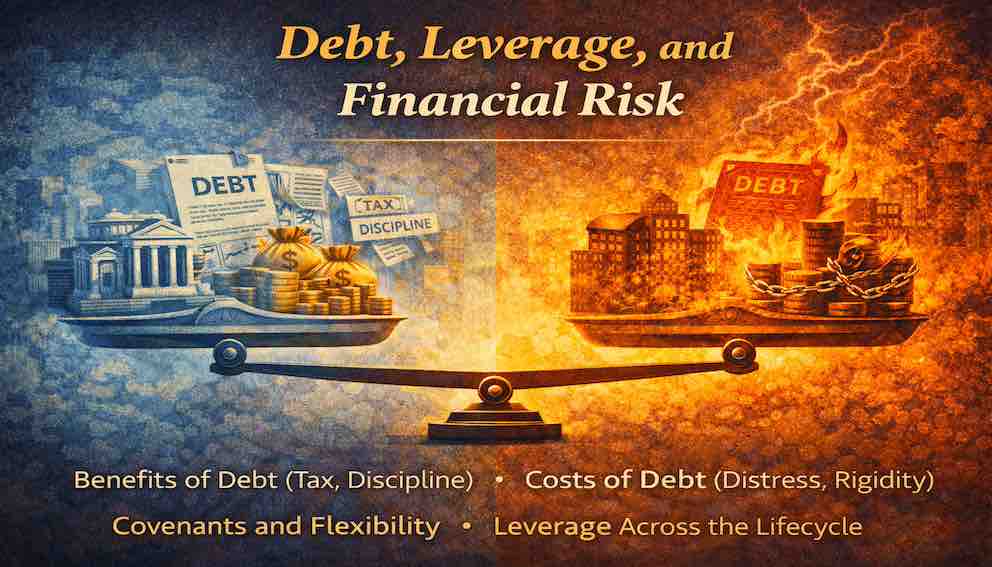
Debt is Janus-faced. Its benefit and its curse are two sides of the same coin: the inflexibility of fixed payments.
The Disciplined Face: The Tax Shield and the ROIC Amplifier
For a mature, stable company like a regulated utility or a branded consumer goods firm, debt has clear advantages:
- The Tax Deductibility of Interest: This is a genuine, value-creating benefit, effectively lowering the government's claim on profits.
- The ROIC Amplifier: This is the core financial benefit. If a stable business earns a 12% return on a project and funds it with debt costing 6%, the excess 6% return accrues directly to equity holders. This "leverage spread" is the mechanism by which judicious debt boosts shareholder returns in predictable environments.
- The "Productivity Whip": Mandatory interest payments force management to generate cash efficiently, discouraging wasteful "empire-building."
In this context, debt is a tailwind. It enhances returns for equity holders in good times and imposes a useful, low-grade stress that optimizes performance.
The Fragile Face: The "Sword of Damocles"
For any company facing volatility—a tech startup, a cyclical manufacturer, a firm in decline—the same inflexibility becomes a lethal threat. Here, debt is a headwind that:
- Erodes Strategic Optionality: It eliminates the ability to "wait and see" or invest through a downturn.
- Amplifies Shocks: A minor setback triggers covenant breaches, credit downgrades, and a loss of stakeholder confidence, creating a downward spiral.
- Forces Perverse Incentives: Management must divert energy from creating long-term value to managing short-term liquidity.
Contrasting Example: Procter & Gamble vs. Toys "R" Us.
- P&G (Stable Cash Flows): Carries significant debt cheaply. Its predictable, global cash flow from Tide and Pampers can easily service interest. The debt provides a tax shield and amplifies ROIC without threatening survival. Debt is a tool.
- Toys "R" Us (Volatile, Declining Cash Flows): Loaded with LBO debt, its cash flow was entirely consumed by interest payments. When e-commerce pressure hit, it had zero capital to adapt—no cash to build a competitive online platform, renovate stores, or weather a holiday slump. Debt was a straitjacket that led to liquidation.
The same instrument; opposite outcomes dictated entirely by the stability of the underlying business.
Covenants: The Remote Control That Governs Every Day
Covenants are not just crisis tripwires; they are a continuous remote-control mechanism that allows lenders to govern a company's strategy in both good times and bad. Their influence is pervasive, shaping decisions long before any hint of distress.
How Covenants Shape Behavior in "Normal" Times:
- Investment Strategy: A company may forgo a promising but risky R&D project because it would lower short-term EBITDA and threaten a leverage covenant, opting instead for a safer, lower-return investment.
- Capital Allocation: A strong balance sheet might be kept artificially weak (e.g., by paying special dividends) to stay within a debt ceiling, preventing the build-up of a strategic war chest.
- Operational Focus: Management spends disproportionate time on short-term financial engineering to optimize covenant ratios rather than on long-term operational improvements.
Example: The Growth Company's Dilemma.
A profitable software company with a 3.5x Debt/EBITDA covenant wants to make a transformative, $50 million acquisition. A recession hits, lowering its EBITDA. It now sits at 3.9x. The covenant, not a lack of cash or opportunity, blocks the deal. The debt contract written in sunny times now dictates strategy in a storm, potentially sacrificing long-term value to avoid a technical default.
The Lifecycle of Leverage: Why Context Is Everything
The prudent level of debt is not a universal number; it is a function of cash flow predictability. This predictability changes dramatically across the corporate lifecycle.
| Lifecycle Stage | Cash Flow Profile | Role of Debt | The Danger |
| Startup | Negative & Unpredictable. Burning cash for growth. | Toxic. Eliminates optionality, the startup's only asset. Even small debts can be fatal. | Death by asphyxiation: running out of cash because of mandatory payments. |
| Growth | Positive but Volatile. Scaling rapidly, reinvesting heavily. | Handle with Care. Can fund capital expenditures but can also force premature profitability over growth. | Stunted growth: cutting R&D or marketing to hit covenant ratios. |
| Maturity | Stable & Predictable. Moat defended, market saturated. | Optimal Tool. Provides tax shield, amplifies ROIC, disciplines management. | Complacency: over-levering because "we've always been stable," forgetting cycles exist. |
| Decline | Predictably Shrinking. Eroding margins, falling demand. | Accelerant of Death. Turns a managed decline into a fire sale. Guarantees conflict between equity and debt holders. | Value destruction: forced liquidation of assets at crisis prices. |
Case in Point: Netflix's Calculated Leverage.
Netflix in its hyper-growth phase made a bold choice: it issued billions in debt. This defied startup/growth norms. Why was it rational? Because its business model transformed its cash flow profile. Subscriptions created highly predictable, recurring revenue, making it resemble a mature utility in its ability to service debt. The debt wasn't funding uncertainty; it was funding a predictable content war to amplify its growth returns. This is the exception that proves the rule: debt is tolerable only when cash flows are reliably forecastable.
The Hidden Tax of Financial Stress
Beyond the clear mechanics of interest payments and covenants, debt imposes a hidden tax of financial stress long before a default. This tax is paid through the erosion of vital intangible capital:
- Supplier Distrust: Vendors may shorten payment terms or demand cash upfront, straining working capital.
- Employee Morale: Talented staff may leave, fearing instability, increasing turnover costs and crippling execution.
- Customer Confidence: Buyers may avoid long-term contracts or service agreements, fearing the company won't be around to honor them.
- Strategic Paralysis: The board and management become consumed with balance-sheet repair, taking their eyes off the competitive landscape.
These are distress costs that are rarely modeled in a spreadsheet but are devastatingly real. They mean that the true cost of debt is not just the interest rate, but the increased vulnerability of the entire business ecosystem.
Behavioral Bankruptcy: How Debt Corrupts Decisions Before the Default
The most insidious cost of debt is not the default event, but the distorted decision-making it causes long before. Faced with the gun to their head of an interest payment, managers don't optimize for value; they optimize for survival.
This leads to Behavioral Bankruptcy, observable in three patterns:
- The "Short-Termism" Trap: Cutting R&D, marketing, or maintenance to boost short-term EBITDA and please covenants, starving the future.
- The "Risk-Shifting" Gambit: Equity holders, facing wipeout, may pressure management to take enormous, "bet-the-company" risks. Heads, equity recovers; tails, debt holders lose more.
- The "Denial" Delay: Management hides operational problems to avoid triggering covenant discussions, making the eventual reckoning far worse.
Example: A Heavily Indebted Retailer.
Instead of investing in e-commerce (a long-term play with upfront costs), management uses all free cash flow to pay down debt and avoid breaching leverage covenants. This ensures solvency for another year but guarantees obsolescence in five. The company is operationally bankrupt long before it files for Chapter 11.
Conclusion: Respect the Sword
Debt is not inherently good or evil. It is a powerful tool whose nature changes with its context. The master allocator does not ask, "Is debt cheap?" but rather, "What script does this debt write for our next crisis?"
- For the stable company, debt writes a script of enhanced returns and disciplined stewardship.
- For the volatile company, debt writes a script of fragile survival, hidden costs, and corrupted decisions.
Therefore, the first rule of leverage is this: Match the maturity and rigidity of your liabilities to the predictability and durability of your assets. Borrow against cash flows you can see with certainty, not hope. In a world of uncertainty, equity—the bearer of residual risk—is not expensive. It is the premium you pay for the priceless option to change your mind and fight another day.
About Swati Sharma
Lead Editor at MyEyze, Economist & Finance Research WriterSwati Sharma is an economist with a Bachelor’s degree in Economics (Honours), CIPD Level 5 certification, and an MBA, and over 18 years of experience across management consulting, investment, and technology organizations. She specializes in research-driven financial education, focusing on economics, markets, and investor behavior, with a passion for making complex financial concepts clear, accurate, and accessible to a broad audience.
Disclaimer
This article is for educational purposes only and should not be interpreted as financial advice. Readers should consult a qualified financial professional before making investment decisions. Assistance from AI-powered generative tools was taken to format and improve language flow. While we strive for accuracy, this content may contain errors or omissions and should be independently verified.