
Tutorial Categories
Last Updated: January 31, 2026 at 19:30
Going Public: IPOs and Life as a Listed Company - Corporate Finance Series
Why do companies go public? This tutorial moves beyond fundraising to explain the IPO as a strategic exit and governance transformation. We introduce the "IPO Readiness Framework," detailing how companies are prepared for listing and the explicit and implicit costs of becoming public. Learn about IPO mechanics like book-building and roadshows, and understand how life as a listed company reshapes capital allocation, from dividends to R&D, under the pressure of quarterly performance. A must-read for understanding the full lifecycle implications of an IPO strategy.
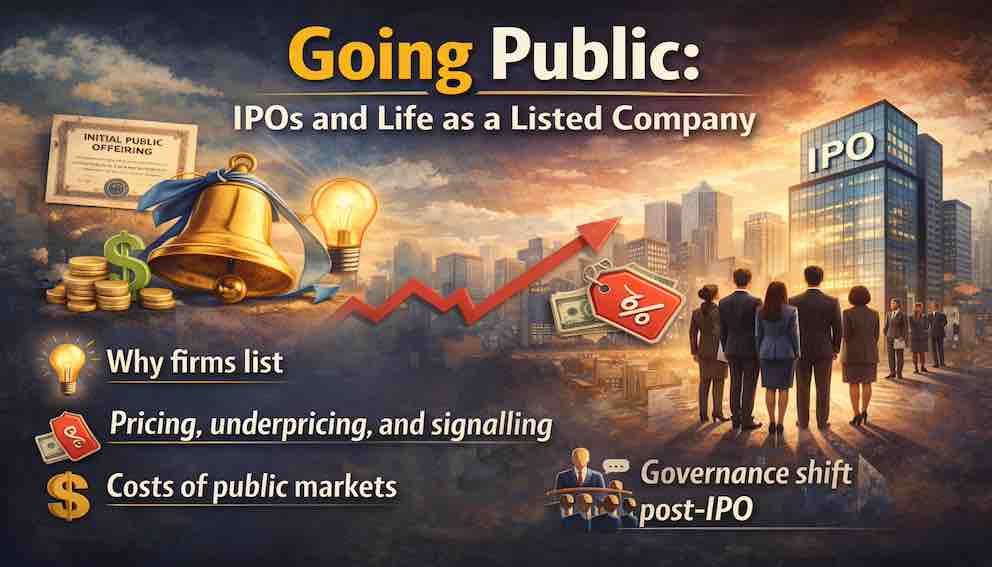
Introduction: The IPO as a Lifecycle Culmination
Throughout this series, we have traced a company's journey—from the growth-focused capital allocation of its youth, through the strategic leverage and M&A of maturity, to the disciplined return of capital in later stages. An Initial Public Offering (IPO) represents a pivotal, strategic milestone in this lifecycle.
For founders, it can be a liquidity event and a platform for the next phase of growth. For financial sponsors like private equity firms, it is often the planned culmination of a value-creation journey—the monetization event that validates years of operational improvement and governance building. This tutorial explores the IPO not just as a transaction, but as a fundamental transformation that reshapes a company's identity, strategy, and its very covenant with capital.
The Pre-IPO Crucible: Building a "Public-Ready" Company
The path to a successful IPO is paved years in advance. It is a deliberate process of enhancing value and de-risking the business to command a premium valuation at exit.
- Operational and Financial Rigor: Sponsors work to implement robust, auditable financial systems and craft a compelling, scalable growth narrative. The goal is to present a company whose operations and financial reporting can withstand intense public market scrutiny.
- Governance Foundation: This is the critical, non-negotiable preparation. As one resource advises, "Start early – really early" [I searched for you]. This involves:
- Board Restructuring: Recruiting independent directors, especially those with financial expertise, to form qualified Audit and Compensation Committees, often 12-24 months pre-IPO [I searched for you].
- Policy Implementation: Adopting public-company policies—codes of ethics, whistleblower programs, insider trading protocols—long before the listing [I searched for you].
- Strategic Goal: To enter the IPO process not as a private company scrambling to comply, but as a public entity in waiting. This readiness is a powerful signal of discipline that strengthens the company's position.
IPO Mechanics: The Roadshow to the Ringing Bell
Understanding the process demystifies the outcome. The IPO journey typically follows these key stages:
- Due Diligence & Book-Building: Investment banks (underwriters) conduct deep due diligence. They then "build the book" by soliciting non-binding indications of interest from institutional investors at various price points to gauge demand.
- The Roadshow: Company leadership embarks on a grueling series of presentations to institutional investors across key financial centers. This is where the investment narrative is sold and management credibility is tested.
- Pricing & Allocation: Based on demand from the book-build, the final offer price is set. Shares are primarily allocated to large institutional investors (pension funds, mutual funds), with a small portion often reserved for retail brokers.
- Listing & Trading: Shares are issued to investors at the offer price and begin trading on the public exchange, where market forces immediately take over.
The Core Framework: The Three Dimensions of IPO Value
The success and financial terms of an Initial Public Offering are not determined by a single factor. Instead, they are dictated by the critical interplay of three strategic dimensions. Mastering the balance between these areas—Governance & Control, Pricing & Cost, and Market Positioning & Narrative—is what separates a merely successful listing from a strategically transformative one that sets the company up for long-term prosperity in the public markets.
1. Governance & Control: Architecting the Post-IPO Power Structure
This dimension defines the fundamental rules of oversight, accountability, and managerial authority after listing. It answers the question: "Who will steer the ship, and with what checks and balances?"
- Board Independence: At IPO, a private, founder-driven board must be restructured. Mandatory independent directors, particularly on the Audit and Compensation committees, shift significant oversight power from company insiders to representatives of public shareholders. This change is non-negotiable for exchange listing and fundamentally alters internal decision-making dynamics.
- Anti-Takeover Provisions: Founders and early investors often use the IPO moment to embed protective mechanisms. Structures like dual-class share (giving founders superior voting rights) or staggered boards (making a hostile takeover more difficult) can protect a long-term strategic vision from short-term market pressure. However, these provisions can also deter certain institutional investors who prioritize equal shareholder rights, potentially impacting the initial investor pool and valuation.
2. Pricing & Cost: The Tangible and Intangible Economics of Listing
This dimension encompasses all financial aspects of the offering, from the direct fees paid to bankers to the more subtle, often larger, cost of capital left unraised.
- Bargaining Power: This is the pivotal lever. A company that is financially strong, operationally prepared, and not desperate for capital enters negotiations from a position of strength. Conversely, a financially constrained firm has less leverage, often resulting in accepting higher underwriting fees and significant share underpricing to ensure the deal gets done.
- Underpricing (The First-Day "Pop"): When shares are offered at $20 but open trading at $25, that $5 difference is capital the company did not receive. While this first-day gain generates positive media buzz and rewards initial investors, it represents a direct transfer of wealth from the company's balance sheet to those investors. The strategic decision of how much to underprice is a complex trade-off between securing a stable, enthusiastic investor base and maximizing the capital raised for the company's future.
3. Market Positioning & Narrative: Selling the Future, Not Just the Present
An IPO is a launch, and every successful launch needs a compelling story. This dimension is about crafting and communicating the strategic thesis that justifies the company's valuation and excites the market about its future.
- The "Value Creation Story": This narrative must do more than recount past financials. It must convincingly bridge the company's private history with its public future. For a private equity-backed firm, the story explains how operational improvements and investments during the private phase have created a platform for scalable public-market growth. It turns historical data into a credible forecast.
- Signaling to Stakeholders: A successful IPO is a powerful signal that extends far beyond investors. It boosts the company's credibility, making it easier to recruit top-tier talent who are attracted to the liquidity and prestige of public equity. It assures key partners and suppliers of the company's stability and longevity, potentially leading to better contract terms. In essence, the IPO itself becomes a monumental marketing and trust-building event for all corporate stakeholders.
The True Cost of Being Public: Beyond the Banker's Fee
The price of admission to public markets is multi-layered and enduring.
- Direct Costs: Underwriting fees (5-7%), legal, accounting, and exchange listing fees. Significant, but predictable.
- Indirect Costs (The Underpricing Discount): This is capital the company forgoes. Academic research shows this cost is systematically higher for financially constrained companies, as they have less negotiating power with underwriters .
- The Long-Term Performance Drag: Critically, studies indicate that companies that were constrained at IPO and paid higher underpricing costs often underperform peers over the next 3-5 years. This creates a vicious cycle for the firms that need capital most.
- The Risk of Short-Termism: The relentless quarterly earnings pressure can distort strategy. Management may delay valuable long-term R&D or essential capital expenditures to hit near-term targets, potentially eroding the company's competitive moat. This is the ultimate "implicit cost" of being publicly traded.
Life as a Listed Company: A New Capital Allocation Regime
The transition to public ownership fundamentally alters a company's financial strategy and stakeholder relationships.
- The Capital Allocation Shift: The discreet, private reinvestment of all cash flow gives way to a public capital allocation policy. Management must now deliberately balance:
- Reinvestment in high-ROIC projects (growth).
- Returning Capital via dividends and buybacks (maturity/return).
- Strengthening the Balance Sheet (resilience).
- Every decision is scrutinized and communicates a strategic priority to the market.
- The Stakeholder Covenant: The IPO creates new, powerful relationships.
- With Employees: Equity compensation (options, RSUs) becomes a key tool for recruitment and retention, directly aligning employee wealth with shareholder value.
- With Customers & Partners: Public listing signals stability and longevity, which can be a competitive advantage in securing large, long-term contracts.
- With The Market: A constant, structured dialogue begins via earnings calls, SEC filings, and investor days. Transparency is mandatory, and narrative management is continuous.
Case Study: Contrasting Approaches – Twitter vs. a PE-Backed Industrial
- Twitter (2013): Facing Market Uncertainty
- Coming after Facebook's rocky debut, Twitter's priority was a successful launch. To guarantee it, they accepted significant underpricing. The 73% first-day pop created massive publicity and a stable base of happy initial investors, but left substantial capital unraised. This was a strategic choice in the Pricing & Cost dimension, prioritizing market positioning over immediate capital maximization.
- A Hypothetical PE-Backed Industrial Firm: The Prepared Exit
- After years of operational improvements and governance building, this firm enters its IPO with strong financials and a ready-made independent board. Its bargaining power is high. It achieves pricing near the top of its range with minimal underpricing, maximizing capital raised for its next lifecycle phase. Its post-IPO narrative focuses on the disciplined capital allocation it learned in the private stage, promising a balanced approach to growth and shareholder returns.
Conclusion: The Public Company Compact
An IPO is the inception of the Public Company Compact: in exchange for permanent capital and liquidity, a company pledges a life of transparency, accountability, and short-term market discipline.
This transition is the ultimate test of strategic maturity. Companies that view it as a mere financial transaction often struggle with the governance and cultural shock. Those that approach it as a lifecycle culmination—prepared over years with rigorous capital discipline, operational excellence, and robust governance—are positioned not just to go public, but to thrive under the spotlight. They understand that the bell on the exchange doesn't just ring in a new stock ticker; it rings in a new era of stewardship.
I hope this comprehensive tutorial strengthens your series. Would you like to delve deeper into any specific area, such as structuring equity compensation for employees or navigating activist investors in the post-IPO world?
About Swati Sharma
Lead Editor at MyEyze, Economist & Finance Research WriterSwati Sharma is an economist with a Bachelor’s degree in Economics (Honours), CIPD Level 5 certification, and an MBA, and over 18 years of experience across management consulting, investment, and technology organizations. She specializes in research-driven financial education, focusing on economics, markets, and investor behavior, with a passion for making complex financial concepts clear, accurate, and accessible to a broad audience.
Disclaimer
This article is for educational purposes only and should not be interpreted as financial advice. Readers should consult a qualified financial professional before making investment decisions. Assistance from AI-powered generative tools was taken to format and improve language flow. While we strive for accuracy, this content may contain errors or omissions and should be independently verified.