
Tutorial Categories
Last Updated: January 31, 2026 at 19:30
Strategic Restructuring and Financial Distress: Preserving Value at the Edge of Failure - Corporate Finance Series
Financial distress is not a failure of strategy, but a failure of capital allocation that demands immediate correction. This tutorial explains how disciplined companies diagnose operational versus financial problems, execute surgical restructuring, and when necessary, use bankruptcy not as surrender but as a strategic tool to reorganize. We detail the creditor negotiation process, the preservation of franchise value, and how restructuring decisions vary across a company's lifecycle. Through contrasting examples, you will learn why proactive, transparent restructuring preserves value while denial and delay destroy it.
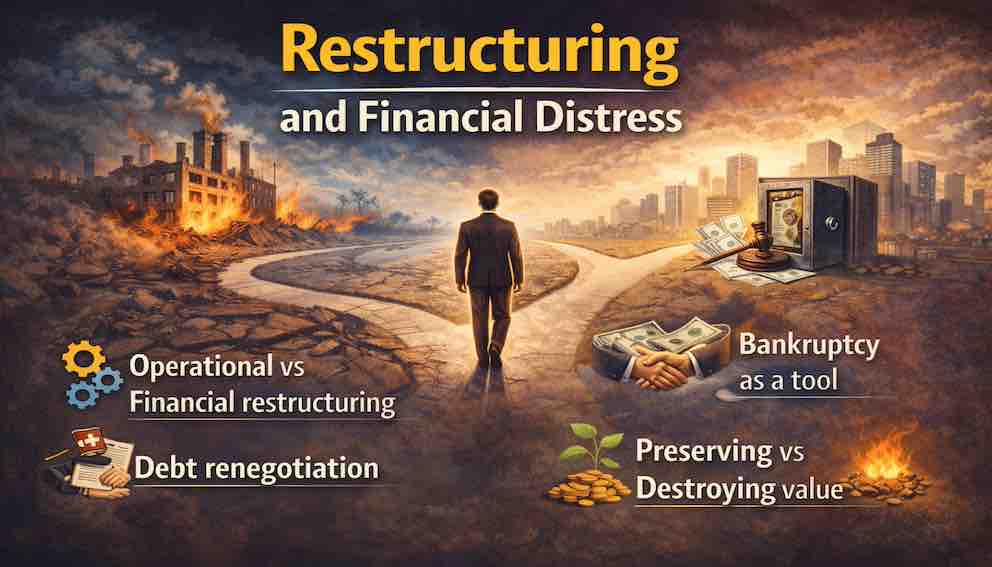
Introduction: The Ultimate Capital Allocation Test
In previous tutorials, we examined capital allocation for growth, maturity, and decline. We now reach its most intense application: financial distress. This occurs when a company cannot meet its financial obligations or faces imminent operational collapse. The core discipline remains the same: allocate scarce resources to maximize long-term value. In distress, however, the stakes are existential, the time is compressed, and the consequences of error are fatal. The guiding principle shifts subtly from maximizing returns to preserving optionality—keeping future strategic choices alive to protect the company's franchise value.
Diagnosis: Operational vs. Financial Restructuring
The first and most critical step is accurate diagnosis. Is the company's problem primarily operational (the business model is broken) or financial (the capital structure is unsustainable)? The prescribed treatment differs radically.
Operational Restructuring: Fixing the Business Engine
Operational restructuring addresses the company's core profit-generating activities. It asks: "Are we producing goods or services at a competitive cost for a viable market?"
Key Levers of Operational Restructuring:
- Cost Rationalization: Reducing discretionary spending, renegotiating supplier contracts, or closing unprofitable business units.
- Strategic Asset Sales: Selling non-core or underperforming assets to raise cash and sharpen strategic focus.
- Business Unit Reorganization: Changing management structures, reporting lines, or operational processes to improve efficiency and accountability.
Example: Ford Motor Company (2008-2009)
During the automotive crisis, Ford avoided bankruptcy through aggressive operational restructuring. It sold luxury brands (Jaguar, Land Rover), mortgaged all assets for liquidity, and radically streamlined its model lineup and production footprint. This operational focus restored its core business to profitability.
Financial Restructuring: Fixing the Balance Sheet
Financial restructuring addresses how the company is funded. It asks: "Can our operating cash flows service our debt and other fixed commitments?"
Key Levers of Financial Restructuring:
- Debt Rescheduling: Negotiating with lenders to extend loan maturities or reduce interest rates.
- Covenant Relief: Asking lenders to temporarily waive loan agreement terms (e.g., minimum earnings ratios) to avoid technical default.
- Debt-for-Equity Swaps: Converting debt obligations into ownership stakes, which dilutes shareholders but reduces the debt burden.
Example: Delta Air Lines (2005-2007)
Delta filed for Chapter 11 bankruptcy in 2005. Its restructuring plan centered on financial restructuring: it converted over $3 billion in debt into equity, rejected unprofitable aircraft leases, and terminated its pension plan. This repaired its balance sheet, allowing its sound operational model to succeed post-bankruptcy.
The Inextricable Link and Strategic Reinforcement
Operational and financial restructuring create a mutually reinforcing cycle. Consider a manufacturer with high debt and inefficient plants. An operational plan to close its oldest factory saves $50 million annually. This improved cash flow projection gives creditors confidence, making them more likely to agree to a financial restructuring that reschedules debt. That rescheduling, in turn, frees up immediate cash, which can be invested in automation at the remaining plants, further improving operations. The reverse is also true: without the operational plan, creditors have no rationale to provide financial relief. This linkage is the practical engine of value preservation in distress.
Bankruptcy as a Strategic Tool
Bankruptcy, particularly Chapter 11 in the U.S., is often mischaracterized as failure. For the disciplined manager, it is a legally-defined process for enforced capital allocation. It serves specific strategic purposes.
The Strategic Purposes of Chapter 11:
- The Automatic Stay: Halts all lawsuits and creditor collection actions immediately, preserving the option to continue operating.
- Debtor-in-Possession (DIP) Financing: Allows the company to access new, senior financing to fund operations during restructuring.
- Power to Reject Burdensome Contracts: Enables the company to shed unprofitable leases, supply agreements, and other obligations.
- Plan of Reorganization: Allows management to propose a restructuring plan that can be approved by the court over some creditor objections ("cram down").
Pre-packaged Bankruptcy (Pre-pack): A sophisticated hybrid where a company negotiates a full restructuring plan with key creditors before filing for Chapter 11. The filing then quickly confirms the pre-negotiated plan, minimizing cost and disruption. This is the ultimate tool for preserving optionality—it combines the certainty of a negotiated deal with the legal power of the court.
Example: General Motors (2009) – A Strategic Reboot
GM's Chapter 11 filing was a deliberate strategic tool. It allowed GM to: 1) Juridically shed unprofitable brands (Pontiac, Hummer) and legacy liabilities, 2) Access DIP financing from the U.S. Treasury, and 3) Emerge weeks later with a clean balance sheet focused on its viable core brands (Chevrolet, Cadillac). Bankruptcy was the scalpel for a radical, rapid restructuring that preserved the optionality of its industrial franchise.
Debt Renegotiation: The Negotiation Calculus and Timing
When bankruptcy is not immediately necessary, restructuring happens through direct negotiation. Success requires understanding the creditor hierarchy—the legal order of payment in a liquidation—and the precise trade-offs for each party.
The Creditor Hierarchy (The Payment "Waterfall"):
- Secured Creditors (e.g., banks with liens on specific assets).
- Unsecured Creditors (e.g., bondholders, trade suppliers).
- Subordinated Debt Holders.
- Preferred Shareholders.
- Common Equity Holders.
The Explicit Decision Calculus:
- For a Secured Creditor: The choice is between (a) amending terms for a likely full recovery over time from a going concern, or (b) seizing and selling collateral in a depressed, fire-sale market for a certain but lower immediate recovery.
- For an Unsecured Creditor: The calculus is starker: accept a discounted cash payment or an equity swap in a restructured company, or hold out and risk receiving pennies on the dollar—or nothing—in a forced liquidation.
- For Equity Holders: Their position is weakest. Their primary leverage is the credible threat of bankruptcy, which would typically wipe them out. To avoid this, they must often offer creditors severe dilution or control in exchange for debt forgiveness, sacrificing today to preserve any future option value.
The "Zone of Insolvency" – A Legal Shift: When a company is near or in distress, directors' fiduciary duties expand to include the interests of creditors, not just shareholders. This legal reality makes proactive, transparent negotiation essential. Timing is critical: early negotiation, while the company still has cash and credibility, leads to better outcomes than last-ditch pleas when leverage is gone.
Example: Southwest Airlines (2020) – Proactive Renegotiation
During the COVID-19 pandemic, Southwest's operational model was sound, but it faced a financial liquidity crisis. It proactively negotiated with lenders, secured new credit lines, and amended existing agreements while it still had substantial cash reserves. This out-of-court financial restructuring provided the runway for its operations to survive, avoiding bankruptcy and preserving all strategic optionality.
Counter-Example: Kodak (Pre-2012) – Destructive Delay
Kodak delayed addressing its massive debt and pension obligations for years while its core business eroded. This delay burned cash and destroyed creditor trust. By its 2012 Chapter 11 filing, it had little cash and no negotiating power, leading to a painful liquidation of assets. Its delayed negotiation turned a difficult situation into a value-destroying catastrophe.
Preserving vs. Destroying Value: The Optionality Principle
Every decision in distress must be judged by one criterion: does it preserve or expand future strategic optionality? Value preservation is fundamentally about keeping choices alive.
Value-Preserving Actions (Expand Optionality):
- Surgical cost-cutting that protects core R&D and customer relationships.
- Strategic asset sales that raise liquidity without mortgaging the future.
- Early creditor engagement that builds trust and keeps out-of-court options open.
- Using bankruptcy as a pre-emptive, calculated tool to force a resolution.
Value-Destroying Traps (Erode Optionality):
- Panic-driven cuts that destroy the brand and talent pool, closing off future recovery paths.
- Denial and delay, which systematically burn through cash—the ultimate source of optionality.
- "Hail Mary" bets with remaining cash that, if they fail, guarantee liquidation.
- Decisions made to protect management ego rather than the company's survival options.
The Lifecycle Lens: Context for Restructuring
The nature of restructuring is dictated by the company's lifecycle stage, directly applying our broader capital allocation framework.
- Growth-Stage Distress: Usually an operational problem (product-market fit, high burn rate). Capital allocation focuses on a strategic pivot and raising dilutive rescue equity to fund a revised growth plan.
- Mature-Stage Distress: Often a financial problem (excessive debt taken on during stable times). Capital allocation requires a balanced mix: operational efficiency gains to improve returns on capital, paired with sophisticated debt renegotiation or equity recapitalization to optimize the balance sheet.
- Decline-Stage Distress: The central capital allocation question is restructure or liquidate? Operational fixes may offer poor returns on invested capital. The disciplined decision is often a financial restructuring aimed at an orderly wind-down or sale—allocating remaining capital to maximize terminal value for stakeholders.
Conclusion: Restructuring as Applied Capital Allocation
Financial distress is the supreme test of the capital allocation principles explored throughout this series. It forces managers to apply the core discipline—allocating scarce resources to maximize long-term value—under conditions of extreme constraint and urgency.
The systematic approach mirrors our lifecycle framework: first, diagnose (operational vs. financial); second, select tools (restructuring levers, negotiation, or bankruptcy) appropriate to the company's stage and problem; third, execute with a clear focus on preserving optionality and franchise value. Just as a growth company allocates capital to R&D for future options, a distressed company allocates its last reserves of cash, credibility, and management attention to keep the enterprise alive.
Ultimately, strategic restructuring is not an alternative to capital allocation; it is its most rigorous form. The companies that emerge stronger from distress do so not by luck, but by making a series of disciplined, painful allocations—cutting this to save that, diluting today to survive tomorrow—all directed at one goal: preserving the option to create value again in the future. In corporate finance, that is the essence of stewardship at the brink.
About Swati Sharma
Lead Editor at MyEyze, Economist & Finance Research WriterSwati Sharma is an economist with a Bachelor’s degree in Economics (Honours), CIPD Level 5 certification, and an MBA, and over 18 years of experience across management consulting, investment, and technology organizations. She specializes in research-driven financial education, focusing on economics, markets, and investor behavior, with a passion for making complex financial concepts clear, accurate, and accessible to a broad audience.
Disclaimer
This article is for educational purposes only and should not be interpreted as financial advice. Readers should consult a qualified financial professional before making investment decisions. Assistance from AI-powered generative tools was taken to format and improve language flow. While we strive for accuracy, this content may contain errors or omissions and should be independently verified.