
Tutorial Categories
Last Updated: January 31, 2026 at 19:30
Strategic Risk Management: Capital Allocation in the Face of Uncertainty - Corporate Finance Series
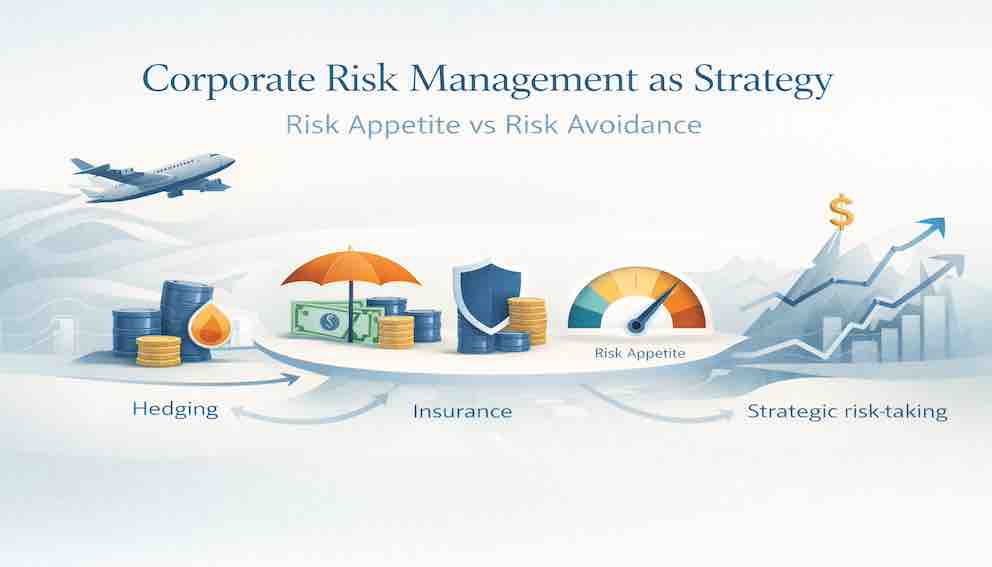
Strategic risk management is not about minimizing risk—it's about optimizing it for value creation. This tutorial introduces the "Risk Strategy Matrix," a framework for classifying risks as either Core (to be managed for advantage) or Non-Core (to be hedged or transferred). Through the lens of capital allocation, we examine how companies like Southwest Airlines use hedging to protect their business model, how a mining company decides between hedging and speculation, and why FX risk management enables global growth. You will learn that disciplined risk-taking creates strategic optionality, turning volatility from a threat into a tool for competitive advantage.
Introduction: Risk as a Resource to be Allocated
In corporate finance, we treat capital, time, and talent as scarce resources to be allocated deliberately. Risk is no different. It is not an external force to be feared, but a fundamental input in the value creation process. The question is not "how do we avoid risk?" but "how do we allocate our risk budget to maximize long-term value?"
Ineffective companies see all risk as a hazard to be minimized. Strategic companies analyze their risk profile with the same rigor they apply to an acquisition or capex budget. They distinguish between risks that are central to their competitive advantage (and should be managed for gain) and risks that are incidental (and should be eliminated). This deliberate approach to risk directly enables smarter capital allocation, protecting cash flows that can be deployed for growth. This tutorial provides the framework for making that distinction and deploying the right tools—hedging, insurance, and strategic risk-taking—to execute your strategy with confidence.
The Risk Strategy Matrix: Core vs. Non-Core Risks
The first step in strategic risk management is categorization. Not all risks are created equal. We can use a simple 2x2 matrix to guide capital allocation toward risk:
1. Core Strategic Risks: These are risks inherent to your business model and source of competitive advantage. You want exposure to these. For an oil exploration company, the risk of not finding oil is core. For a tech startup, the risk that a new product fails is core. The goal is not to hedge these away, but to manage them for superior returns through expertise, information, and operational excellence. Allocating capital here is an investment in your franchise.
2. Non-Core (Financial/Incidental) Risks: These are risks you bear as a byproduct of doing business but which provide no competitive advantage. For an airline, jet fuel price volatility is a non-core risk; their advantage is in routing and service, not predicting oil markets. For a U.S. exporter, the EUR/USD exchange rate is non-core. The goal is to hedge, transfer, or minimize these risks as efficiently as possible to protect profitability and free up management focus.
The Capital Allocation Link: Your "risk budget" should be heavily weighted toward Core Risks. Capital and management attention spent mitigating Non-Core risks is wasted; it should be spent on instruments that transfer that risk cheaply (e.g., futures contracts, insurance), freeing resources to double down on Core Risks where you have an edge.
Hedging Non-Core Risks: Protecting the Business Model & Enabling Investment
Hedging is the strategic elimination of Non-Core risks. It is a capital allocation decision: we spend a known, small cost (the hedge premium) to avoid a potentially large, uncontrollable loss. This directly stabilizes cash flow, which is the lifeblood of corporate strategy.
Stable, predictable cash flows enable three critical financial advantages:
- Debt Capacity: Lenders offer better terms to companies with lower earnings volatility.
- Investment Certainty: Management can approve long-term capital projects (new factories, R&D) without fear that a price swing will render them unprofitable.
- Strategic Optionality: Preserved capital creates a "war chest" for opportunistic acquisitions or market expansions during downturns.
Case Study: Southwest Airlines – The Quantifiable Advantage
In the mid-2000s, Southwest Airlines famously hedged a large portion of its jet fuel. Consider a simplified, illustrative scenario:
- Annual Fuel Need: 1.5 billion gallons
- Hedged Price: Locked in at $1.50/gallon
- Market Price Spike: Rises to $2.00/gallon
The Outcome:
- Cost Without Hedge: 1.5B gallons * $2.00 = $3.0 Billion
- Cost With Hedge: 1.5B gallons * $1.50 = $2.25 Billion
- Cash Flow Saved: $750 Million
This $750 million wasn't just "saved." It was capital reallocated. Southwest used this cash flow advantage to undercut competitors on fares, expand its route network, and maintain profitability while rivals were crippled. They turned a Non-Core risk (oil prices) into a source of competitive advantage by hedging it perfectly.
Sophisticated Risk Transfer: Insurance, Self-Insurance, and Layered Strategies
For catastrophic or operational risks, the tools are insurance and self-insurance. The choice between them is a pure cost-of-capital calculation.
- Insurance: Pay a predictable premium to transfer a severe, low-probability risk (e.g., total factory loss). This protects the balance sheet from a knockout blow.
- Self-Insurance: Retain smaller, more frequent risks internally (e.g., a deductible on vehicle fleets). This is cheaper than paying an insurer's overhead and profit margin.
Advanced Strategy: Layered Risk Transfer
Sophisticated firms don't just choose one tool. They create a layered strategy for Non-Core risks.
- Layer 1 (Self-Insure): Retain the first $1 million of any potential cyberattack loss.
- Layer 2 (Insurance): Transfer the next $25 million of risk to an insurer via a premium.
- Layer 3 (Catastrophe Bond): For a "tail risk" beyond $26 million, use a capital markets instrument.
This layered approach minimizes total cost while providing comprehensive protection, optimizing the capital spent on risk transfer.
Strategic Risk-Taking on Core Risks: The Engine of Growth
This is the flip side of the matrix. Once Non-Core risks are hedged or transferred, a firm can and should consciously increase its exposure to Core Strategic Risks. This is how asymmetric returns and growth are achieved.
Example: A Mining Company's Capital Allocation
A copper miner's core competency is finding and efficiently extracting ore. The market price of copper is a Non-Core Risk—it is set by global macro forces. A disciplined miner would use futures contracts to hedge next year's production, locking in a price that ensures its mines meet their return hurdles.
The capital preserved and certainty gained from this hedge is then deployed toward the Core Risk: funding new exploration projects. The company is strategically taking on geological risk—where it has expertise—while eliminating commodity price risk—where it has none. An undisciplined miner might gamble on copper prices instead, risking the entire company on a Non-Core bet.
The Global Perspective: FX Hedging as an Enabler
For multinational corporations, foreign exchange (FX) risk is a quintessential Non-Core risk. A U.S. company with a factory in Germany earns revenues in Euros but reports in Dollars. A weak Euro can wipe out the profitability of that operation, not due to poor management, but due to currency moves.
Strategic FX Management in Action:
A U.S. tech firm plans a €100 million investment in a European R&D center. The project has a 15% expected return in Euros. However, a 10% drop in the Euro versus the Dollar would erase most of that return.
- The Reactive Approach: Do nothing, hope currencies stay stable. The investment's returns become a gamble on FX.
- The Strategic Approach: Use currency forwards to lock in the EUR/USD exchange rate for the future Euro cash flows the center will generate. The cost of the hedge is a known expense. The payoff is certainty: the firm can approve the investment based solely on its operational merits, knowing FX volatility won't sabotage it. The hedge enables the Core Strategic investment.
Integration with Corporate Lifecycle and Capital Allocation
A firm's position on the Risk Strategy Matrix evolves with its lifecycle, directly dictating where capital and management focus should flow.
- Startup/Growth: Almost all risks are Core. Capital is allocated almost exclusively to strategic risk-taking (product development, market entry). There is little excess capital to hedge Non-Core risks; survival depends on winning Core bets.
- Maturity: The firm has stable cash flows. Non-Core risks (FX, input costs, liability) become material threats to the profit engine. This is the stage for systematic hedging and insurance to protect the core business. Freed-up certainty allows capital to be allocated to shareholder returns (dividends/buybacks) and carefully chosen new Core Risk ventures.
- Decline: The imperative shifts to capital preservation and harvesting. Strategic risk-taking shrinks. Hedging Non-Core risks becomes even more critical to ensure a predictable wind-down and maximize terminal value for stakeholders.
Conclusion: Creating Optionality Through Disciplined Risk Allocation
Strategic risk management is the discipline of allocating your risk budget to where you have an advantage. It requires the courage to take bold, concentrated bets on Core Risks—the risks that define your business—and the discipline to meticulously hedge away the Non-Core risks that merely create noise.
The ultimate goal is strategic optionality. By using hedging and insurance to create predictable financial outcomes, you buy the most valuable asset in business: the right, but not the obligation, to pursue future opportunities. You secure the balance sheet strength to invest in a downturn, the cash flow stability to finance a breakthrough R&D project, and the operational resilience to enter a new market.
A company that masters this does not just defend against uncertainty. It uses the certainty it manufactures in non-core areas as a stable platform. From this platform, it can deliberately leverage the uncertainty in its core, transforming risk from a pervasive cost of business into the definitive source of its competitive edge and the engine of its long-term value creation.
About Swati Sharma
Lead Editor at MyEyze, Economist & Finance Research WriterSwati Sharma is an economist with a Bachelor’s degree in Economics (Honours), CIPD Level 5 certification, and an MBA, and over 18 years of experience across management consulting, investment, and technology organizations. She specializes in research-driven financial education, focusing on economics, markets, and investor behavior, with a passion for making complex financial concepts clear, accurate, and accessible to a broad audience.
Disclaimer
This article is for educational purposes only and should not be interpreted as financial advice. Readers should consult a qualified financial professional before making investment decisions. Assistance from AI-powered generative tools was taken to format and improve language flow. While we strive for accuracy, this content may contain errors or omissions and should be independently verified.