
Tutorial Categories
Last Updated: January 31, 2026 at 19:30
Economic Profit, ROIC, and WACC: A Manager’s Guide to Value Creation and Strategic Capital Allocation - Corporate Finance Series
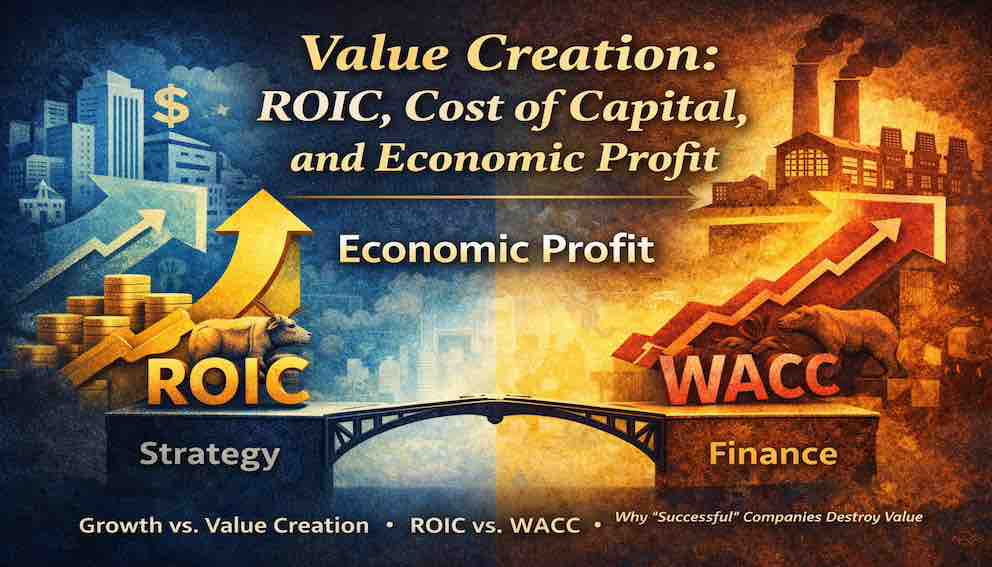
Every manager faces the same core challenge: with countless projects competing for limited capital, how do you identify which ones truly create shareholder value? This tutorial provides the answer. We move beyond simplistic profit metrics to establish ROIC (Return on Invested Capital), WACC (Weighted Average Cost of Capital), and Economic Profit as the fundamental operating system for strategic decision-making. Through practical frameworks and examples, you will learn how to calculate these metrics, use them to filter investment opportunities, and understand why a project can be "profitable" yet still destroy value. By the end, you'll have a disciplined, quantitative compass to guide capital allocation, prioritize initiatives, and build a business that generates sustainable wealth.
Introduction: The Search for a Reliable Scorecard
You have defined the objective: maximize long-term, risk-adjusted value. You've acknowledged the noise: stock prices offer imperfect signals. Now comes the critical operational question: How do we measure our progress toward that objective on a daily, quarterly, and annual basis?
Traditional metrics like earnings per share (EPS) or return on equity (ROE) are dangerously incomplete. They can be gamed through accounting choices, amplified by leverage, and often reward short-term actions that undermine the future. We need a measurement system that is directly wired to intrinsic value—one that is cash-flow focused, risk-aware, and capital-conscious. That system is built on three interconnected concepts: ROIC, WACC, and Economic Profit.
The Fundamental Equation: ROIC vs. WACC
Value creation is not about absolute profit; it’s about profit relative to the capital employed and its risk.
- Return on Invested Capital (ROIC) measures how efficiently a company converts its invested capital into operating profit.
- Formula: ROIC = NOPAT / Average Invested Capital
- NOPAT = Net Operating Profit After Tax (the after-tax profit from core operations, excluding financing costs).
- Invested Capital = Net Working Capital + Net Fixed Assets (the total capital tied up in the business).
- Think of it as: The unlevered, pre-financing return the business earns on its total asset base.
- Weighted Average Cost of Capital (WACC) represents the minimum acceptable return for all capital providers (debt and equity holders), weighted by their proportion in the capital structure. It is the opportunity cost of capital—the rate investors could expect to earn by investing in other assets of comparable risk.
- Think of it as: The company's "rent" on the capital it uses.
The single most important rule in corporate finance emerges from their comparison:
If ROIC > WACC, the firm is creating value. If ROIC < WACC, it is destroying value, regardless of how much accounting profit it reports.
This spread—the difference between ROIC and WACC—is the engine of shareholder wealth creation.
Market Noise vs. Credible Signals: The Manager's Decoder Ring
The market's price signal is a blend of three inputs: Fundamental Value, Noise, and Sentiment. Your ROIC/WACC framework is the tool to decode it.
- The Marginal Investor Sets the Price: The market price reflects the valuation of the next buyer or seller at the margin—often a sophisticated institutional investor. A price decline driven by short-term algorithmic trading is noise. A decline driven by a long-term fundamental investor selling a large position is a credible signal that warrants immediate investigation: has this investor identified a threat to our future ROIC or a rise in our risk profile (WACC) that we have missed?
- Market Efficiency is a Spectrum: Markets quickly price simple data (earnings beats) but digest complex strategic shifts slowly. This "friction" is where narratives flourish and where your internal compass is essential. A falling price during a long-term transformation may be noise (impatience) if your ROIC/WACC trajectory remains intact, or a signal (skepticism) if your plan lacks credibility.
- The Peril of Overvaluation: A high stock price is seductive but dangerous. It represents elevated expectations for future ROIC. Using overvalued stock as "cheap currency" for acquisitions often destroys value when the market recalibrates (e.g., Cisco in 2000). The disciplined question is always: "Does this acquisition target's ROIC exceed our WACC, and can we integrate it without diluting our own?" The market's optimism is not a strategy.
Investor Relations as a Strategic Lever to Protect Value
A firm's Investor Relations (IR) function is not a publicity desk; it is a strategic lever to actively manage WACC and align market price with intrinsic value. A proactive IR strategy:
- Reduces the Cost of Capital (WACC): By clearly communicating business model resilience and capital discipline, IR lowers the perceived risk among debt and equity holders, directly reducing the risk premium embedded in WACC.
- Translates Value Drivers: IR articulates how operational initiatives (e.g., a new technology investment) link to future ROIC improvement, helping the market price the firm on fundamentals rather than narratives.
- Filters Noise: By maintaining consistent dialogue with the marginal investor, IR can distinguish transient selling pressure from a genuine loss of confidence, informing management's response.
Effective IR doesn't just report results; it manages the critical input of perceived risk in your valuation equation.
From Measurement to Action: The Capital Allocation Filter
This framework transforms from a scorecard into a decision-making filter for all capital allocation:
The Rule: Any new investment or project should only be undertaken if its expected Return on New Invested Capital (RONIC) exceeds the WACC. This ensures every incremental dollar of capital creates positive Economic Profit.
Case Study: The "Profitable" Expansion Trap
A retail chain is considering a store expansion. The project requires $10 million in capital. The finance team projects it will add $1.2 million in annual NOPAT—a seemingly attractive 12% return.
- Superficial Analysis: "12% is a good return. Let's approve it."
- Value-Creation Analysis: The company's WACC is 9%. The project's RONIC (12%) > WACC (9%). Economic Profit = $1.2M - ($10M × 9%) = $300,000. The project creates value and should be approved.
Now, change one variable: Interest rates rise, and the company's WACC increases to 13%.
- New Analysis: RONIC (12%) < WACC (13%). Economic Profit = $1.2M - ($10M × 13%) = -$100,000. The same project now destroys value. The "good return" is illusory because it fails to clear the higher hurdle rate. A manager using EPS or simple ROI would miss this critical shift.
This filter applies to everything: R&D projects, marketing campaigns, acquisitions, and new equipment. It forces discipline by explicitly charging for capital.
The Strategic Implications: What Drives ROIC and WACC?
Understanding the drivers turns finance from a policing function into a strategic tool.
Drivers of ROIC (The Numerator):
- Pricing Power & Value to Customer: Can you charge a premium?
- Operational Efficiency: Cost structure and asset turnover.
- Sustainable Competitive Advantage: The moat that protects high returns.
- A strategy that doesn't articulate how it will improve or defend ROIC is not a complete financial strategy.
Drivers of WACC (The Hurdle):
- Business Risk: Volatility of the firm's underlying cash flows (operating leverage, cyclicality).
- Financial Risk: The amount of debt in the capital structure (leverage).
- Market Conditions: The risk-free rate and overall equity risk premium.
- Managers influence WACC through their choice of capital structure and by communicating clearly with investors to reduce perceived risk.
The Bridge to Valuation and Shareholder Wealth
This internal framework is directly wired to the firm's market value and long-term wealth creation.
- The Valuation Link: A firm's value can be modeled as its current invested capital plus the present value of its future Economic Profit. Sustained positive Economic Profit (ROIC > WACC) is what drives market value above book value. A company trading at a low price-to-book multiple is often one the market expects will generate ROIC at or below its WACC.
- The Reinvestment Flywheel: The sustainable growth rate in value is a function of the ROIC/WACC spread and the reinvestment rate. A firm with a high positive spread (ROIC >> WACC) that reinvests heavily accelerates value creation. A firm with a narrow or negative spread destroys more value the faster it grows.
- Long-Term Capital Budgeting: This framework scales from a single project to the entire corporate strategy. The strategic plan should be a portfolio of initiatives, each vetted on its RONIC vs. WACC, whose aggregate effect is to elevate the firm's overall ROIC profile over the planning horizon.
Conclusion: Your Operating System for Value
ROIC, WACC, and Economic Profit are not just finance department metrics. They are the core operating system for any manager entrusted with capital. This system provides:
- A Universal Yardstick: It compares disparate projects (marketing vs. factories) on a consistent, value-based basis.
- A Defense Against Illusion: It exposes "profitable" projects that destroy wealth and highlights value-creating activities that simpler metrics overlook.
- Strategic Clarity: It forces strategy to be expressed in terms of competitive advantage (ROIC) and risk management (WACC).
- A Market Decoder: It equips you to distinguish market noise from fundamental signals, and to understand the true meaning—and danger—of a high stock price.
- A Bridge to Valuation: It directly links day-to-day decisions to the drivers of long-term shareholder wealth.
Embrace this framework. Let it be the filter for every investment proposal, the scorecard for every division, and the foundation of every strategic plan. In a world of noise, narratives, and uncertainty, it is your most reliable guide to building genuine, durable value.
About Swati Sharma
Lead Editor at MyEyze, Economist & Finance Research WriterSwati Sharma is an economist with a Bachelor’s degree in Economics (Honours), CIPD Level 5 certification, and an MBA, and over 18 years of experience across management consulting, investment, and technology organizations. She specializes in research-driven financial education, focusing on economics, markets, and investor behavior, with a passion for making complex financial concepts clear, accurate, and accessible to a broad audience.
Disclaimer
This article is for educational purposes only and should not be interpreted as financial advice. Readers should consult a qualified financial professional before making investment decisions. Assistance from AI-powered generative tools was taken to format and improve language flow. While we strive for accuracy, this content may contain errors or omissions and should be independently verified.