
Tutorial Categories
Last Updated: January 31, 2026 at 19:30
Capital Allocation in Mature Companies: When Growth Slows and Returning Cash Becomes the Smartest Decision - Corporate Finance Series
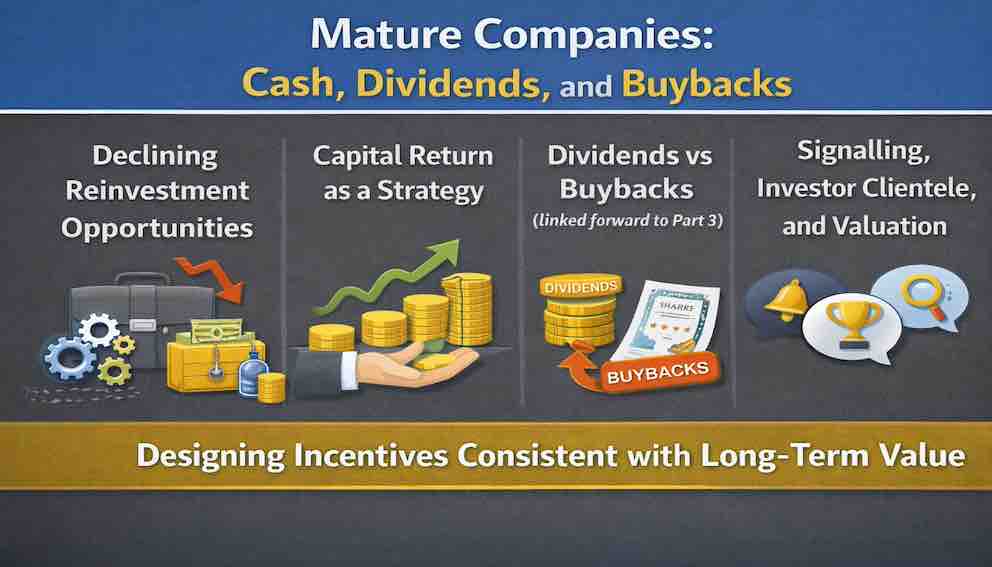
For a mature company, the most disciplined decision is often to stop reinvesting. This tutorial explores the final stage of the capital allocation lifecycle, where the core challenge shifts from finding growth to admitting when profitable growth has ended. We introduce the "Capital Return Dashboard," a practical framework that forces management to choose returning cash over value-destroying investments. Using stark contrasts between companies like Procter & Gamble and Kraft Heinz, you will learn the strategic calculus behind dividends and buybacks, how payout policy signals financial health, and why returning capital is not a sign of failure, but the hallmark of a confident, shareholder-focused steward. By the end, you'll understand that giving money back can be the highest-value activity a company can undertake.
Introduction: The Final Exam of Capital Discipline
Our series has followed the arc of corporate life. First came The Founder's Calculus, a fight for survival where capital was scarce and optionality was everything. Then, The Scaling Calculus, a race for value-accretive growth where discipline separated the winners from the cash-burners.
Now we arrive at maturity. The furious growth has slowed, markets are saturated, and the business generates torrents of cash. This presents the ultimate test of managerial discipline: What do you do when you can't reinvest your profits at an attractive return?
The flawed, intuitive answer is to reinvest anyway—to chase new markets, overpay for acquisitions, or build empires. The correct, disciplined answer is often to return the capital to its owners. This tutorial provides the framework for making that difficult, correct choice.
The Unavoidable Reality: The Fade of High-ROIC Opportunities
No company can maintain sky-high returns on invested capital forever. It's not a failure of management; it's the law of large numbers and competitive markets. A startup can double its revenue by landing one big client. A global consumer goods giant must spend billions to move the needle a few percentage points.
The critical metric shifts from overall ROIC to Return on New Invested Capital (RONIC). This is the return projected for the next dollar to be reinvested in the business. The defining question for a mature company becomes:
"Does our next best internal investment opportunity have a RONIC that exceeds our Weighted Average Cost of Capital (WACC)?"
This is the core discipline. Of course, both RONIC and WACC are estimates, not observed facts. RONIC is a forecast shrouded in uncertainty, and WACC is a range reflecting market risk. The rigor lies in making these estimates with intellectual honesty, not in pretending they are precise.
Example: The "Strategic" Factory Upgrade
A mature automaker debates a $1 billion upgrade to a factory. The finance team, using conservative assumptions, projects a RONIC of 6%. The company's estimated WACC is 8%.
- The Imperial CEO: "Your model is too pessimistic. This is strategic for our future!" Result: A $1B bet on hope, violating the discipline of the hurdle rate.
- The Disciplined Steward: "6% is below our 8% hurdle. We will not approve based on optimism. Show us a cheaper redesign that hits 9%, or we allocate the capital elsewhere." The framework forces decisions based on evidence, not narrative.
A Critical Distinction: Defensive vs. Surplus Capital
A crucial nuance must be addressed to avoid misinterpretation. The RONIC vs. WACC framework applies to surplus capital—cash available after funding all necessary expenditures to keep the business healthy.
Mature companies have two types of investment:
- Defensive (Maintenance) Capital: Spending required to sustain the current cash-generating capacity of the core business. This includes essential maintenance, regulatory compliance, cybersecurity, and brand-preserving marketing. This spending is not optional. It is the cost of staying in business and is funded before any "surplus" exists.
- Surplus (Growth/Expansion) Capital: Cash available after defensive needs are met, earmarked for new initiatives, acquisitions, or returns to shareholders.
The Capital Return Dashboard, and the entire logic of this tutorial, assumes the company is first and foremost a responsible operator, fully funding its defensive needs. The question of returning capital applies only to the true surplus that remains. Starving the core business to pay dividends is the opposite of discipline; it is liquidation.
The Capital Return Dashboard: A Decision-Making Framework
Faced with true surplus cash, management needs a disciplined process. The Capital Return Dashboard provides that process—a forced ranking of options based on strict value criteria.
The Dashboard Protocol:
- Step 1: Fund All High-ROIC Internal Projects. Every project with a credible RONIC > WACC gets funded first.
- Step 2: Consider Strategic Acquisitions. Only if a target can be bought at a price where its post-synergy ROIC > your WACC.
- Step 3: Fortify the Balance Sheet (If Needed). In uncertain times, strengthening liquidity can have a high implied return by avoiding distress.
- Step 4: Return Capital to Shareholders. This is the default, value-creating choice if, and only if, the first three options do not clear their hurdles.
This dashboard transforms capital allocation from a narrative-driven debate into a rule-based system. It makes returning capital the logical outcome of rigorous analysis, not a last resort.
Case Study: Discipline vs. Delusion – P&G vs. Kraft Heinz
The starkest lessons come from contrasting corporate destinies.
| Aspect | Procter & Gamble (The Disciplined Steward) | Kraft Heinz (The Imperial Delusion, Pre-2019) |
| Core Reality | Mature, cash-cow brands in stable markets. | Mature, cash-cow brands in stable markets. |
| Response to Maturity | Accepted the RONIC fade. Used the Dashboard. | Denied it. Pursued growth at any cost. |
| Capital Strategy | Aggressively returned surplus capital. Over $150 billion in dividends & buybacks in a decade. | Loaded up on debt to fund a massive, "transformative" acquisition, while slashing defensive brand investment. |
| Reinvestment Quality | Targeted innovation; strict RONIC hurdle. | Brutal cost-cutting masquerading as investment (destroying brand equity). |
| Signaling | Dividend as a signal of permanent, dependable cash flow. | Leverage and under-investment signaled desperation and decline. |
| Result | Became a bedrock "widow-and-orphan" stock. Lowered cost of capital, rewarded loyal shareholders. | The RONIC of the acquisition was negative. Dividend slashed 36% in 2019, $15 billion write-down, massive value destruction. |
The Lesson: P&G respected the math of maturity. Kraft Heinz tried to defy it. The market rewards disciplined stewards and punishes imperial delusion.
Dividends vs. Buybacks: A Strategic Choice, Not a Toss-Up
Both return cash, but they are different tools for different jobs. Choosing the right one is a core strategic decision.
| Condition | Favors a Dividend | Favors a Buyback |
| Primary Signal | "Our excess cash flow is permanent and predictable." | "We believe our stock is significantly undervalued right now." |
| Valuation Context | Stock price is at or above fair value. | Stock price is below intrinsic value (a margin of safety exists). |
| Investor Clientele | Attracts and rewards long-term, income-focused shareholders. | Directly benefits continuing shareholders in a tax-efficient way. |
| Flexibility | Low. A cut is a catastrophic signal. | High. Can be turned on/off opportunistically. |
Example: Apple's Masterclass in Tool Selection
- 2012: After hoarding cash, Apple initiated a dividend. Signal: "Our explosive growth is maturing into durable, generational cash flow."
- 2013-Present: Apple launched history's largest buyback program, accelerating it when the stock dipped. Signal: "We believe our market consistently undervalues our ecosystem's strength. Repurchases are our highest-RONIC activity."
- Apple used both tools deliberately for different strategic objectives within its Dashboard.
The Perils of Getting It Wrong: The "Cocaine of EPS"
A critical warning must be heeded: buybacks can be dangerously misused. When a company with a stagnant business borrows cheap debt to repurchase shares, it creates an addictive illusion—the "Cocaine of EPS."
The Mechanics of the Illusion:
Fewer shares outstanding + same earnings = Higher Earnings Per Share (EPS).
This can trigger executive bonuses and briefly please the market, all while the underlying business erodes and leverage increases.
The Hall of Shame: Throughout the 2010s, countless large firms used cheap debt for buybacks, artificially inflating EPS while under-investing in their businesses. When interest rates rose and growth stalled, they were left with weaker competitive positions and heavier debt loads—a recipe for value destruction. This is financial engineering, not value creation. A buyback is only virtuous if funded from true surplus cash and executed when the stock is cheap.
The Steward's Creed: Humility, Trust, and the Cost of Capital
The journey from founder to steward ends with a creed of humility. The mature company's leader must have the confidence to say: "We will not waste your money." This commitment does more than return cash; it systematically lowers the company's cost of capital, creating a virtuous cycle.
Here’s the mechanism:
- Predictable Dividends reduce the equity risk premium investors demand, because stable payouts imply lower business risk.
- Credible, Opportunistic Buybacks reduce perceived agency risk—the fear that management will hoard or misuse cash—because they demonstrate capital discipline.
- Together, these policies attract a stable, long-term shareholder base. This reduces stock price volatility and the risk of forced selling during downturns, further cementing a lower cost of capital.
This is the hidden lever of mature-stage finance. While growth companies create value by boosting the numerator (cash flows), mature companies can create immense value by minimizing the denominator (the discount rate). Disciplined capital return is the primary tool for this task. It builds trust, and the market pays for trust with a lower cost of capital and a higher valuation.
Conclusion: The Final, and Most Important, Calculus
The Return of Capital is the final, and perhaps most important, calculus. It requires the courage to defy the cult of growth and the wisdom to see that a company's greatest service can be to gracefully step aside and recycle capital to where it can be more productive.
Mastering this stage means internalizing that:
- RONIC is the Final Arbiter: For surplus capital, if the credible estimate is below WACC, do not reinvest.
- The Dashboard is Your Guide: It provides the discipline to choose returning capital over value-destructive alternatives.
- Signaling is Strategic: Dividends and buybacks send powerful messages; choose the tool that matches your reality.
- Stewardship Builds Value: Discipline doesn't just return cash; it builds the trust that lowers your cost of capital, compounding value for decades.
In the end, the mature company that excels at returning capital doesn't signal its journey is over. It signals it has finally learned the most valuable lesson of all: how to finish well.
About Swati Sharma
Lead Editor at MyEyze, Economist & Finance Research WriterSwati Sharma is an economist with a Bachelor’s degree in Economics (Honours), CIPD Level 5 certification, and an MBA, and over 18 years of experience across management consulting, investment, and technology organizations. She specializes in research-driven financial education, focusing on economics, markets, and investor behavior, with a passion for making complex financial concepts clear, accurate, and accessible to a broad audience.
Disclaimer
This article is for educational purposes only and should not be interpreted as financial advice. Readers should consult a qualified financial professional before making investment decisions. Assistance from AI-powered generative tools was taken to format and improve language flow. While we strive for accuracy, this content may contain errors or omissions and should be independently verified.