
Tutorial Categories
Last Updated: February 13, 2026 at 19:30
Incentives, Compensation, and Misaligned Decisions: How Reward Structures Shape Financial Behavior and Organizational Outcomes
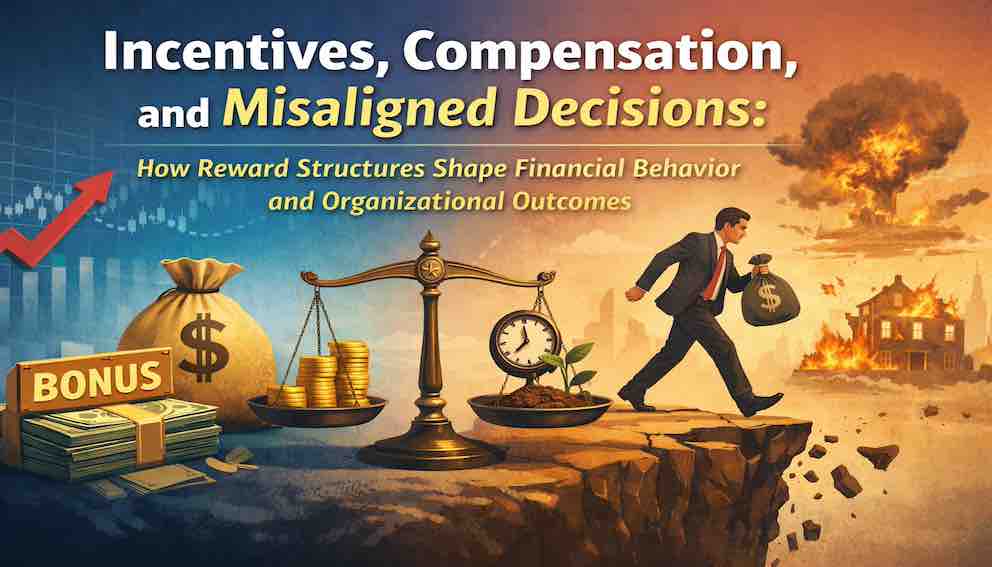
In this tutorial, we explore how incentive structures and compensation systems shape behavior in finance and business. From CEO stock options to trader bonuses and mortgage originator commissions, incentives determine the risks people take, the decisions they prioritize, and the time horizons they consider. We examine how misaligned incentives create agency problems, amplify cognitive biases, and encourage short-term thinking at the expense of long-term value. You will learn practical principles for designing incentive systems that align individual behavior with sustainable organizational outcomes. Through stories, real-world examples, and actionable takeaways, we reveal why what you reward is ultimately what you get.
Introduction: Why Incentives Matter in Finance
In our previous tutorials, we explored the ways human psychology shapes financial decision-making. Concepts like overconfidence, loss aversion, anchoring, and herding explain why even intelligent, well-informed people make predictable mistakes. Yet, while biases influence perception, they do not fully account for why people in organizations act in ways that sometimes contradict long-term interests.
Incentives bridge this gap between individual cognition and organizational outcomes. They are the signals embedded in compensation structures, performance metrics, and promotion criteria that guide what individuals prioritize and how they allocate their attention and effort. Simply put, incentives tell people what is rewarded—and human beings, even the most principled, naturally respond to what is rewarded.
This tutorial explores how incentive systems operate, why they often produce unintended consequences, and how thoughtful design can align behavior with long-term value. We will examine stories from auto mechanics to mortgage originators, traders, and executives, and highlight principles that organizations can adopt to reduce misalignment.
The Mechanic and the Bonus: How Incentives Reshape Perception
Let us start with a simple example that illustrates the subtle power of incentives.
Imagine a mechanic who is paid a flat hourly wage. He diagnoses problems carefully, recommends only necessary repairs, and takes pride in his work. Customers trust him.
Now, the shop owner changes the compensation system. The mechanic receives a commission on every repair he sells—20% of labor charges, 10% of parts markup.
What happens next?
- The mechanic does not become dishonest overnight.
- He does not consciously decide to defraud his customers.
Instead, his perception shifts. A belt that could wait six months now seems urgent. Slightly discolored fluid now requires immediate replacement. A noise he once ignored now seems critical.
Within months, he genuinely believes these repairs are necessary. His behavior has changed, and so has his judgment. The incentive does not merely reward certain actions—it reshapes how he interprets reality.
Takeaway: Incentives are powerful enough to change not just behavior, but perception and belief.
Agency Problems: When Principals and Agents Diverge
In organizations, incentive misalignment is formalized in what economists call the agency problem.
- Principals are the people who bear ultimate consequences. Shareholders, for example, own the company and bear its financial risks.
- Agents are the people who make decisions on behalf of the principals: CEOs, fund managers, loan officers, traders.
The agency problem arises when agents’ incentives do not perfectly align with the principals’ objectives. Even virtuous agents will act according to the rewards and penalties communicated by their environment.
Examples of misalignment:
- If customer satisfaction is emphasized verbally but bonuses are tied to sales volume, employees prioritize sales.
- If risk management is critical but traders are compensated solely on profit without risk adjustment, they ignore risk.
- If long-term value is the goal but stock options vest in three years, executives optimize within the three-year window.
Lesson: What you reward is what you get. Misalignment is rarely malicious—it is structural.
Stock Options: Alignment or Addiction?
Stock options illustrate how well-intentioned incentives can produce perverse outcomes.
The theory:
In the 1980s and 1990s, executives often had high salaries and bonuses unrelated to performance. Reformers introduced stock options to align CEO wealth with shareholder value. If the stock price rose, so would the CEO’s wealth.
The practice:
- Executives found it faster and more reliable to increase stock price through earnings management or financial engineering rather than long-term investment.
- Options create asymmetric incentives: upside participation with little downside risk encourages excessive risk-taking.
- Vesting periods of three years emphasize short-term performance over sustainable growth.
Lesson: Incentives must be designed with attention to time horizons, risk, and behavior, not just theoretical alignment. Stock options can align interests but, without constraints, they amplify perverse behavior.
Practical Tip: Use long vesting periods, holding requirements, and clawbacks. Separate rewards for stock price appreciation from true value creation.
Traders and Asymmetric Rewards
Traders’ compensation often highlights risk-taking incentives:
- Bonuses are linked to profits.
- Losses affect the bank, not the trader.
- This creates a one-way bet: the upside is theirs, the downside belongs to others.
This is rational behavior in response to perverse incentives, not greed. Deferred compensation and clawbacks can reduce, but not eliminate, this asymmetry.
Broader Insight: Any agent whose compensation is tied to outcomes they cannot fully control—and whose downside is limited—faces similar incentives. Venture capitalists, private equity partners, and fund managers all operate under comparable structures.
Takeaway: Risk-taking is essential for growth, but asymmetry must be managed to avoid systemic harm.
Mortgage Originators and the 2008 Financial Crisis
The 2008 crisis vividly illustrates how incentives shape behavior at scale:
- Traditionally, banks held loans on their balance sheets, so they had every incentive to underwrite carefully.
- Pre-crisis, banks sold loans to investors, and officers were paid based on origination volume, not quality.
- Loans that defaulted after sale imposed no cost on the officer, only on investors.
Result: sloppy underwriting, high-risk loans, and widespread defaults.
Lesson: Incentives drive behavior even when agents know the long-term consequences are negative.
Rating Agencies and Conflicts of Interest
Rating agencies provide another example:
- Initially, investors(buyers of bonds) paid for ratings, aligning incentives to produce accurate ratings.
- Later, issuers(issuers of mortgage backed securities) paid for ratings. Analysts were now embedded in a structure where favorable ratings maintained client revenue and repeat business for analysts.
- The indirect incentive produced systematically inflated ratings, contributing to the global crisis.
Lesson: Incentive misalignment can be subtle and embedded in business models, yet still have enormous consequences.
The Paradox of Pay for Performance
Rewarding performance is inherently tricky:
- Measuring performance changes behavior.
- Teachers rewarded for test scores teach to the test.
- Fund managers rewarded for annual returns may increase risk, trade excessively, or window-dress portfolios.
- Executives rewarded for earnings per share may reduce long-term investment or manipulate accounting.
Key Insight: Performance-based compensation requires humility in design, diversity of metrics, and continuous monitoring.
Principles for Better Incentive Design
We can design more aligned incentive systems by following six key principles:
1. Measure What Matters, Not Just What Is Measurable
- Avoid over-reliance on easily quantifiable metrics.
- Supplement formulaic measures with qualitative assessment and judgment.
- Practical example: Evaluate executives not only on EPS but also on long-term strategic progress.
2. Align Time Horizons
- People discount the future more than organizations should.
- Deferred compensation, restricted stock, and clawbacks lengthen horizons.
- Tip: Vesting periods and multi-year bonus structures give exposure to long-term consequences.
3. Incorporate Risk Adjustment
- Raw returns do not capture risk.
- Consider volatility, leverage, and tail risk.
Example: Bonuses reduced if trading positions generate outsized tail risk exposure. In practice, this means that a trader’s compensation would not depend solely on the profits generated during the year, but also on the level of extreme downside risk embedded in the positions that produced those profits. Tail risk refers to the possibility of rare but severe losses that occur in extreme market conditions—events that may not show up in ordinary volatility measures but can cause catastrophic damage when they materialize. Under a risk-adjusted compensation system, if a trader earns high returns by concentrating the portfolio in highly leveraged or illiquid positions that would suffer disproportionately in a market shock, a portion of the bonus would be reduced or deferred to reflect that embedded vulnerability.
4. Avoid Asymmetric Rewards
- Ensure participation in downside as well as upside.
- Approaches: deferred compensation, clawbacks, bonus pools reduced for losses.
- Tip: Symmetry need not be perfect but should reduce the “upside-only” incentive effect.
5. Diversify Metrics
- A single metric is always gamed.
- Use a portfolio of measures: financial, non-financial, short-term, long-term, quantitative, qualitative.
- Tip: Balanced scorecards are effective for multi-dimensional evaluation.
6. Monitor and Adjust
- No system is perfect initially.
- Track behavior, not just outcomes.
- Tip: Review loan origination patterns, trading behavior, and investment decisions quarterly to detect perverse incentives early.
Incentives and Cognitive Biases
Incentives interact with human psychology:
- Overconfidence amplifies risk-taking.
- Loss aversion can encourage risky late-year trades to avoid bonus reduction.
- Herding is strengthened when relative performance drives rewards.
Design must anticipate behavioral tendencies to create robust, real-world systems.
Conclusion: Designing for Alignment, Not Perfection
Incentives are the hidden architecture of organizational behavior. They translate objectives into action.
- The agency problem is universal; perfect alignment is impossible.
- Metrics can be gamed, targets create perverse behavior, rewards reshape perception.
- Historical failures—stock options, mortgage commissions, issuer-pays ratings—demonstrate the consequences of misaligned incentives.
The solution is humility, monitoring, diversity, and adjustment. Incentive systems are among the most powerful tools for shaping behavior. They can be improved, and with thoughtful design, they can promote sustainable, aligned decision-making. The aware organization is not perfect—it is capable of detecting and correcting incentive-driven errors before they produce systemic harm.
Takeaway: What you reward is ultimately what you get. Design thoughtfully, monitor continuously, and adjust relentlessly.
About Swati Sharma
Lead Editor at MyEyze, Economist & Finance Research WriterSwati Sharma is an economist with a Bachelor’s degree in Economics (Honours), CIPD Level 5 certification, and an MBA, and over 18 years of experience across management consulting, investment, and technology organizations. She specializes in research-driven financial education, focusing on economics, markets, and investor behavior, with a passion for making complex financial concepts clear, accurate, and accessible to a broad audience.
Disclaimer
This article is for educational purposes only and should not be interpreted as financial advice. Readers should consult a qualified financial professional before making investment decisions. Assistance from AI-powered generative tools was taken to format and improve language flow. While we strive for accuracy, this content may contain errors or omissions and should be independently verified.