
Tutorial Categories
Last Updated: February 14, 2026 at 10:30
Financial Management in Startups and High-Growth Firms: Runway, Burn Rate, Optionality, and Strategic Discipline
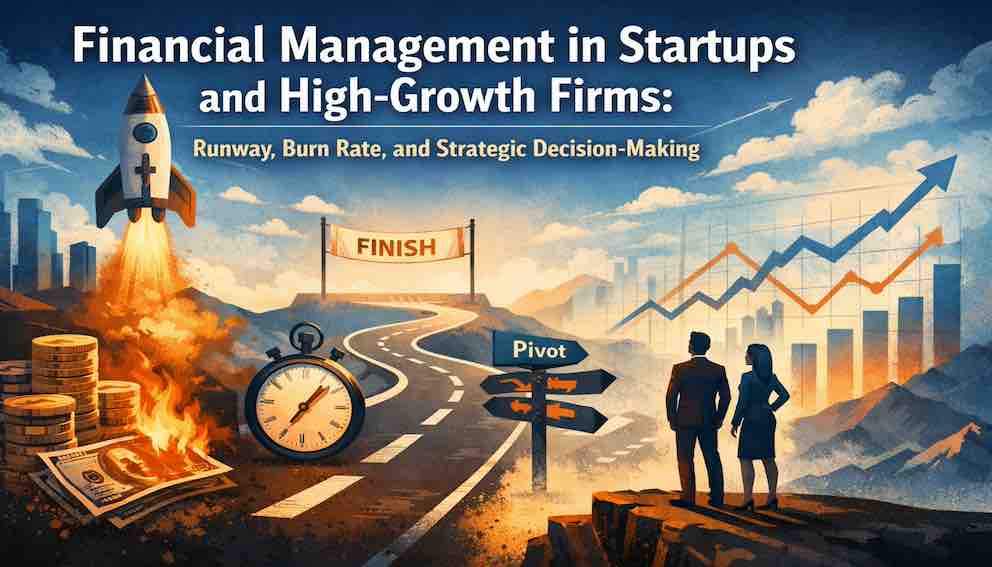
Imagine two climbers attempting the same mountain. One carries a heavy load of supplies and moves slowly, while the other carries only essentials and can pivot when the weather shifts. Startups are like the second climber, navigating uncertainty with speed, flexibility, and careful resource allocation. This tutorial explores the central concepts of startup finance—runway, burn rate, optionality, and staged financing—and explains why traditional metrics often fail in early-stage companies. Through vivid examples, we will see how founders balance survival with growth, align incentives, and make ethical, high-stakes financial decisions. By the end, you will understand that startup financial management is not a smaller version of corporate finance, but a distinct discipline that requires judgment, adaptability, and courage.
Introduction: A Different Financial Landscape
In established companies, financial management is guided by predictability. Managers rely on historical data to forecast revenue, measure unit economics, and calculate optimal capital structure. Cash flows are often stable, and the focus is on efficiency, risk management, and incremental optimization.
Startups live in a different world. They have no operating history, speculative unit economics, and revenue that is aspirational rather than assured. Decisions about spending, hiring, and investment carry existential weight. Premature optimization can lead to overcommitment of resources, while excessive experimentation without discipline can quickly burn precious cash.
The central tension for founders is balancing the discipline required to survive with the flexibility required to discover a viable business model. Financial management in startups is therefore not just about numbers—it is about judgment, foresight, and adaptability under uncertainty.
The Story of Two Founders
To illustrate the difference between corporate finance and startup finance, consider two founders starting technology startups.
Founder A: A former CFO in a manufacturing firm. She builds a detailed five-year forecast, hires full-time staff for every function, negotiates long-term leases, and raises capital to fund eighteen months of operations. She applies the frameworks she mastered in corporate life, expecting that structured planning ensures stability.
Founder B: A former product manager in a tech company. He raises just enough capital to reach the next milestone, rents coworking space by the month, and hires contractors to maintain flexibility. He embraces experimentation, knowing that assumptions will change and some investments may fail.
Eighteen months later, Founder A has exhausted her funding. Forecasts were wrong, leases are liabilities, and layoffs are unavoidable. Founder B, meanwhile, has completed several funding rounds, scaled carefully, and used mistakes as learning opportunities without threatening survival.
This is not about intelligence or experience. It is about understanding the environment and applying the right tools for the right context. Corporate finance frameworks can be deadly when misapplied in high-uncertainty startups.
Runway: Measuring the Distance to Extinction
Runway is the amount of time a startup can continue operating before it runs out of cash, assuming no change in spending or revenue patterns.
How to calculate runway:
- Take the current cash balance.
- Divide by monthly net burn (expenses minus revenues).
Example: A startup has £1,000,000 in cash and a net burn of £100,000 per month. Runway = 10 months.
Runway is existential, not merely numerical. It is a countdown, a measure of how long the company can continue experimenting, learning, and validating its business model.
The psychology of runway(depending on how much runway is left):
- Above ten months, founders may feel a buffer but still face pressure.
- At six months, urgency increases—investors, employees, and partners sense instability.
- Below three months, decision-making is compressed, often leading to reactive choices that compromise long-term value.
Every hire, marketing campaign, or software purchase is a trade-off between progress today and time tomorrow. Preserving runway is arguably the single most important financial discipline for a founder.
Burn Rate: The Speed of Consumption
If runway is the distance to extinction, burn rate is the velocity toward it.
Two types of burn rate:
- Gross burn: Total monthly cash outflows, including salaries, rent, marketing, infrastructure, and legal fees.
- Net burn: Gross burn minus revenue.
Example: A startup spends £150,000 monthly and earns £50,000. Net burn = £100,000.
Burn rate provides insight into operational efficiency and financial sustainability:
- A rising gross burn with stagnant revenue signals inefficiency.
- A declining net burn indicates the business is moving toward profitability.
The burn rate multiplier: Hiring is never just a salary. Costs include recruiting, onboarding, management, tools, software, and office space. A £100,000 hire may cost £150,000 per year in total cash outflow. Experienced founders focus relentlessly on the long-term financial commitment of every hire, not just the immediate affordability.
The Tyranny of Fixed Costs
Startups and established companies view fixed costs very differently.
- Established companies seek fixed costs: long-term leases, permanent staff, owned equipment. Fixed costs reduce uncertainty and support optimization.
- Startups should avoid fixed costs. Fixed costs limit optionality, forcing the company to continue on paths that may become irrelevant or detrimental.
Examples of optionality-preserving choices:
- Renting office space monthly rather than signing a five-year lease.
- Using contractors instead of hiring permanent employees.
- Leveraging cloud infrastructure instead of purchasing servers.
Each fixed cost is a bet that the future resembles the present. For startups, that bet is almost always wrong. Optionality—the ability to change course quickly and cheaply—is survival.
Staged Financing: Milestones and Discipline
Staged financing involves raising capital in discrete rounds tied to specific, measurable milestones rather than funding everything upfront.
Why staged financing works:
- Reduces risk for investors and founders.
- Forces disciplined capital allocation.
- Creates alignment: founders must demonstrate measurable progress to secure the next tranche.
Milestones can take various forms:
- Seed round: Build a working prototype and conduct initial customer interviews.
- Series A: Acquire first paying customers and validate unit economics.
- Series B: Expand geographically or develop new product lines.
Each milestone achieved increases company value, validates assumptions, and justifies additional capital. Staged financing is not merely fundraising; it is a governance and strategic tool that encourages discipline in the face of uncertainty.
Metrics That Matter in Startups
Traditional corporate metrics can mislead in early-stage ventures:
- Net income: Profits may appear good, but underinvesting for growth can be a death sentence.
- EBITDA: Excludes significant growth-related costs such as stock-based compensation and capital expenditures.
- Return on equity: Often negative and meaningless in a loss-making startup.
Instead, startups focus on metrics tied to growth and sustainability:
- Unit economics: Revenue minus direct costs per transaction. Positive unit economics indicate eventual profitability.
- Customer acquisition cost (CAC): Marketing and sales cost per new customer, evaluated against customer lifetime value.
- Cohort analysis: Tracks behavior of customers acquired in different periods to reveal retention trends.
- Monthly recurring revenue (MRR): For subscription businesses, MRR shows scale and predictability.
- Gross margin: Revenue retained after direct costs. High margins support scalable growth.
Example: Two SaaS companies illustrate this clearly:
- Company A: £10M revenue, £9M expenses, net income £1M. Profitable but slow-growing; CAC £5,000; LTV £8,000; growth 10%.
- Company B: £5M revenue, £8M expenses, net loss £3M. Unprofitable today but growing 100%; CAC £10,000; LTV £50,000; high gross margin.
Company B is far more valuable despite losses because its investments in growth have high future returns. Losses alone are insufficient to evaluate startup performance—context and economics matter.
Optionality: Flexibility as a Strategic Advantage
Optionality, in the context of startups and high-growth companies, is the ability to keep your future choices open—to avoid committing to decisions that are irreversible until you have enough information to make them wisely. It is a form of flexibility that allows a company to respond to uncertainty, adapt to new information, and pivot strategy without suffering catastrophic consequences.
Think of it like holding a ticket that lets you choose among several paths later rather than committing to one path now. In business, optionality is about preserving those choices in operations, finance, and strategy so that mistakes or unexpected changes don’t force you into failure.
Optionality allows startups to pivot, experiment, and survive under radical uncertainty.
- Financial optionality: Maintain runway, raise capital before urgently needed, preserve flexibility to reduce spending quickly.
- Operational optionality: Use variable costs, avoid long-term commitments, and design scalable processes.
- Strategic optionality: Test multiple hypotheses, structure partnerships to enable pivots, explore multiple customer segments.
Trade-offs: Optionality comes at a cost. Contractors cost more per hour, cloud infrastructure is more expensive long-term than owned servers, pursuing multiple paths disperses focus. The payoff is survival under uncertainty, which outweighs the efficiency cost of fixed commitments.
Ethics in Startup Financial Management
Financial decisions in startups are not just technical—they carry profound ethical implications:
- Promise to employees: Hiring when runway is short is a breach of trust. Employees invest their time, skills, and sometimes relocate based on an assumption of stability.
- Promise to investors: Deviation from disclosed plans without transparency is misleading. Strategic pivots are acceptable, but honesty is essential.
- Facing reality: Denial about runway or burn only worsens the situation. Acknowledging cash constraints early creates options; waiting until the last minute eliminates them.
Ethics is not abstract—it is practical. Ethical financial management preserves both trust and survival.
The Founder's Dilemma: Growth vs. Survival
Every founder faces a central tension:
- Growth requires spending.
- Survival requires conserving.
There is no formula to calculate the perfect burn rate. The answer lies in continuous monitoring, judgment, and disciplined experimentation:
- Spend on experiments that generate learning.
- Cut costs on activities that produce activity without insight.
- Hire when the marginal gain justifies the long-term cost.
This is the core of financial judgment in startups—a constant calibration of risk, opportunity, and optionality.
Conclusion: The Discipline of Uncertainty
Startups are not smaller corporations—they are different entities altogether. They operate under radical uncertainty, consume cash rather than generate it initially, and must discover their business model through experimentation.
Key takeaways:
- Runway measures survival time, not efficiency.
- Burn rate measures speed toward that survival limit; context matters more than absolute numbers.
- Fixed costs reduce optionality; optionality is survival.
- Staged financing is both a fundraising strategy and a governance mechanism.
- Startup metrics focus on unit economics, customer acquisition efficiency, retention, and growth rather than net income or EBITDA.
- Optionality is a strategic advantage, enabling pivots, experiments, and course corrections.
- Ethical financial management protects employees, investors, and long-term value.
The discipline of startups is judgment under uncertainty, not optimization. Success comes from allocating resources thoughtfully, experimenting efficiently, monitoring continuously, and preserving the flexibility to respond to new information.
The startup, like a climber in the mountains, survives and succeeds not because of past experience or rigid planning, but because of speed, flexibility, and the courage to make hard choices under uncertainty.
About Swati Sharma
Lead Editor at MyEyze, Economist & Finance Research WriterSwati Sharma is an economist with a Bachelor’s degree in Economics (Honours), CIPD Level 5 certification, and an MBA, and over 18 years of experience across management consulting, investment, and technology organizations. She specializes in research-driven financial education, focusing on economics, markets, and investor behavior, with a passion for making complex financial concepts clear, accurate, and accessible to a broad audience.
Disclaimer
This article is for educational purposes only and should not be interpreted as financial advice. Readers should consult a qualified financial professional before making investment decisions. Assistance from AI-powered generative tools was taken to format and improve language flow. While we strive for accuracy, this content may contain errors or omissions and should be independently verified.