Tutorial Categories
Last Updated: February 9, 2026 at 19:30
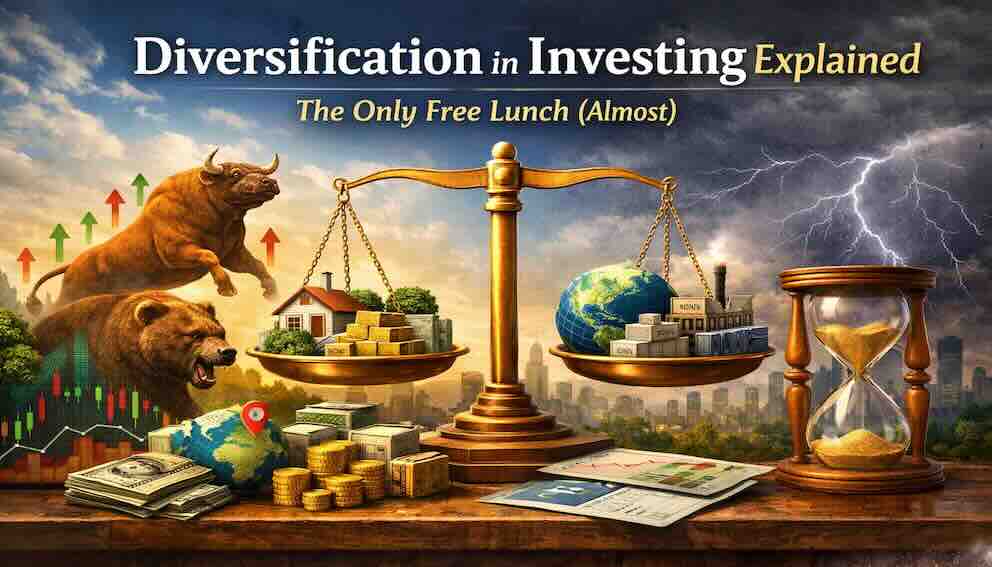
Diversification in Investing Explained: The Only Free Lunch (Almost)
The phrase "diversification is the only free lunch in investing" is repeated so often it risks becoming meaningless. This tutorial seeks to restore its true power. We explore what diversification actually achieves—not the elimination of risk, but the intelligent reshaping of it—by combining assets that don't all fail for the same reason. We will debunk common myths, examine why it sometimes appears to fail in a crisis, and reveal how true diversification extends far beyond owning many stocks to include asset classes, geographies, and time itself. By understanding its limits and its profound strengths, you can build a portfolio that is not just a collection of assets, but a resilient, interlocking system designed for endurance.
Introduction: The Misunderstood Meal
In investing, as in life, there are few true bargains. Higher potential returns typically demand that you accept greater risk and uncertainty. It is a relentless trade-off. Yet, for generations, economists and seasoned investors have pointed to one celebrated exception: diversification. They call it "the only free lunch" the market offers. But what does a "free lunch" mean in a realm where nothing is truly free? Does it mean you can eat your cake and have it too—enjoy high returns with no risk? Of course not. The "free lunch" is more subtle, more mechanical, and far more powerful than that cliché suggests.
This tutorial is an investigation into that subtlety. We will move beyond the simplistic mantra to understand what diversification truly is, what it painfully is not, and why it remains the cornerstone of prudent investing. We'll see that its greatest value is not in making you rich quickly, but in providing the one thing every long-term investor desperately needs: a strategy that can survive your own miscalculations and the market's inevitable storms.
What Diversification Actually Is: The Farmer's Wisdom
At its core, diversification is an ancient and intuitive principle. Consider a farmer whose livelihood depends on the harvest. If she plants only one crop—say, a single variety of wheat—her fate is sealed by a single roll of the dice. Perfect weather brings a bumper crop and prosperity. A blight, a drought, or a price collapse in wheat wipes her out.
Now, imagine a different farmer. She plants wheat, but also drought-resistant sorghum, a small orchard of fruit trees, and keeps a herd of goats. No single season will be perfect for all these things. The orchard may suffer in a late frost, but the goats will still produce milk. The grain prices may fall, but the fruit harvest may be abundant. Her annual income is less spectacular in a perfect year, but it is also far less catastrophic in a bad one. Her system is resilient.
Diversification in investing is this farmer's wisdom applied to capital. It is the deliberate spreading of your investments across different assets so that your financial well-being does not depend on the success of a single company, a single sector, or a single economic story.
The magic—the "free lunch"—lies in the mathematics of correlation. Correlation measures how two investments move in relation to each other. If they move in perfect lockstep (correlation of +1), there is no diversification benefit. But if they are imperfectly correlated (moving independently or even in opposite directions under certain conditions), combining them can reduce the overall volatility of your portfolio without necessarily reducing your expected return. You are not adding more return; you are getting the same expected return with a smoother, less nauseating ride. That smoother ride is the "free" part—it’s reduced emotional cost and increased staying power, paid for with wisdom, not dollars.
The Two Types of Risk: What Diversification Can and Cannot Do
To appreciate diversification fully, we must understand the two fundamental types of risk it manages: Unsystematic Risk and Systematic Risk.
Unsystematic Risk (The Unique Hazard): This is the risk specific to a single company, industry, or country. It is the chance that a particular company's CEO makes a catastrophic error, that a pharmaceutical firm's key drug fails clinical trials, or that a national government makes a disastrous policy decision. This risk is, in theory, diversifiable. By owning a broad basket of companies across different industries and geographies, the impact of any one company's failure is diluted to near-irrelevance. This is the primary risk that diversification is designed to neutralize.
Systematic Risk (The Shared Hazard): This is the risk inherent to the entire market or economy. It is the broad risk of recession, war, rising inflation, or a global pandemic that affects nearly all businesses and assets simultaneously. This risk is not diversifiable in the traditional sense. When this kind of storm hits, almost everything is affected.
Diversification cannot make you immune to systematic risk. What it can do, however, is ensure that when the market-wide storm arrives, your portfolio is not also simultaneously suffering from a dozen unique, company-specific disasters. It allows you to face the one broad storm with a sturdy vessel, rather than a leaking boat already full of holes. Diversification removes the unnecessary, uncompensated risks so you are left to manage only the essential, inescapable ones.
The Illusion of Diversification: What It Is Not
Before we embrace its power, we must clear away the common illusions that surround diversification, as these misunderstandings lead directly to disappointment.
1. It is not about the number of holdings.
Owning 50 different technology stocks or 30 different speculative mining companies is not diversification. It is concentration in disguise. You have spread your bets, but you are still betting on the same underlying theme: the success of tech or the price of minerals. If that theme falls out of favor, your long list of holdings will provide little comfort as they all fall together. True diversification is about differences in drivers of returns, not differences in ticker symbols.
2. It does not make you immune to losses.
In a systemic crisis—a true economic heart attack like 2008 or the COVID panic of 2020—fear becomes the only driver. In these moments, correlations between assets can spike toward 1. Everything can go down together. Diversification is not a forcefield against bear markets. It is, however, a defense against idiosyncratic risk—the unique, company-specific disaster (a fraud, a failed drug trial, a CEO scandal) that can wipe out a single stock. It protects you from the tree falling in the forest, not from the forest fire.
The inflation-driven selloff of 2022 provided a stark modern lesson. As central banks raised interest rates aggressively to combat high inflation, both stocks and bonds fell in unison for an extended period. This tested the patience of even diversified investors, proving that when the economic shock is broad and fundamental, even traditional safe havens can be impacted. Diversification does not prevent these episodes; it is designed to help you endure them with a portfolio that is wounded, not annihilated, so you can recover when conditions normalize.
3. It is not optimized when everything is "working."
A well-diversified portfolio should often feel slightly uncomfortable. At any given time, some parts will be lagging or falling while others are rising. If every single one of your investments is soaring simultaneously, it is a red flag. It likely means you are not diversified at all, but are instead riding a single, hot risk factor (like speculative growth or low interest rates) that will eventually reverse. The discomfort of mixed performance is a feature, not a bug; it is evidence that your assets are not all hostage to the same fate.
When Diversification Becomes "Diworsification"
There is a point where the earnest pursuit of diversification can tip over into self-defeating complexity, a trap famously dubbed "diworsification" by investor Peter Lynch. This occurs when adding more investments ceases to improve your portfolio's resilience and instead only adds clutter, cost, and confusion.
Diworsification happens when:
- You own multiple funds that hold essentially the same assets. (For example, owning an S&P 500 index fund, a large-cap growth fund, and a technology sector ETF—you are largely just tripling down on big U.S. companies, primarily in tech).
- You chase niche, exotic assets in tiny amounts that have no meaningful impact on your overall outcome but require mental energy to track.
- The complexity of your portfolio becomes so great that you cannot easily understand what you own or why, making you more likely to make behavioral mistakes during stress.
The principle is simple: Each new holding should earn its place by changing the behavior of your portfolio in a beneficial way. If adding a new fund doesn't meaningfully alter your exposure to different risks or economic drivers, it is likely just window dressing. True diversification is about strategic breadth, not indiscriminate accumulation. The goal is a coherent, understandable system, not a sprawling collection of ticker symbols.
The Free Lunch, Explained: Replacing Hopeful Gambles with a Reliable System
So where is this famous "free lunch"? Let's illustrate it with a simple, two-asset example.
Imagine you can invest in two islands: Sunny Isle and Cloudy Isle. Their economies are different.
- Sunny Isle's tourism booms in beautiful summers but crashes in rainy years.
- Cloudy Isle's umbrella and raincoat factories thrive in rainy years but struggle in droughts.
Investing 100% in Sunny Isle is a gamble on perfect weather. Investing 100% in Cloudy Isle is a gamble on perpetual rain. Both are volatile, all-or-nothing strategies.
But what if you split your money 50/50? In a sunny year, your Sunny Isle investments soar while Cloudy Isle's lag. In a rainy year, the reverse happens. Your average return over many years might be similar to picking the "right" island each year, but your journey is dramatically smoother. You have given up the chance for a spectacular score in any single year, but you have also eliminated the risk of a devastating loss. You have engineered a more reliable outcome without sacrificing long-term growth. That is the free lunch: you've reduced risk without paying for it with lower returns.
In real market history, this mathematical benefit is measurable. For example, a simple, globally diversified portfolio of stocks and bonds has historically exhibited roughly 20-30% less volatility—fewer and shallower peaks and valleys—than a portfolio invested solely in stocks, with a very similar long-term return. This smoother path is the "free lunch" made manifest.
In real markets, the "islands" are asset classes: stocks versus bonds, domestic versus international, growth versus value. By combining them, you are not betting on a single future. You are building a portfolio that can endure and benefit from many possible futures.
Diversifying the Reasons You Make Money: A Deeper Layer
The most sophisticated form of diversification goes beyond labels like "stocks" and "bonds" to consider the underlying risk factors that drive returns. This is diversification at the level of causality. It asks: "Why do my investments succeed or fail?"
Different assets profit from different economic environments:
- Growth Assets (like growth stocks) thrive when the economy is expanding and optimism is high.
- Inflation Hedges (like certain commodities or real estate) can protect purchasing power when prices are rising.
- Stability Assets (like high-quality bonds or consumer staples stocks) tend to hold up when growth slows.
- Deflation Protectors (like long-term government bonds) can surge when economic activity crashes and interest rates fall.
A portfolio heavily tilted toward just one of these drivers—say, only growth stocks—is vulnerable when that single story changes. True resilience comes from owning a balance of assets that succeed for different reasons. This way, your portfolio isn't a bet on one narrative about the future; it's a toolkit prepared for several plausible futures.
Building True Diversification: A Three-Layered Architecture
Real diversification is not haphazard; it is architectural. It is built in deliberate, logical layers.
Layer 1: Asset Class Diversification (The Strongest Pillar)
This asks: Am I exposed to fundamentally different sources of risk and return?
- Stocks for long-term growth.
- Bonds for income and stability—particularly during economic slowdowns or market panics driven by fear. It's important to note that their stabilizing power is most reliable during crises of economic confidence; during sharp rises in inflation (like 2022), both stocks and bonds can suffer together, reminding us that no diversification is absolute.
- Real Assets (like real estate investment trusts) for inflation protection.
- Cash for liquidity and optionality.
- This foundational mix ensures your portfolio isn't hostage to a single economic script.
Layer 2: Diversification Within Asset Classes
Within your stock allocation, for instance, this means spreading across:
- Geography: Not just U.S. companies, but developed international and emerging markets. This is especially powerful. Historically, adding international stocks to a domestic portfolio has been one of the most reliable ways to reduce overall volatility, as different economies often grow at different paces. However, in our interconnected global economy, correlations have risen—meaning during a true global crisis, international markets are more likely to fall in unison. Their diversification benefit is thus strongest during regional or single-country setbacks, and remains a vital, though not infallible, component of a resilient portfolio.
- Sector & Industry: Technology, healthcare, finance, consumer goods, utilities.
- Company Size: Large, mid-sized, and small companies.
- A simple, low-cost total world stock market index fund accomplishes this layer with remarkable efficiency.
Layer 3: Temporal Diversification (The Most Overlooked Layer)
This is the diversification of time itself. It means consistently investing a fixed amount of money at regular intervals (dollar-cost averaging). You are not making one giant bet at a single moment, which could be spectacularly good or terribly bad. Instead, you buy shares at high prices, low prices, and everything in between, automatically smoothing your average purchase price over years. This leverages time as a tool to reduce timing risk.
The Behavioral Superpower: Diversification as an Emotional Shock Absorber
The quantitative benefits of diversification are clear, but its psychological advantages may be even more valuable. Investing with a concentrated portfolio is an extreme test of emotional fortitude. It forces you to be both perfectly right in your analysis and perfectly stoic in your temperament, all at once.
Diversification lowers the stakes of being wrong. It allows you to make mistakes—to pick a stock that falters or misjudge a sector—without those mistakes defining your entire financial future. This dramatically reduces the emotional extremes of greed and fear. When one part of your portfolio is struggling, another part is likely holding steady or even advancing. This mixed performance, while sometimes frustrating, is profoundly stabilizing. It quietens the noise, reduces the urge to constantly tinker or panic-sell, and makes the long journey not just survivable, but sustainable.
A concentrated portfolio is a tightrope. A diversified portfolio is a wide, well-guarded bridge. The latter may not be as thrilling, but it is the one you can actually cross with confidence over a lifetime.
A Glimpse of a Coherent, Diversified Whole
To see how these principles come together, imagine a simple, conceptual portfolio built for a long-term goal:
- 60% in a Global Stock Index Fund: This is your growth engine. It provides instant, low-cost exposure to thousands of companies across dozens of countries and sectors, capturing the collective growth of the world economy (Layer 1 & 2 diversification).
- 30% in a Broad Bond Index Fund: This is your stabilizer. It generates income and historically has provided ballast when stock markets fall, smoothing the overall ride (Layer 1 diversification).
- 10% in a Real Assets Fund (like a REIT): This is your inflation-aware component. It offers a chance for returns driven by different factors than stocks and bonds, such as property values and rents (Diversifying your return drivers).
This is not a prescription, but an illustration of coherence. Each piece has a clear, distinct role. Together, they form a system designed for growth, stability, and resilience, not a random collection of investments.
Conclusion: The Architecture of Endurance
Diversification, understood deeply, is not a mere tactic for picking assets. It is the foundational architecture for enduring investment success. We have seen that its celebrated "free lunch" is the reduction of unnecessary, company-specific risk, allowing you to focus on managing the essential, market-wide risks that remain. We have navigated past the illusions and the pitfall of "diworsification," learning that true resilience comes from combining assets that succeed for different reasons.
Most importantly, we have seen that diversification's greatest gift may be behavioral. It builds a portfolio you can actually live with—a structure that reduces panic, encourages patience, and makes the marathon of compounding not just possible, but peaceful.
Diversification builds the resilient structure. The patient, disciplined execution of that plan over decades—through regular contributions, thoughtful rebalancing, and a steady temperament—is what allows the structure to fulfill its purpose. It is the quiet, steadfast practice that turns a good design into a lifetime of financial well-being.
About Swati Sharma
Lead Editor at MyEyze, Economist & Finance Research WriterSwati Sharma is an economist with a Bachelor’s degree in Economics (Honours), CIPD Level 5 certification, and an MBA, and over 18 years of experience across management consulting, investment, and technology organizations. She specializes in research-driven financial education, focusing on economics, markets, and investor behavior, with a passion for making complex financial concepts clear, accurate, and accessible to a broad audience.
Disclaimer
This article is for educational purposes only and should not be interpreted as financial advice. Readers should consult a qualified financial professional before making investment decisions. Assistance from AI-powered generative tools was taken to format and improve language flow. While we strive for accuracy, this content may contain errors or omissions and should be independently verified.