
Tutorial Categories
Last Updated: February 11, 2026 at 16:30
Great Companies Can Be Terrible Investments: Why Valuation Matters More Than Business Quality
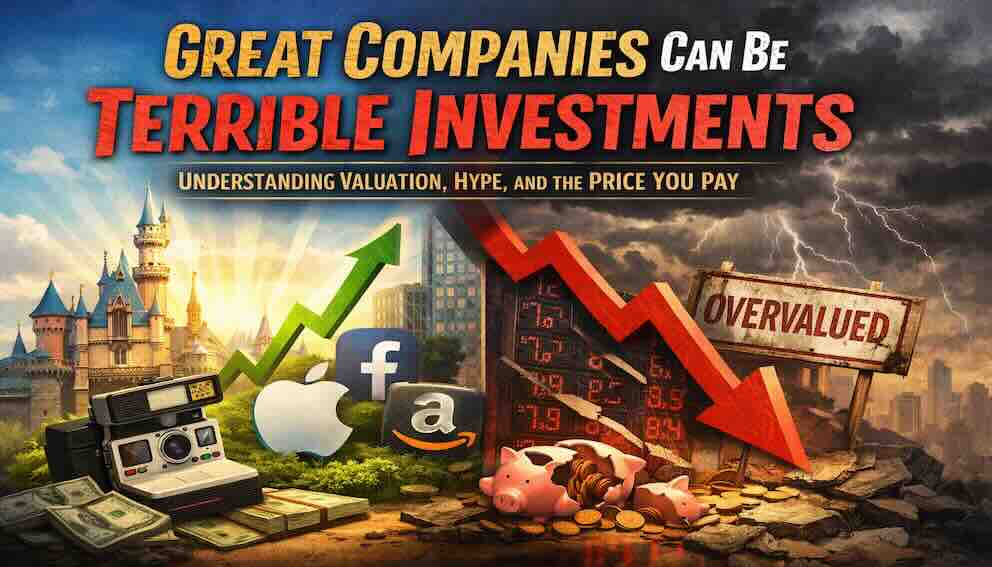
Many investors assume that buying the best companies automatically leads to great investment results, but history repeatedly shows that this belief can be dangerously misleading. This tutorial explores how outstanding businesses can become poor investments when their stock prices rise far beyond reasonable valuation, using famous historical and modern examples. You will learn the simple math of how overpaying destroys returns, the psychological traps that lead us to confuse great companies with great stocks, and why time alone cannot fix a bad starting price. By the end, you'll have a clear framework for separating business admiration from investment discipline, ensuring you never overpay for excellence again.
Introduction: A Story from 1972
Imagine a dinner party in early 1972. A successful investor proudly tells his friends about his portfolio: he owns the very best American companies—Polaroid with its revolutionary instant photography, Xerox dominating office copying, Avon Products reaching millions of homes, and Walt Disney creating magical entertainment. These weren't speculative bets; they were the "Nifty Fifty"—widely considered the safest, most dependable growth stocks you could own. His friends nod in approval. He's not just investing; he's owning pieces of America's future.
Over the next two years, many of these wonderful businesses would lose 70%, 80%, or even 90% of their value. Some wouldn't reach new highs for over a decade. The investor wasn't wrong about the companies' quality—people still took Polaroid pictures and visited Disneyland. He was catastrophically wrong about the price he paid.
This uncomfortable truth challenges our deepest investing instincts: A company can be excellent in almost every operational sense and still deliver terrible returns to shareholders who overpay. The problem isn't the business quality—it's the bridge between that quality and your returns: the price you pay.
This tutorial will slowly unpack why confusing great companies with great investments is perhaps the most common and costly mistake investors make. We'll examine historical patterns, reveal the simple mathematics behind returns, and explore the psychological traps that lead us to overpay. Our goal is to help you build the crucial discipline of separating admiration for a business from analysis of its stock price.
The Crucial Distinction: Wonderful Business vs. Wonderful Investment
Let's make this separation absolutely clear from the start. These are two different concepts that answer different questions:
A Wonderful Business is defined by its internal characteristics:
- Does it have a durable competitive advantage (a "moat")?
- Does it generate high returns on capital?
- Does it have capable management and loyal customers?
- Can it grow earnings over time?
Key Question: "Is this enterprise well-run and built to last?"
A Wonderful Investment is defined by the relationship between price and value:
- Is the current price significantly below my estimate of intrinsic value?
- Does the price leave room for error (a "margin of safety")?
- Does it offer an attractive potential return relative to alternatives?
Key Question: "Is this a good deal at this price?"
The confusion arises because our instincts from daily life don't translate to investing. In shopping, higher quality usually justifies a higher price. A well-made car should cost more than a poorly made one. But in investing, the price you pay determines your return, not the quality of the business alone.
Think of it this way: You find a beautifully engineered, reliable luxury sedan—a wonderful vehicle. Paying $10,000 below market value makes it a wonderful investment. Paying fair market value is reasonable. But if, in a frenzy of excitement about its new features, buyers bid the price to twice its value, buying it becomes a terrible financial decision—even though the car itself hasn't changed.
The investor's challenge is this: You must first identify wonderful businesses, then have the discipline to buy them only when they're offered at wonderful prices.
The Mathematics of Returns: Why Starting Price Determines Your Fate
To understand why price matters so profoundly, we need to understand where long-term stock returns actually come from. They're composed of just three elements:
Long-Term Return = Earnings Growth + Dividends + Change in Valuation Multiple
Let's break this down with a simple example:
Imagine two investors, Alex and Bailey, both buy shares in the same excellent company.
The Business Facts:
- Current earnings per share: $5.00
- Earnings grow 12% annually for 10 years
- No dividends paid
- Starting P/E (Price-to-Earnings ratio): The only difference
Alex's Scenario (Buys at Fair Price - P/E of 20):
- Purchase price: $100 per share ($5 earnings × 20 P/E)
- After 10 years of 12% growth, earnings reach $15.53
- If the P/E remains at 20, stock price = $310.60
- Alex's annual return: 12% (matching the business growth)
Bailey's Scenario (Buys at High Price - P/E of 40):
- Purchase price: $200 per share ($5 earnings × 40 P/E)
- After 10 years of 12% growth, earnings still reach $15.53
- If the P/E contracts to a still-respectable 25, stock price = $388.25
- Bailey's annual return: 6.8% (barely beating inflation)
Both owned the same wonderful business. Both experienced the same 12% annual earnings growth. Yet Bailey earned less than half of Alex's return. Why? Because Bailey started with a sky-high valuation that had to come down.
The Silent Killer: Multiple Compression
This brings us to the most overlooked aspect of investing: valuation multiple compression. When you buy at a high P/E ratio, you're essentially borrowing returns from the future. Much of the business's future growth goes toward justifying your high starting price rather than generating new gains.
In our example, Bailey's return was dragged down because the market's enthusiasm (P/E of 40) cooled to mere admiration (P/E of 25). This multiple compression acted as a -3.2% annual headwind against the business's +12% growth.
This is the mathematics of disappointment: Even strong business growth can be canceled out by valuation compression when you start from an elevated price.
Historical Proof: The Nifty Fifty's Lost Decade
The Era of "One-Decision Stocks"
In the late 1960s and early 1970s, approximately fifty large American companies became known as the "Nifty Fifty." These were the blue-chip champions of their time: IBM, Xerox, Polaroid, Coca-Cola, McDonald's, Johnson & Johnson, and Walt Disney among them.
A powerful narrative took hold: these companies were so dominant, their futures so secure, that they were "one-decision stocks." The only decision was to buy them. Selling—or worrying about price—seemed unnecessary. As one fund manager reportedly said, "If the price drops, I'll just buy more."
The Valuation Peak and Its Consequences
As this belief spread, valuations detached from reality. While the broader market traded at a P/E around 15, Nifty Fifty stocks commanded extraordinary premiums:
- Polaroid: P/E over 90
- Xerox: P/E over 40
- Avon Products: P/E over 60
- Disney: P/E over 70
Investors weren't paying for past success; they were prepaying for decades of flawless future growth. The prices assumed these companies would conquer all competition, never make mistakes, and grow at exceptional rates forever.
The Reckoning: When Business Success Wasn't Enough
Then reality arrived. The 1970s brought stagflation—high inflation combined with economic stagnation. Interest rates soared. While most Nifty Fifty companies remained fundamentally sound (people still drank Coke and visited Disneyland), their earnings growth couldn't possibly justify the astronomical prices paid.
The result was devastating:
- Many stocks fell 70-90% from their peaks
- Xerox took 26 years to recover its 1972 high
- Polaroid never fully recovered and eventually went bankrupt
- Even winners like McDonald's and Coca-Cola required over a decade to break even from 1972 prices
The crucial lesson: These were largely wonderful businesses that delivered terrible returns to investors who bought at the peak. The quality of the company couldn't save investors from the consequences of overpaying.
Modern Parallels: The Concentration Conundrum
The market has repeatedly become concentrated in a small group of seemingly indispensable leaders—first the "Four Horsemen" of the 1990s tech bubble, then the FAANG stocks, and in 2024-2025 what some call the "Magnificent seven" mega-cap tech companies.
The psychological script remains eerily similar:
- Extraordinary Business Success: A company genuinely transforms an industry (e.g., Amazon in retail, Netflix in entertainment).
- Narrative Formation: Stories emerge about "disruption," "network effects," and "winner-take-all" markets.
- Valuation Stretch: Traditional metrics are declared obsolete. "This time is different" becomes conventional wisdom.
- The Inevitable Test: Growth eventually slows, competition emerges, or interest rates rise.
Consider Netflix in late 2021. It was a transformative service with deep cultural penetration. Yet its stock price assumed it would continue adding tens of millions of subscribers quarterly indefinitely, fend off all competitors (Disney+, HBO Max, etc.), and maintain unlimited pricing power. When subscriber growth briefly stalled in early 2022, the stock lost over 70% of its value in six months.
The business was still Netflix—a streaming leader with millions of loyal customers. But the investment became terrible for those who bought at peak valuation.
This pattern doesn't mean today's leaders are doomed. Apple and Microsoft are more profitable and resilient than ever. The point is that the quality of the business and the attractiveness of the stock price remain two separate questions. Periods of widespread belief that "price doesn't matter" are often when it matters most.
The Psychology of Overpaying: Why We Keep Making This Mistake
Understanding the mathematics is straightforward. Understanding why we ignore it is more complex. Several psychological traps conspire against us:
1. The Narrative Heuristic
Our brains are wired for stories. A compelling narrative about innovation and dominance ("They own the future!") is more emotionally resonant than dry discounted cash flow analysis. We fall for the story and overlook the price tag.
2. Social Proof & FOMO
When everyone is buying and talking about a stock, it creates powerful social proof. Buying feels like joining the winning team. The fear of missing out (FOMO) overwhelms rational valuation concerns.
3. The "Great Company" Justification
Perhaps the most dangerous phrase in investing: "It's such a great company." This becomes a blanket justification for paying any price. We mentally convert business admiration into investment validity.
4. Extrapolation Bias
We assume recent trends continue indefinitely. A company that grew 30% annually for five years must do so for the next five. The market often prices this presumption in full, leaving no room for normal slowdown.
5. The Comfort of Familiarity
Famous companies feel safer than obscure ones. This feeling of safety lowers our guard against overpaying. We think, "It's Apple, how bad could it be?" forgetting that security of principal and a high starting price are often opposites.
The Hidden Cost: Opportunity Lost
The damage of overpaying extends beyond poor returns in the overpriced asset itself. There's a second, subtler cost: opportunity cost.
Money tied up in an overvalued "wonderful company" isn't available for truly wonderful investments that may emerge. While you wait years for an overpriced stock to "grow into" its valuation (if it ever does), you miss:
- Undervalued quality companies trading at reasonable prices
- Special situations with asymmetric risk/reward
- Simply earning a safe return in Treasury bonds
This is why legendary investors like Warren Buffett emphasize "waiting for the right pitch." The discipline to avoid overpaying isn't just about avoiding losses—it's about preserving dry powder for genuine opportunities.
A Practical Framework: How to Avoid This Trap
How can you apply this wisdom? By building a simple process that forcibly separates business analysis from price analysis.
Step 1: Analyze the Business in a Vacuum
First, ask: "Is this a wonderful business?" Look for durable competitive advantages, financial strength, capable management, and growth potential. Be ruthlessly objective. If it doesn't pass this test, stop. No price makes a bad business a good investment.
Step 2: Estimate a Range of Fair Value
Before looking at the current market price, estimate what the business might be intrinsically worth. You don't need precision. Ask:
- What would a reasonable P/E ratio be for this growth and stability?
- What multiple of current cash flow seems sustainable?
- What might the business be worth in 5-10 years under realistic scenarios?
Establish a zone of sensible value, not a precise number.
Step 3: Compare Price to Value
Now look at the market price. The critical question: "What future performance does this price demand?"
Does a P/E of 40 assume 20% growth forever? Does a price-to-sales ratio of 10 assume profit margins will triple? If the price is far above your estimated zone of fair value, the stock is a pass, no matter how much you admire the company.
Step 4: Demand a Margin of Safety
A wonderful investment emerges only when there's a gap—a margin of safety—between the market price and your conservative estimate of value. This gap is your buffer against error and misfortune. For a truly exceptional business, you might accept a smaller margin, but you should always demand one.
Step 5: Implement Guardrails
- The Replacement Test: Periodically ask, "If I had cash instead of this position, would I buy it at today's price?" If not, consider selling.
- Position Sizing: Even when quality and price align, size positions appropriately. Never let admiration for one company become overconcentration in your portfolio.
- Trim at Extremes: If a holding becomes egregiously overvalued (trading at 2-3x your estimate of fair value), consider trimming regardless of how wonderful the business is.
Nuance: When Paying a Premium Can Make Sense (With Limits)
To prevent misunderstanding: this tutorial isn't arguing that you should only buy statistically cheap companies. Sometimes paying a fair premium for exceptional quality is rational. The danger lies in paying any price.
Consider two scenarios:
Paying a Fair Premium:
- Business: Exceptional, wide moat, 15% sustainable growth
- Fair Value Range: $80-100 per share
- Market Price: $110
- Decision: Might be acceptable for a portion of the portfolio, with eyes open to the reduced margin of safety
Paying Any Price:
- Same exceptional business
- Market Price: $200
- Decision: Avoid, regardless of quality
The distinction is between paying up for quality and ignoring price altogether. The former requires even more stringent analysis of business durability; the latter is speculation.
Conclusion: The Discipline That Separates Admiration from Returns
We've explored one of investing's most important yet frequently overlooked principles: Your return is determined not by the quality of the company you buy, but by the price you pay for that quality.
The historical record is clear: wonderful businesses can become terrible investments when purchased at wonderful prices. The Nifty Fifty taught this lesson brutally in the 1970s, and market cycles continue to reinforce it today.
The mathematics are straightforward: returns come from business growth, dividends, and changes in valuation. When you start with an elevated valuation, you're fighting the headwind of potential multiple compression. Even strong growth can deliver mediocre returns if the starting price was too high.
Perhaps most importantly, we've seen why this mistake is so persistent. It's not a failure of intelligence but of psychology. Compelling narratives, social proof, and the comfort of familiar names lead us to suspend our valuation discipline precisely when we need it most.
The practical path forward is a deliberate two-step process:
- Cultivate the discernment to identify truly wonderful businesses.
- Cultivate the emotional discipline to buy them only when the market offers a sensible price.
This requires the patience to wait, the skepticism to question popular enthusiasm, and the courage to sometimes stand aside while others chase.
In the end, successful investing isn't about owning the most admired names. It's about owning the most wisely priced assets. Great companies deserve our admiration. Great investments deserve our discipline. By forever tethering your business analysis to rigorous price analysis, you build the bridge that turns opportunity into tangible, financial reward.
Remember the investor from our opening story. He wasn't wrong about the companies. He was wrong about the price. Let his experience—and the experience of countless investors who've repeated his mistake—guide you toward better discipline. Your future returns will thank you.
About Swati Sharma
Lead Editor at MyEyze, Economist & Finance Research WriterSwati Sharma is an economist with a Bachelor’s degree in Economics (Honours), CIPD Level 5 certification, and an MBA, and over 18 years of experience across management consulting, investment, and technology organizations. She specializes in research-driven financial education, focusing on economics, markets, and investor behavior, with a passion for making complex financial concepts clear, accurate, and accessible to a broad audience.
Disclaimer
This article is for educational purposes only and should not be interpreted as financial advice. Readers should consult a qualified financial professional before making investment decisions. Assistance from AI-powered generative tools was taken to format and improve language flow. While we strive for accuracy, this content may contain errors or omissions and should be independently verified.