Tutorial Categories
Last Updated: January 27, 2026 at 10:30
The Origins of Modern Finance: How Trade, Risk, and Crisis Management Evolved - World Financial History Series
We often imagine trade as a clean meeting of supply and demand. Its origins were messier and far more human. Before efficiency, before profit, before anything resembling a market, there was fear—not the passing anxiety of a bad outcome, but the real possibility of total and irreversible loss. To understand how modern financial systems came to rely on centralized guarantees, we need to begin much earlier. Not in a stock exchange or a royal mint, but on a dock, watching a ship disappear beyond the horizon, carrying with it a merchant’s savings, reputation, and future. What follows is the story of how people learned to live with failure—and how, over centuries, that learning quietly changed the meaning of money itself.
Trade as a Confrontation with the Unknown
In the ancient world, long‑distance trade was not a competitive game. It was a confrontation with uncertainty.
Whether it was Phoenician ships carrying dye across the Mediterranean, Arab traders crossing the Indian Ocean, or later European merchants sailing the Atlantic, the risks were the same. Storms destroyed ships. Pirates seized cargo. Disease wiped out crews. Navigation failed. Political borders shifted without warning.
The defining economic fact was not price, but loss.
Loss was not rare or surprising. It was expected often enough to shape every decision. A merchant who financed an entire voyage alone risked something close to financial extinction. One failed journey could erase years of accumulated wealth and end a career permanently.
Faced with that reality, many rational people chose not to trade at all. Commerce stalled not because opportunity was absent, but because failure was too costly to survive.
The first problem markets had to solve was not efficiency. It was survivability.
Sharing Loss to Enable Participation
The solution emerged from necessity rather than theory.
Merchants began to pool resources. Instead of one person financing an entire voyage, several participants contributed capital or goods. Profits were divided according to agreed shares. Losses were divided the same way.
This arrangement mattered less for how it rewarded success than for how it handled failure.
By spreading the damage of a shipwreck across multiple people, no single loss ended anyone’s participation entirely. A merchant could endure a failed voyage and continue trading, supported by returns from other ventures that succeeded.
Because failure no longer meant ruin, merchants could think in sequences rather than single bets. They could plan for many voyages, form recurring partnerships, and build lasting trade networks.
Markets, in this early sense, were not tools for discovering prices. They were tools for keeping people in the game.
Money functioned accordingly. It recorded who owed what once uncertainty had resolved itself. It coordinated obligations after risk had played out, not before.
Turning Uncertainty into a Known Cost
Over time, these informal sharing arrangements became formal contracts.
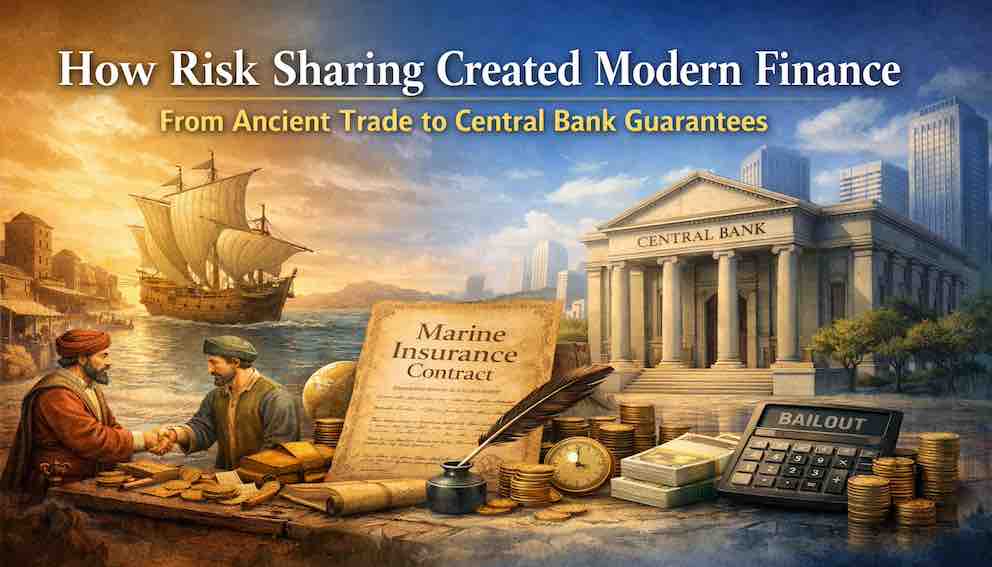
Marine insurance emerged as a way to transfer risk explicitly. A merchant paid a fixed premium in advance. In return, the insurer accepted responsibility for losses if a ship failed to return.
This felt transformative. An unpredictable, potentially ruinous loss was converted into a known, manageable expense.
That change reshaped behavior. Merchants planned farther ahead. They financed larger cargoes. Trade expanded in scale and distance.
For a time, this transfer of risk worked. Insurers prospered by diversifying across voyages, believing disasters were isolated events. But this system contained a hidden flaw: it assumed losses would never all happen at once. The model worked only as long as the world’s misfortunes remained scattered.
When the Sea Turns Against All Ships
Eventually, that assumption failed.
Wars closed entire trade routes. Plagues emptied ports. Political revolutions invalidated contracts across regions. When storms—both literal and metaphorical—struck every fleet simultaneously, the insurers were overwhelmed. Losses, now correlated and catastrophic, crashed through the fragile diversifications. The risk-poolers themselves went under. Credit chains, stretched across continents, snapped. Commerce froze.
These moments produced a different, deeper panic. It was no longer the fear of a single ship lost, but the dread that the entire mechanism for absorbing failure was broken.
Into this breach stepped the state.
At first, rulers intervened reluctantly. They offered emergency loans, guaranteed certain obligations, or temporarily suspended repayments. These actions were framed as exceptional responses to extraordinary events—a king’s mercy in a time of collective distress.
But repetition changes meaning.
Each crisis resolved by authority altered expectations. What once seemed unthinkable became possible. What seemed possible began to feel normal. Gradually, merchants and financiers learned that when private arrangements collapsed under systemic stress, a public backstop might appear. The sovereign, who once demanded taxes from trade, now found himself its potential guarantor.
How Guarantees Change Behavior
Once people begin to believe that catastrophic losses will be managed by a central authority, decision‑making changes. The ground beneath the merchant’s feet softens.
The fear of total ruin, once the dominant force in every calculation, begins to fade. Attention shifts away from mere survival and toward capturing gains, often through larger positions, thinner margins of safety, and greater leverage.
This is not recklessness. It is a rational response to a changed environment. If the worst outcomes are likely to be absorbed elsewhere—by a central bank, a treasury, a deposit insurance fund—then taking on more risk becomes sensible. The danger is not that risk vanishes, but that those making decisions no longer feel its coldest breath on their necks.
Trust, consequently, migrates. It pulls away from the personal, from the handshake between partners who would share a loss directly, and drifts toward distant institutions believed to have both the authority and the deep pockets to prevent collapse.
Money, in this new setting, transforms. It becomes less a token of mutual obligation and more a certificate of institutional promise.
The Paradox of Managed Stability
Modern financial systems are built on this inheritance. Central banks act as lenders of last resort. Deposits are guaranteed. Governments orchestrate bailouts. These tools are marvels of social engineering, designed to prevent panic and maintain the continuity of daily economic life.
And they succeed—but at a cost.
Because visible crises are suppressed, their warning signals grow subtle. Instead of bank runs, we see investors hunting for vanishing yield, compressing risk premiums to nothing. Instead of open fear, we see a quiet, pervasive dependence on liquidity support. The system appears calm, even serene, while pressure builds in hidden conduits and complex linkages.
Earlier systems distributed risk among participants who directly bore its consequences. Modern systems concentrate risk within the very institutions tasked with managing it. The goal is stability. The result is a different, more pervasive kind of fragility—one where trouble, when it comes, threatens not a single venture, but the plaza itself.
Conclusion: The Displacement of Fear
Over centuries, the journey of finance has been a journey of displacing fear. The merchant on the dock, watching his ship vanish, feared the storm and the pirates—a tangible, immediate loss. His fear had a face and a name.
Our fear is different. It is no longer about a single ship, but about the stability of the harbor itself. No longer about personal ruin, but about the failure of the guarantees designed to prevent it. We have transferred the locus of dread from the horizon to the foundations.
This history explains why modern crises feel so sudden after such long calm. Risk accumulates quietly when its consequences are deferred, layered into systems and promises. When confidence in the public backstop wavers, all that suppressed uncertainty returns in a rush—not as a storm, but as a terrifying doubt in the seaworthiness of the entire fleet.
We have not eliminated the confrontation with the unknown. We have built vast, sophisticated systems to manage it—cathedrals of credit, central banking, and sovereign promise. But in doing so, we have changed the nature of the threat. The defining question of our era is therefore no longer how to prevent a single ship from sinking, but how to maintain a sea calm enough for all to sail.
That is the fragile, and fundamentally human, legacy of our financial history. We mastered the fear of the wave, only to inherit the anxiety of the tide.
About Swati Sharma
Lead Editor at MyEyze, Economist & Finance Research WriterSwati Sharma is an economist with a Bachelor’s degree in Economics (Honours), CIPD Level 5 certification, and an MBA, and over 18 years of experience across management consulting, investment, and technology organizations. She specializes in research-driven financial education, focusing on economics, markets, and investor behavior, with a passion for making complex financial concepts clear, accurate, and accessible to a broad audience.
Disclaimer
This article is for educational purposes only and should not be interpreted as financial advice. Readers should consult a qualified financial professional before making investment decisions. Assistance from AI-powered generative tools was taken to format and improve language flow. While we strive for accuracy, this content may contain errors or omissions and should be independently verified.