
Tutorial Categories
Last Updated: January 25, 2026 at 10:30
Debasement and Decline: A Financial History of Inflationary Breakdown - World Financial History Series
History shows that inflation follows a recurring pattern. Authorities expand the money supply to address urgent pressures—war, debt, or social strain—because it feels less painful than taxes or spending cuts. At first, it works, which encourages repetition, and a temporary fix becomes routine. The damage appears first in behavior, not statistics, as people shorten horizons, seek alternatives, and pass money along quickly rather than trust it. From Roman debasement to early paper money and modern fiat systems, monetary breakdown is gradual, learned, and only recognized after coordination has already begun to fail.
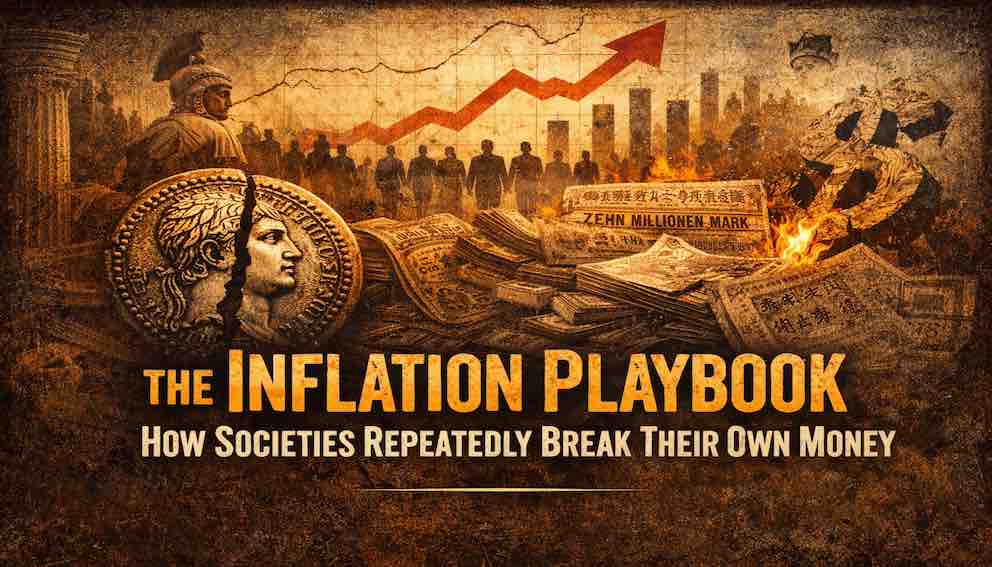
How Societies Learn to Break Their Own Money
Money is, at its core, a promise people make to one another. The material it takes—metal coins, paper notes, or digital entries—matters far less than the role it plays. Money has value because people share the belief that it can be exchanged for goods, used to pay for work, and relied upon in the future. When that shared belief begins to weaken, the monetary system does not collapse immediately. Instead, people slowly change their habits, and the system erodes over time.
History shows that currencies rarely fail in a single dramatic moment. They fade gradually, through a series of decisions that each feel reasonable at the time. Because these choices often relieve pressure in the short run, societies are tempted to repeat them. The pattern appears again and again, with remarkable consistency.
This tutorial examines that pattern through several historical episodes: Roman coin debasement, the Song Dynasty’s experiment with paper money, and the inflationary collapse of Weimar Germany. These cases show that inflation is not simply an economic accident. It is a political and behavioral response to stress, one that societies have repeatedly chosen across very different eras.
The Roman Blueprint — How to Debase a World
The denarius was the core currency of the ancient Roman world, serving a role similar to that of the dollar in a modern reserve system. For centuries, it remained reliable because it contained roughly 95 percent silver and was minted consistently by the Roman Republic. This consistency allowed merchants, soldiers, and taxpayers to trust the coin across the empire and over long periods of time. By anchoring expectations about value, the denarius helped hold the Roman economy together.
The system began to change in 64 AD, when Emperor Nero faced the enormous cost of rebuilding Rome after the Great Fire. Raising taxes risked public unrest, and large-scale borrowing was not a viable option. Nero instead chose a quieter solution: he reduced the silver content of the denarius to about 90 percent. The coins looked the same as before, and the imperial stamp preserved the appearance of continuity. This allowed the state to mint more coins from the same amount of silver and increase spending without immediate resistance.
This decision introduced a powerful but dangerous tool: seigniorage as a hidden form of taxation. Once established, it proved difficult to abandon. Successive emperors reused debasement whenever fiscal pressure returned, because each reduction appeared small and justified on its own. Over time, however, the cumulative effect was severe. By the reign of Septimius Severus, the denarius contained only about 50 percent silver. During the Crisis of the Third Century, it became largely copper, coated with a thin layer of silver.
The economic consequences followed a familiar pattern. As more lower-quality coins circulated, prices rose because more money chased the same goods. The deeper damage, however, was behavioral. People began to lose trust in the currency and adjust their actions accordingly. Older, higher-quality coins were hoarded, while newer coins circulated rapidly. Merchants raised prices, soldiers demanded higher pay, and long-term contracts became risky because the unit of account itself was unstable.
The Roman state attempted to contain the problem through coercive measures, including price controls and forced acceptance of the debased currency. These efforts failed because they addressed surface symptoms rather than the underlying loss of trust. Rome did not destroy its monetary system in a single moment. It weakened it gradually, as each seemingly practical decision reduced the credibility of the promise embedded in its money.
The Paper Trail — The Song Dynasty’s Faustian Bargain
A long time after that, around the Song Dynasty, China was dealing with some economic growth issues. The economy kept expanding fast, but the old bronze coins just couldnt keep up with all the trade happening. Moving those heavy metal coins over long distances was a real hassle, expensive and slow. So they came up with this idea for paper money, the first kind issued by the state, called jiaozi, to fix the coordination problems in trade.
It worked pretty well at the beginning. The notes could be swapped for actual coins or silk, and they didnt print too many of them right away. People trusted it because the backing seemed solid. Commerce got a boost, less friction in transactions, and it showed that coming up with new money ideas isnt always bad.
But then military stuff got in the way. Wars with northern enemies meant huge spending, draining the treasury. Instead of hiking taxes or trimming budgets, the government just printed more paper notes than they had reserves for. It was the easy way out to cover ongoing deficits.
Once that happened, trust started falling apart quick. More notes floating around, and folks rushed to trade them for real things like land, metal, grain, before the value dropped even more. The state tried decrees and punishments to steady things, but it didnt help much, trust was gone. Inflation just sped up since everyones behavior had shifted already.
The Mongols took over the Song and kept the paper money going. Under the Yuan Dynasty, they pushed it even further, making the same overissuing error but bigger. It feels like this keeps happening in money history. The urge to print too much comes from how power is set up in institutions, not really from culture or tech stuff. I think thats the main point, though its kind of repeated across dynasties.
The Behavioral Breakdown — Weimar Germany’s Descent
Weimar Germany provides one of the clearest historical examples of how monetary systems break down through changes in behavior rather than through a single technical failure. After World War I, Germany was required to pay large reparations denominated in foreign currencies, which placed enormous pressure on the state. Rather than impose immediate spending cuts or heavy taxes, the government chose a less visible option: it expanded the supply of Reichsmarks to purchase the foreign currency it needed.
In the early stages, this approach appeared successful. Economic activity increased, employment improved, and factories returned to production. These short-term gains reinforced the belief that inflation could be managed and reversed at will. However, as money creation continued, people began to adjust their behavior in ways that accelerated the breakdown. Those adaptations, rather than policy decisions alone, are what ultimately pushed the system from strain into collapse.
The Historical Playbook: Repeating Stages
Across these cases, the same sequence appears:
- Temporary Fix — Monetary tools are used to avoid immediate political pain.
- Normalization — The tool becomes a routine response to fiscal pressure.
- Loss of Anchors — Money fails as a store of value.
- Behavioral Flight — Society adapts through indexing, substitution, and avoidance.
- Reset or Collapse — Stability returns only through credible restraint or regime change.
Each stage feels manageable while it is unfolding. The fatal belief is always that control can be restored later.
Conclusion: The Pattern That Persists
Money changes with technology all the time, but the way people mess it up stays the same, I guess. Like inflation, its not really about not knowing economics. More like politicians like the idea of pushing costs to later, making things easier now.
Societies that do this always think they are different somehow. Rome had its army to rely on, the Song dynasty their officials, and Weimar figured their smart people would handle it. But yeah, they all ended up in the same spot.
The big takeaway from history with money seems pretty straightforward. Inflation isnt just math going wrong. Its about not lining up plans over time. People figure out eventually, from what happens, that promises for later get thrown under the bus for keeping things calm today. So money stops being that reliable link from now to the future. Fixing the trust part always takes breaking things up, some tough rules, and real giving up, instead of just saying its all fine.
About Swati Sharma
Lead Editor at MyEyze, Economist & Finance Research WriterSwati Sharma is an economist with a Bachelor’s degree in Economics (Honours), CIPD Level 5 certification, and an MBA, and over 18 years of experience across management consulting, investment, and technology organizations. She specializes in research-driven financial education, focusing on economics, markets, and investor behavior, with a passion for making complex financial concepts clear, accurate, and accessible to a broad audience.
Disclaimer
This article is for educational purposes only and should not be interpreted as financial advice. Readers should consult a qualified financial professional before making investment decisions. Assistance from AI-powered generative tools was taken to format and improve language flow. While we strive for accuracy, this content may contain errors or omissions and should be independently verified.