
Tutorial Categories
Last Updated: January 15, 2026 at 08:30
Regret Aversion in Investing: Why Fear of Mistakes Leads to Inaction - Behavioral Finance Series
Why do so many investors stay in cash even when they know markets offer long-term opportunity? Why do we delay rebalancing, cling to losing positions, or avoid decisions altogether—only to regret it later? This tutorial explores regret aversion, one of the most powerful and least understood forces in investing. Unlike loss aversion, regret aversion is not just about losing money—it is about fearing responsibility for a bad outcome. We examine how the anticipation of regret leads to inaction, excessive caution, herd behavior, and missed opportunities. Using real-world investing examples and insights from psychology and decision theory, the tutorial shows how regret shapes portfolio choices, diversification, and timing decisions. It also explains how professional investors design rules, systems, and processes that reduce regret—not by eliminating uncertainty, but by managing it intelligently. The goal is not to suppress emotion, but to build decision frameworks that prevent emotion from quietly hijacking long-term wealth outcomes.
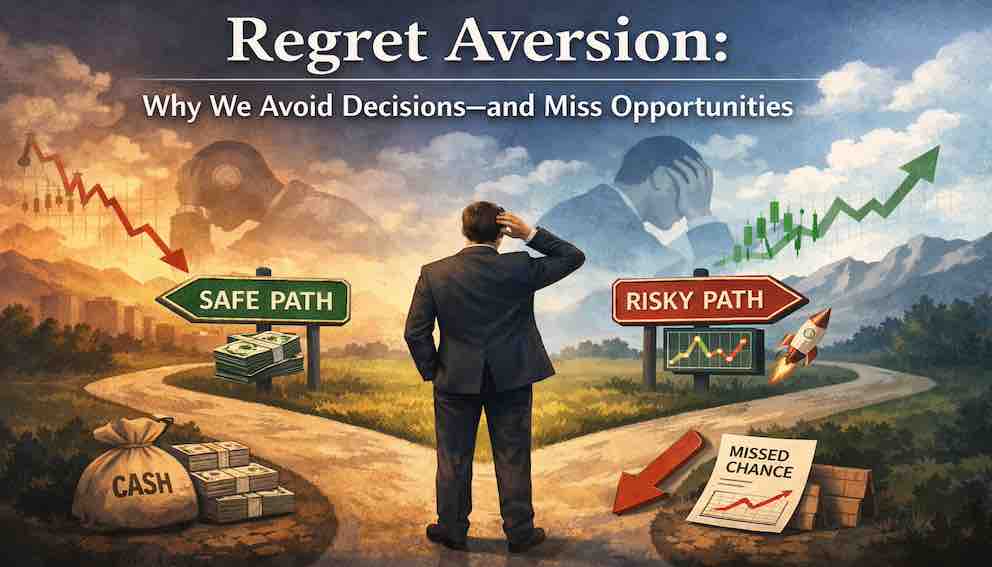
In early 2020, markets fell sharply. Prices dropped. Long-term expected returns arguably improved.
Many investors knew this.
And yet, millions stayed in cash.
They didn’t panic-sell. They didn’t speculate wildly. They did something quieter—and far more common.
They did nothing.
Months later, as markets recovered, a familiar thought appeared:
“I knew I should have invested… but what if things had gotten worse?”
This is the central paradox of regret aversion:
We often avoid decisions not because we lack information or intelligence, but because we fear how we might feel if the decision turns out badly.
In trying to avoid regret, we often create a different one—the regret of missed opportunity.
Core Theory: What Is Regret Aversion?
The Basic Idea
Regret aversion is the tendency to delay, avoid, or soften decisions because we fear feeling regret in the future.
It is not just about losing money.
It is about being responsible for a loss.
A simple comparison helps:
- Loss aversion: “Losing money feels painful.”
- Regret aversion: “Losing money because I chose wrong feels unbearable.”
That extra layer—self-blame—is what makes regret uniquely powerful.
Anticipated vs. Experienced Regret
A crucial distinction:
- Anticipated regret: The fear before a decision—“What if I regret this?”
- Experienced regret: The pain after an outcome—“I regret what I did.”
Decision theory focuses on anticipated regret, because it is what shapes behavior.
Most investors are not reacting to actual regret.
They are reacting to the possibility of future regret—and altering decisions to avoid it.
Ironically, this avoidance often leads to worse outcomes.
How is it different from loss aversion?
Loss aversion and regret aversion are related but distinct psychological biases that influence financial decisions. Loss aversion is outcome-focused: people feel the pain of losing money about twice as strongly as the pleasure of gaining the same amount, leading them to hold losing investments or avoid risk. Regret aversion, by contrast, is action-focused: it arises from the fear of being responsible for a poor outcome, so investors may delay decisions, stay in cash, avoid rebalancing, or follow the crowd to minimize anticipated regret. In short, loss aversion is about not wanting to lose money, while regret aversion is about not wanting to be blamed for losing money. Both can distort behavior, but loss aversion reacts to the result itself, whereas regret aversion reacts to the sense of personal responsibility for that result.
Why Regret Is So Powerful
Regret is a counterfactual emotion. It depends on imagining an alternative world:
- “If only I had waited.”
- “If only I had invested sooner.”
- “If only I had sold earlier.”
Psychologically, regret combines:
- Emotional pain
- Self-criticism
- Hindsight (“I should have known better”)
Economists Bell (1982) and Loomes & Sugden (1982) showed that people systematically change decisions to minimize anticipated regret—even when doing so lowers expected returns.
System 1 vs. System 2
- System 1 wants emotional safety: avoid embarrassment, blame, and feeling foolish.
- System 2 understands probabilities, diversification, and long-term returns.
When outcomes are uncertain, visible, or irreversible, System 1 often wins.
That is why regret aversion affects even intelligent, experienced investors.
The Responsibility Gap: Why Inaction Feels Safer
Regret aversion is tightly linked to omission bias—the tendency to prefer harm caused by inaction over harm caused by action.
This happens because of a responsibility gap:
- Loss caused by action → “This is my fault.”
- Loss caused by inaction → “That’s just how things turned out.”
Even if the financial outcome is identical, the emotional experience is not.
This explains why:
- Not investing feels safer than investing and losing
- Holding cash feels prudent, even when it erodes purchasing power
- Doing nothing feels neutral—even when it is a choice
This responsibility gap is the engine of decision paralysis.
Related Biases That Reinforce Regret Aversion
Status Quo Bias
Changing something makes us responsible.
Leaving things as they are does not feel like a decision.
So investors stick with:
- Cash positions
- Old allocations
- Legacy holdings
—even when change is clearly warranted.
Hindsight Bias
Once outcomes are known, the past feels obvious.
- “It was clear markets would recover.”
- “That stock was obviously overvalued.”
Hindsight bias magnifies regret, making reasonable decisions look foolish after the fact—and increasing fear of making future decisions.
Financial Consequences of Regret Aversion
1. Staying in Cash Too Long
After market declines, many investors wait for “clarity.”
But clarity usually arrives after prices rise.
Research consistently shows:
- Missing the best days in the market dramatically reduces long-term returns
- Those days cluster near periods of fear and uncertainty
Regret aversion shifts risk from volatility (which feels scary) to opportunity cost (which feels quiet—but compounds relentlessly).
2. Avoiding Rebalancing
Rebalancing requires:
- Selling recent winners
- Buying recent losers
If the loser keeps falling, regret feels personal:
“Why did I add more to this?”
So investors delay, rationalize, or avoid rebalancing altogether—allowing portfolios to drift into unintended risk.
Professionals see rebalancing as maintenance.
Individuals experience it as a risky judgment call.
3. Holding Losing Positions Too Long
This looks like loss aversion—but regret aversion adds another layer.
Selling a loser:
- Turns a paper loss into an admitted mistake
- Creates a clear moment that can be judged later
Holding keeps hope alive and regret postponed.
This is especially strong for:
- Stocks chosen with conviction
- Inherited or emotionally significant holdings
- Public or identity-linked investments
4. Herd Behavior
When everyone is wrong, regret feels smaller.
- “At least I wasn’t alone.”
- “Even professionals got it wrong.”
This explains why investors:
- Buy near peaks
- Sell near bottoms
- Feel safer being wrong in a crowd than right alone
Social consensus reduces emotional liability.
5. Under-Diversification Through “Regret-Proofing”
Some investors avoid entire asset classes—not because of careful analysis, but because of fear of a specific kind of regret.
Examples:
- Avoiding international stocks
- Avoiding emerging markets
- Avoiding new or unconventional assets
The fear is not just loss—it is the regret of:
“Why did I invest in that when safe assets did better?”
The result is a portfolio that feels emotionally comfortable—but is often poorly diversified.
6. Regret Aversion and the Endowment Effect
Regret aversion reinforces the endowment effect—overvaluing what we already own.
Selling a long-held or inherited asset feels like an action that could trigger regret:
“What if it skyrockets after I sell?”
So investors cling to assets they would not buy today—simply to avoid the emotional risk of being wrong.
Expert vs. Novice Behavior
How Novices Decide
Novice investors tend to:
- Judge decisions by outcomes
- Focus on “Was I right?”
- Replay past choices emotionally
This mindset makes regret sharper and more frequent.
How Professionals Design Decisions
Professionals do not try to eliminate regret.
They design systems that reduce its influence.
Common features:
- Predefined rules
- Mandatory rebalancing
- Checklists and models
- Decision journals
- Committees and shared accountability
Importantly, these systems manage not just regret—but blame.
Regret-Theoretic Framing
In high-stakes or one-off decisions, experts sometimes use minimax regret:
“Which option would create the least regret in the worst-case scenario?”
This does not eliminate uncertainty—but it channels regret into structured analysis rather than emotional avoidance.
Blame Circuits in Organizations
In professional settings, regret is tied to career risk.
Processes exist not only to optimize portfolios—but to:
- Protect individuals
- Create defensible decisions
- Reduce personal exposure to blame
This is why rules and committees are so powerful.
Practical Mitigation Strategies
1. Pre-Commitment Rules
Decide before emotions arise.
Examples:
- “I rebalance once a year, no exceptions.”
- “I invest monthly regardless of headlines.”
- “If allocations drift by 5%, I rebalance.”
Rules turn emotional decisions into routine actions.
2. Automate Where Possible
Automation removes the decision—and the regret.
- Automatic investments
- Target-date funds
- Robo-rebalancing
No decision. No hesitation. No emotional second-guessing.
3. Decision Journals
Write down:
- What you decided
- Why you decided it
- What you knew
- What you did not know
This protects against hindsight bias and reframes regret as learning.
4. Redefine Success
Ask:
- “Was this decision reasonable at the time?”
Not:
- “Did it work out?”
This shift alone dramatically reduces regret.
Nuance & Debate: Is Regret Aversion Always Bad?
No.
Regret aversion can:
- Prevent reckless speculation
- Encourage caution in irreversible decisions
- Counter overconfidence
It can be adaptive in situations with:
- High leverage
- Illiquidity
- Severe downside consequences
Regret as a Learning Signal
Experienced regret—while painful—is a powerful teacher.
The problem arises when:
- Fear of regret prevents action
- Learning never happens
- Decisions are postponed indefinitely
The goal is not to avoid regret, but to ensure it informs future process rather than paralyzing present action.
Cultural Differences in Regret
Research suggests regret aversion varies across cultures.
Societies emphasizing:
- Individual responsibility
- Personal agency
may experience stronger regret from action than omission—adding an important layer of nuance beyond universal claims.
Clear Takeaway
Regret aversion does not make investors reckless.
It makes them cautious—and often inactive.
But in investing, inaction is still a decision.
The solution is not emotional control, but system design:
- Rules over discretion
- Processes over intuition
- Reasoning over outcomes
Reflective Prompt
Which financial decision are you postponing—not because you lack information, but because you fear regretting it later?
If that fear were removed, what would your system already tell you to do?
About Swati Sharma
Lead Editor at MyEyze, Economist & Finance Research WriterSwati Sharma is an economist with a Bachelor’s degree in Economics (Honours), CIPD Level 5 certification, and an MBA, and over 18 years of experience across management consulting, investment, and technology organizations. She specializes in research-driven financial education, focusing on economics, markets, and investor behavior, with a passion for making complex financial concepts clear, accurate, and accessible to a broad audience.
Disclaimer
This article is for educational purposes only and should not be interpreted as financial advice. Readers should consult a qualified financial professional before making investment decisions. Assistance from AI-powered generative tools was taken to format and improve language flow. While we strive for accuracy, this content may contain errors or omissions and should be independently verified.