
Tutorial Categories
Last Updated: February 10, 2026 at 19:30
Bond Funds and ETFs: Owning Bonds Indirectly
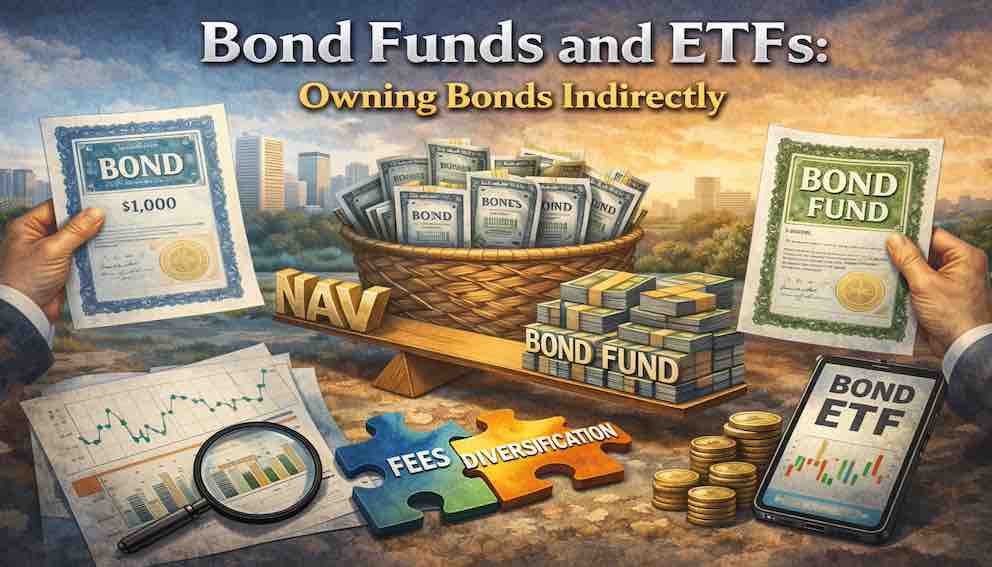
Investing in individual bonds can be rewarding but also challenging, especially when it comes to managing large portfolios, tracking interest rate changes, and maintaining diversification. Bond funds and ETFs offer a practical way to access bonds indirectly, pooling investor capital to trade and manage a diversified portfolio. This tutorial explains how bond funds work, how net asset value (NAV) changes, why constant maturity affects returns differently than owning individual bonds, and what fees and diversification mean in practice. By the end, you will understand when bond funds are appropriate for your portfolio and how they trade certainty for flexibility and professional management.
Introduction: The DIY Approach vs. The Managed Garden
Imagine you are a gardener. Buying an individual bond is like planting one specific apple tree. You know exactly what kind of tree it is, when it will produce fruit (its maturity), and roughly how much fruit it should produce each year. As long as the tree stays healthy, you can rely on it. But all your risk is tied to that one tree.
Now imagine investing in a managed orchard instead. This is what a bond fund looks like. You own a small share of hundreds of different trees, all at different stages of growth. A professional gardener, the fund manager, takes care of the orchard. They plant new trees, remove old ones, and adjust what is grown over time. Your harvest comes from the orchard as a whole, not from any single tree.
The key difference is ownership. With a bond fund, you no longer own a single asset with a known end date. You own a share of a portfolio that is constantly renewed. In exchange for giving up maturity and certainty, you gain diversification, flexibility, and professional management.
Understanding this trade-off is essential to using bond funds correctly.
Part 1: The Core Mechanism – A Pool, Not a Promise
A bond fund is a collective investment vehicle. When you buy shares, your money is pooled with that of thousands of other investors. This pool is used by a fund manager to construct and maintain a portfolio of bonds according to a specific mandate—for example, "U.S. Investment-Grade Corporate Bonds" or "Short-Term Municipal Bonds."
Net Asset Value (NAV): Your Share Price
Unlike an individual bond that has a face value (e.g., $1,000), a bond fund does not guarantee repayment of principal. Instead, your investment is measured by Net Asset Value (NAV), which is calculated at the end of each trading day.
Example:
- Suppose the "Steady Income Bond Fund" holds three bonds:
- Bond A: $1,000,000 market value
- Bond B: $500,000 market value
- Bond C: $1,500,000 market value
- Total portfolio value = $3,000,000
- Shares outstanding = 300,000
- NAV per share = $3,000,000 ÷ 300,000 = $10
If interest rates rise and Bond A and Bond B fall in market value to $900,000 and $450,000 respectively, the total value becomes $2,850,000. NAV per share = $2,850,000 ÷ 300,000 = $9.50.
Notice: no bond defaulted. Your statement shows a decline because the market values of the bonds changed, not because the bonds failed to pay. This illustrates the daily reality of fund ownership, in contrast to holding an individual bond to maturity.
Part 2: The "Constant Maturity" Conundrum – A Perpetual Roll
An individual bond has a fixed maturity. Buy a 10-year bond, and in 10 years it expires, returning your principal. Its sensitivity to interest rates (duration) decreases daily, like sugar dissolving in water.
A bond fund, however, typically maintains a constant average maturity or duration target. The fund manager collects coupons, reinvests principal from maturing bonds, and sells bonds to maintain the fund’s risk profile. The fund has no fixed "maturity," it perpetually rolls.
Example: Two investors in a rising rate environment
- Lena buys a single 10-year Treasury note yielding 1.5%. As rates rise, the market price falls. But if she holds to maturity, she will receive her principal plus the 1.5% coupon each year. Her return is locked in.
- Sam buys shares in an intermediate Treasury bond fund with an average maturity of 10 years. The fund’s NAV drops like Lena’s bond, but the manager reinvests matured bonds into higher-yielding bonds. Sam’s future income potential gradually increases.
Key takeaway: bond funds react differently to interest rate changes than individual bonds due to continuous reinvestment and turnover.
Part 3: Diversification – Reducing Risk Through Numbers
Diversification is one of the biggest advantages of bond funds. By pooling capital, investors gain access to a wide range of bonds they could not buy individually.
Example:
Suppose a $10,000 investment is spread across 200 bonds. Each bond represents only 0.5% of the portfolio. If one bond defaults, the effect on the total investment is minimal. Contrast this with buying a single corporate bond for $10,000: a default would wipe out your entire principal.
Bond funds reduce issuer-specific risk, spread sector exposure, and provide smoother income streams. While the orchard metaphor captures this concept, numbers reinforce the real-world impact.
Part 4: Bond ETFs – Trading Bonds Like Stocks
Exchange-Traded Funds (ETFs) operate like bond funds but trade on stock exchanges throughout the day.
- They have an underlying NAV based on their bond holdings.
- They have a market price set by buyers and sellers.
Normally, arbitrage keeps the market price close to NAV. However, during periods of stress, such as March 2020’s “dash for cash,” bond ETFs traded below NAV because panic selling overwhelmed the arbitrage mechanism.
Lesson: ETFs provide liquidity and convenience, but the liquidity of the share is not the same as the liquidity of the underlying bonds. You can sell a share instantly, but the price may not fully reflect the underlying value.
Part 5: Costs, Income, and Practical Considerations
Fees and Expenses
Bond funds charge management fees, usually expressed as an expense ratio, deducted from the fund’s assets.
- Example: a 0.5% annual expense ratio reduces your effective yield by half a percent.
- While seemingly small, fees accumulate over time, especially in low-yield environments.
Income Variability
Unlike a single bond with fixed coupons, a bond fund’s income can fluctuate. Coupon payments depend on:
- Reinvestment of matured bonds
- Changing yields of new purchases
- Shifts in the portfolio’s composition
Investors seeking predictable cash flows must understand that income from bond funds may vary month to month.
Part 6: Practical Guidance – Choosing Your Path
When individual bonds make sense:
- Known future liability: e.g., college tuition in 7 years.
- Predictable, non-fluctuating income for living expenses.
- Psychological comfort with holding to maturity despite interim price swings.
When bond funds or ETFs make sense:
- Broad diversification with minimal capital.
- Professional, active management of credit and interest rate risk.
- Flexible allocation: quick adjustment of duration or market exposure.
- Automatic reinvestment and simplified portfolio management.
Conclusion: The Mental Model of the "Perpetual Portfolio"
Moving from individual bonds to bond funds is a shift from certainty to dynamic management.
- A single bond is a known IOU with a fixed maturity and coupon.
- A bond fund is a perpetual business owning bonds. NAV fluctuates, income varies, and principal is not guaranteed on a specific date.
The key mental model: bond funds trade the certainty of individual bonds for the flexibility, diversification, and professional management of pooled assets.
Understanding this distinction allows you to use bond funds effectively, set realistic expectations, and leverage them as a powerful tool in a modern fixed-income portfolio.
About Swati Sharma
Lead Editor at MyEyze, Economist & Finance Research WriterSwati Sharma is an economist with a Bachelor’s degree in Economics (Honours), CIPD Level 5 certification, and an MBA, and over 18 years of experience across management consulting, investment, and technology organizations. She specializes in research-driven financial education, focusing on economics, markets, and investor behavior, with a passion for making complex financial concepts clear, accurate, and accessible to a broad audience.
Disclaimer
This article is for educational purposes only and should not be interpreted as financial advice. Readers should consult a qualified financial professional before making investment decisions. Assistance from AI-powered generative tools was taken to format and improve language flow. While we strive for accuracy, this content may contain errors or omissions and should be independently verified.