
Tutorial Categories
Last Updated: February 2, 2026 at 10:30
Investing Wisdom Series Introduction
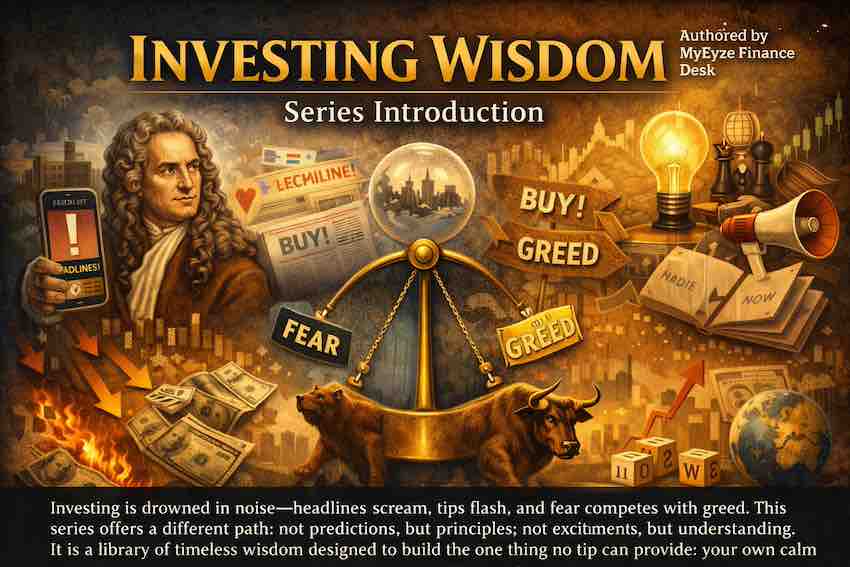
Investing is drowned in noise—headlines scream, tips flash, and fear competes with greed. This series offers a different path: not predictions, but principles; not excitement, but understanding. It is a library of timeless wisdom designed to build the one thing no tip can provide: your own calm judgment.
A Story from 1720
In the autumn of 1720, Sir Isaac Newton sold his shares in the South Sea Company, locking in a profit of £7,000—a fortune at the time. He was content. But as winter approached, he watched from the sidelines as the shares continued to soar. Friends, neighbors, and colleagues were growing far richer, their gains spoken of in coffeehouses and court.
Driven by a feeling we would now call FOMO—the fear of missing out—Newton re-entered the market near its peak. When the bubble finally burst, he lost £20,000. His famous lament was not about mathematics or markets, but about human nature: “I can calculate the motion of heavenly bodies, but not the madness of people.”
This story, three centuries old, contains the entire reason for this series. The greatest minds are not defeated by a lack of intelligence, but by a surplus of emotion. The market’s central challenge has never been computational. It is psychological.
Today, the noise Newton faced in London’s coffeehouses arrives through a thousand digital channels—headlines, alerts, and social feeds—amplified and accelerated. The feeling is the same: a constant, low-grade anxiety that you should be doing something, that you’re behind, that everyone else knows something you don’t.
This series exists because that feeling is both universal and manageable. Not by finding better tips, but by ceasing to look for them.
The Architecture of Noise
Financial media is built on a simple, relentless engine: urgency. Its currency is your attention, and it earns that attention by stimulating either fear or greed. A “crash” is always imminent; a “revolutionary” opportunity is always slipping away. This creates a perceptual distortion: we come to believe that investing is a series of urgent decisions, of critical moments that must be seized or avoided.
This is an illusion. Successful investing is not a sport of reaction. It is a discipline of patience.
The noise, therefore, is not merely background static. It is an active force that reshapes our decision-making environment, prompting us to act when we should wait and worry when we should be calm. To invest wisely, one must first learn to perceive the noise for what it is: a weather system of human emotion, interesting to observe but dangerous to fly in.
Principles as Antidotes
If noise is the disease, principles are the inoculation. A principle is not a tactic for today’s market. It is a framework for understanding all markets.
Consider the principle of a margin of safety, introduced by Benjamin Graham in the 1930s. It is the simple idea of buying something for meaningfully less than your estimate of its worth. This principle provided clarity in 1932, in 1974, in 2008, and will provide it in the next crisis. It requires no update.
Or consider diversification—not as the hollow mantra of “don’t put all your eggs in one basket,” but as the mathematical insight that uncorrelated risks can combine to produce a more stable outcome. This principle protects you from the specific, catastrophic failure that no tipster can predict.
These principles are quiet. They are undramatic. They will never trend on social media. Their power lies precisely in their boredom, in their immunity to the news cycle. They work not by helping you predict the future, but by structuring your actions so that you don’t need to.
What You Will Not Find Here
Let us be explicit about the boundaries of this library.
- You will find no stock recommendations.
- You will find no price targets or market predictions for the coming quarter.
- You will find no “secret strategies” or promises of abnormal returns.
- You will find no urgent calls to action.
This is not an omission; it is the premise. The goal is not to tell you what to think about the market next week. The goal is to change how you think about investing for the next decade.
The Shape of the Wisdom Ahead
This series is structured as a progression from the internal to the external. We begin where all lasting success must begin: with the self.
Part I examines the psychology of the investor. We will explore why we are wired to fail, how emotions create predictable cycles of buying high and selling low, and why intelligence is often a poor defense against instinct.
Part II steps back to observe the market itself as a phenomenon. We will study its historical rhythms—its bubbles, its busts, its tendency to revert to means—not as abstract patterns, but as the collective output of the very psychology we examined in ourselves.
Part III builds a foundation of core principles. Concepts like risk, margin of safety, and allocation are not presented as rules to follow, but as tools for thinking. They are the intellectual scaffolding on which sound decisions are built.
Part IV translates principle into practice. We will discuss the mechanics of strategy—how to buy, how to size positions, when to sell—always focusing on the systematic removal of emotional choice.
Parts V through VII then expand the view, exploring different investment philosophies, the lessons of history’s great investors, and the macroeconomic realities that provide context. Finally, we will synthesize everything into the creation of a personal investment philosophy—a written constitution for your future decisions.
Each tutorial is designed to stand alone as a complete exploration of one idea, yet together they form a coherent architecture of understanding.
Continuing Your Investment Learning
Becoming a skilled investor is a lifelong journey. There are three core pillars to explore: fundamental analysis (understanding businesses, financial statements, and valuation), technical analysis (interpreting price trends and market signals), and behavioral finance (how human psychology drives market cycles and decisions). These pillars complement the timeless principles from this series, giving context and structure to each choice you make. Each area opens doors to deeper insights, practical lessons from history, and guidance for disciplined decision-making.
To deepen your understanding of market psychology and the behavioral patterns that influence investing decisions, explore our Behavioral Finance series here. To gain a broader perspective on how the economy works and how macro forces shape markets, visit our Macroeconomy series here. And to become a more mature investor who learns from history, our World Financial History series provides case studies, patterns, and lessons from markets across centuries here.
Combine these studies with reflection on your own past investing actions, and you’ll develop the calm, informed mindset needed to navigate markets confidently and build resilient, long-term portfolios.
A Quiet Conclusion
The physicist Richard Feynman once said, “The first principle is that you must not fool yourself—and you are the easiest person to fool.”
This series is, in essence, a guided effort in not fooling ourselves. It is an invitation to replace the seductive clarity of fleeting tips, market noise, and hype with the durable, hard-won clarity of timeless investing principles. The journey will be slower—but the knowledge you build will be yours. It will rest on ideas that have stood the test of centuries, the same lessons that guided investors from Benjamin Graham and Warren Buffett to Peter Lynch and Howard Marks.
By the end of this series, you will not simply understand concepts—you will have built:
- A calmer, more composed investor mindset – able to see through market hysteria and act with clarity rather than impulse.
- Historical perspective and insights from top investors – learning from the successes and mistakes of the greatest minds and understanding why their wisdom endures.
- A resilient portfolio mindset – knowing how to construct and maintain investments that can weather bull and bear markets, crises, and bubbles without being derailed.
- A structured approach to decision-making – frameworks that guide what to do, when to wait, and how to size positions without gambling on luck.
You will also find paths to deepen your knowledge beyond this series: recommended readings, case studies, historical analyses, and advanced frameworks that reinforce your understanding and make you an even stronger investor over time.
You will not finish this series with a list of stocks to buy. Instead, you will finish with something far more valuable: the ability to filter out the noise, understand the forces at play in the market, and return to your work or life with calm confidence.
That is the promise: not instant riches, but clarity, composure, and the enduring tools of a wiser investor. Let us begin.
About Swati Sharma
Lead Editor at MyEyze, Economist & Finance Research WriterSwati Sharma is an economist with a Bachelor’s degree in Economics (Honours), CIPD Level 5 certification, and an MBA, and over 18 years of experience across management consulting, investment, and technology organizations. She specializes in research-driven financial education, focusing on economics, markets, and investor behavior, with a passion for making complex financial concepts clear, accurate, and accessible to a broad audience.
Disclaimer
This article is for educational purposes only and should not be interpreted as financial advice. Readers should consult a qualified financial professional before making investment decisions. Assistance from AI-powered generative tools was taken to format and improve language flow. While we strive for accuracy, this content may contain errors or omissions and should be independently verified.