
Tutorial Categories
Last Updated: January 29, 2026 at 10:30
Risk in Capital Budgeting Explained: Uncertainty, Irreversibility, and Managerial Flexibility - Financial History Series
Risk in capital budgeting is not about volatility, formulas, or adjusting discount rates until the spreadsheet feels comfortable. It is about exposure: what can go wrong, what cannot be undone, and how constrained a firm becomes once capital is committed. This tutorial explains why uncertainty becomes dangerous only when it meets irreversibility, why shortcut metrics like IRR and payback often hide the most important risks, and why flexibility is often the real economic asset in investment decisions. Using concrete business examples, it shows how scenario analysis and stress testing are tools for revealing vulnerability rather than predicting outcomes. The goal is to help managers and students ask better questions about exposure, adaptation, and survival after commitment.
Introduction: Risk Is Not a Number, It's a Trap
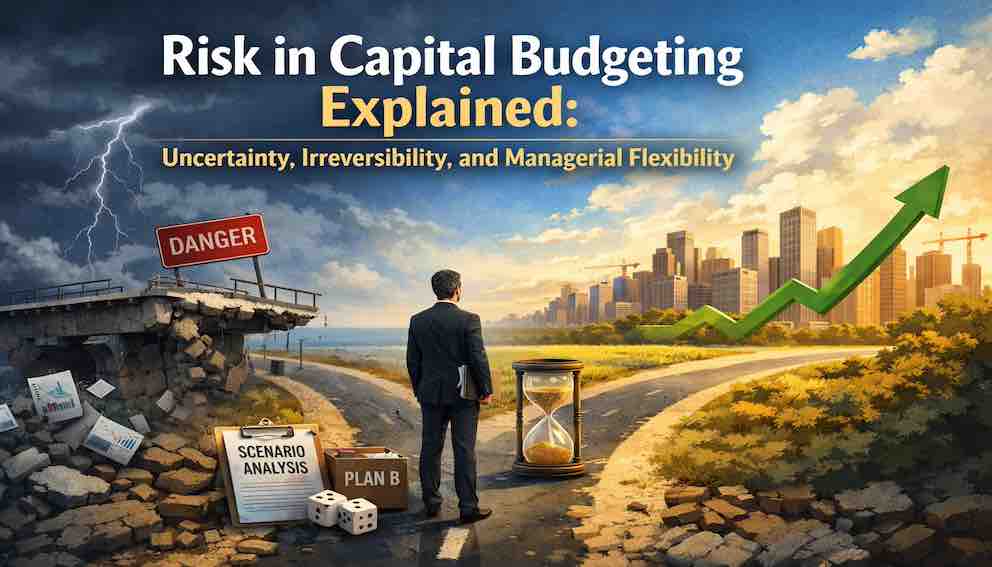
When managers talk about risk in investments, they often sound like statisticians: "The forecast has a standard deviation of 10%." But in reality, managers don't fear a 10% swing. They fear the trap—the point where a bad outcome meets an irreversible commitment, leaving the firm stuck, bleeding cash, with no good way out. True risk in capital budgeting isn't about fluctuations around an average; it's about exposure to a future you can't adapt to.
A Tale of Two Risks: The Pop-Up Shop vs. The Factory
Imagine a clothing brand, "Urban Threads," wants to enter a new city. It has two strategies:
- Strategy A (The Pop-Up): Rent a small storefront for 6 months. Invest in a limited inventory and local marketing.
- Strategy B (The Flagship): Buy a prime property, sign a 10-year lease, invest in a full inventory and custom fittings.
Both strategies face the same uncertainty: Will the city's fashion trends embrace the brand? But they carry vastly different risk.
If the pop-up fails, Urban Threads loses 6 months of rent and some inventory. It's a manageable setback. If the flagship fails, the firm is trapped in a 10-year lease with a huge, illiquid store it can't fill. The irreversibility of the commitment (the long lease, the custom fittings) transforms the same uncertainty into an existential threat. Risk is the product of Uncertainty x Irreversibility(not as a formula, but as a way of thinking about how danger is created).
Why "Expected Value" Can Be a Dangerous Illusion
Let's say a spreadsheet spits out an "expected" NPV of +£100,000 for the flagship store, based on a 60% chance of success and a 40% chance of a moderate loss. That sounds positive. But what if that "moderate loss" scenario actually means being stuck in a lease that costs £50,000 a year for a decade? The £100,000 expected gain is a mathematical average that hides a catastrophic downside.
This is the core problem: risk is asymmetric. The upside (more profit) is nice, but the downside (being trapped in a loss-making commitment) can kill the firm. Good capital budgeting focuses on understanding and limiting that downside exposure, not just calculating the average.
The Fatal Flaw of "Fixing" Risk with the Discount Rate
A common shortcut is to take a "risky" project and just increase the discount rate until the NPV looks small or negative. This is like seeing a suspicious, deep hole in the ground and deciding to just paint it black so you can't see it anymore. You haven't made it safer; you've just hidden it.
Increasing the discount rate punishes all future cash flows but doesn't tell you why the project is risky. Is it because demand is fickle? Because costs could spike? Because a new law could shut you down? Bluntly hiking the rate obscures the specific, actionable vulnerabilities. It gives a false sense of control while leaving the structural trap completely unexamined.
How IRR and Payback Hide the Trap
This is also why managers love metrics like Payback Period and IRR. They are comforting illusions, not risk-analyzers.
A two-year payback feels safe because you "get your money back fast," reducing the time you're exposed. But it ignores what happens after payback. What if the project becomes a huge liability in year three? Payback doesn't care.
A high IRR feels efficient, but it says nothing about the project's durability or what happens in a bad scenario. These metrics provide psychological comfort by compressing the complex reality of exposure into a simple, seemingly safe number.
Scenario Analysis: Mapping the Traps
The antidote to hiding risk is to bring it into the light. Scenario Analysis doesn't try to predict the one right future. It builds a few plausible, coherent stories about how the world could turn out to see where the traps are.
For Urban Threads' flagship store, instead of one "base case," management should model:
- The Best Case: Trends take off, becoming the city's hot brand.
- The Base Case: Steady, modest growth as planned.
- The Stress Case: A new competitor opens next door, stealing 30% of forecast sales.
- The Survival Case: A recession hits; consumer spending drops 40%.
The goal isn't to guess probabilities. It's to answer: "In the Survival Case, do we go bankrupt, or can we adapt?" If the model shows that even a mild stress case wipes out all cash and triggers loan covenants, you've identified a fatal trap. The single-point NPV is irrelevant; the project is too fragile.
Sensitivity Analysis: Finding the Brittle Parts
Sensitivity Analysis is the diagnostic tool that pokes at individual assumptions. You ask: "Which variable, if we're slightly wrong, hurts us the most?"
For a mining project, NPV might be highly sensitive to the commodity price but barely budge if labour costs rise 10%. This tells you the biggest risk is price exposure, not wage negotiations. You now know where to focus your risk management—maybe by hedging the commodity price—instead of worrying about everything equally.
The Systemic Danger: When Risks Correlate
The most dangerous risks are rarely confined to one project. They are systemic—they strike across the entire portfolio at once. A recession doesn't just hurt one flagship store; it hurts all discretionary retail. A spike in interest rates doesn't just affect one loan; it tightens financing for the whole firm and its customers.
This is why evaluating projects in isolation is so misleading. A portfolio of projects, each with a "fast payback," can still collapse simultaneously if they all depend on the same fragile economic assumption. True risk assessment must ask: "What could happen that would cause all our key assumptions to break at the same time?" This systemic perspective transforms scenario analysis from a project review into a test of the firm's entire strategic positioning.
The Ultimate Test: The Survival Stress Test
The most important question is often ignored: "Can the business survive being wrong?"
A Stress Test forces you to answer this. It applies extreme but plausible shocks to see if the firm breaks. For example: "What if our top three customers leave simultaneously? What if our main factory is shut down for 6 months? What if interest rates double?"
If the project—or the entire firm—cannot withstand these correlated, systemic stresses without collapsing, then it is riskier than any spreadsheet NPV can convey, regardless of the discount rate used.
Flexibility: The Ultimate Risk Mitigation Tool
This brings us to the most powerful concept: Flexibility is a valuable asset. When you can adapt your decisions as the future unfolds, you turn uncertainty from a threat into an opportunity. This is often called Real Options.
Let's return to Urban Threads. A flexible, lower-risk strategy might be:
- Start with the Pop-Up (The Pilot): Low commitment, low irreversibility.
- If it's a hit, you have the option to expand (lease the bigger flagship).
- If it fails, you have the option to abandon with minimal loss.
The "option to expand" has real value because it lets you benefit from upside without being forced to suffer the full downside upfront. A traditional NPV of the pop-up alone might underestimate its total value because it misses this strategic optionality. Designing projects with built-in flexibility—modular phases, short-term leases, scalable technology—is one of the most effective forms of risk management.
Conclusion: From Calculating Risk to Managing Exposure
We've learned that risk in capital budgeting is not a statistical input to be fed into a formula. It is the economic exposure created when irreversible commitments collide with an uncertain future.
The sophisticated financial manager doesn't just calculate a single NPV. They use scenarios to map the terrain of possible futures, sensitivity analysis to find brittle assumptions, and stress tests to check for survivability—especially from risks that could strike the entire portfolio at once. Most importantly, they design flexibility into investments to preserve the ability to pivot, adapt, and survive.
The final question for any capital allocation decision is not "What's the expected return?" but "Where are we exposed, what happens if we're wrong, and what can we still do about it?" Answering that moves you from being a passive calculator of risk to an active manager of the firm's future.
About Swati Sharma
Lead Editor at MyEyze, Economist & Finance Research WriterSwati Sharma is an economist with a Bachelor’s degree in Economics (Honours), CIPD Level 5 certification, and an MBA, and over 18 years of experience across management consulting, investment, and technology organizations. She specializes in research-driven financial education, focusing on economics, markets, and investor behavior, with a passion for making complex financial concepts clear, accurate, and accessible to a broad audience.
Disclaimer
This article is for educational purposes only and should not be interpreted as financial advice. Readers should consult a qualified financial professional before making investment decisions. Assistance from AI-powered generative tools was taken to format and improve language flow. While we strive for accuracy, this content may contain errors or omissions and should be independently verified.