
Tutorial Categories
Last Updated: February 12, 2026 at 10:30
Why Capital Structure Exists: Debt vs Equity, Taxes, Risk, Incentives, and Control Explained
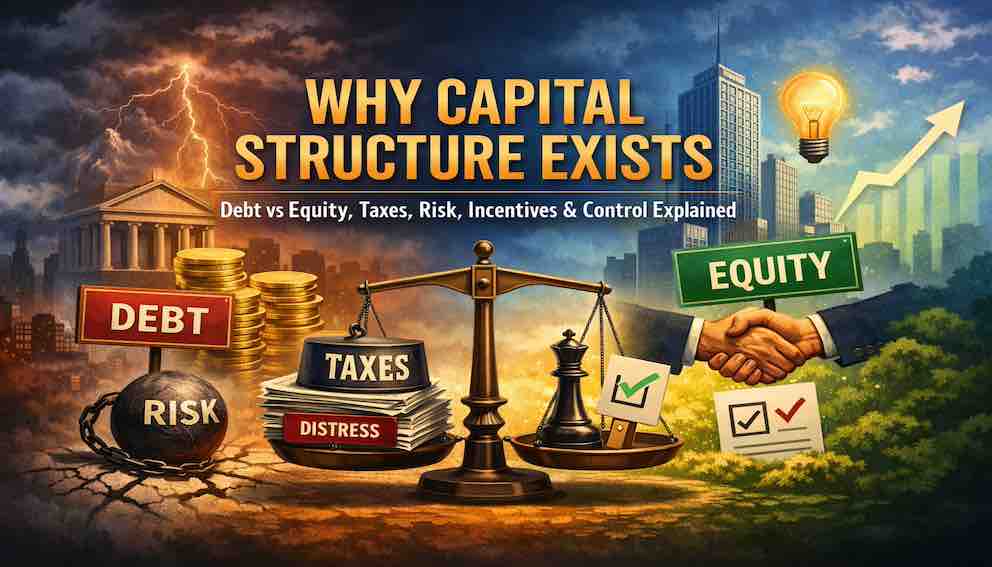
Why do some companies operate comfortably with billions in debt while others avoid borrowing almost entirely? If debt is dangerous, why do successful firms use it voluntarily? And if equity is safe, why not fund everything with ownership capital? This tutorial explains why capital structure exists at all and why it is not about formulas but about trade-offs. We will walk slowly through taxes, bankruptcy risk, managerial incentives, control, life cycle effects, and the deeper theories that explain financing decisions. By the end, you will see capital structure not as a ratio on a balance sheet, but as a strategic choice shaped by uncertainty, power, and human behavior.
Introduction: The Question Behind Every Balance Sheet
Open any corporate balance sheet and you will see two broad categories on the right-hand side: debt and equity. One represents money borrowed with a promise to repay. The other represents ownership capital contributed by shareholders. Together they finance the assets of the firm.
At first glance, this division appears technical. Money is money. Whether it comes from a bank or an investor, it still funds factories, hires employees, and buys inventory. Yet this surface view misses something fundamental. The source of money changes behavior. It changes who bears risk. It changes who has power. It changes what happens in good times and what happens when things go wrong.
So the real question is not simply what capital structure is. The deeper question is why capital structure exists at all. If funding is just funding, why does the mix matter?
To answer that properly, we must begin with a benchmark world that does not exist.
The Benchmark: A World Where Capital Structure Would Not Matter
In a perfectly frictionless world, capital structure would be irrelevant.
Imagine a world with no corporate taxes, no bankruptcy costs, no agency conflicts between managers and investors, no information asymmetries, and no transaction costs. In that world, whether a firm financed itself with 100 percent equity or 50 percent debt and 50 percent equity would not change its total value.
Why?
Because investors could replicate any capital structure on their own. If a firm used too little debt, an investor who preferred leverage could borrow personally. If a firm used too much debt, an investor could offset that risk by lending or holding more equity elsewhere. The mix of debt and equity at the firm level would not create or destroy value — it would simply rearrange who bears risk.
This insight forms the foundation of what is known as the Modigliani–Miller theorem. Its core proposition is stark: in the absence of frictions, the value of the firm depends only on the cash flows generated by its assets — not on how those cash flows are divided between debt holders and equity holders.
In other words, slicing the pie differently does not change the size of the pie.
Capital structure, in that ideal world, would be a cosmetic choice.
But we do not live in that world.
We live in a world with taxes. We live in a world where bankruptcy destroys value. We live in a world where managers are human, investors disagree, information is imperfect, and control matters deeply.
Once these frictions enter the picture, the way we slice the pie can change the size of the pie.
Capital structure exists because these frictions exist.
A Simple Analogy: Buying a House
Consider a decision you may one day face: buying a house.
You could wait fifteen years, save every pound, and pay cash. Or you could borrow most of the purchase price today and move in immediately.
In both cases, you end up living in the house. But the experience is different.
If you pay cash, you sleep peacefully. There are no monthly payments. But you waited years to move in.
If you borrow, you move in immediately. Yet every month, regardless of how life unfolds, the mortgage payment is due. If your income falls, the bank does not share your stress. It expects payment.
Corporate financing is exactly the same. Firms can finance growth with retained earnings and new equity, or they can borrow. The cash raised may be identical, but the obligations attached to that cash are profoundly different.
This is why capital structure is not an accounting curiosity. It is a choice about pressure, timing, flexibility, and control.
What Capital Structure Really Means: Two Bakers
Let us step away from formulas for a moment.
Imagine two people — Priya and James — who both dream of opening a bakery. Each needs £100,000 to buy ovens, renovate the space, and purchase equipment.
Priya has spent years saving. She has the full £100,000 in cash.
James has only £20,000. To open his bakery, he borrows £80,000 from a bank.
There is something subtle here.
Priya could open only because she waited. She delayed her dream until she had accumulated enough capital. Her path required patience and accumulation before action.
James did not need to wait. Debt allowed him to begin immediately. Instead of spending years saving, he used future cash flows — the bakery’s expected earnings — to finance the present.
On opening day, their bakeries look identical. The ovens are the same. The counters are the same. Customers smell the same bread. From the outside, there is no visible difference.
Both businesses contain £100,000 worth of assets. But their financial lives are not the same.
Now imagine that sales are disappointing in the first month.
Priya earns less than she expected. She may decide not to pay herself. She absorbs the shortfall quietly. There is no one demanding a payment from her. The business can survive a slow start because no legal obligation forces cash out of the firm.
James faces something different. Regardless of how sales go, he owes the bank a fixed payment. The bank does not adjust its expectations based on foot traffic. If he cannot make that payment, the bank has the right to take back the ovens.
Nothing about the bakery itself has changed. But the pressure is different. Debt does not change the physical assets. It changes the timing and consequences of performance.
Because James has that fixed obligation, he will likely behave differently. He may open earlier. He may close later. He may advertise more aggressively. He may watch costs with unusual intensity. Debt creates urgency. It narrows the margin for error.
But now let us consider a different outcome.
Suppose the bakery does well. At the end of the year, it earns £20,000 in profit.
Priya invested £100,000 of her own money. She earns £20,000. That is a 20 percent return.
James must first pay interest — say £5,000. After that payment, £15,000 remains for him. But he invested only £20,000 of his own savings. So £15,000 on £20,000 is a 75 percent return.
Debt magnifies outcomes. It increases pressure in weak periods. It increases returns in strong periods. And it accelerates opportunity by allowing action before full capital is accumulated.
Equity provides flexibility because losses are absorbed quietly.
Debt provides speed, scale, and higher potential returns — but it introduces fragility and the possibility of loss of control.
Capital structure is not simply about where the money came from. It is about how financing changes timing, incentives, risk, and behavior.
And that is why two identical bakeries can represent two very different financial lives.
The First Attraction of Debt: The Tax Shield
Now we move to the first major friction: taxes.
In many tax systems, interest payments on debt are deductible. Dividends paid to shareholders are not.
Let us walk through this carefully.
Suppose your business earns £100,000 before interest and taxes. The corporate tax rate is 30 percent.
If you have no debt, you pay £30,000 in tax and keep £70,000.
Now suppose you have borrowed money and pay £20,000 in interest. Your taxable income is no longer £100,000. It is £80,000.
Thirty percent of £80,000 is £24,000.
By borrowing, you reduced your tax bill by £6,000. The government effectively paid 30 percent of your interest expense.
That £6,000 is real cash. It increases the value of the firm. This benefit is known as the tax shield of debt.
The more stable and predictable your profits, the more valuable this shield becomes. Over time, it can amount to substantial savings.
This is the glitter on the slope of debt.
The Second Force: The Cost of Financial Distress
Debt can help a firm grow. It can create tax savings. It can sharpen discipline.
But debt has a shadow.
When a firm borrows, it makes a promise. That promise must be honored regardless of whether the year turns out well or badly. If the firm begins to struggle and cannot comfortably meet its obligations, it enters what we call financial distress.
Notice something important: distress does not begin the day a firm declares bankruptcy.
It begins much earlier.
Imagine that rumors start circulating that a company is under pressure.
Suppliers hear about it. They begin to worry: Will we be paid? Instead of allowing payment in 60 days, they demand cash on delivery.
Customers hear about it. They hesitate before signing long-term contracts. They ask themselves: Will this company still be around next year?
Employees sense instability. Some begin looking for safer jobs. The most talented often leave first.
Managers, instead of focusing on innovation or growth, spend their days negotiating with lenders, restructuring payment schedules, and reassuring stakeholders.
None of this shows up clearly as a line item called “distress cost.”
But the business weakens.
These are indirect costs of financial distress. They are subtle, but they are powerful.
If the situation worsens, direct costs appear. Legal fees accumulate. Advisors are hired. Assets may be sold quickly, and when assets are sold under pressure, they rarely fetch their full value.
So debt creates two forces pulling in opposite directions.
On one side, there is benefit. Interest payments reduce taxable income. That means the government effectively shares part of the cost of borrowing. As debt increases, these tax savings increase.
On the other side, there is risk. As debt increases, fixed obligations increase. And as fixed obligations increase, the chance that the firm cannot meet them also increases — especially if revenues fluctuate.
At low levels of borrowing, the risk of distress may be small. The firm enjoys tax savings, and the probability of serious trouble remains remote.
But as borrowing rises, the situation changes gradually. The firm becomes less flexible. A small downturn that once would have been manageable now feels threatening.
There is no sudden cliff. There is no flashing red line.
Instead, there is a gradual shift.
At some point, the additional benefit from borrowing a little more is roughly matched by the additional fragility it introduces.
Beyond that point, extra debt may do more harm than good.
This is what the trade-off theory is trying to describe — not a precise formula, but a balancing act.
Firms borrow because debt provides advantages.
They stop borrowing because too much debt makes survival uncertain.
The “right” amount of debt is therefore not a single number carved in stone. It is a range — a zone in which the firm gains the advantages of borrowing without becoming dangerously exposed.
Finding that range requires judgment. It depends on how stable the firm’s cash flows are, how competitive its industry is, how easily its assets can be sold, and how much volatility management can realistically withstand.
Debt can add value.
But if pushed too far, it quietly begins to subtract it.
And that subtraction often begins long before anyone uses the word “bankruptcy.”
Risk Determines Capacity
Not all firms face the same level of uncertainty.
A regulated water utility has stable, predictable cash flows. Customers pay their bills regardless of economic conditions. Such a firm can safely carry significant debt because the likelihood of missing interest payments is low.
A biotechnology startup developing an experimental drug has no guaranteed revenue. Its future depends on regulatory approval and scientific success. Heavy borrowing would be reckless.
Risk is not just volatility in share price. It is the unpredictability of operating cash flows. The more uncertain the future, the more equity a firm needs as a cushion.
Debt requires predictability. Equity tolerates uncertainty.
Asset Tangibility and Collateral
Lenders care about recoverability.
If a real estate company defaults, its properties can be sold. If a manufacturing firm defaults, its machinery can often be repurposed or auctioned.
But what if a software startup defaults? Its primary assets may be code and human capital. Those are difficult to liquidate. There is little collateral.
Firms with tangible, easily valued assets can borrow more because lenders feel protected. Firms built on intangible assets must rely more heavily on equity.
This is why capital structure varies systematically across industries. It is not fashion. It is collateral.
Incentives and Agency Conflicts
Human behavior introduces another friction: agency problems.
Managers may not always act in the best interests of shareholders. When firms accumulate large cash reserves, managers may invest in projects that increase company size but not shareholder value. Debt can serve as a disciplining device by forcing regular interest payments, reducing free cash flow available for wasteful spending.
However, agency conflicts also arise between shareholders and creditors.
Imagine James the baker is deeply in debt and near default. A risky new oven could either rescue the bakery or destroy it completely. If it succeeds, James benefits enormously. If it fails, the bank absorbs most of the loss.
From James’s perspective, the gamble is rational. He has little left to lose. This is called risk-shifting or asset substitution.
Creditors anticipate this possibility. They impose covenants, require collateral, and monitor behavior. Capital structure is therefore a negotiated arrangement shaped by incentive conflicts.
Financing as Control Allocation
Debt and equity differ not only in risk but in power.
Equity investors typically receive voting rights. They influence board composition and strategic direction. Issuing new shares dilutes ownership and control.
Debt holders, by contrast, usually have no voting rights unless default occurs. They receive fixed payments and contractual protections but rarely participate in daily governance.
This distinction explains why some founders prefer debt even when equity might appear financially safer. Borrowing preserves control. Issuing shares distributes it.
Private equity firms often use significant leverage for precisely this reason. By financing acquisitions largely with debt, they avoid sharing ownership broadly and retain concentrated control.
Capital structure is therefore a political decision as much as a financial one. It allocates authority.
The Pecking Order: How Firms Actually Finance
In practice, firms often follow what is known as the pecking order theory.
They prefer to finance investments first with internal funds, such as retained earnings. If internal funds are insufficient, they prefer debt. Equity issuance is typically a last resort.
Why?
Because issuing new shares can signal that management believes the stock is overvalued. Investors may interpret equity issuance as a negative signal, leading to price declines.
Debt is less sensitive to such signaling concerns. Borrowing does not usually imply overvaluation.
Thus, firms often move down a hierarchy: internal cash, then debt, then equity. This pattern is not universal, but it is common enough to influence corporate behavior.
The Life Cycle of Leverage
Capital structure evolves as firms mature.
Young firms rely heavily on equity because they lack stable cash flows and collateral. Lenders hesitate to extend credit.
As firms grow and earnings stabilize, they gain borrowing capacity. They introduce moderate debt to capture tax benefits and enhance returns.
Mature firms with strong cash flows may increase leverage further, sometimes borrowing to repurchase shares or distribute dividends. This stage reflects confidence in stability and a desire to optimize capital allocation.
Thus, capital structure is dynamic. It reflects where a firm stands in its economic life.
Why There Is No Magic Ratio
Textbooks sometimes depict an optimal capital structure as a precise point on a graph. In reality, managers operate within a range.
The probability of bankruptcy cannot be measured with certainty. The exact cost of distress is unknowable in advance. Economic shocks occur unexpectedly.
Rather than targeting a single number, prudent managers ask practical questions:
Can we survive a significant downturn?
Are lenders comfortable with our risk profile?
Do we retain flexibility for future opportunities?
Can we sleep at night with this obligation?
Capital structure is ultimately a judgment call under uncertainty.
Connecting to the Cost of Capital
One final insight prepares us for the next step in the series.
Debt is usually cheaper than equity because creditors bear less risk. They are paid before shareholders in bankruptcy. Therefore, they demand lower returns.
However, increasing debt makes equity riskier. As leverage rises, equity holders demand higher returns to compensate for increased volatility.
The overall cost of capital is therefore shaped by this interaction. Borrowing can lower average cost up to a point, but excessive leverage raises required returns across the board.
Capital structure does not change only risk distribution. It changes required returns. And required returns determine firm value.
Conclusion: Capital Structure as a Strategic Choice
Capital structure exists because the real world is imperfect.
If there were no taxes, debt would lose its subsidy.
If there were no bankruptcy costs, leverage would be harmless.
If managers were perfect stewards, discipline would be unnecessary.
If control did not matter, dilution would be irrelevant.
But taxes exist. Distress destroys value. Managers are human. Founders care about power. Cash flows are uncertain.
Debt offers tax benefits, potential return amplification, and discipline. It also introduces fragility and incentive distortions.
Equity offers flexibility, resilience, and shared risk. It also dilutes ownership and demands higher expected returns.
There is no universal formula. Each firm balances these forces differently based on risk, industry, life cycle stage, collateral, governance priorities, and strategic ambition.
When you now look at a balance sheet, do not see just liabilities and shareholders’ equity. See a set of choices about risk tolerance, control, discipline, flexibility, and survival.
Capital structure is not merely a ratio. It is a statement about how a firm chooses to face uncertainty.
In the next tutorial, we will examine how these choices affect the cost of capital and ultimately determine how markets value the firm’s future cash flows.
About Swati Sharma
Lead Editor at MyEyze, Economist & Finance Research WriterSwati Sharma is an economist with a Bachelor’s degree in Economics (Honours), CIPD Level 5 certification, and an MBA, and over 18 years of experience across management consulting, investment, and technology organizations. She specializes in research-driven financial education, focusing on economics, markets, and investor behavior, with a passion for making complex financial concepts clear, accurate, and accessible to a broad audience.
Disclaimer
This article is for educational purposes only and should not be interpreted as financial advice. Readers should consult a qualified financial professional before making investment decisions. Assistance from AI-powered generative tools was taken to format and improve language flow. While we strive for accuracy, this content may contain errors or omissions and should be independently verified.