
Tutorial Categories
Last Updated: February 12, 2026 at 10:30
How Corporate Debt and Financial Leverage Shape Discipline, Fragility, and Default Risk: A Deep Dive into Leverage and Survival
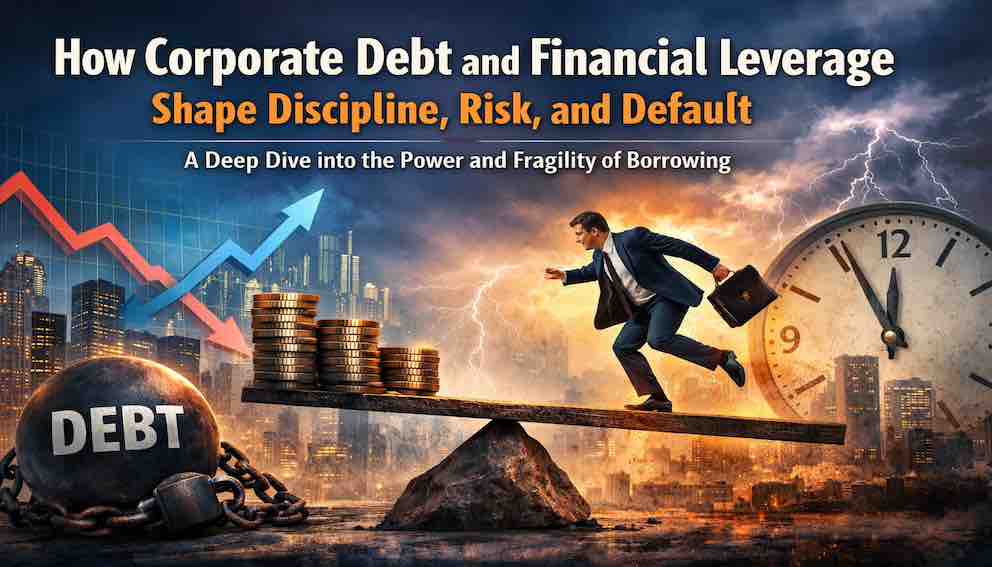
Corporate debt is not merely borrowed money recorded on a balance sheet. It is a contractual force that reshapes incentives, magnifies outcomes, and compresses time. In this tutorial, we explore how financial leverage amplifies both gains and losses, how fixed obligations create discipline but also fragility, and how covenants, refinancing risk, and operating leverage interact to determine survival. We examine what default truly means in practice, how equity behaves when debt rises, and when leverage shifts from strategic to existential. By the end, you will not simply calculate leverage ratios—you will understand what they imply about stability, risk transfer, and long-term resilience.
Risk Transfer and the Option-Like Nature of Equity
When debt enters the capital structure, risk is redistributed among stakeholders.
Debt holders have a contractual claim. They receive fixed payments unless the firm defaults. Their upside is limited to the promised interest and principal. Their downside is mitigated by priority in liquidation.
Equity holders, by contrast, are residual claimants. They receive what remains after all obligations are met.
As leverage increases, equity begins to resemble a call option on the firm’s assets.
If asset value rises significantly above debt obligations, equity captures the upside.
If asset value falls below debt obligations, equity can be wiped out.
This asymmetry creates powerful incentives. When a firm is highly leveraged and approaching distress, shareholders may prefer riskier strategies because they participate fully in upside but share downside with creditors. Lenders understand this dynamic, which is one reason covenants and monitoring exist.
Leverage therefore changes not only financial outcomes, but also incentive structures.
Operating Leverage and Financial Leverage: When Fixed Costs Multiply
To understand why some companies are stable while others are fragile, we need to distinguish between two different kinds of leverage.
They are related, but they operate at different levels.
Operating leverage comes from fixed costs inside the business.
These are costs that do not change much when revenue changes.
Financial leverage comes from fixed obligations created by debt.
These are payments — mainly interest — that must be made regardless of how the business performs.
Both create pressure. But they create pressure in different ways.
Step One: Operating Leverage
Imagine an airline.
An airline must pay for aircraft leases, maintenance infrastructure, airport slots, technology systems, and salaried staff. Many of these costs remain even if fewer passengers fly this month.
This means a large portion of the airline’s costs are fixed.
Now consider what happens when revenue falls.
If ticket sales decline by 10%, total costs do not fall by 10%. Many expenses barely move at all. As a result, profit does not fall gradually. It falls sharply.
That is operating leverage.
Small changes in revenue lead to larger changes in operating profit because fixed costs do not adjust quickly.
The same effect works in reverse. When demand rises, revenue increases while many costs stay fixed. Profit can grow rapidly.
Operating leverage amplifies outcomes — both upward and downward.
Step Two: Financial Leverage
Now add debt to the picture.
Suppose the airline has borrowed heavily to purchase aircraft. It now owes fixed interest payments every quarter.
Interest must be paid whether planes are full or empty.
If operating profit declines because of lower ticket sales, interest payments do not decline. They remain fixed.
This means a decline in operating profit now causes an even larger decline in profit available to shareholders.
That is financial leverage.
Debt magnifies the effect of changes in operating performance on equity returns.
When Both Forms Combine
Now we can see the interaction.
- Revenue falls.
- Operating leverage causes profit to fall more than revenue.
- Financial leverage then causes equity value to fall more than profit.
Fixed costs at two levels — inside operations and inside financing — compound each other.
In expansion, this combination can look impressive.
Revenue rises. Profit rises faster. Equity returns surge.
But in contraction, the same structure becomes dangerous.
Revenue falls. Profit collapses. Equity value can decline dramatically.
The structure that amplified growth now amplifies distress.
A Contrast: Low Operating Leverage
Consider a consulting firm.
It rents modest office space, employs staff who can be hired or released as projects change, and carries little debt.
If revenue declines, expenses can be adjusted more quickly. Costs move more closely with income.
Operating profit falls, but not disproportionately.
With little debt, there are no heavy fixed financial obligations adding further pressure.
The result is a more flexible cost structure and less volatility.
The Core Insight
Industries with high operating leverage — airlines, utilities, manufacturing, telecommunications — already carry significant fixed commitments within their operations.
Adding heavy financial leverage on top of that increases fragility.
Fixed costs at two levels do not merely add risk.
They multiply it.
That is why businesses with high operating leverage must be especially cautious about taking on debt. The combination can create powerful gains in good times — and severe instability in bad times.
Leverage, in both forms, is not inherently good or bad.
It is a structure.
And structures determine how small changes turn into large consequences.
Debt as Discipline: The Agency Perspective
Debt can serve a constructive purpose.
When companies generate large amounts of free cash flow and face limited oversight, managers may invest in projects that increase size but not value. They may pursue acquisitions for prestige rather than profitability. This is an agency problem: managers control resources that belong to shareholders.
Debt reduces this discretionary cash flow. Interest payments force cash out of the firm. Managers must justify new investments carefully because liquidity is constrained.
In this sense, debt can function as a governance tool. It disciplines managerial behaviour by imposing mandatory performance thresholds.
However, discipline and fragility are intertwined. The same fixed obligation that prevents wasteful expansion can become a source of distress if revenues decline unexpectedly.
Debt does not eliminate agency problems. It transforms them.
Fragility: The Mismatch Between Fixed Obligations and Variable Outcomes
Businesses operate in uncertain environments. Revenues fluctuate. Costs shift. Markets evolve.
Debt does not fluctuate with conditions. It is contractual.
This mismatch is the source of fragility.
Imagine a retailer earning £50 million in operating profit with £15 million in annual interest payments. The coverage ratio appears comfortable.
Now a recession reduces profit to £20 million. Interest remains £15 million. The margin for error disappears.
If profit falls further, the company may struggle to meet obligations despite remaining operationally viable.
Fragility is not defined by the absolute level of debt. It is defined by the relationship between fixed commitments and cash flow volatility.
Stable businesses can carry more leverage. Volatile businesses cannot.
Covenants and Monitoring: Debt as Governance Architecture
Debt contracts typically contain covenants that restrict borrower behaviour.
These may require maintaining minimum interest coverage ratios, limiting additional borrowing, restricting dividends, or preserving certain asset levels.
Covenants serve two purposes.
First, they provide lenders with early warning signals.
Second, they influence managerial behaviour before distress occurs.
When management knows that a breach could trigger lender intervention, strategic decisions are made more conservatively.
If a covenant is breached, negotiations often follow. Lenders may waive violations in exchange for higher interest rates, additional collateral, or stricter terms. The balance of power shifts, but liquidation is rarely the immediate outcome.
Debt therefore embeds a system of ongoing oversight. It is not passive capital.
Refinancing Risk and Maturity Structure: Borrowed Time
Debt has maturity dates. Equity does not.
A company may be fully capable of servicing interest payments but still face risk if large obligations mature during adverse market conditions.
This is refinancing risk.
Imagine a company with £200 million in debt maturing next year. Its operations are sound. However, credit markets tighten due to a financial crisis. Lenders become risk-averse. Interest rates rise.
Even a healthy company may struggle to refinance on acceptable terms.
The structure of debt therefore matters:
- Long-term, staggered maturities reduce refinancing concentration risk.
- Short-term debt increases vulnerability to market sentiment.
- Floating-rate debt exposes firms to interest rate increases.
Two companies may report the same leverage ratio, yet face very different levels of risk. The difference often lies in the structure of their debt — specifically, when it must be repaid and whether interest rates are fixed or variable.
This is why debt represents borrowed time. It introduces deadlines that equity does not.
What Default Really Means
Default is rarely an instantaneous collapse. It is typically a process.
It may begin with a technical covenant breach while payments continue.
It may proceed through waivers and renegotiations.
It may escalate to restructuring, where maturities are extended or debt is converted to equity.
Only when the business itself is no longer viable does liquidation become inevitable.
In restructuring, equity holders often lose substantial value. Creditors may accept reduced claims in exchange for preserving long-term recovery.
Understanding this process demystifies default. It is not merely failure. It is reallocation of claims when prior assumptions about cash flow prove too optimistic.
Strategic Leverage Versus Existential Leverage
The central managerial question is not simply whether to use debt.
It is how much debt the business can carry without endangering its survival.
Debt becomes strategic leverage when it enhances returns while the company can still withstand reasonable levels of stress. In this case, borrowing improves efficiency without threatening stability.
Debt becomes existential leverage when even a modest disruption — a downturn, a delay, a shock — could impair the firm’s ability to meet its obligations. At that point, leverage no longer amplifies opportunity. It threatens continuity.
The distinction depends on the stability of the underlying business.
Consider a regulated utility. Its revenues are typically stable and predictable. Demand for electricity or water does not fluctuate dramatically from year to year. Because cash flows are steady, the company can sustain higher levels of debt. Even during economic slowdowns, its ability to service interest payments remains relatively intact.
Now contrast this with a biotechnology startup. Its future depends on research outcomes, regulatory approvals, and uncertain market adoption. Cash flows may be negative for years. Revenue, if it comes, may be delayed or uneven. In this case, even moderate debt could become dangerous. A single failed trial or regulatory setback could eliminate the firm’s ability to meet fixed obligations.
The same debt ratio that is manageable for one company could be catastrophic for another.
The appropriate level of leverage depends on context, including:
- Cash flow predictability – How stable and recurring are revenues?
- Asset tangibility – Are there hard assets that can serve as collateral?
- Industry cyclicality – How sensitive is demand to economic conditions?
- Access to capital markets – Can the firm raise new capital if needed?
- Management quality – Does leadership allocate capital prudently and plan conservatively?
There is no universally “optimal” debt ratio.
There is only alignment — or misalignment — between leverage and the firm’s economic reality.
Debt is safe not because it is small in absolute terms, but because it fits the structure of the business.
Seeing Beyond Ratios
Financial ratios such as debt-to-equity or interest coverage are useful starting points. They provide a quick snapshot of leverage.
But they are only summaries. And summaries can hide important details.
Two companies can report similar ratios while facing very different levels of risk.
To understand debt properly, we must look beneath the surface.
In particular, we should examine:
- Maturity distribution – When does the debt come due? Is it spread over many years, or concentrated in the near term?
- Interest rate structure – Is the debt fixed-rate, or does it fluctuate with market rates?
- Covenants – How restrictive are the contractual conditions attached to the debt?
- Asset quality – Are there strong, tangible assets supporting the borrowing?
- Industry cyclicality – How volatile are revenues across economic cycles?
- Operating leverage – How sensitive is profit to changes in revenue?
Each of these factors affects how resilient the company will be under stress.
For example, a company with moderate leverage but large repayments due next year may face refinancing risk. If credit markets tighten, it could struggle to roll over its debt.
By contrast, another company might carry higher total leverage but with long-term, fixed-rate debt that does not mature for a decade. That firm may actually be more stable, because it has time and predictable financing costs.
The ratios may look similar.
The risk is not.
Debt analysis therefore requires structural understanding, not mechanical comparison. Ratios are tools — but structure determines outcomes.
Conclusion: Debt as Amplifier, Constraint, and Commitment
We began by examining capital structure as a deliberate balance between flexibility and obligation. In this tutorial, we have examined debt as the force within that structure.
We have learned that financial leverage amplifies returns when performance is strong and accelerates losses when performance weakens. We have seen how equity under leverage behaves like a residual claim with option-like characteristics. We have distinguished operating leverage from financial leverage and understood how their interaction multiplies volatility.
We have explored how debt disciplines managerial behaviour by limiting free cash flow, while simultaneously introducing fragility through fixed obligations. We have examined covenants as instruments of governance, refinancing risk as exposure to market sentiment, and default as a negotiated process rather than a sudden event.
Debt is not inherently beneficial or harmful. It is powerful.
It concentrates risk.
It redistributes incentives.
It compresses time.
It rewards stability and punishes volatility.
When aligned with predictable cash flows and prudent management, debt enhances returns and strengthens discipline. When misaligned with uncertainty and optimism, it transforms manageable fluctuations into existential threats.
Debt is borrowed capital, but it is also borrowed stability and borrowed time. It must be serviced not only with money, but with resilience, foresight, and disciplined decision-making.
To evaluate a company’s leverage is therefore not to count liabilities. It is to assess whether the structure of obligations matches the character of the business that must carry them.
About Swati Sharma
Lead Editor at MyEyze, Economist & Finance Research WriterSwati Sharma is an economist with a Bachelor’s degree in Economics (Honours), CIPD Level 5 certification, and an MBA, and over 18 years of experience across management consulting, investment, and technology organizations. She specializes in research-driven financial education, focusing on economics, markets, and investor behavior, with a passion for making complex financial concepts clear, accurate, and accessible to a broad audience.
Disclaimer
This article is for educational purposes only and should not be interpreted as financial advice. Readers should consult a qualified financial professional before making investment decisions. Assistance from AI-powered generative tools was taken to format and improve language flow. While we strive for accuracy, this content may contain errors or omissions and should be independently verified.