Tutorial Categories
Last Updated: February 16, 2026 at 14:30
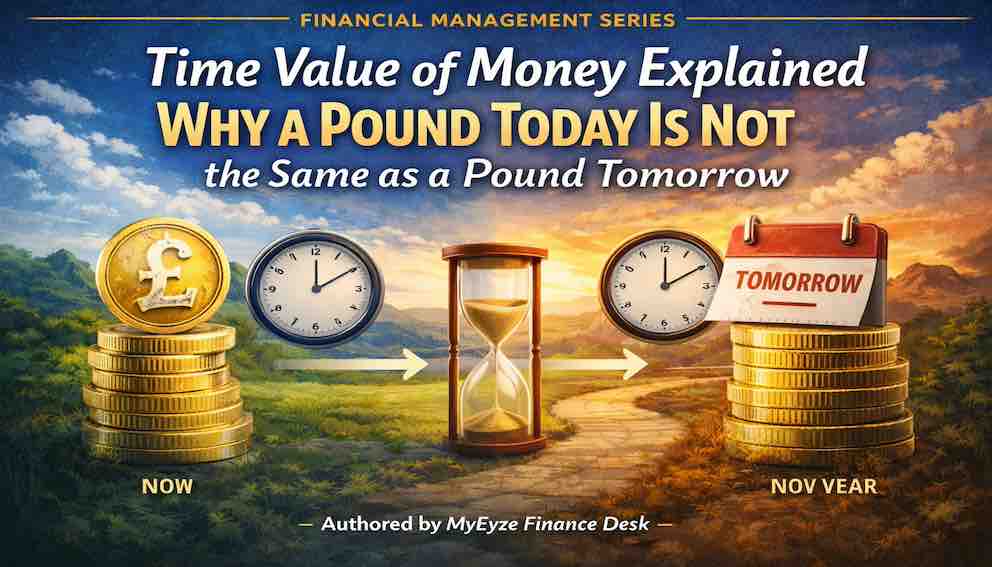
Time Value of Money Explained: Why a Pound Today Is Not the Same as a Pound Tomorrow - Financial Management Series
This tutorial explains the core idea that sits beneath all financial decisions: money changes value as time passes. Instead of starting with formulas, it builds intuition by examining everyday experiences such as waiting, lending, saving, and postponing consumption. It shows how interest, inflation, opportunity cost, and risk are different expressions of the same underlying truth about time. By the end, readers develop mental models that make later financial formulas feel natural and inevitable rather than abstract or imposed.
Money Over Time: The Core Idea Behind All Finance
In our first tutorial, we established that financial management is about making choices whose consequences unfold in the future. Those choices only make sense once we accept that time itself changes the nature of value. Before we can talk meaningfully about risk, return, or valuation, we need to understand why timing alone reshapes what money is worth.
This tutorial focuses on a single idea that quietly governs every financial decision, whether personal, corporate, or institutional: A pound today and a pound tomorrow are not the same economic object.
This is not a clever financial trick, and it is not a technical claim that requires advanced mathematics to appreciate. It is a reflection of how humans live in time, how resources are used, and how uncertainty grows as we move away from the present moment. We will approach this idea slowly, from intuition to structure, and only later touch the formulas that summarize what we already understand.
Everyday Experience: Why Waiting Changes Value
Let's begin with situations that have nothing to do with finance.
Imagine you're really thirsty on a hot day. Someone offers you a cold bottle of water right now. Another person offers you the same bottle of water tomorrow. Even though the water is identical, the value to you is completely different. Today's water satisfies an immediate need. Tomorrow's water might arrive too late.
Money behaves in the same way. A pound today gives you immediate access to choice. You can spend it, save it, lend it, or use it to solve a problem right now. A pound promised for tomorrow doesn't help you with today's needs. Even if the amount is identical, the economic experience is different because availability in time is different.
This preference for immediacy isn't about impatience or weakness. It's about the structure of real life, where earlier access expands options and delayed access restricts them.
Productive Use of Money Over Time
Now let's shift from individual experience to economic activity.
Consider a farmer with £1,000. If she receives this money in March, she can buy seeds, plant her crop, and potentially harvest £1,500 worth of produce by autumn. The same £1,000 received in August is much less useful—the planting season has passed, and the money can't help with this year's harvest.
This is a crucial insight: Money is not static. When deployed at the right time, it can generate additional resources, capabilities, and options. Earlier money can be used more times, in more ways, across more decision cycles. Later money compresses those possibilities.
Think about starting a business. £50,000 today might allow you to rent space, buy equipment, and launch your product. The same £50,000 in two years means you've missed the market opportunity while competitors have moved ahead. The difference isn't the amount of money—it's the time during which it could be used productively.
Uncertainty Grows With Time
So far, we've assumed that future money will arrive exactly as promised. In practice, most financial arrangements involve claims on the future rather than immediate exchange.
The future isn't empty space. It's filled with uncertainty.
Consider a simple promise: your friend agrees to pay you back £100 next month. Now consider the same friend promising to pay you £100 in five years. The longer timeframe introduces more possibilities for things to change: your friend might move away, face financial difficulties, or simply forget. Even with honest intentions, time introduces fragility.
This uncertainty isn't limited to personal promises. Businesses can fail, economies can change, governments can adjust policies—all of these risks increase as we look further into the future. Because future cash depends on events that haven't yet occurred, it carries risk by default. Present cash does not.
Opportunity Cost: The Invisible Trade-Off
Now consider a dimension that's often mentioned but rarely felt clearly: opportunity cost.
Suppose you lend £5,000 to a family member for three years without interest. They're trustworthy, and you fully expect to get your money back. What have you actually given up during those three years?
You've given up the ability to:
- Invest that money elsewhere
- Use it for unexpected opportunities that might arise
- Keep it as a safety reserve
- Spend it on something valuable now
Even if nothing goes wrong—even if every penny is repaid—the decision still has a cost. That cost isn't a visible loss in accounting terms, but a loss of alternatives. Opportunity cost is the economic shadow cast by every choice. When money is tied up, the futures it could have supported are closed off.
This is why time matters even in the absence of risk or inflation. Locking money away means refusing other paths that might have been taken.
Interest as the Price of Time
At this point, the idea of interest should no longer feel arbitrary or mysterious.
Interest isn't a reward for greed, nor a punishment for borrowing. It's a price, and like all prices, it reflects trade-offs. When someone lends money, they're giving up:
- Immediate use
- Productive opportunities
- Flexibility
- Certainty
Interest compensates for that sacrifice. It translates time, uncertainty, and foregone alternatives into a numeric adjustment.
This leads to a practical question: What is the baseline price for time in an economy? In finance, this is often approximated by what's called the "risk-free rate"—typically the interest on a government bond from a stable country. Why a government bond? Because it represents compensation for pure time (and a little inflation) with virtually no risk of the government defaulting.
If you can earn 3% risk-free by lending to the government, then any other use of your money—whether lending to a friend, investing in a business, or buying corporate bonds—must offer the prospect of a return greater than 3% to compensate you for the additional risk and opportunity cost you're taking on. This risk-free rate is the foundational building block—it's the market's collective answer to the question, "What is a pound today worth in a year's time, if we remove all other risks?"
Inflation as Reinforcement, Not Foundation
Many people think inflation is the main reason money loses value over time. This framing is incomplete.
Yes, inflation reduces the purchasing power of money. A pound in the future will likely buy fewer goods and services than a pound today. This clearly matters, especially over long horizons.
However, even in a world with zero inflation, future money would still be worth less than present money. Why? Because:
- It cannot be used immediately
- It cannot be deployed productively sooner
- It is subject to increasing uncertainty
- It carries opportunity cost
Inflation amplifies time value differences, but it doesn't create them. It's a reinforcing factor layered on top of deeper structural reasons. Understanding this prevents a common confusion later, where discounting is mistakenly treated as just an inflation adjustment rather than a broader reflection of time itself.
From Intuition to Structure: Discounting Future Cash
By now, the logic should feel cumulative rather than imposed. If future money:
- Is available later
- Cannot be used productively sooner
- Is exposed to growing uncertainty
- Excludes alternative uses
- May lose purchasing power through inflation
Then it follows naturally that future money must be adjusted when compared to present money. This adjustment is called discounting.
Discounting isn't a mathematical trick. It's a translation. It converts future value into present terms so that choices across time can be compared meaningfully.
When financial formulas appear later in this series, they will simply encode the logic we've already walked through step by step. They will summarize intuition, not replace it.
Bringing It All Together: A Simple Choice
Let's apply every layer we've discussed to a concrete decision. Imagine you're offered £1,000 today, or £1,100 in one year. Which should you choose?
First, consider the risk-free alternative: If government bonds pay 3%, your £1,000 today could become £1,030 in one year with minimal risk.
Next, consider uncertainty: The promise of £1,100 carries the risk that the promisor might not pay.
Now, consider opportunity cost: By waiting a year, you give up whatever else you could have done with the money during that time.
To make a fair comparison, we need to ask: "What is the present value of that future £1,100?" If we decide that we need a 5% return to compensate for the risk and opportunity cost (higher than the 3% risk-free rate), we would discount the £1,100. Here's the simple math:
£1,100 divided by 1.05 = approximately £1,047.62 today.
The analysis is now clear:
- The present value of the future £1,100 (at our required 5% rate) is about £1,048
- This is higher than the £1,000 offered today, so the future promise might be the better financial choice—but only if we trust the promisor
- If we required a 12% return due to higher perceived risk, the present value would be only £982, making the £1,000 today the better choice
This simple calculation shows the machinery of discounting at work. It's not a formula in search of a problem; it's the necessary arithmetic for comparing "apples" (money now) with "oranges" (more money, later, and riskier).
Why This Idea Sits Beneath All Finance
Every major financial concept depends on the time value of money:
Investment returns compare present sacrifice to future payoff
Valuation translates future cash flows into today's terms
Interest rates coordinate saving and borrowing across time
Capital budgeting chooses between projects with different timelines
Retirement planning balances present contributions against future needs
Without a clear understanding of why time reshapes value, these topics become mechanical and opaque. With it, they become variations on a single, understandable theme.
Finance doesn't begin with equations. It begins with the recognition that when something happens is just as important as what happens.
Conclusion: What We Have Learned About Time and Value
In this tutorial, we slowed down to examine a fact that's so familiar it often goes unnoticed: money exists in time, and time changes what money means.
We saw that a pound today differs from a pound tomorrow not because of abstract theory, but because earlier access expands choice, enables productive use, and avoids uncertainty. We explored how promises weaken as they move further into the future, how tying money up closes off alternative paths, and how interest emerges naturally as the price of delayed access—with the risk-free rate serving as our economic benchmark for pure time value.
Most importantly, we built mental models that allow later financial tools to feel descriptive rather than prescriptive. Discounting, interest rates, and valuation formulas won't appear as external rules imposed by finance, but as structured ways of expressing realities we already understand.
About Swati Sharma
Lead Editor at MyEyze, Economist & Finance Research WriterSwati Sharma is an economist with a Bachelor’s degree in Economics (Honours), CIPD Level 5 certification, and an MBA, and over 18 years of experience across management consulting, investment, and technology organizations. She specializes in research-driven financial education, focusing on economics, markets, and investor behavior, with a passion for making complex financial concepts clear, accurate, and accessible to a broad audience.
Disclaimer
This article is for educational purposes only and should not be interpreted as financial advice. Readers should consult a qualified financial professional before making investment decisions. Assistance from AI-powered generative tools was taken to format and improve language flow. While we strive for accuracy, this content may contain errors or omissions and should be independently verified.