
Tutorial Categories
Last Updated: January 29, 2026 at 10:30
Financial Ratios Explained Properly: Why They Are Tools for Interpretation, Not Statements of Truth - Financial Managements Series
Financial ratios are often taught as objective measures of performance, strength, or efficiency, but this view mistakes compression for clarity. This tutorial explains what financial ratios actually do: they collapse long, time-bound business stories into single numbers that are useful only when interpreted carefully. By linking ratios back to financial statements, operating decisions, and business models, we explore what ratios illuminate—and what they inevitably hide. You will learn how liquidity, solvency, efficiency, and profitability ratios function as signals rather than verdicts, and why using them without context leads to confident but fragile conclusions.
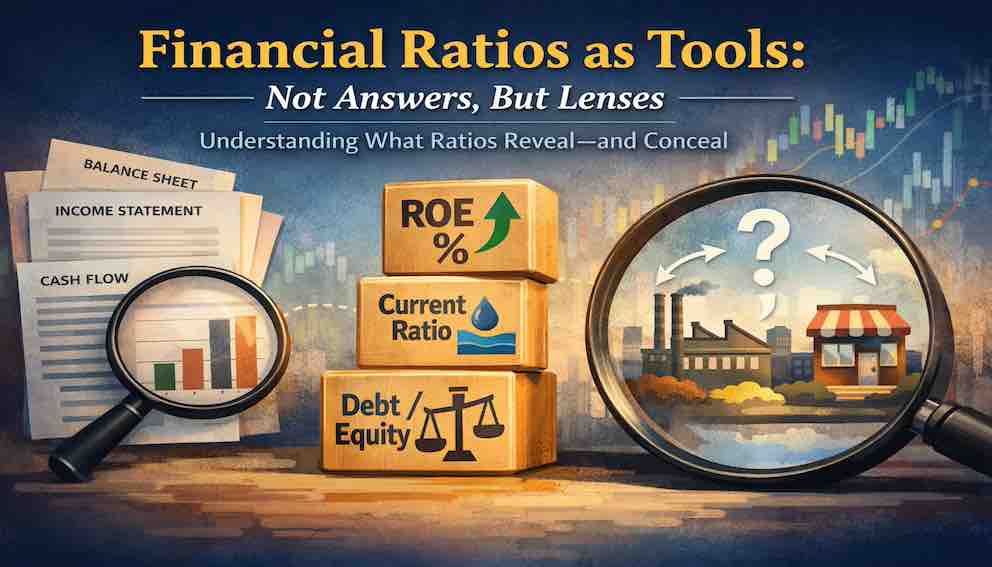
Financial Ratios as Compressed Stories, Not Answers
Once financial statements are understood as a connected story of decisions over time, ratios reveal their true role—not as answers, but as lenses that compress those stories, sometimes helpfully and sometimes dangerously.
A ratio does not introduce new information into the analysis. It rearranges existing information into a more compact form. Two or three numbers that previously sat in different places on a financial statement are pushed together, divided or compared, and presented as a single figure that feels easier to grasp. This sense of ease is precisely why ratios are popular, and it is also why they are frequently misused.
When someone says that a company’s “current ratio is strong” or that its “return on equity is weak,” what they are really saying is that a complex set of operating decisions, timing choices, accounting conventions, and business constraints has been flattened into a single measurement that appears to resemble certainty. The ratio feels like a fact, even though it is better understood as a question generator wearing the mask of a conclusion.
To treat ratios properly, we must always remember what they are compressing. Every ratio sits on top of financial statements. Every financial statement reflects accumulated decisions. And every decision was made under uncertainty, with trade-offs that cannot survive compression without distortion.
This tutorial does not attempt to make you faster at ratio analysis. It attempts to make you slower, but more accurate.
Why Ratios Exist at All
Ratios exist because human cognition struggles with raw scale and complexity. Looking at a balance sheet with hundreds of millions in assets, layered with accruals, reserves, and financing choices made years apart, is cognitively demanding. Ratios offer relief by suggesting relationships rather than quantities. They say, in effect, “Do not look at everything; look at this relationship instead.”
Consider liquidity. The underlying question is not whether a firm is profitable, admired, or growing, but whether it can meet obligations as they come due. The balance sheet contains the relevant information, but it is scattered across line items with different maturities, degrees of certainty, and economic meanings. A liquidity ratio compresses this scattered information into a single comparison that gestures toward an answer.
This gesture is useful. But it is not neutral.
Every ratio is built on assumptions about what should be grouped together, what should be excluded, and what timing differences can be ignored. These assumptions are rarely stated explicitly, which is why ratios feel more objective than they truly are.
Liquidity Ratios: The Illusion of Immediate Safety
Liquidity ratios attempt to describe a firm’s ability to survive the near future using resources already on hand. They compress questions of timing, convertibility, and operational rhythm into a single comparison between short-term assets and short-term obligations.
Imagine two companies with identical current ratios. On paper, both appear equally positioned to meet near-term liabilities. Yet one company operates a grocery business with daily cash inflows, rapid inventory turnover, and predictable supplier payment cycles. The other operates a heavy equipment manufacturer that sells on long contracts, carries specialized inventory, and collects cash months after production begins.
The ratio is identical. The reality is not.
The liquidity ratio hides the tempo of the business. It treats all current assets as if they were equally available and all current liabilities as if they arrived in a smooth, predictable flow. It does not ask how quickly inventory converts into cash, how reliable receivables are, or whether payables can be stretched without damaging operations. These are not minor omissions. They are the core of liquidity risk.
A strong liquidity ratio can coexist with acute cash stress if the underlying assets are slow-moving or illiquid in practice. Conversely, a weak ratio can appear in businesses that operate safely because cash inflows arrive continuously and predictably. The ratio does not know this. It cannot know this. It has compressed the story too aggressively.
The proper response to a liquidity ratio is never acceptance. It is interrogation. What must be true about cash conversion, customer behavior, and operating cadence for this number to be meaningful?
Solvency Ratios: Stability Without Time
Solvency ratios attempt to say something about long-term financial resilience. They compare obligations to resources in ways that suggest durability, endurance, or fragility.
What they cannot do is account for time in a meaningful way.
A company with substantial long-term debt may appear fragile when viewed through a leverage ratio, yet that same debt may be fixed-rate, long-dated, and matched to assets that produce steady cash flows. Another company with modest leverage may rely on rolling short-term financing that exposes it to refinancing risk during market stress. The ratio sees debt. It does not see structure.
Solvency ratios also blur the distinction between accounting capital and economic flexibility. Equity on the balance sheet is not a reservoir of usable cash. It is an accumulation of past outcomes, shaped by accounting choices and historical conditions. A high equity ratio does not guarantee adaptability in the face of disruption, just as a low equity ratio does not guarantee collapse.
The danger with solvency ratios is not that they are useless, but that they appear definitive. They invite language like “over-leveraged” or “under-capitalized,” which feels conclusive but often rests on unexamined assumptions about refinancing access, asset liquidity, and the stability of cash flows over time.
The ratio compresses a future-facing question into a static snapshot. That compression must always be handled with caution.
Efficiency Ratios: Speed Without Friction
Efficiency ratios attempt to describe how effectively a business uses its resources to generate activity. Inventory turnover, receivables days, and asset utilization ratios fall into this category.
These ratios are seductive because they imply motion. They suggest that faster is better, that higher turnover signals superior management, and that slack is waste.
What they hide is friction.
A company may accelerate inventory turnover by reducing buffers, tightening reorder points, or relying on just-in-time logistics. This improves the ratio. It also increases vulnerability to supply disruptions. Another company may tolerate slower turnover because its customers demand customization, reliability, or long lead times. The ratio penalizes this choice, even if it aligns perfectly with the business model.
Efficiency ratios also erase strategic intent. They do not distinguish between inefficiency caused by poor execution and inefficiency chosen deliberately to protect resilience, quality, or customer trust. They measure outcomes, not reasoning.
When an efficiency ratio changes, the important question is not whether it improved or deteriorated, but what decision altered the underlying flow of operations. Without that context, the ratio is a speedometer disconnected from the road.
Profitability Ratios: The Most Dangerous Comfort
Profitability ratios are often treated as the ultimate scorecard. They appear to answer the most fundamental question: how much value is being generated relative to some base.
This apparent clarity is deceptive.
Profitability ratios compress pricing power, cost structure, capital intensity, accounting judgments, and timing differences into a single figure that feels definitive. They reward businesses that recognize revenue early, defer costs, or operate with minimal capital on the balance sheet. They penalize businesses that invest heavily upfront, expense conservatively, or operate in asset-heavy industries.
Two companies with identical profitability ratios may be on radically different trajectories. One may be harvesting past investments with limited future optionality. The other may be absorbing costs today to create durable advantages tomorrow. The ratio does not know which is which.
Return-based ratios are especially prone to distortion because the denominator often reflects historical book values rather than current economic realities. A fully depreciated asset continues to generate cash, inflating returns without any improvement in operations. A recently acquired asset depresses returns, even if it strengthens future cash flows.
Profitability ratios feel like conclusions because they summarize performance in a way that aligns with intuition. They should instead be treated as prompts. What has been recognized? What has been deferred? What investment cycle is the business currently in?
The Interrogation in Action: A Single Ratio from Number to Narrative
Let's apply everything we've learned to one ratio, step-by-step. Suppose we calculate Company X's Current Ratio (Current Assets / Current Liabilities) and find it is 0.8. The textbook says anything below 1.0 is a warning sign of poor liquidity. A novice might stop there and deem the company risky.
Step 1: Decompress the Ratio.
What is being compressed? Current Assets likely includes Cash, Inventory, and Accounts Receivable. Current Liabilities likely includes Accounts Payable and Short-Term Debt.
Step 2: Interrogate the Components.
- Cash: Is it a tiny amount or a meaningful buffer?
- Inventory: What kind? Is it perishable groceries (fast-moving) or specialized machinery (slow-moving)? The ratio counts them the same.
- Receivables: Are they from creditworthy customers paying in 30 days, or from struggling clients stretching to 90 days?
- Payables: Can the company safely delay these payments to suppliers, or would it damage crucial relationships?
- Debt: Is there a large bullet payment due next month, or are the payments small and staggered?
Step 3: Reconstruct the Story.
A ratio of 0.8 tells us that, on this snapshot date, obligations due soon outweigh liquid resources. But why?
- Scenario A (The Alarm): Cash is near zero, inventory isn't selling, and a large loan is due next week. This is a crisis.
- Scenario B (The Tempo Story): This is a subscription software company. It has almost no inventory. Its "current assets" are mostly cash from annual subscriptions collected upfront. Its "current liabilities" are mostly payables for monthly cloud services and salaries. It is profoundly liquid (full of cash), but the ratio looks "weak" because its business model doesn't require holding traditional current assets. The ratio has been misapplied.
Step 4: Ask the Guiding Question.
The ratio doesn't tell you which scenario is true. Its entire value is in forcing you to ask: "What specific conditions about the quality and timing of these assets and liabilities must exist for this 0.8 to be safe... or dangerous?" The answer is never in the ratio; it's in the deeper story you uncover next.
Why Ratios Fail Across Businesses
One of the most common misuses of ratios is comparison across firms without regard to business model, operating cycle, or strategic intent.
Ratios assume similarity. Markets reward difference.
A subscription software company, a retail bank, and a construction firm operate under fundamentally different rhythms of cash flow, risk exposure, and asset usage. Comparing their ratios is not just unhelpful; it actively obscures understanding by implying a common standard that does not exist.
Even within the same industry, firms at different stages of maturity will produce ratios that reflect their position in the investment cycle rather than their competence. A growing firm will often look inefficient and unprofitable by ratio standards precisely because it is investing aggressively. A declining firm may look efficient and profitable because it is extracting value rather than building it.
Ratios erase lifecycle context. They freeze time.
Using Ratios Properly: From Verdicts to Questions
The disciplined use of ratios begins with restraint.
A ratio should never be the first thing you look at. It should never be the last. It belongs in the middle, after the statements are understood and before conclusions are drawn.
When a ratio appears strong, the appropriate response is not approval but curiosity. What conditions must be true for this strength to be sustainable? What risks are being compressed out of view?
When a ratio appears weak, the response should not be alarm but investigation. Is this weakness a temporary artifact of timing, investment, or accounting choice? Or does it reflect a structural constraint in the business model?
Ratios do not tell you what is happening. They tell you where to look next.
Conclusion: Learning to See Through Compression
In this tutorial, we treated financial ratios not as measurements of truth, but as compressions of reality. We examined how liquidity ratios flatten timing and cash flow rhythms, how solvency ratios obscure structure and duration, how efficiency ratios hide friction and intent, and how profitability ratios often reward accounting optics over economic substance.
Through a detailed interrogation of a single current ratio, we modeled the essential practice: moving from a compressed number to the specific, narrative questions it implies. Across all categories, the same lesson emerged. Ratios simplify stories that should not be simplified without care. They remove context, erase time, and hide decision paths, even as they offer useful signals when interpreted cautiously.
The skilled financial thinker does not reject ratios, but neither do they trust them. They use ratios as lenses, knowing that every lens distorts as it clarifies. The real work lies beneath the number, in the sequence of decisions and constraints that produced it. Once this perspective is internalized, ratios stop being shortcuts. They become invitations to think more deeply, not less.
About Swati Sharma
Lead Editor at MyEyze, Economist & Finance Research WriterSwati Sharma is an economist with a Bachelor’s degree in Economics (Honours), CIPD Level 5 certification, and an MBA, and over 18 years of experience across management consulting, investment, and technology organizations. She specializes in research-driven financial education, focusing on economics, markets, and investor behavior, with a passion for making complex financial concepts clear, accurate, and accessible to a broad audience.
Disclaimer
This article is for educational purposes only and should not be interpreted as financial advice. Readers should consult a qualified financial professional before making investment decisions. Assistance from AI-powered generative tools was taken to format and improve language flow. While we strive for accuracy, this content may contain errors or omissions and should be independently verified.