Tutorial Categories
Last Updated: January 29, 2026 at 10:30
How to Read Financial Statements as a Story: Connecting Income, Balance Sheet, and Cash Flow - Financial Management Series
Financial statements are often treated as separate spreadsheets filled with rules and ratios, but they are better understood as three connected views of the same underlying business reality. This tutorial explains how the income statement, balance sheet, and cash flow statement form a continuous narrative shaped by timing decisions, judgment calls, and real-world constraints. By following simple, concrete examples, readers learn how performance, accumulation, and liquidity interact over time. The focus is not on memorizing formats, but on tracing the sequence of decisions that must have produced the numbers. By the end, financial statements begin to read less like static reports and more like a living record of choices, trade-offs, and emerging risks.
Financial Statements as a Story, Not a Spreadsheet
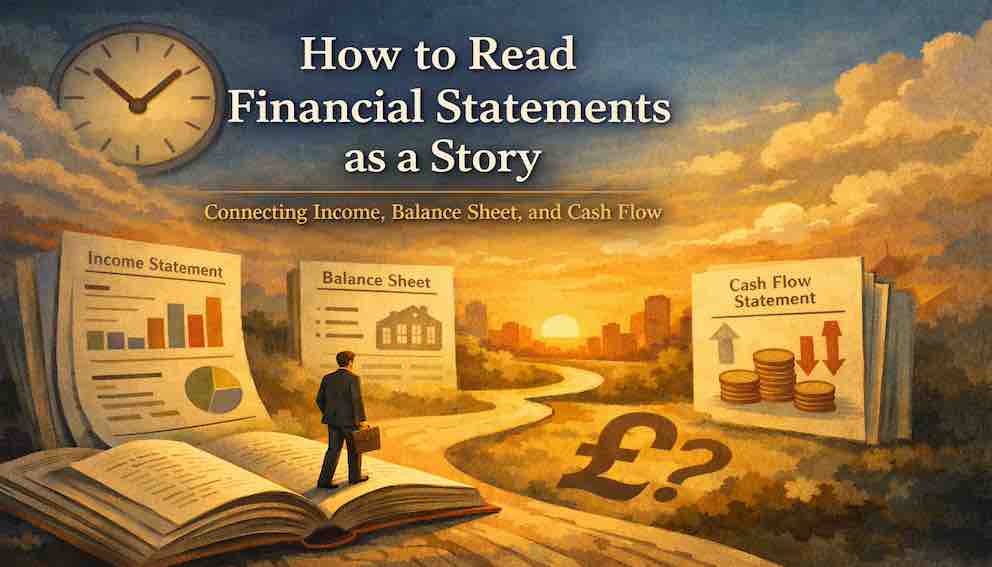
Now that we understand how time reshapes value, and how cash reveals survival risk, we can see financial statements not as separate reports, but as different chapters of the same story—each shaped by timing, judgment, and consequence.
Most people first encounter financial statements as tables of numbers that need to be reconciled, memorized, or mechanically analyzed. The income statement is on one page, the balance sheet is on another, and the cash flow statement is often treated as a technical appendix that only specialists truly understand. When taught this way, statements feel abstract and disconnected, as if they describe three different businesses rather than one evolving organization.
That feeling is not accidental. Accounting statements are designed to categorize reality, not narrate it. They slice the same set of events along different dimensions: performance over a period, position at a moment in time, and movement of cash across that period. If you look at those slices in isolation, you miss the continuity that gives them meaning.
The purpose of this tutorial is to slow down and reconnect those slices. Instead of asking what each number is called, we will ask what decisions had to occur, in what order, for these numbers to exist together. When statements are read this way, inconsistencies become signals, not errors, and patterns become legible long before ratios are calculated.
One Business, Three Lenses
Every business, regardless of size or industry, is engaged in a continuous sequence of decisions. It decides to hire people, to buy inventory, to extend credit to customers, to borrow money, to delay payments, or to invest in new capacity. These decisions do not happen separately for accounting purposes. They happen in real time, under uncertainty, and often under pressure.
Financial statements are simply three different ways of observing the consequences of those decisions.
- The Income Statement observes them through the lens of performance over time. It asks whether the business created more value than it consumed during a period, according to accrual rules that attempt to match effort with outcome.
- The Balance Sheet observes the same decisions through the lens of accumulation. It asks what the business owns, what it owes, and what is left over after all past decisions have settled, at a specific point in time.
- The Cash Flow Statement observes those decisions through the lens of liquidity. It asks how much actual cash moved, when it moved, and whether the business generated or consumed the cash needed to continue operating.
These are not competing perspectives. They are coordinated views of the same reality. When they diverge, the divergence itself is information.
The Income Statement: A Performance Story Shaped by Timing
Consider a small consulting firm that signs a twelve-month contract with a client worth £120,000, billed monthly. The consultants do the work steadily throughout the year, and the client pays on time.
From a cash perspective, £10,000 arrives each month. From a performance perspective, the firm earns revenue gradually as work is performed. In this simple case, cash flow and income align neatly, and the income statement feels intuitive.
Now change one detail. Suppose the firm completes the work in the first six months, invoices the client for the full £120,000 at that point, but allows the client to pay over the remaining six months.
The income statement will still show revenue based on when the work was performed, not when cash arrived. Profit may look strong early in the year, reflecting completed work, even as cash inflows lag behind. The income statement is not lying. It is telling a story about performance that deliberately ignores cash timing in order to better reflect economic effort.
The key implication is that income is always a constructed narrative. It depends on judgments about when value is created and when costs should be recognized. Depreciation spreads the cost of equipment over time. Accruals recognize expenses before they are paid. Revenue recognition rules decide when a sale becomes “real” for reporting purposes.
These choices are not arbitrary, but they are not mechanical reflections of cash either. They exist to answer a specific question: did the business, over this period, appear to create economic value from its activities?
Understanding this framing prevents a common mistake. When profit rises while cash weakens, the conclusion should not be that one statement is wrong. The correct response is to ask what timing assumptions are currently dominating the performance story.
The Balance Sheet: Accumulated Consequences Frozen in Time
If the income statement is a movie, the balance sheet is a photograph. It captures the cumulative result of all past income statements and all past cash flows, filtered through financing decisions and accounting classifications.
Return to the consulting firm example. When the firm invoices the client but has not yet been paid, the balance sheet records an accounts receivable. This is not an abstract accounting artifact. It is the accumulated consequence of a decision to deliver work before collecting cash.
Similarly, when the firm buys computers for its consultants, the balance sheet records an asset, even though cash has already left the business. The cost is not immediately expensed in full, because the benefit is expected to extend into the future.
The balance sheet therefore acts as a memory of unresolved timing differences. Receivables represent earned but uncollected value. Payables represent consumed but unpaid resources. Debt represents borrowed time, with future obligations attached. Equity represents the residual claim after all these promises are accounted for.
What matters is not the labels, but the story they imply. A balance sheet heavy with receivables tells a story of deferred cash collection. A balance sheet heavy with short-term debt tells a story of near-term pressure. A growing asset base funded by borrowing tells a story of expansion that assumes future success.
Because the balance sheet is cumulative, it is often where stress hides before it becomes visible in performance. A business can report steady profits while its balance sheet quietly fills with obligations that will soon demand cash.
The Cash Flow Statement: Where Decisions Meet Reality
The cash flow statement exists because neither profit nor accumulated balances answer the survival question directly. It traces how cash actually moved, categorized by the type of decision that caused the movement.
- Operating cash flows show how much cash the core business activities generated or consumed.
- Investing cash flows show how much cash was committed to or released from long-term assets.
- Financing cash flows show how the business borrowed, repaid, or returned capital.
Viewed in isolation, these categories can feel technical. Viewed as part of a story, they describe how the business is funding itself over time.
Imagine a retail company that reports growing profits year after year. The income statement suggests success. The balance sheet shows expanding inventory and new store locations. The cash flow statement, however, reveals consistently negative operating cash flow, offset by increasing borrowing.
This pattern tells a specific story. The company is selling goods profitably on paper, but it is tying up cash in inventory faster than it collects from customers. To survive, it relies on external financing. As long as lenders remain confident, the story continues. When confidence breaks, the gap between profit and cash becomes fatal.
Again, no statement is wrong. The power lies in reading them together.
How the Statements Connect: Following a Single Thread
To see how the three statements form a single narrative, it helps to follow one decision through all of them. Let's trace a simple, concrete example: a company sells a product for £1,000 that cost £600 to make. The customer pays in 60 days.
1. At the Moment of Sale (Day 0):
- Income Statement: Revenue increases by £1,000, Cost of Goods Sold increases by £600, so Net Income increases by £400.
- Balance Sheet: Inventory (an asset) decreases by £600. Accounts Receivable (an asset) increases by £1,000. The difference of £400 flows to Retained Earnings in Equity. The Balance Sheet balances.
- Cash Flow Statement: No cash has moved yet. The £400 profit is not cash. It is an accrual.
2. When the Customer Pays (Day 60):
- Income Statement: Unaffected. The revenue and cost were already recorded.
- Balance Sheet: Accounts Receivable decreases by £1,000. Cash increases by £1,000.
- Cash Flow Statement: The £1,000 inflow appears in Operating Activities, finally converting the earlier accrual into cash.
This simple thread shows the story: The business earned £400 in profit on Day 0, but it only received the cash 60 days later. The balance sheet acted as the bridge, holding the promise (Receivable) until it was fulfilled. The statements are literally and mechanically connected; one transaction leaves its mark on all three, just at different times.
Discrepancies as Diagnostic Tools
When beginners encounter differences between profit and cash, or between balance sheet growth and cash flow weakness, they often assume something is wrong. In reality, these differences are where insight lives.
A growing gap between net income and operating cash flow often signals aggressive revenue recognition, rising receivables, or inventory buildup. A balance sheet that grows faster than revenue may indicate capital intensity or inefficiency. Strong cash flow paired with weak reported profits may reflect heavy depreciation or conservative accounting choices.
None of these patterns are automatically good or bad. They are prompts for questions. What assumptions about timing are embedded here? What future conditions must hold true for this picture to remain stable?
This shift—from validating numbers to interrogating narratives—is the transition from accounting literacy to financial understanding.
Early Warning Signs Hidden in Plain Sight
Because statements reflect decisions over time, they often reveal stress before it becomes obvious externally.
- A company that extends payment terms to customers to sustain revenue growth will show rising receivables. Initially, profits look healthy. Later, cash tightens. Eventually, bad debts appear.
- A company that delays paying suppliers will show strong operating cash flow while payables rise. This creates temporary relief at the cost of future strain on relationships and credibility.
- A company that funds dividends with borrowing rather than operating cash flow tells a story about priorities that may not be sustainable.
These are not advanced forensic techniques. They are natural consequences of reading statements as connected chapters rather than isolated exhibits.
Moving from Numbers to Meaning
The ultimate goal is not to become fluent in accounting mechanics, but to become fluent in translation. Each line item should trigger a mental question: what decision does this represent, and what future condition does it depend on?
When you see revenue, ask how and when cash will follow. When you see assets, ask what obligations they quietly require. When you see cash inflows, ask whether they came from customers or creditors.
Over time, this habit changes how statements feel. They stop being static and start feeling directional. You begin to sense momentum, fragility, and optionality long before formal analysis begins.
Conclusion: What We Have Learned
In this tutorial, we reframed financial statements from disconnected spreadsheets into a coherent narrative of decisions unfolding over time. We saw that the income statement tells a performance story shaped by accrual timing and judgment, the balance sheet captures the accumulated consequences of past choices, and the cash flow statement reveals how those choices interact with liquidity and survival.
By following a simple sale through all three statements, we saw the literal, mechanical link that binds them together into a single story. We learned that discrepancies between statements are not errors to be resolved, but signals to be interpreted. By reading for these signals, we can detect stress, dependency, and risk earlier and more clearly.
Most importantly, we shifted the central question from “what does this number mean?” to “what sequence of decisions must have produced this picture?” This way of reading builds directly on our understanding of time and cash, and it prepares the ground for all the analysis to come. Financial statements, when read patiently, tell the story of a business trying to navigate time, uncertainty, and human judgment.
About Swati Sharma
Lead Editor at MyEyze, Economist & Finance Research WriterSwati Sharma is an economist with a Bachelor’s degree in Economics (Honours), CIPD Level 5 certification, and an MBA, and over 18 years of experience across management consulting, investment, and technology organizations. She specializes in research-driven financial education, focusing on economics, markets, and investor behavior, with a passion for making complex financial concepts clear, accurate, and accessible to a broad audience.
Disclaimer
This article is for educational purposes only and should not be interpreted as financial advice. Readers should consult a qualified financial professional before making investment decisions. Assistance from AI-powered generative tools was taken to format and improve language flow. While we strive for accuracy, this content may contain errors or omissions and should be independently verified.