
Tutorial Categories
Last Updated: February 6, 2026 at 16:00
Valuation in Depth: Discounted Cash Flow (DCF) Modeling, Sensitivity Analysis, and the Discipline of Assumptions - Fundamental Analysis Series
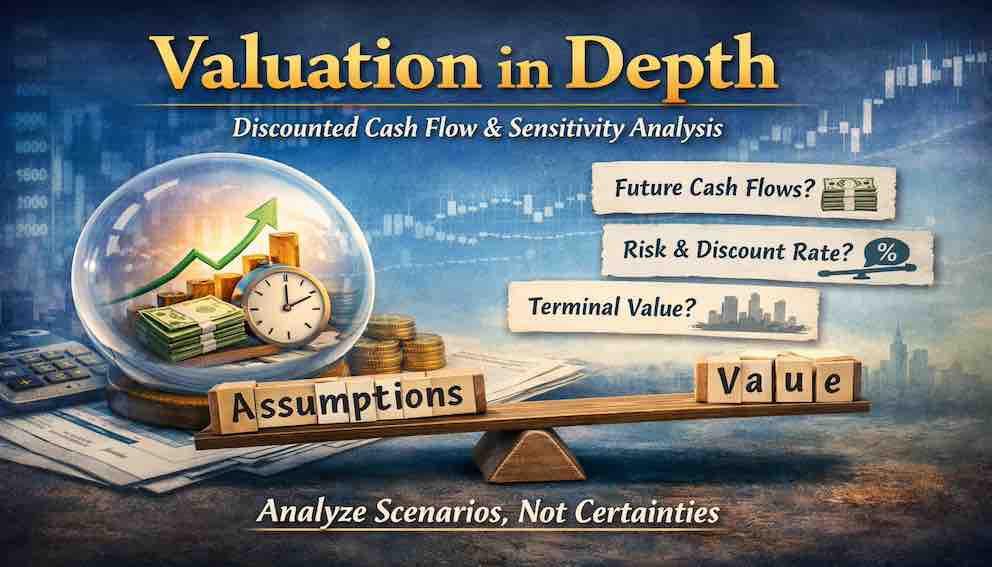
Discounted Cash Flow (DCF) valuation is often treated as a technical spreadsheet exercise, but its true value lies in structured thinking about the future. This tutorial explains DCF as a judgment framework rather than a precision tool, showing how assumptions about growth, risk, and competitive durability shape valuation outcomes. Through simple examples and sensitivity analysis, learners discover why small assumption changes can dramatically alter intrinsic value. The lesson emphasizes valuation ranges, humility, and risk awareness over false numerical confidence, completing the transition from estimating what a business is worth to confidently deciding what it is worth to you.
Introduction: Making the Invisible Logic of Valuation Visible
In the previous tutorial, Valuation 101: Price, Value, and the Judgment of Multiples, we focused on how a price tag in the market summarizes a complex story about growth and risk. We learned that a high P/E ratio whispers, "Investors expect rapid growth," while a low one often signals, "This future is seen as risky or slow."
What we did not fully unpack was the deeper logic hiding beneath every single one of those multiples. Every valuation metric, from a simple P/E ratio to a sophisticated enterprise value multiple, is ultimately built on one foundational idea: the value of a business is the present value of all the cash it will generate in the future. Multiples are simply a convenient shorthand for this core principle.
This tutorial exists to slow that idea down and examine it carefully.
A DCF model can seem intimidating—a labyrinth of spreadsheets and formulas promising precise answers to several decimal places. That framing misses the point entirely. A DCF is not a machine that produces truth. Instead, it is a disciplined framework for asking one critical question: “What must be true about this business for today’s price to make sense?”
By the end of this lesson, you will feel less impressed by complex spreadsheets and more confident in your ability to reason about future cash flows, risk, and uncertainty in a structured way.
The Core Principle: Time, Risk, and the Compounding Power of Today's Cash
At its heart, DCF is anchored in an intuitive economic fact: a dollar today is worth more than a dollar promised in the future.
This isn't just about inflation or impatience; it's about opportunity and certainty. Money in your hand today can be invested elsewhere to earn a return. Money promised in the future carries risk—the risk that the promise won't be kept, or that you could have earned more elsewhere. Therefore, to value a future promise of cash, we must discount it, scaling it down to reflect this time and risk.
This discount rate is your personal or the market's "hurdle rate." It's the minimum return you require to compensate you for the risk of the investment. A stable utility company might require a lower discount rate (say, 6%) than a volatile biotech startup (which might demand 15% or more). This discount rate is the engine of a DCF: it systematically reduces the value of cash flows the further into the uncertain future they occur.
The Three Pillars of a DCF Model
Every DCF, from a back-of-the-napkin sketch to a Wall Street analyst's complex model, rests on these three pillars. Mastering the judgment behind them matters far more than memorizing formulas.
Pillar 1: Free Cash Flow (FCF) – The Business's True Economic Engine
Revenue is an accounting concept. Earnings can be massaged. Free Cash Flow is what remains after a business has paid its operating expenses and reinvested what is necessary to maintain and grow its assets. It's the real, distributable cash—the economic lifeblood that can be paid to owners, used to pay down debt, or fund new projects.
For example, a mature supermarket chain might have modest sales growth but convert almost all its earnings into robust free cash flow. A fast-growing tech company might report soaring revenues but have negative free cash flow for years as it spends heavily on research and marketing to capture its market. The DCF forces you to distinguish between headline growth and genuine, cash-generating value creation.
Pillar 2: The Discount Rate – The Penalty for Uncertainty
The discount rate is your tool for penalizing uncertainty. It’s not a reward for optimism; it is a mathematical adjustment for risk. The higher the risk—whether from industry volatility, financial leverage, or poor management—the higher the discount rate should be.
A small change here has an outsized impact. Increasing the discount rate from 8% to 9% can slash the calculated value of long-term cash flows by 10-15% or more. This sensitivity is not a flaw in DCF; it is the model's most important feature, powerfully illustrating how fragile value can be when assumptions about risk change.
Pillar 3: Terminal Value – Confronting the Distant Horizon
You cannot forecast a company's cash flows year-by-year forever. At some point, you must make a simplifying assumption about the "steady state"—the value of all cash flows beyond your explicit forecast period. This is the Terminal Value.
In most DCF models, especially those with a 5-10 year forecast, the terminal value often accounts for 60% to 80% of the total calculated value. This fact should trigger immediate intellectual humility. It means the majority of your valuation rests not on near-term forecasts you can scrutinize, but on a long-term assumption about a company's perpetual growth rate or its final sale price.
Consider two different terminal value assumptions for the same company. Using a perpetual growth rate of 2% versus 3% (a difference of just one percentage point) might change the terminal value by 20-30%. This starkly reveals that DCF models are not precise calculators but frameworks for testing the reasonableness of your long-term beliefs.
From Single-Point Fantasy to Real-World Ranges: The Power of Sensitivity Analysis
Because assumptions drive outcomes, treating a DCF's output as a single "correct" number is the gravest mistake an analyst can make. A spreadsheet with twenty tabs and six decimal places does not reduce uncertainty; it often hides it. The most important step in any DCF is the step that comes after the initial calculation: Sensitivity Analysis.
Sensitivity analysis involves consciously and systematically varying your key assumptions (like growth rates and discount rates) to see how the valuation responds. You stop asking, "What is the value?" and start asking, "What range of values emerges under different plausible futures?"
Here’s a practical way to think about it: Imagine you value a local coffee shop chain. Your "base case" might assume 5% annual growth and an 11% discount rate, giving an intrinsic value of $1 million. But what if a new competitor enters, slowing growth to 3%? What if interest rates rise, pushing your required return to 13%?
- Scenario A (Optimistic): Growth: 6%, Discount Rate: 10% → Value: $1.3 million
- Scenario B (Base Case): Growth: 5%, Discount Rate: 11% → Value: $1.0 million
- Scenario C (Conservative): Growth: 3%, Discount Rate: 13% → Value: $700,000
Your valuation is not $1 million. It is a range from $700,000 to $1.3 million, with the most likely outcome clustered around the center. This range-based thinking transforms DCF from a pseudo-scientific prediction into a powerful tool for risk management and decision-making. If you can buy the business for $500,000, you have a wide "margin of safety" across all scenarios. If the asking price is $1.2 million, you are betting heavily on the most optimistic outcome.
The Bridge to Reality: Translating DCF Back to Market Prices
This structured thinking is most powerful when you use it to bridge the gap between your analysis and the market's mood. DCF is the perfect tool for reverse-engineering market expectations.
Ask yourself: "What assumptions are baked into the current stock price?" For a company trading at a sky-high P/E of 50, a quick DCF exercise might show that its current price only makes sense if it can grow its cash flows at 15% annually for the next 15 years. Does that seem reasonable given the competitive landscape? Or does it require an assumption of market dominance that the company's current position cannot support?
This is where DCF connects back to the competitive analysis from earlier tutorials. A company's "moat"—its durable competitive advantage—directly translates into assumptions about cash flow decay. A strong moat allows you to model high cash flows that persist for many years, justifying a higher terminal value. A weak competitive position forces you to assume that extraordinary profits will quickly revert to the mean as rivals catch up, resulting in a lower valuation. Your belief in a company's durability is not just qualitative; it is quantified in your growth rate and terminal value assumptions.
The Invisible Driver: Confronting Bias and Knowing DCF's Limits
All the mechanics of DCF occur within a field shaped by a powerful, often invisible force: analyst bias. We almost never start a valuation with a blank slate. If you read a negative news article about a company, you may unconsciously project lower growth. If you are an investment banker paid only if a merger deal closes, you have a powerful incentive to find a higher valuation.
Bias manifests in subtle ways: choosing an unjustifiably low discount rate for a company you like, extending the "high growth" phase for an extra few years, or tweaking terminal value assumptions until the output matches a desired price. The best defense is not to pretend you have none, but to practice rigorous self-awareness. Explicitly state your starting assumptions and biases before you begin. Test your conclusions against bearish viewpoints. This intellectual honesty is what separates a rigorous valuation from a spreadsheet that merely justifies a preordained conclusion.
Finally, it's crucial to understand where DCF shines and where it falters. DCF is poorly suited for businesses with highly uncertain or binary outcomes, where future cash flows cannot be reasonably bounded. Early-stage biotech companies, mineral exploration firms, or turnarounds in industries undergoing radical disruption often defy the steady-state assumptions a DCF requires. For these, other tools—like scenario analysis or real options—may be more appropriate.
Conclusion: DCF as a Framework for Disciplined Judgment
We have moved beyond valuation shortcuts and made the fundamental engine of value explicit. You have learned that a Discounted Cash Flow analysis is not a formulaic verdict but a structured thinking process that forces clarity about your assumptions.
You now understand the three pillars—cash flow, discount rate, and terminal value—and see that small, reasonable changes in these judgment calls can lead to dramatically different outcomes. You've learned to use sensitivity analysis to map a landscape of possible outcomes and to reverse-engineer the sometimes-heroic assumptions embedded in market prices. This marks a meaningful transition—from analyzing businesses to making investment judgments with structure and discipline.
You now possess the core toolkit:
- The ability to see past accounting profits to Free Cash Flow.
- The discipline to penalize future promises with an appropriate Discount Rate.
- The humility to acknowledge that most of a company's value lies in a distant, uncertain future captured by Terminal Value.
- The wisdom to use Sensitivity Analysis to map a landscape of possible outcomes, not chase a single mirage.
- The self-awareness to check your own Biases at the door and know the model's Limits.
Ultimately, a DCF does not tell you what will happen. It helps you understand what must be true for an investment to succeed, and whether you are comfortable making that bet. In a world of noise and narrative, this disciplined framework is your anchor to rationality.
About Swati Sharma
Lead Editor at MyEyze, Economist & Finance Research WriterSwati Sharma is an economist with a Bachelor’s degree in Economics (Honours), CIPD Level 5 certification, and an MBA, and over 18 years of experience across management consulting, investment, and technology organizations. She specializes in research-driven financial education, focusing on economics, markets, and investor behavior, with a passion for making complex financial concepts clear, accurate, and accessible to a broad audience.
Disclaimer
This article is for educational purposes only and should not be interpreted as financial advice. Readers should consult a qualified financial professional before making investment decisions. Assistance from AI-powered generative tools was taken to format and improve language flow. While we strive for accuracy, this content may contain errors or omissions and should be independently verified.