
Tutorial Categories
Last Updated: February 5, 2026 at 10:30
The Human Factor in Investing: Evaluating Management, Capital Allocation, and Governance for Long-Term Wealth Creation - Fundamental Analysis
Understanding a company’s competitive advantages is only part of the investing journey. This tutorial explores the human factor: how management quality, capital allocation decisions, and governance structures shape long-term shareholder value. Readers will learn frameworks for assessing executives’ strategic clarity, execution skill, and adaptability, as well as practical insights into evaluating reinvestment, dividends, share buybacks, and acquisitions. Real-world examples illustrate both successful and disastrous decisions, reinforcing how disciplined leadership amplifies competitive moats and drives sustainable growth.
Introduction: The Ultimate Determinant of Value
Our analytical journey has equipped you to decode financial statements, assess a company's health, measure its profitability and cash generation, evaluate its growth quality, and identify its durable competitive advantages (moats). These are the quantitative and structural foundations of a great business.
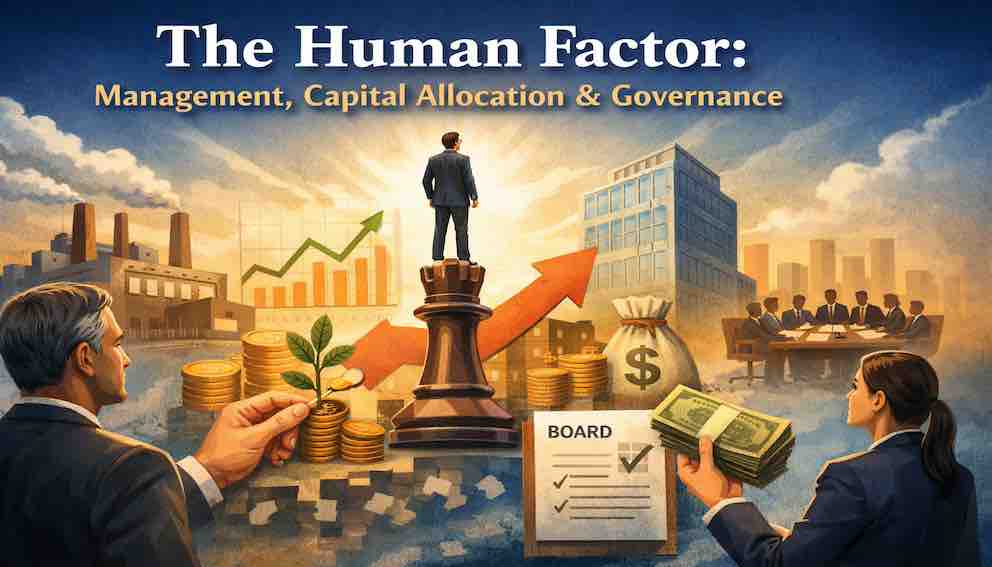
But a castle, no matter how well-designed, crumbles without a wise steward. This tutorial addresses the ultimate determinant of whether a company's potential is realized or squandered: the human factor. Management is the steward of the moat and the allocator of capital. Their decisions—where to reinvest, when to buy back stock, whether to make an acquisition—directly determine if a wide moat leads to decades of compounding or gradual erosion. We will bridge the gap between qualitative judgment and quantitative results, showing you how poor stewardship manifests in declining Return on Invested Capital (ROIC) and fragile Free Cash Flow (FCF).
Part 1: The Executive "Job Interview"—Assessing Management Quality
When you buy a stock, you are hiring a management team. Your most critical due diligence is this "job interview," conducted not through headlines, but through the company's own communications and historical actions.
The "CEO Letter" Investigation: Reading Between the Lines
The annual letter to shareholders is a primary source. Don't read for optimism; read for character, clarity, and capital discipline.
- Candor vs. Spin: Does the CEO openly discuss setbacks and failures with the same depth as successes? A trustworthy steward, like Warren Buffett, famously dedicates ample space to his mistakes. A letter that spins every outcome as a victory lacks integrity.
- Strategic Clarity: After reading, can you explain the company's core strategy in one clear sentence? Is this strategy consistent with the one outlined five years ago? Frequent, drastic pivots often signal a lack of conviction. Beware of buzzword bingo—vague promises of "synergy," "paradigm shifts," or "disruption" without a concrete plan.
- Capital Allocation Philosophy: Does the letter explain the why behind capital decisions? A great allocator frames buybacks, dividends, or acquisitions as calculated moves to increase per-share intrinsic value.
Example in Action: The Tale of Two Allocators
- The Steward (Focused & Candid): For years, Amazon's letters relentlessly focused on long-term customer value over short-term profit, preparing investors for heavy, sustained reinvestment. This strategic clarity allowed for patience as the model compounded.
- The Promoter (Reactive & Vague): In contrast, the letters of many legacy firms during the dot-com era were full of buzzwords but devoid of a durable plan, often preceding a decade of value stagnation and poor capital deployment.
The Track Record: History Doesn't Lie
Past decisions are the best predictor of future behavior. Scrutinize management's history, especially during stress.
- A Major Red Flag: Frequent CEO or C-suite turnover. This often indicates strategic instability, board dysfunction, or an inability to execute.
- The Litmus Test: Examine major capital decisions from 5-10 years ago. Did that large acquisition create value? Did a period of heavy reinvestment lead to higher margins and market share? History reveals competence.
Part 2: The Capital Allocation Scorecard—Where the Rubber Meets the Road
Capital allocation is management's most powerful tool. It's the direct link between qualitative judgment and quantitative results. A company’s cash flow statement is your audit trail.
Track these five uses of cash over a multi-year period. The story they tell is more revealing than any earnings headline.
1. Reinvestment in the Business (The Moat's Lifeblood)
This is cash spent on new equipment, technology, or research (CapEx & R&D).
- The Key Question: Is reinvestment generating an adequate return?
- How to Spot It: Monitor Return on Invested Capital (ROIC). A stable or rising ROIC while reinvestment grows is a green light. A declining ROIC alongside high reinvestment is a major red flag—it means management is funding mediocre projects, destroying value.
- Example: Microsoft's massive reinvestment in cloud computing under Satya Nadella was validated by a soaring ROIC, directly amplifying its software moat.
2. Strategic Acquisitions (Buying Growth or Buying Trouble)
- The Key Question: Did the acquisition create true economic value, or just make the company bigger?
- How to Spot It: Analyze the price paid and the subsequent financial integration. Watch for a collapse in ROIC or FCF margins post-acquisition, which signals overpayment or failed integration.
- Case Study - Value Destruction: Valeant Pharmaceuticals grew via debt-fueled acquisitions while slashing R&D. This destroyed the innovative moat of the companies it bought. Its ROIC collapsed from over 12% to near 4% in three years, a quantitative scream of mismanagement that preceded its downfall.
3. Share Buybacks (The Art of Buying Low)
- The Golden Rule: Buybacks create value only when the stock price is below intrinsic value.
- How to Spot It: Compare the timing of major buyback programs to the stock's valuation (e.g., P/E ratio). Aggressive buybacks at peak valuations destroy shareholder wealth.
- Example: Apple's program has been largely executed during periods of reasonable valuation, systematically increasing per-share value.
4. Dividends (A Direct Return of Capital)
- The Key Question: Does the dividend policy match the company's life stage?
- Red Flag: A fast-growing tech startup paying a large dividend often signals a lack of high-return projects to reinvest in.
- Green Flag: A mature, cash-generative company with a consistent, growing dividend (like Johnson & Johnson) signals a commitment to returning excess capital it cannot deploy at high rates.
5. Paying Down Debt (Fortifying the Foundation)
Prudent management uses periods of strong cash flow to strengthen the balance sheet, creating resilience for downturns. Consistently negative free cash flow coupled with rising debt to fund operations is a critical warning sign of a fragile business model.
Part 3: Governance—The Rules That Enforce Alignment
Governance is the system that ensures management's interests are welded to your long-term interests as an owner. Weak governance allows for short-termism, self-dealing, and excessive risk.
Your Practical Governance Audit:
- Board Independence & Oversight: Is the Board of Directors dominated by insiders and the CEO's friends, or does it have a strong majority of independent directors? Check for key committees (Audit, Compensation) led by independents. CEO duality (when the CEO is also Board Chair) can concentrate too much power and is a noted governance concern.
- Skin in the Game: Do the CEO and key executives own a meaningful amount of company stock they purchased themselves? Options are not ownership. You want leaders whose net worth is meaningfully tied to the long-term stock price.
- Pay for Long-Term Performance: Is executive compensation heavily weighted toward short-term stock price or annual earnings targets (which can be manipulated)? Or is a significant portion tied to 3-5 year goals like ROIC improvement, sustainable market share gain, or FCF growth?
Synthesis: Connecting the Dots for a Complete Picture
This is where your entire analytical journey converges. A supreme investment candidate is a powerful, interlocking structure:
- A Wide Moat: The durable competitive advantage.
- Financial Excellence: The moat produces high, stable ROIC, strong Free Cash Flow, and healthy growth.
- Exceptional Stewardship (This Tutorial): Management protects the moat through smart reinvestment, amplifies it through shrewd capital allocation, and ensures its longevity through sound governance.
When this human factor is neglected, the financial excellence falters. Declining ROIC, volatile FCF, and eroding margins are often the quantitative symptoms of poor qualitative stewardship.
Your First Management Audit: A Practical Exercise
This week, pick one company and conduct a 60-minute stewardship review:
- Read the Latest CEO Letter: Apply the "Candor, Clarity, Capital" test. What's your impression?
- Skim the Proxy Statement (DEF 14A): In the "Executive Compensation" section, what are the key performance metrics? Are they long-term?
- Review the Cash Flow Statement (5 Years): Sketch the story. Is the capital being deployed with evident discipline?
- The Owner's Mindset Exercise: Imagine the company is a local bakery with $100,000 in annual profit. How would you allocate it between a new oven (reinvestment), a savings buffer (debt paydown), a owner bonus (dividend), or buying the rival shop next door (acquisition)? Now, compare your reasoned choices to the actual management's historical decisions. This gap analysis is the core of evaluation.
Conclusion: The Final, Decisive Factor
Fundamental analysis is the pursuit of understanding a business as an owner. We have built that understanding layer by layer, from the language of finance to the sources of durability. This tutorial equipped you with the final, decisive layer: the framework to judge the stewards.
Investing is an act of entrusting your capital to others. The tools you now possess allow you to decide who is worthy of that trust. Seek the stewards—the leaders who think in decades, allocate capital with surgical discipline, and whose wealth is built alongside yours. In them, and in the durable enterprises they guide, you will find the true partners for a lifelong journey of compounding wealth.
Think Like an Owner: This weekend, think of a local business you frequent. If you were a silent partner, what one capital allocation decision would you want to review with the manager from last year? Your instinct to ask that question is the seed of evaluating management. Now, apply that same rigorous, owner's mindset to the companies in your portfolio.
About Swati Sharma
Lead Editor at MyEyze, Economist & Finance Research WriterSwati Sharma is an economist with a Bachelor’s degree in Economics (Honours), CIPD Level 5 certification, and an MBA, and over 18 years of experience across management consulting, investment, and technology organizations. She specializes in research-driven financial education, focusing on economics, markets, and investor behavior, with a passion for making complex financial concepts clear, accurate, and accessible to a broad audience.
Disclaimer
This article is for educational purposes only and should not be interpreted as financial advice. Readers should consult a qualified financial professional before making investment decisions. Assistance from AI-powered generative tools was taken to format and improve language flow. While we strive for accuracy, this content may contain errors or omissions and should be independently verified.