Tutorial Categories
Last Updated: January 31, 2026 at 19:30
Build Your Financial Foundation First - Why Your Emergency Fund and Debt Are Your First "Investments" Introduction To Investing Series
Before investing, the most important work happens outside the market. This tutorial explains why emergency funds and debt management are your first true investments, using real-life examples to show how financial shocks derail unprepared investors. Learn how high-interest debt destroys returns, how savings protect compounding, and how to build a stable foundation that lets your investments survive volatility. This is the quiet preparation that separates short-term speculation from long-term wealth building.
Introduction: The Story of Two Investors
Meet Alex and Sam, both recent graduates starting their first jobs at £30,000.
Alex is excited by investing. Following advice about "starting early," they immediately invest £200 monthly in a popular index fund. Their social feed shows market gains and crypto success stories. "Why keep cash idle?" they think.
Sam takes a different path. They list their financial realities: £2,000 credit card debt at 22% interest, no savings, and monthly rent of £800. For their first six months, Sam pays off the credit card completely and builds a £3,000 emergency fund in a separate savings account. Only then do they begin investing.
One year later, both face a £1,200 car repair.
- Alex checks their investment account. The market is temporarily down 10%, and their £2,400 investment is now worth £2,160. With no emergency fund, they sell £1,200 worth of investments, locking in a £120 loss and missing the eventual market recovery.
- Sam transfers £1,200 from their emergency savings account. Their automated £200 monthly investment continues uninterrupted. They sleep well.
This is the power of preparation. This tutorial isn't about stocks or funds—it's about the two most important financial decisions you'll make before buying any investment. They transform you from a vulnerable speculator into a resilient, long-term investor.
Part 1: Your Emergency Fund—The Ultimate Financial Shock Absorber
What It Is (And Isn't)
An emergency fund is money set aside for unexpected expenses. It is NOT an investment. Its purpose is liquidity and stability, not growth.
Think of it as insurance for your future self. Just as you wouldn't drive a car without insurance, you shouldn't invest without this financial buffer.
The Cost of Not Having One: A Real Example
Scenario: Maria, a university student, invests her entire £1,500 summer earnings. In November, her laptop—essential for her dissertation—fails. A replacement costs £800.
- Without an emergency fund: She sells £800 of her investments. If the market is down 15%, she locks in a £120 loss. More importantly, she removes £800 from her long-term compounding journey.
- With an emergency fund (£1,000 saved): She buys the laptop from savings. Her investments remain untouched, continuing to grow for her future.
The emergency fund didn't earn her money—it prevented a loss.
Your Action Plan:
Determine Your Target:
- Students/Part-time workers: Start with a £500–£1,000 "starter fund."
- Graduates/Full-time employees: Build toward 3–6 months of essential expenses (rent, groceries, utilities, minimum debt payments).
Where to Keep It:
- A separate, easy-access savings account (not your current account).
- Consider a "high-yield savings account" for slightly better interest.
- Never in stocks, crypto, or anything that can lose value overnight.
How to Build It:
- Set up an automatic transfer of £50–£100 per pay-cheque to your emergency fund account.
- Treat this transfer as a non-negotiable bill—the first "bill" you pay to your future self.
Part 2: The Debt vs. Investment Math—Your Guaranteed "Return"
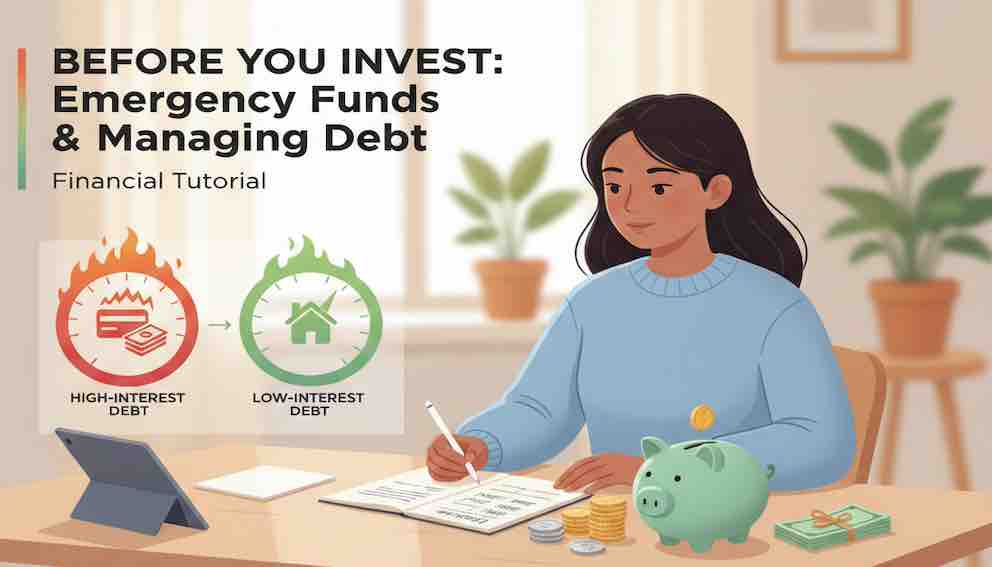
The Critical Distinction: Good Debt vs. Toxic Debt
High-Interest ("Toxic") Debt:
- Examples: Credit card balances (18–30% APR), payday loans, store cards.
- Why it's dangerous: The interest compounds rapidly, creating a financial hole that's hard to escape.
- Rule: Always pay this off before investing.
Low-Interest ("Manageable") Debt:
- Examples: Student loans (3–7%), mortgages (2–5%), some government-backed loans.
- The math is different: The interest rate is often lower than long-term investment returns.
- Strategy: You can often tackle this debt while also investing modest amounts.
The Math That Changes Everything
Let's revisit Alex's choice, but with clear numbers:
The Situation: £3,000 credit card debt at 22% APR. £3,000 in cash available.
Option 1: Invest the £3,000
- What happens: You invest £3,000 and earn 10% return = £3,300
- Meanwhile: Your £3,000 debt grows at 22% = £3,660
- Result: £3,300 (investments) - £3,660 (debt) = -£360
- You're £360 WORSE OFF
Option 2: Pay Off the Debt
- What happens: You pay off the £3,000 debt completely = £0 debt
- Meanwhile: You have no investment, so no return
- Result: You avoid £660 in interest charges
- You're £660 BETTER OFF
By paying the 22% debt, you effectively earned a guaranteed, risk-free 22% return. In the investing world, that's extraordinary. No stock, fund, or crypto can promise that kind of guaranteed performance.
The math is brutally clear: Carrying high-interest debt while investing is like trying to fill a bucket with a hole in the bottom. You must fix the leak (pay the debt) before you can effectively build wealth through investing.
Your Debt Action Plan:
- List all debts by interest rate (highest to lowest).
- Pause all investing (except any employer retirement match—that's free money).
- Throw every spare pound at the highest-interest debt while making minimum payments on the rest.
- Celebrate each debt paid off, then attack the next one.
- Once all high-interest debt is gone, redirect those payments to your emergency fund and investments.
Part 3: How Debt Warps Your Investing Psychology
Debt doesn't just drain your wallet—it clouds your judgment. Behavioral finance research shows that financial stress leads to poorer decisions.
The Debt-Induced Investor Traps:
- The "Catch-Up" Gambler: "I need to make 30% this year to outpace my credit card interest!" This leads to chasing meme stocks, options, or crypto without understanding the risks.
- The Panic Seller: When you're financially stretched, a normal 10% market dip feels like a crisis. You sell low, breaking the fundamental rule of investing.
- The Fee Ignorer: Desperate for returns, you might invest in high-fee funds or platforms that eat away at your already-slim gains.
Contrast this with the Prepared Investor:
With an emergency fund and no toxic debt, a market dip is an opportunity, not a threat. You can stay calm, stick to your plan, and even consider investing more when prices are low. This psychological advantage is worth more than any stock tip.
Part 4: Setting Realistic Goals—The Tortoise Wins
Avoid the "All or Nothing" Trap
The Unrealistic Plan: "I'll save 50% of my income!"
What happens: You eat rice and beans for a month, feel deprived, then splurge and abandon saving altogether.
The Sustainable Plan: "I'll automatically save 15% of each pay-cheque."
What happens: You barely notice it's gone. In 12 months, you've saved nearly two months' salary without drama.
Your Phased Financial Foundation Plan
Phase 1: The Starter Fund (1–3 months)
- Goal: Save £1,000–£3,000 in your emergency account.
- Action: Automate transfers immediately. This is your top priority.
Phase 2: Debt Demolition
- Goal: Eliminate all high-interest debt.
- Action: List debts, attack the highest rate first with any extra cash.
Phase 3: Full Foundation & First Investments
- Goal: Complete your 3–6 month emergency fund.
- Action: Start your first automated investment with the money you were using for debt payments.
Remember: Consistency beats intensity. £50 saved automatically every week is better than £500 saved once and then forgotten.
The "Ready to Invest" Checklist
Before you proceed to Tutorial 2 (Why Investing Matters), use this checklist:
✅ The Essentials
- I have at least £1,000 in a separate emergency savings account (or 1 month of essential expenses).
- I am actively paying down any high-interest debt (credit cards, payday loans).
- My essential monthly expenses are less than my income.
✅ The Mindset
- I understand that paying off 20% debt gives me a better return than most investments.
- I view my emergency fund as financial insurance, not "idle cash."
- I'm prepared to invest consistently rather than chase quick returns.
✅ The System
- I have a simple budget (even just mental) tracking income vs. expenses.
- I've automated my savings to my emergency fund.
- I know where every pound is going each month.
Conclusion: The Foundation Is Everything
Building this financial foundation feels like a delay, but it's actually the ultimate acceleration. You're not just preparing to invest—you're preparing to stay invested through market cycles, job changes, and life's surprises.
The most successful investors aren't necessarily the best stock-pickers; they're the ones who never have to sell at the wrong time. Your emergency fund and debt-free status guarantee you that privilege.
When you start investing with this foundation, you're not just putting money in the market—you're ensuring you'll be able to leave it there to compound for decades.
What looks like patience today becomes power tomorrow.
About Swati Sharma
Lead Editor at MyEyze, Economist & Finance Research WriterSwati Sharma is an economist with a Bachelor’s degree in Economics (Honours), CIPD Level 5 certification, and an MBA, and over 18 years of experience across management consulting, investment, and technology organizations. She specializes in research-driven financial education, focusing on economics, markets, and investor behavior, with a passion for making complex financial concepts clear, accurate, and accessible to a broad audience.
Disclaimer
This article is for educational purposes only and should not be interpreted as financial advice. Readers should consult a qualified financial professional before making investment decisions. Assistance from AI-powered generative tools was taken to format and improve language flow. While we strive for accuracy, this content may contain errors or omissions and should be independently verified.