
Tutorial Categories
Last Updated: January 31, 2026 at 19:30
Why Investing Matters for Beginners: Risk, Return, and the One Superpower Your Money Needs - Introduction to Investing Series
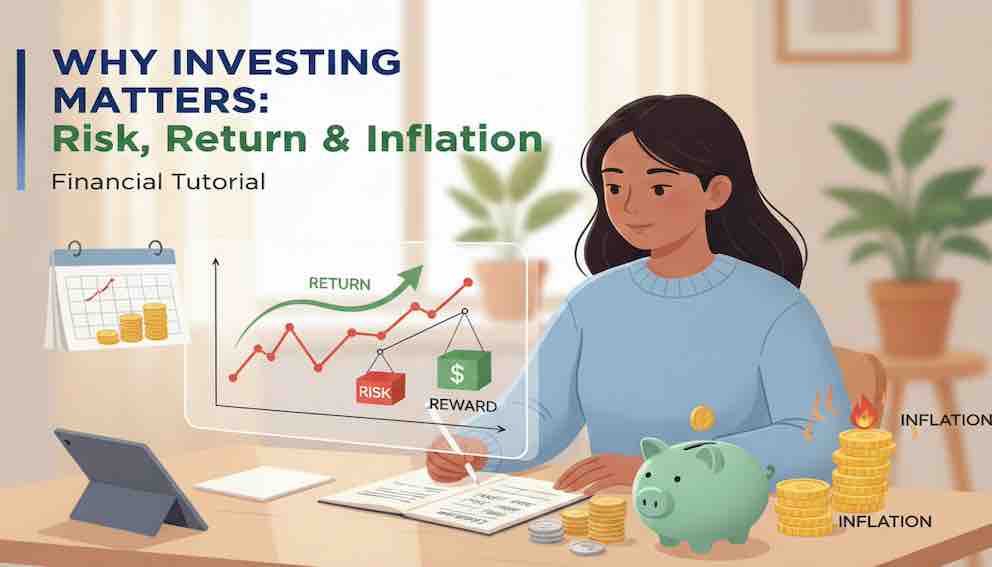
Snippet: For beginner investors, understanding the fundamentals is key to long-term wealth growth. Saving money is safe, but it’s a losing battle against a silent thief: inflation. This tutorial reveals why investing is essential not just to grow wealth, but to protect your money from inflation and build real purchasing power over time. We’ll break down the fundamental trade-off between risk and return, demonstrate how the power of compounding turns modest savings into significant sums, and show why time is your most valuable asset. You’ll learn why starting early—even with small amounts—is your single most powerful financial decision.
Introduction: The Silent Thief in Your Wallet
Imagine your grandparents bought a house for £20,000 in 1970. Today, that same house might be worth £400,000. Did the house become magically better? No. The pound in your pocket became steadily less valuable.
This is inflation—the gradual rise in the price of goods and services over time. At a common 3% annual inflation rate, a £3 coffee costs about £4 in 10 years and £6 in 25 years. If your money is sitting in a savings account earning 1%, it is effectively shrinking in purchasing power every year.
This is the core reason investing matters for building long-term wealth: To build real, lasting wealth, your money must grow faster than inflation. Saving preserves capital for the short term; investing grows purchasing power for the long term. This tutorial is about understanding the engine of that growth and how to harness it from the start.
Part 1: Saving vs. Investing for Beginners – Safety vs. Growth
Let’s be clear: Saving is not investing. Both are crucial, but they serve completely different financial masters.
| Aspect | Saving | Investing |
| Purpose | Safety & liquidity for short-term needs (<5 years) | Growth & building wealth for long-term goals (5+ years) |
| Where It Lives | Bank account, Cash ISA, money market account | Stocks, Bonds, ETFs, Mutual Funds, Property |
| Risk Profile | Very Low (capital is protected) | Low to High (value fluctuates) |
| Expected Return | Low (typically 0.5% - 3%) | Historically Higher (global equities ~7-10% annually*) |
| Best For | The you who needs cash next year | The future you in 10, 20, or 40 years |
*Important Note: Past performance, like the historical 7-10% average for stocks, is not a guarantee of future results. It is, however, a useful long-term benchmark based on broad market history.*
The Critical Insight for Long-Term Wealth Growth: If the money for your distant future is only in savings, you are choosing a guaranteed, gradual erosion of what it can buy. Investing accepts short-term uncertainty for the essential goal of long-term growth that outpaces inflation.
Part 2: Understanding Risk & Return – The Inescapable Trade-Off
The Fundamental Rule of Finance: Higher potential returns always come with higher potential risk.
Think of risk as the price of admission for growth. In investing, "risk" isn't about gambling; it's uncertainty—the range of possible outcomes and the volatility you experience along the way.
The Investment Risk Spectrum
Here’s how common assets compare, from safest to riskiest:
Lowest Risk / Lowest Return
- Cash & Government Bonds: Very safe, but growth often doesn’t beat inflation
- Corporate Bonds: Slightly riskier than government bonds, with modestly higher returns
- Diversified ETFs & Mutual Funds: The beginner's sweet spot—spread risk across hundreds of assets
- Individual Stocks: Higher potential returns, but concentrated risk in single companies
- Cryptocurrency: Very high volatility and uncertainty
- Highest Risk / Highest Potential Return
Why Diversification Matters
When you buy a diversified ETF or mutual fund, you’re buying tiny pieces of many companies. If one company struggles, others may succeed. This spreading of risk is called diversification—it’s why broad market funds are recommended for beginners. Over long periods (10+ years), diversified investing has provided strong growth while significantly smoothing out the ride.
Your Most Important Tool: Time Horizon
Your time horizon—how long you can leave your money invested—determines how much risk makes sense:
- Short-Term Goal (e.g., holiday next year): Use savings. The risk of a market drop is too great with a short timeline.
- Long-Term Goal (e.g., retirement in 40 years): You can confidently invest in diversified stocks/ETFs. You have time to ride out downturns and capture long-term growth.
Part 3: Inflation Explained – Protecting Your Purchasing Power
While risk feels scary, inflation is the guaranteed threat. It’s why “safe” savings can lead to insecure futures.
The Math of Erosion:
- With 3% annual inflation, £10,000 today will have the purchasing power of only about £7,400 in 10 years.
- A savings account paying 1% interest doesn't solve this. After inflation, your “real” return is negative 2%. You're losing purchasing power safely and quietly.
Investing is the Primary Defense. History shows that assets like stocks and real estate have, over long periods, generated returns that outpace inflation. This means your wealth grows in real terms—it can buy more in the future, not less. Bonds provide less inflation protection but can add stability.
Part 4: The Power of Compounding for Long-Term Wealth Growth
Albert Einstein called it the “eighth wonder of the world.” Compounding occurs when your investment earnings generate their own earnings. It’s growth on growth.
A Real-World Example: The £5 Daily Coffee
- The Habit: You buy a £5 coffee every weekday.
- Annual Cost: £5 × 5 days × 52 weeks = £1,300.
- The Alternative: Invest that £1,300 annually (£108/month) in a diversified portfolio with a hypothetical 7% average annual return.
| Time Period | Total You Invested | Approximate Value (7% return) |
| After 10 years | £13,000 | £18,000 |
| After 20 years | £26,000 | £57,000 |
| After 30 years | £39,000 | £138,000 |
| After 40 years | £52,000 | £310,000 |
That’s the raw power of compounding. Notice after 40 years, your £52,000 in contributions generated over £250,000 in investment growth. The money you saved in years 1-10 did decades of heavy lifting.
The Crucial Distinction: Nominal vs. Real Returns
- Nominal Return: The stated percentage growth of your investment (e.g., 7%)
- Real Return: The nominal return minus inflation—what actually matters for purchasing power:
-If your investment earns 7% and inflation is 3%, your real return is about 4%
-This 4% is the true increase in what your money can buy
Part 5: The Real-World Showdown: Chloe vs. Ben
Let’s see these forces—inflation, compounding, risk—play out in a relatable life example.
The Goal: Building a retirement nest egg
The Start: Both are 25 years old. Both can set aside £300 per month.
Chloe (The Prudent Saver): "Markets are scary!" She saves £300/month into a cash account earning 1% interest.
Ben (The Consistent Investor): He invests £300/month into a low-cost global index fund (targeting a long-term average return of ~7%).
Results at Age 65 (40 years later):
| Metric | Chloe (The Saver) | Ben (The Investor) |
| Total Contribution | £144,000 | £144,000 |
| Nominal Account Value | ~£177,000 | ~£720,000 |
| Growth (Nominal) | £33,000 | £576,000 |
| Purchasing Power Today* | ~£54,000 | ~£220,000 |
Adjusted for 3% annual inflation over 40 years
The Lesson: Ben didn’t pick magical stocks. He simply harnessed compounding in diversified assets over a long time horizon. Chloe’s “safe” choice cost her over £500,000 in future wealth and left her brutally exposed to inflation’s erosion. Her money was safe, but her future purchasing power was not.
Conclusion & Key Takeaways: Your Investor Mindset Shift
Investing isn’t about getting rich quick. It’s a rational system for ensuring the money you work hard for today retains—and grows—its value for the future you.
The Three Pillars of the Beginner Investor’s Mindset:
- Think in Real Terms: Always consider inflation. Chase returns that beat it, not just big nominal numbers. Your goal is to increase purchasing power.
- Embrace the Right Risk: Use diversified investments (like ETFs) and a long time horizon to turn short-term volatility from a scary monster into a source of long-term growth. Start with broad funds, not individual stocks.
- Trust Time & Consistency: Your monthly contribution rate and your starting age are far more important than picking the “hot” stock. Automate your investments and let compounding work silently in the background.
You don’t need to be a stock-picking genius. You need to be patient, consistent, and understand these fundamental rules. By investing in a diversified portfolio, you’re not betting on a single company—you’re betting on the broad, long-term progress of the global economy and putting the most powerful force in finance on your side.
Your Action Point Before the Next Tutorial:
Use a free compound interest calculator online. Plug in a small monthly amount you could save (£50, £100) for 30 years at a 6% return. Then, change the return to 1% (a savings rate). See the staggering difference. That future gap is your motivation to begin.
About Swati Sharma
Lead Editor at MyEyze, Economist & Finance Research WriterSwati Sharma is an economist with a Bachelor’s degree in Economics (Honours), CIPD Level 5 certification, and an MBA, and over 18 years of experience across management consulting, investment, and technology organizations. She specializes in research-driven financial education, focusing on economics, markets, and investor behavior, with a passion for making complex financial concepts clear, accurate, and accessible to a broad audience.
Disclaimer
This article is for educational purposes only and should not be interpreted as financial advice. Readers should consult a qualified financial professional before making investment decisions. Assistance from AI-powered generative tools was taken to format and improve language flow. While we strive for accuracy, this content may contain errors or omissions and should be independently verified.