
Tutorial Categories
Last Updated: January 31, 2026 at 19:30
Introduction to Bonds & Fixed Income: A Beginner’s Guide to Safer Investing - Introduction to Investing Series
Think bonds are just for retirees? Think again. This guide reveals how bonds act as an essential shock absorber in your portfolio, reducing risk and providing stability. Learn the simple difference between government and corporate bonds, understand key terms like yield and duration, and discover the safest, easiest ways for beginners to add bonds to their strategy. With clear examples, you'll see how bonds protect your money and create opportunities, even in a volatile market.
Introduction: The Unsung Hero of Your Portfolio
Imagine driving a car without shock absorbers. Every bump would be jarring, stressful, and could damage the vehicle. Now, imagine your investment portfolio: stocks are the powerful engine, but bonds are the shock absorbers.
While everyone talks about exciting stocks, bonds play a critical, understated role: they reduce violent swings, provide steady income, and give you the courage to stay invested when stock markets plummet. This tutorial will show you why bonds are a non-negotiable tool for any smart investor, especially beginners.
Let's follow Alex, who is saving a £20,000 deposit for a house in 3 years. He can't afford to have his savings wiped out by a stock market crash right before he needs the money. Bonds are his solution.
Part 1: What is a Bond? It's a Simple IOU.
At its heart, a bond is a formal loan. You are the banker.
- The Borrower: A government (UK, US, Germany) or a company (Apple, Tesco).
- The Loan Amount: The "Face Value" (e.g., £1,000).
- The Interest Rate: The "Coupon" (e.g., 4% per year).
- The Repayment Date: The "Maturity Date" (e.g., 5 years from now).
Alex's Example:
Alex lends £1,000 to the UK government by buying a "Gilt." The terms: "We will pay Alex £30 every year for 10 years, and then return his £1,000." The £30 is his coupon payment. This provides predictable, low-risk income.
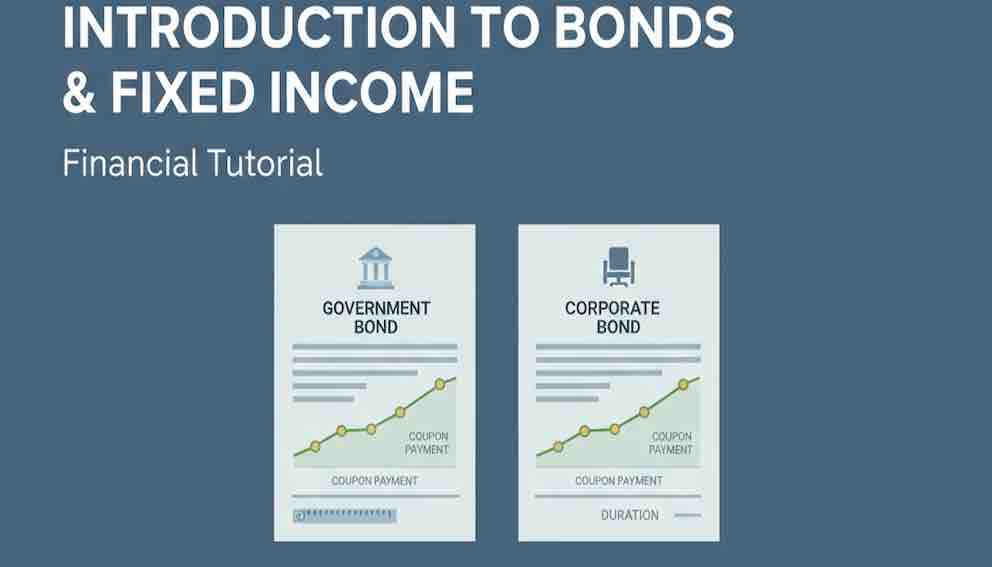
Part 2: Government vs. Corporate Bonds – The Safety vs. Return Trade-Off
Not all borrowers are equally reliable. This creates a spectrum of risk and return.
Government Bonds (UK Gilts, US Treasuries): The "Sleep-Soundly" Loan
- Risk: Extremely Low. Governments can raise taxes or (theoretically) print money to repay debt. Default is very rare.
- Return: Lower. You're paid for safety. Yield might be 3-4%.
- For: Preserving capital, short-term goals, the ultimate safety portion of your portfolio. This is where Alex puts his house deposit money.
Corporate Bonds: The "Business Loan"
- Risk: Higher. Companies can go bankrupt. Risk varies by company health, which is measured by credit ratings (e.g., AAA, AA, BBB).
- Return: Higher. You're paid extra for taking on risk. Investment-grade bonds (BBB- and above) offer moderate yields. High-yield or "junk" bonds (BB+ and below) offer much higher yields but come with significantly higher default risk.
- For: Boosting income in a portfolio while accepting more risk than government bonds.
Part 3: The Two Key Concepts You Must Understand
1. Yield: Your True Rate of Return
The coupon is fixed, but the yield changes based on the bond's market price, which can be above or below its face value.
- Buy at a Discount (<£1,000): Your yield is higher than the coupon.
- Example: Alex buys a £1,000 Gilt for £950 with a 3% coupon (£30/year). His effective yield is £30 / £950 ≈ 3.16%. He got a bargain.
- Buy at a Premium (>£1,000): Your yield is lower than the coupon.
- Example: If he paid £1,050 for the same bond, his yield is £30 / £1,050 ≈ 2.86%.
Why it matters: You'll see bonds quoted by their yield. It tells you what you're actually earning based on today's price.
2. Duration & Interest Rates: The "See-Saw" Effect
This is the trickiest but most important concept. Duration measures how much a bond's price will move when interest rates change.
The Interest Rate See-Saw:
- Interest Rates UP ➔ Existing Bond Prices DOWN.
- Interest Rates DOWN ➔ Existing Bond Prices UP.
Why? The Context & The "Annuity Analogy": Central banks raise rates to cool inflation or a hot economy, and lower them to stimulate growth. Imagine you own a bond paying £50/year. If new bonds are issued paying £60/year, why would anyone buy yours for the same price? They wouldn't. Your bond's price must drop to make its yield competitive. That's interest rate risk.
Duration as a "Volatility Meter":
- High Duration (e.g., 10 years): Bond price is very sensitive to rate changes. (Higher risk & potential reward).
- Low Duration (e.g., 2 years): Bond price is barely affected by rate changes. (More stable).
Alex's Application: For his 3-year house goal, Alex chooses short-duration government bonds. Their prices are stable, so his £20,000 will be roughly £20,000 (+ small interest) when he needs it, regardless of rate moves.
Part 4: How Bonds Make You a Better Stock Investor
This is the magic. Bonds aren't just a "safe asset." They are a strategic tool.
1. The Shock Absorber Effect (Diversification):
When stocks crash, investors often flee to the safety of government bonds. This "flight to quality" can cause bond prices to rise while stocks are falling, cushioning your portfolio's fall.
- Portfolio A (100% Stocks): In a -20% market crash, it's down 20%.
- Portfolio B (60% Stocks, 40% Bonds): In the same crash, stocks drag it down 12%, but bonds might hold steady or gain 2%. Net result: maybe -10%. The ride is half as bumpy.
2. The "Dry Powder" Effect (Opportunity):
When your bonds pay regular coupons, that's cash flowing in. During a market panic, you can use that cash to buy stocks at sale prices instead of selling your own stocks at a loss. Bonds give you options.
Part 5: Your Beginner's Action Plan – How to Actually Buy Bonds
You don't need to buy £1,000 increments directly from the government. The easiest, most diversified way is through Bond ETFs or Mutual Funds.
Individual Bonds vs. Bond Funds:
- Individual Bond: You loan to one entity. You know the exact maturity date and get your principal back if you hold to maturity. Good for specific future cash needs (like Alex's house plan).
- Bond Fund/ETF: You pool money with others to own hundreds of bonds. No maturity date—you buy and sell shares of the fund. It's more liquid and diversified, but the value constantly fluctuates with interest rates.
The Beginner's Recommendation: Start with a Bond ETF.
- What to buy: A low-cost, short-to-medium term government bond ETF (e.g., a "UK Gilt ETF" or "Global Aggregate Bond ETF"). For greater diversification and slightly higher yield, consider a fund that mixes government and high-quality corporate bonds across different durations (short, medium, long).
- Why an ETF? Instant diversification, low minimum investment (£50), and you can buy it in your existing Stocks and Shares ISA. It's simple.
- Tax Note: In the UK, holding bonds within a Stocks and Shares ISA makes all returns tax-free. Some government bonds (like Gilts) also have favourable tax treatment on interest outside an ISA. Always check the tax rules for your country.
- What to search: Look for low "Ongoing Charge Figure (OCF)" (<0.20%) and the word "UCITS" (a regulatory safety standard).
Alex's Final Move: Alex decides to split his approach. For the £20,000 house fund, he buys individual short-term Gilts (for capital certainty). For the long-term retirement portfolio in his ISA, he allocates 30% to a global aggregate bond ETF for broad diversification across governments and corporates.
Conclusion & Key Takeaways: Embrace the Shock Absorber
Bonds complete your financial toolkit. They transform you from a speculative passenger in the market to a strategic driver with control over your portfolio's smoothness.
Remember:
- Bonds = Loans. Government bonds are safest; corporate bonds (rated by credit agencies) pay more for more risk.
- Market Price Matters. Buying below face value (a discount) increases your yield; buying above (a premium) decreases it.
- Yield is your true return. Duration is your interest rate volatility meter, and it moves with the economic cycle.
- Bonds protect your portfolio by zigging when stocks zag (diversification) and providing income to buy opportunities (dry powder).
- Start simply & diversify. Use a low-cost, diversified bond ETF in your tax-advantaged account (like an ISA) as your foundation. You can mix durations and credit qualities to fine-tune risk.
You don't need to love bonds. You just need to respect the essential job they do: making sure you have the stability to stick with your stock investments for the long haul. That’s how wealth is truly built.
About Swati Sharma
Lead Editor at MyEyze, Economist & Finance Research WriterSwati Sharma is an economist with a Bachelor’s degree in Economics (Honours), CIPD Level 5 certification, and an MBA, and over 18 years of experience across management consulting, investment, and technology organizations. She specializes in research-driven financial education, focusing on economics, markets, and investor behavior, with a passion for making complex financial concepts clear, accurate, and accessible to a broad audience.
Disclaimer
This article is for educational purposes only and should not be interpreted as financial advice. Readers should consult a qualified financial professional before making investment decisions. Assistance from AI-powered generative tools was taken to format and improve language flow. While we strive for accuracy, this content may contain errors or omissions and should be independently verified.