Tutorial Categories
Last Updated: January 31, 2026 at 19:30
Portfolio Diversification & Asset Allocation for Beginners: A Practical Guide to Reducing Risk and Growing Wealth - Introduction to Investing
Don't put all your eggs in one basket? That's just the start. This guide teaches you how to build a resilient "financial ecosystem" by mixing stocks, bonds, and international assets. Learn how diversification reduces risk, how to choose your personal stock/bond mix (asset allocation), and get three simple, actionable portfolio recipes. We'll show you how to maintain your portfolio over time, helping you grow wealth steadily while sleeping soundly at night.
Introduction: The Forest vs. The Single Tree
Imagine two plots of land:
- Plot A: A vast field of a single, high-yield crop. It booms in perfect conditions but is wiped out by one specific blight.
- Plot B: A diverse forest with oaks, pines, shrubs, and streams. A drought might stress the oaks, but the pines thrive. A storm damages some branches, but the ecosystem survives and regrows.
Your investment portfolio is the same. Concentration (Plot A) promises huge rewards but risks total loss. Diversification (Plot B) builds resilience, ensuring your wealth can weather any season.
This tutorial is your guide to cultivating your own financial ecosystem. We'll cover the blueprint (asset allocation) and the planting strategy (diversification) to build a portfolio that grows steadily for decades.
Part 1: Why Diversification is Your Financial Immune System
Diversification isn't just "not putting all eggs in one basket." It's intentionally combining assets that respond differently to the same economic event.
The Core Principle: Low Correlation.
- High Correlation: Tech stocks often rise and fall together. If you only own tech, you're not diversified.
- Low/Negative Correlation: When bad news hits stocks, investors often flee to the safety of government bonds, causing their prices to rise. They don't move in lockstep.
The Psychological Payoff: Remember the lesson on panic selling? A diversified portfolio falls less during a stock market crash. Because the drop is less severe, you're far less likely to make the catastrophic mistake of selling low. Diversification is the system that protects you from yourself.
Part 2: Asset Allocation – The Master Blueprint
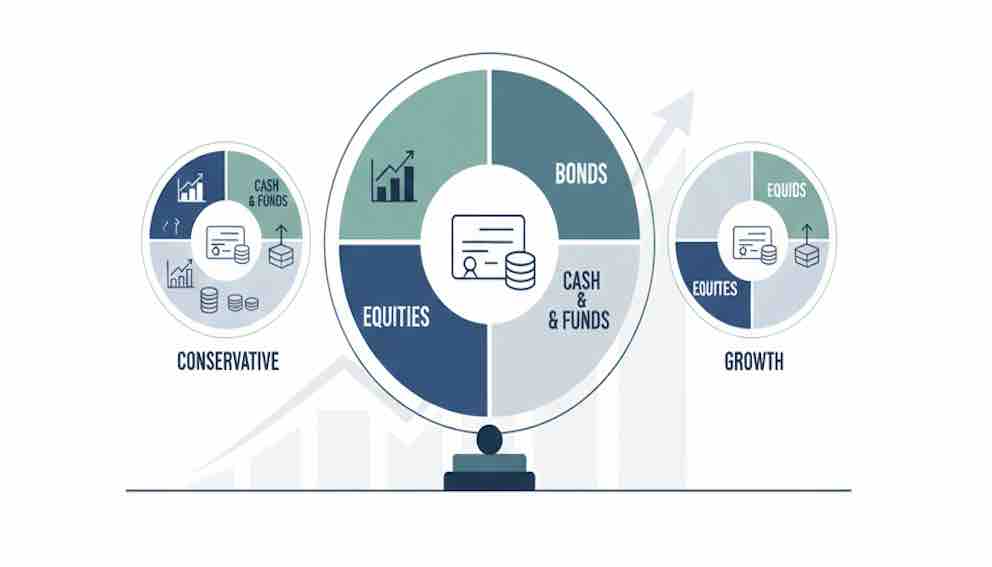
If diversification is what you own, asset allocation is how much you own of each major type. This is your single most important investment decision.
The Big Three Asset Classes:
- Stocks (Equities): The "Growth" layer of your forest. High potential, but volatile (tall trees that sway in the storm).
- Bonds (Fixed Income): The "Stability" layer. Lower growth, but provides steady income and reduces overall volatility (the sturdy undergrowth and soil).
- Cash/Cash Equivalents: The "Seed" layer. Not for long-term growth, but provides liquidity for opportunities or short-term needs. (This is different from your emergency fund).
Your Personal Blueprint: The "Age & Comfort" Guideline
A classic starting point is to hold a percentage in bonds roughly equal to your age. But your personal comfort (risk tolerance) overrides this.
- A 25-year-old with high risk tolerance: Might choose 90% Stocks / 10% Bonds.
- A 25-year-old who is risk-averse: Might choose 60% Stocks / 40% Bonds.
- The rule: Your allocation should let you watch a market downturn without losing sleep or selling.
The Critical Dimension: Time Horizon
- Long-Term Goals (10+ years): You can plant a "Timber" portfolio. You have time to recover from deep drawdowns, so you can prioritize growth (more stocks).
- Short-Term Goals (<5 years): You need a "Sapling" portfolio. You cannot afford a major loss right before you need the money, so you must prioritize stability (more bonds/cash).
Part 3: Building Your Ecosystem – Three Simple Recipes
Let's translate theory into practice. Here are three model portfolios using the simple, diversified funds we discussed earlier. These are designed for long-term growth (5+ year horizon). Money needed sooner belongs in safer savings.
Portfolio 1: The "Sapling" Portfolio (Conservative)
- Goal: Steady growth with low volatility. For the risk-averse or for medium-term goals (5-10 years away).
- Blueprint: 40% Stocks, 55% Bonds, 5% Cash
- Risk/Return Profile: Lower long-term growth potential, but significantly smaller swings. In a crisis (Stock Market -20%), it might only fall ~8-10%.
- How to Build It:
- 40% → Global Stock ETF (e.g., VWRL - for international diversification)
- 55% → Global Bond ETF (e.g., VAGP)
- 5% → Cash in your account
Portfolio 2: The "Growing Forest" Portfolio (Moderate)
- Goal: Balanced growth for a core long-term goal (10+ years). The recommended starting point for most.
- Blueprint: 70% Stocks, 28% Bonds, 2% Cash
- Risk/Return Profile: Good growth with manageable volatility. In a crisis, it might fall ~14-15%.
- How to Build It:
- 70% → Global Stock ETF (This provides automatic international diversification, reducing your risk from any single country's economy).
- 28% → Global Bond ETF
- 2% → Cash
Portfolio 3: The "Timber" Portfolio (Aggressive)
- Goal: Maximum long-term growth (15+ year horizon). For those emotionally prepared for large drawdowns.
- Blueprint: 90% Stocks, 10% Bonds
- Risk/Return Profile: Highest growth potential, but highest volatility. In a crisis, it could fall ~18% or more.
- How to Build It:
- 90% → Global Stock ETF
- 10% → Global Bond ETF
Why "Global" Matters: Investing globally isn't just about chasing growth abroad; it's a key risk reducer. If your home country's market struggles (like Japan in the 1990s), other regions may thrive, stabilizing your portfolio.
Part 4: The Magic of Rebalancing – Gardening Your Portfolio
Your portfolio isn't a "set and forget." It's a living ecosystem that needs occasional tending. Rebalancing is the process of selling what has done well and buying what has lagged to return to your target blueprint.
Why It's a Superpower:
- It Enforces Discipline: It makes you "sell high" (trim winning assets) and "buy low" (top up lagging ones).
- It Controls Risk: If stocks surge, your portfolio becomes riskier than you intended. Rebalancing brings the risk back to your comfort level.
How to Do It (The Simple Way):
- Check once a year.
- If any asset class is off by more than 5% from its target, rebalance.
- Example: Your Moderate portfolio (70/30) drifts to 77% Stocks / 23% Bonds after a bull market. Sell enough stock ETFs to buy bond ETFs and return to 70/30.
Part 5: Your Action Plan – Cultivate Your Wealth
Step 1: Choose Your Blueprint. Based on your goal timeline and the "sleep test," pick one of the three recipes above. If unsure, start with Moderate.
Step 2: Pick Your Funds. Use broad, low-cost global ETFs to fill each allocation, as shown.
Step 3: Execute in the Right Account. Build this inside a tax-advantaged account. In the UK, use a Stocks and Shares ISA. In the US, use a Roth IRA or 401(k). In Canada, use a TFSA or RRSP. This protects your returns from tax drag, letting your money compound faster.
Step 4: Automate Contributions. Set up a monthly direct debit. This is like watering your garden regularly.
Step 5: Schedule Your Gardening (Rebalancing). Put a yearly reminder in your calendar to check and rebalance.
Common Mistakes to Uproot:
- The Monoculture Mistake: Owning 10 different tech stock funds is not diversification.
- The Home-Bias Neglect: Only investing in your home country ignores global opportunities and concentrates risk.
- The Neglect Mistake: Letting your portfolio drift to 90% stocks when you chose a 70% blueprint.
- The Over-tilling Mistake: Rebalancing monthly or reacting to news. Annual check-ups are enough.
Conclusion & Key Takeaways: You Are Now a Portfolio Architect
You've moved beyond picking investments to designing a system. Diversification and asset allocation are the bedrock of this system.
- Diversification is about uncorrelated assets (stocks vs. bonds, domestic vs. international) to build a resilient financial ecosystem.
- Asset Allocation is your personal risk/return blueprint, determined by your timeline and temperament. Long horizons can handle more stock volatility.
- Rebalancing is the disciplined maintenance that keeps your portfolio aligned with your goals.
- Tax Efficiency is a Force Multiplier. Always use available tax-advantaged accounts (ISA, 401k, etc.) to house your long-term portfolio.
- Simplicity Wins. A two-ETF, globally diversified portfolio following a clear blueprint is far superior to a complex, concentrated one.
By adopting this structured approach, you are no longer gambling on single outcomes. You are cultivating long-term, resilient wealth. You have built a portfolio that can survive storms, droughts, and seasons of uncertainty, and grow steadily for decades to come.
About Swati Sharma
Lead Editor at MyEyze, Economist & Finance Research WriterSwati Sharma is an economist with a Bachelor’s degree in Economics (Honours), CIPD Level 5 certification, and an MBA, and over 18 years of experience across management consulting, investment, and technology organizations. She specializes in research-driven financial education, focusing on economics, markets, and investor behavior, with a passion for making complex financial concepts clear, accurate, and accessible to a broad audience.
Disclaimer
This article is for educational purposes only and should not be interpreted as financial advice. Readers should consult a qualified financial professional before making investment decisions. Assistance from AI-powered generative tools was taken to format and improve language flow. While we strive for accuracy, this content may contain errors or omissions and should be independently verified.