Tutorial Categories
Last Updated: February 8, 2026 at 18:30
World Markets Move Together: Why Diversification Breaks Down in a Crisis
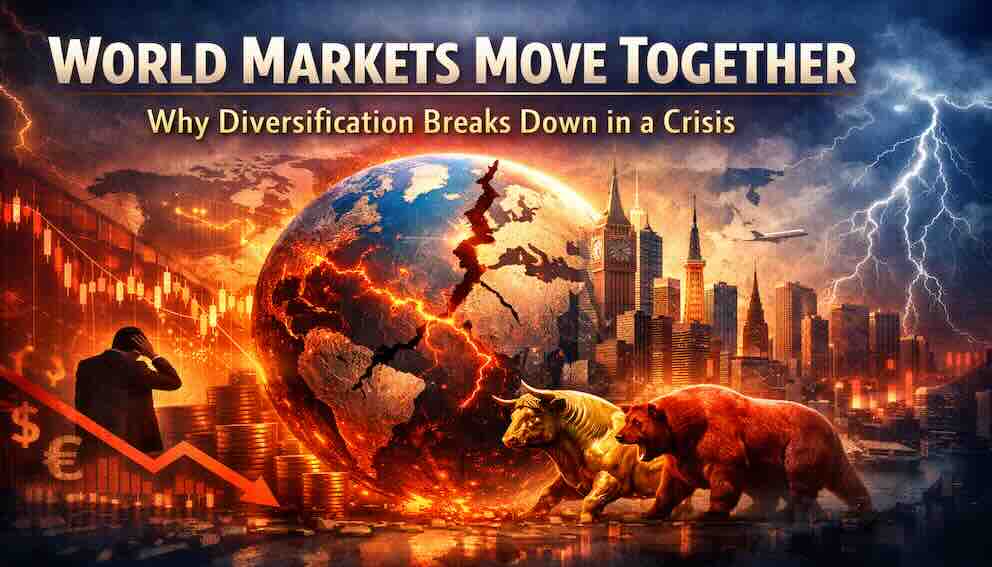
A core promise of investing is that spreading your money across different countries shields your portfolio from risk. In calm markets, this often seems true, creating a comforting sense of security. However, history’s greatest market shocks reveal an inconvenient truth: during a true crisis, the deep-seated connections of our global economy pull markets into a frighteningly synchronized decline. This tutorial explains why the diversification you count on often fails when you need it most, moving beyond simple geography to explore the hidden links of investor psychology, institutional mechanics, and global supply chains. By understanding how volatility, currency, and time itself reshape correlations, you can build a portfolio resilient not just on paper, but under real-world stress.
Introduction: The Fracturing of a Comforting Idea
The proposition is elegant and logical: if you spread your investments across the world, a storm in one region should be balanced by calm in another. For decades, this principle of geographic diversification has been a cornerstone of prudent investing. It appeals to our innate understanding of not putting all our eggs in one basket and is supported by historical data showing that different national markets do not move in perfect lockstep.
This idea forms the basis of the classic 60/40 portfolio and is championed by financial advisors everywhere. It feels like a financial safety net, a rational hedge against the unpredictable fortunes of any single nation. For many long-term investors, it is the first and most powerful strategy they learn for managing risk.
But what happens when the entire global basket is jolted at once? The 2008 financial crisis offered a stark answer. As the U.S. housing market crumbled, investors watched in disbelief as stock markets from Frankfurt to Tokyo, São Paulo to Sydney, plummeted in a global wave of selling. The promised diversification seemed to vanish overnight. A similar story played out in March 2020, when the onset of the COVID-19 pandemic triggered one of the fastest global market crashes in history. Assets that were supposed to be uncorrelated fell together with startling speed.
These events expose a critical flaw in the simplistic geographic model. True diversification is not about labels on a map; it is about the underlying economic and psychological engines that drive returns. When fear takes over, borders blur, and the world’s markets can begin to move as one. This tutorial is an exploration of that phenomenon—an investigation into why diversification breaks down when it is needed most, and how we can think more clearly about building genuine resilience.
The Illusion of Independence: Correlation is Not a Constant
To understand the failure, we must first understand the tool. In finance, correlation is a statistical measure of how two assets move in relation to each other. A low correlation is the holy grail of diversification—it suggests that when one zigs, the other zags, smoothing your journey.
In tranquil times, global markets often exhibit this desirable low correlation. One country may be raising interest rates while another cuts them; one region may boom on commodity exports while another slows. Their stock markets can appear pleasingly disconnected, lulling investors into a sense of security.
However, this measured correlation is not a fixed law of physics; it is a description of behavior under specific, calm conditions. It is like observing two neighbors who live separate, independent lives. The relationship appears stable until a wildfire threatens the entire hillside—suddenly, their fates are perfectly correlated in the face of a shared, existential threat.
Financial correlations are regime-dependent. The relationships you measure during a long bull market tell you very little about how assets will behave when the system is under acute stress. In a crisis, the latent connections—the shared vulnerabilities—become the only thing that matters, and correlations across global equities spike toward 1. They move in perfect, painful lockstep.
The Domino Effect: Three Channels of Global Contagion
When a major crisis strikes, it does not politely respect national borders. It rips through the global system via interconnected channels that swiftly turn a local problem into a worldwide event.
1. The Psychological Channel: The Viral Nature of Fear
Fear is the most potent and contagious force in finance. When investors in New York see a 7% market plunge, a primal question echoes in Tokyo and London: “What do they know that I don’t?” This triggers precautionary selling—a decision to reduce risk first and ask questions later. In our digital age, this herd instinct is amplified 24/7 by global financial media and social networks, broadcasting panic and creating a single, unified narrative of dread. Before any analyst can assess a company’s local fundamentals in Milan or Mumbai, its stock is being sold because of a mood that originated halfway around the world.
2. The Institutional Channel: The Mechanics of Forced Selling
Modern finance is dominated by giant global institutions—pension funds, hedge funds, and algorithmic trading systems. These entities manage trillion-dollar portfolios bound by strict risk models, leverage limits, and volatility triggers.
This is where volatility itself becomes the driver. To these systems, a sharp rise in market volatility isn't just noise; it is a direct signal that "risk" has increased. When the VIX (the "fear index") spikes, risk models automatically mandate a reduction in exposure. Margin calls are issued, forcing leveraged funds to sell assets to post more collateral. This selling is not a thoughtful analysis of German versus Japanese prospects; it is a mechanistic, indiscriminate dump of "risk assets" from across the entire global portfolio to meet a cold, mathematical requirement. The 2008 crisis was a brutal lesson in this: a problem with American subprime mortgages triggered forced liquidations of stocks in Europe and Asia, not because those companies were failing, but because the system was seizing up.
3. The Fundamental Channel: Our Shared Economic Bedrock
Our economies are not merely linked; they are fused into a single, complex organism. Consider a "German" company like Volkswagen. It assembles cars in Tennessee with semiconductors from Taiwan, financed by loans from London, to be sold to consumers in Brazil. Its fate is tied to global supply chains, commodity prices, and the health of consumers on three continents.
This deep interdependence means the profits of companies listed on distant stock exchanges are often driven by the same few global master variables: the spending power of the American consumer, the pace of Chinese industrial demand, and the cost of dollar-denominated debt. When this shared bedrock shakes—as it did in 2008 with credit, or in 2020 with global commerce—everything built upon it trembles in unison. A recession in the U.S. doesn't just hurt S&P 500 earnings; it depresses profits from Bavaria to Seoul.
The Currency Wildcard: The Unseen Amplifier
When investing globally, you are not just buying a foreign stock; you are making a twin bet on that company and its home currency. This adds a powerful, often overlooked layer of complexity that can distort the diversification story.
During a crisis, two things typically happen simultaneously: global stocks fall, and there is a "flight to safety" into the U.S. dollar. For an American investor holding unhedged foreign stocks, this creates a double-whammy. First, the share price falls in its local currency. Second, that local currency (like the Brazilian real or the Turkish lira) often weakens sharply against the dollar. When you convert your shrunken investment back to dollars, the loss is magnified.
Conversely, this dynamic can work in reverse for a non-U.S. investor. The surge in the dollar can partially offset their losses in U.S. stocks. The crucial lesson is that the "return" of a foreign asset is a combination of its local price change and the currency movement. In a crisis, these forces often align in the worst way for international portfolios, making correlated losses feel even more severe. True global diversification requires an intentional decision about whether to hedge this currency risk—a choice that fundamentally changes the risk and return profile of your foreign holdings.
The Map is Not the Territory: Why Geographic Labels Mislead
This leads to the core misconception: believing that a company’s stock exchange listing defines its economic exposure. Buying the stock of a "Japanese" company like Toyota does not give you a pure stake in Japan’s domestic economy. You are buying a global industrial giant whose fortunes rise and fall with worldwide auto demand, U.S. interest rates, and Chinese supply chains.
During the 2020 crash, it didn’t matter if you owned airlines in France, banks in Canada, or miners in Australia. If their business model was sensitive to global growth and liquidity, they were all hit by the same tidal wave. The geographic label was a distraction from the true, shared risk factor: global cyclical exposure.
True diversification, therefore, is not achieved by allocating capital across a map. It is achieved by analyzing what drives a company’s profits. Is it a global cyclical business (like semiconductors or shipping), vulnerable to worldwide downturns? Or is it a local, defensive business (like a regional utility or a grocery chain) that may hold up better when international trade seizes? The latter may provide more genuine diversification, even if it’s in your home country, because its fate is decoupled from the global fear cycle.
The Asymmetry of Diversification: A Test of Patience
This reveals a frustrating but fundamental feature of global investing: the asymmetry of diversification benefits. For years, or even decades, global diversification works beautifully. Different markets lead and lag, providing smooth returns and reducing volatility. This long, peaceful period validates the strategy and builds unwavering confidence.
Then, a systemic crisis arrives. In that precise moment—when protection is most desperately needed—correlations spike toward 1. All equities fall together. The diversification benefit seems to evaporate. This is the moment of truth and profound disillusionment, when many investors make the catastrophic error of abandoning the strategy at its point of maximum future potential.
For it is after the crisis, when correlations fall back to normal levels, that global diversification reasserts its profound value. This is where time horizon is everything. While short-term movements are synchronized, medium- and long-term outcomes dramatically diverge.
- Short-Term (Days/Weeks): Panic dominates. Correlations → 1. Everything falls.
- Medium-Term (Months/Years): Recovery paths fork. Nations with better policies, healthier banks, or different economic structures begin to outperform. This is where geographic differences truly matter.
- Long-Term (Decades): Structural forces—demographics, innovation cycles, governance—dominate again, driving powerful divergences in national market returns.
The diversification didn’t fail in 2008; it merely entered a different, less visible phase of its cycle. The patient investor who held a globally diversified portfolio participated not only in the synchronized crash but, crucially, in the uneven, powerful recovery that followed, where some markets soared while others lagged.
Building Genuine Resilience: A Portfolio in Practice
So, if buying foreign stocks isn't a magic shield, what does a resilient portfolio look like? The goal is to diversify by underlying risk drivers, not by geographic labels. Let's contrast two hypothetical investors, Alex and Sam, during a crisis.
Investor Alex: The Geographic Collector
Alex’s portfolio is 100% equities, spread across 12 ETFs covering the U.S., Europe, Japan, and Emerging Markets. On paper, it’s globally diversified. In a crisis, Alex discovers that all these ETFs hold companies whose profits depend on global growth and credit. When volatility spikes and institutions deleverage, all 12 ETFs plunge in unison. Alex’s geographic diversification provides no cushion.
Investor Sam: The Risk-Driver Architect
Sam’s portfolio also has global equities, but they are balanced with truly different assets:
- High-Quality Government Bonds: In a "flight-to-safety," these often rise as stocks fall, providing real counterbalance and dry powder.
- A Hedged Currency Stance: Sam has consciously decided to hedge the currency risk on a portion of foreign holdings, separating the bet on companies from the bet on foreign exchange.
- Defensive Equities: Sam has allocated to sectors like consumer staples or utilities, which are less sensitive to the global economic cycle.
During the crisis, Sam’s portfolio still falls, but less severely. More importantly, the bonds hold their value or even appreciate. This is not just a paper gain; it provides the critical ability to rebalance—to sell a piece of the bonds that held up and buy more of the equities that became cheap at the moment of maximum fear. This disciplined, mechanical act is the true superpower of a well-diversified portfolio.
Conclusion: Wisdom for an Interconnected World
The story of global markets moving together is not a tale of diversification’s failure, but a lesson in its true, more demanding nature. We have seen that our world is woven together by threads of shared psychology, institutional mechanics, and fundamental economic interdependence—threads that are invisible in sunlight but become unbreakable cables in a storm.
The investor’s task is to see past the comforting fiction of geographic labels. A portfolio of stocks from a dozen countries, all leveraged to the same global growth cycle, is not diversified; it is a single, concentrated bet wearing a dozen different costumes.
True resilience comes from understanding the deep drivers of return and assembling a portfolio where some of those drivers are genuinely different. It means accepting that in a panic, your equities will likely suffer together. The ultimate test of your strategy is not avoiding that moment, but whether you have built a portfolio with the balance, patience, and non-correlated assets to endure the storm, keep your footing, and act with clarity when the world, once again, begins to move at its own distinct and separate pace.
About Swati Sharma
Lead Editor at MyEyze, Economist & Finance Research WriterSwati Sharma is an economist with a Bachelor’s degree in Economics (Honours), CIPD Level 5 certification, and an MBA, and over 18 years of experience across management consulting, investment, and technology organizations. She specializes in research-driven financial education, focusing on economics, markets, and investor behavior, with a passion for making complex financial concepts clear, accurate, and accessible to a broad audience.
Disclaimer
This article is for educational purposes only and should not be interpreted as financial advice. Readers should consult a qualified financial professional before making investment decisions. Assistance from AI-powered generative tools was taken to format and improve language flow. While we strive for accuracy, this content may contain errors or omissions and should be independently verified.