Tutorial Categories
Last Updated: February 9, 2026 at 19:30
Risk, Not Return, Is the First Question: A Practical Guide to Seeing the Real Dangers in Investing
When you consider an investment, what is the first question you ask? Most of us instinctively ask about return—how much money we can make. This tutorial argues that this is the wrong starting point. The first, most crucial question must always be about risk: How can this investment fail, and what would that loss mean for me? We will explore why the dangers that truly matter—permanent loss of capital, broken compounding, and emotional ruin—are often hidden behind comforting statistics like past returns. By learning to see risk clearly, you build a foundation for decisions that protect your capital first, allowing sustainable returns to follow as a natural consequence of survival.
Introduction: The Lure of the Easy Question
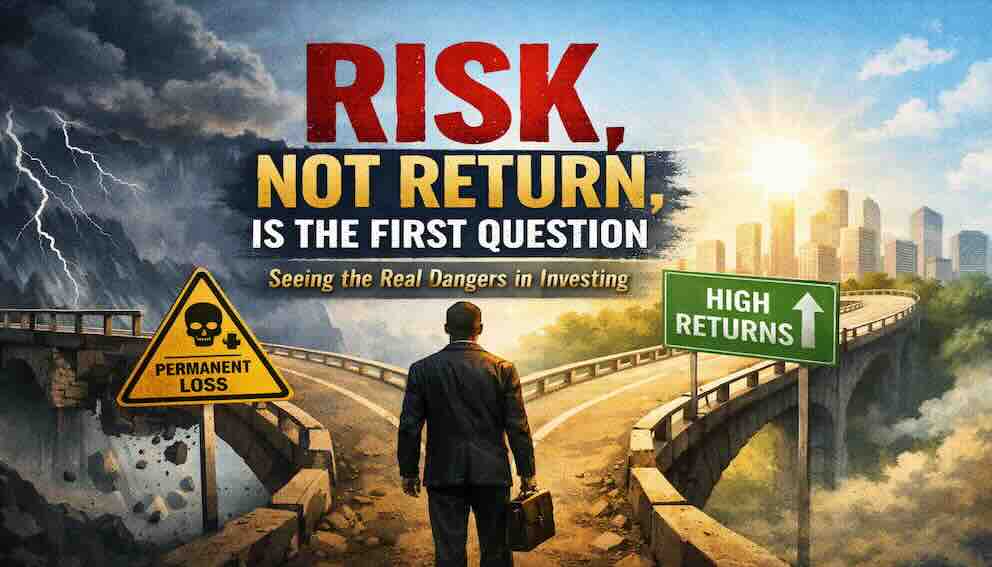
Picture yourself standing at the edge of a new bridge, eager to reach the opportunities on the other side. Your first, natural question is likely, “How quickly can I get across?” It’s exciting, forward-looking, and full of promise. Few of us would think to first ask, “How was this bridge engineered? What storms has it weathered? Could it collapse under my weight?”
This is the fundamental error in how most people approach investing. The conversation begins, and often ends, with return. How much can I make? What’s the growth rate? What’s hot right now? This focus is understandable. Returns are quantifiable, marketable, and speak directly to our hopes. But this instinct prioritizes the destination while ignoring the integrity of the bridge we must cross to get there.
The uncomfortable truth is that in investing, the journey is not separate from the destination; it defines it. A path littered with hidden chasms can lead to ruin long before the promised land is in sight. This tutorial is an invitation to reorder your questions. Before you ask about gain, you must interrogate potential loss. This is not a call to fearful inaction, but to clear-eyed preparation. By making risk your first question, you shift from being a passive passenger on the market’s rollercoaster to becoming the engineer of your own financial resilience.
What Risk Is (And What It Is Not): Moving Beyond the Label
In finance, “risk” is a deceptively simple word that masks a complex reality. It is often used as a catch-all for anything unpleasant, but to manage it, we must separate its distinct flavors. At its core, investing risk is the possibility that reality will deviate from your expectations in a way that harms your financial goals. Notice the emphasis on harm; not all deviations are equal. A pleasant surprise is a deviation, but we don’t call it risk.
To navigate this, let’s distinguish between three layers of risk that are often conflated:
- Uncertainty: The broad, general state of not knowing the future. This is unavoidable and present in every single investment.
- Volatility: The short-term ups and downs in the quoted price of an asset. This is what charts measure and what makes headlines.
- Permanent Loss of Capital: The real, enduring impairment of your wealth. This is the ultimate danger.
The common mistake is to assume these are a chain of causation: that Uncertainty leads directly to Volatility, which is synonymous with Permanent Loss. This is a dangerous oversimplification. True risk management is about preventing Uncertainty and Volatility from ever culminating in Permanent Loss. A rocky road (volatility) does not mean you will crash your car (permanent loss), if you are driving a sturdy vehicle at a prudent speed.
The Siren Song of Volatility: A Noisy Distraction
Modern finance has enshrined volatility as the definitive measure of risk. Tools like Standard Deviation and the VIX “Fear Index” quantify how wildly prices swing. This is convenient for models and labels, but it can be deeply misleading for investors.
Consider two assets:
- Asset A: The stock of a century-old, profitable utility company. Its price bounces around daily with market sentiment, news cycles, and interest rate speculation. It has high volatility.
- Asset B: A private loan to a trendy, fast-growing restaurant chain. The price doesn’t change because there’s no public market. It shows low volatility. However, the chain is burning cash and relies on constant new funding to survive.
If you equate risk with volatility, Asset A looks “risky” and Asset B looks “safe.” This is precisely backwards. The utility’s short-term price noise is likely irrelevant to a long-term owner collecting its dividends. The restaurant loan’s stable price masks a high risk of a 100% permanent loss if the chain fails.
Volatility is merely the noise of the crowd’s changing opinion. It measures emotional temperature, not economic health. Focusing on it invites two errors: panic-selling a sound asset during a temporary downdraft, and feeling secure in a deteriorating one because the price hasn’t yet moved. True risk lies in the underlying business or asset’s intrinsic value, not in the day-to-day bidding war over it.
The True Enemy: Permanent Loss of Capital and the Broken Compounder
This brings us to the only risk that fundamentally matters for a long-term investor: Permanent Loss of Capital. This occurs when capital is allocated to an investment that loses its economic value and does not recover, or when an investor is forced to liquidate at a loss to meet other obligations.
Permanent loss is catastrophic because it breaks the most powerful force in finance: compounding. The mathematics are brutal and asymmetric. A 50% loss requires a 100% gain just to return to breakeven. A 90% loss—as seen by shareholders of many bankrupt companies—requires a 900% gain. Such recoveries are the stuff of legend, not a reliable strategy.
This damage typically happens through two doors:
- The Door of Broken Business: The investment itself fails. A company goes bankrupt. A speculative asset like a meme stock or a worthless cryptocurrency goes to zero. A piece of real estate is bought in a declining neighborhood. Here, the loss is baked into the asset’s fate.
- The Door of Broken Behavior: Here, the asset might have been sound, but the investor’s choices convert volatility into permanence. This happens through:
- Over-leverage: Using borrowed money (margin) to invest. A mild market drop triggers a margin call, forcing the sale of assets at the worst time to repay the loan.
- Poor Liquidity Planning: Needing to sell investments to cover an unexpected life expense during a market downturn.
- Panic: Selling a diversified index fund or a blue-chip stock after a 30% drop, locking in a temporary paper loss as a permanent one.
The second door is especially insidious because it turns a psychological failing into a financial catastrophe. Protecting yourself from permanent loss, therefore, is as much about understanding your own psychology and personal finances as it is about analyzing balance sheets.
The Personal Nature of Risk: Where You Stand Determines What You See
A crucial insight is that risk is not an absolute property of an asset; it emerges from the interaction between an asset and an individual investor. The same investment carries vastly different risks depending on your personal context.
Consider Time Horizon, your most powerful yet most wasted asset. A 30-year-old saving for retirement has time to recover from a market crash. For them, volatility is largely a psychological test, not a financial one. A 70-year-old drawing income from their portfolio faces a different reality. A deep, prolonged downturn can force them to sell depreciated assets to fund living expenses, converting paper losses into permanent ones. Time doesn't eliminate the risk of a bad business, but it does neutralize the danger of temporary price fluctuations.
Now consider Liquidity Needs. An investor with a robust emergency fund and stable income can ride out volatility. An investor who may need to tap their portfolio for a down payment or medical bill in the next two years cannot afford to have that money in a volatile asset, no matter its long-term potential.
This means the first step in a risk-first analysis is looking in the mirror. You must ask: "Given my timeline, my obligations, and my ability to sleep at night, what kind of volatility can I endure without being forced to make a catastrophic sale?" The right asset in the wrong hands is a ticking bomb.
The Hidden Danger of Correlated Failure: When "Diversification" Is an Illusion
A risk-first mindset must extend beyond individual picks to the entire portfolio. One of the most devastating mistakes is believing you are diversified when, in fact, all your investments are exposed to the same underlying danger. This is correlation risk.
Imagine an investor in 1999 who thought they were diversified because they owned 20 different technology stocks. Or an investor in 2006 who owned a primary home, two rental properties, and shares in several homebuilding companies. On paper, these portfolios are spread across many assets. In reality, they are a single, concentrated bet on one theme. When the dot-com bubble burst or the housing market collapsed, everything fell together. The diversification was an illusion because the assets were highly correlated—they all failed for the same reason.
True diversification isn't just about owning many things; it's about owning things that are unlikely to fail simultaneously for the same reason. This means spreading your bets across different:
- Economic Drivers: (e.g., consumer staples vs. luxury travel)
- Geographies: (though this has limits, as we've seen)
- Asset Classes: (e.g., stocks, bonds, real assets)
The risk-first question becomes: "If my main investment thesis is wrong, what else in my portfolio will be dragged down with it?"
The Architect’s Mindset: Building with a Margin of Safety
How do we operationalize a risk-first approach? We adopt the mindset of a civil engineer, not a lottery-ticket buyer. An engineer doesn’t build a bridge to handle the average expected weight; they build it to handle the maximum plausible weight plus a significant buffer. This buffer is the Margin of Safety.
In investing, a Margin of Safety means purchasing an asset for significantly less than your conservative estimate of its intrinsic value. It is the difference between price and value. This concept, championed by Benjamin Graham, is the foundational practice of risk-first investing.
- If you pay $100 for something you believe is worth $100, you have no margin. Any miscalculation or piece of bad luck leads to a loss.
- If you pay $60 for something you conservatively believe is worth $100, you have a 40% margin of safety. This buffer absorbs errors in your analysis, unexpected bad news, or general market declines. The downside is limited; the upside, if you’re right, remains substantial.
A Margin of Safety is not a guarantee, but it is a practical tool that directly addresses the risk of permanent loss. It forces the question of value first and demands a favorable price as a precondition for action. It is the mathematical embodiment of the principle: “Don’t lose money.”
The Risk of Standing Still: A Necessary Clarification
A risk-first philosophy can be misinterpreted as advocating for excessive caution. It is important to clarify that risk-first does not mean risk-zero. There is a real, often silent, risk in avoiding risk altogether: the risk of falling short.
This manifests in two ways:
- The Erosion of Inflation: Holding all your wealth in "safe" cash guarantees its purchasing power will be eroded over time by inflation. This is a certain, slow-motion permanent loss.
- The Opportunity Cost of Non-Participation: Avoiding the volatility of equity markets often means missing their long-term compounding returns, which have historically been the most reliable engine for building wealth over decades.
The goal, therefore, is not to eliminate risk but to take intelligent, compensated risks. You accept the volatility of the stock market because history suggests you are compensated for it with higher long-term returns. You do not accept the risk of a single, unproven stock at a sky-high price, because the potential compensation does not justify the high probability of permanent loss. The risk-first framework helps you distinguish between the two.
From Theory to Practice: A Risk-First Filter for Any Decision
Let’s apply this full lens to a modern example: evaluating a popular, fast-growing technology stock.
The Return-First Approach:
- Question 1: “It’s grown revenue 40% for three years. Can it continue?”
- Question 2: “The addressable market is huge. What’s my upside?”
- Risk is an afterthought: “It’s a bit volatile, but that’s normal for growth.”
The Risk-First Approach:
- Question 1 (Personal Context): “Does this match my time horizon and liquidity needs? Could a 50% drop force me to sell?”
- Question 2 (Portfolio Context): “Do I already own many assets that would fail if the ‘growth stock’ theme falls out of favor? Am I concentrated?”
- Question 3 (Survival): “How could this business be permanently impaired?” Look for: extreme competition, technological disruption, high burn rate, complex accounting.
- Question 4 (Margin of Safety): “Given these risks, what price would give me a sufficient buffer? Is the current price at that level, or is it pricing in perfection?”
- Question 5 (Intelligent Risk): “Only if I can satisfy the first four questions do I ask: Is the potential return a fair compensation for the real, understood risks I am taking?”
This filtering process doesn’t make investing easy, but it makes it disciplined. It systematically exposes hidden dangers before you get seduced by the visible upside. It might lead you to pass on many “exciting” opportunities, but it will also help you avoid the one catastrophic, portfolio-level loss that could derail a decade of progress.
Conclusion: Risk as the Foundation, Not the Footnote
We end where we began, at the edge of the bridge. The investor who asks only about speed may cross first, but they gamble on the integrity of the structure unseen beneath their feet. The investor who first inspects the foundations—checking the materials (margin of safety), the design (correlation), and their own load (personal context)—may start later, but they walk across with confidence, knowing they will reach the other side.
Putting risk first is the ultimate form of financial self-respect. It acknowledges that markets are unpredictable, that our psychology is flawed, and that our personal situation dictates what we can safely hold. It replaces the thrilling but dangerous pursuit of maximum return with the more achievable, and ultimately more fruitful, goal of durable compounding.
Return is the output of a process. Risk management is the process. By making “How could this hurt me?” your first, most rigorous, and most personal question, you do not eliminate risk—you master it. You build a portfolio that can withstand storms, recover from mistakes, and compound quietly over the long time horizon you have deliberately aligned it with. In the long run, the returns will take care of themselves for the investor who was wise enough to worry about survival first.
About Swati Sharma
Lead Editor at MyEyze, Economist & Finance Research WriterSwati Sharma is an economist with a Bachelor’s degree in Economics (Honours), CIPD Level 5 certification, and an MBA, and over 18 years of experience across management consulting, investment, and technology organizations. She specializes in research-driven financial education, focusing on economics, markets, and investor behavior, with a passion for making complex financial concepts clear, accurate, and accessible to a broad audience.
Disclaimer
This article is for educational purposes only and should not be interpreted as financial advice. Readers should consult a qualified financial professional before making investment decisions. Assistance from AI-powered generative tools was taken to format and improve language flow. While we strive for accuracy, this content may contain errors or omissions and should be independently verified.