
Tutorial Categories
Last Updated: February 9, 2026 at 19:30
Risk-Taking Capacity in Investing: How to Know How Much Risk You Can Truly Handle and Build a Strategy That Fits You
Risk-taking capacity is one of the most misunderstood ideas in investing, yet it quietly shapes nearly every success and failure investors experience. Many people assume that age alone determines how much risk they should take, but in reality, emotional resilience, life circumstances, and personal temperament matter just as much as financial facts. This tutorial explores the difference between financial capacity, emotional capacity, and the often-overlooked concept of risk need. It explains why simple age-based rules fail and shows how to match an investing strategy to who you truly are. By understanding yourself more deeply, you can build a portfolio that you can stay committed to through both good markets and difficult ones.
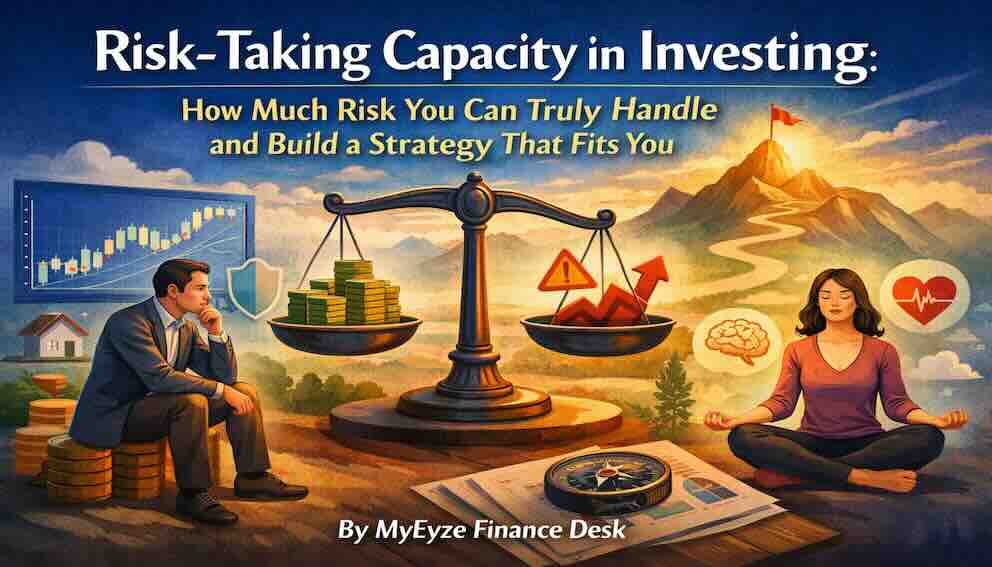
Risk-Taking Capacity: Knowing How Much You Can Actually Bear
In the world of investing, people often talk about returns, market trends, stock picks, and economic forecasts. These topics sound impressive, and they certainly matter. However, beneath all of these technical discussions lies a quieter but far more powerful force that determines whether an investor succeeds or fails over time. That force is risk-taking capacity.
Risk-taking capacity is not simply about how much money you can afford to lose on paper. It is about how much uncertainty, volatility, and emotional discomfort you can live with in real life without making decisions that damage your long-term plan. Many investors discover too late that they believed they were comfortable with risk, but when markets fell sharply, their behavior revealed something very different.
This tutorial is about helping you understand yourself better as an investor. It will explore financial risk capacity, emotional risk capacity, and the often-overlooked idea of risk need. It will explain why age alone does not provide a complete answer and show how aligning your investing strategy with your temperament creates a calmer, more sustainable path forward.
Successful investing is not about pushing yourself to tolerate maximum risk. It is about choosing a level of risk that you can live with year after year.
To begin making this idea concrete, it helps to first separate what can be measured from what must be felt. The most natural starting point is the practical, observable side of risk-taking capacity.
Financial Risk Capacity: The Practical Side of Risk
Financial risk capacity focuses on your objective ability to absorb losses without jeopardizing your essential life needs or long-term goals.
To understand this, imagine two people who both invest $50,000 in the stock market. One person has $2 million in total assets, no debt, and a stable job. The other person has $60,000 in total savings and carries high-interest credit card debt. Even though they invested the same amount, their financial risk capacity is dramatically different.
For the first person, a temporary loss of $10,000 may be disappointing but not life-changing. For the second person, the same loss could delay paying bills, increase stress, and force difficult lifestyle sacrifices. This difference matters deeply.
Financial risk capacity is influenced by several factors.
Income Stability
Someone with a steady, predictable income can usually tolerate more investment volatility than someone whose income fluctuates widely. For example, a tenured teacher or government employee with reliable paychecks may feel more comfortable riding out market downturns than a freelance artist whose income varies from month to month.
Emergency Savings
Having a healthy emergency fund acts like a shock absorber. When unexpected expenses arise, you do not need to sell investments at an unfavorable time. Without this buffer, even small market declines can feel threatening.
Time Horizon
If you will not need your invested money for decades, short-term market movements matter far less. However, if you will need the money within a few years for a house purchase or retirement income, your ability to tolerate risk naturally decreases.
Obligations and Dependents
Supporting children, elderly parents, or other dependents increases the importance of preserving capital. A person responsible for multiple dependents often has less room for aggressive risk-taking than someone with no such responsibilities.
Financial risk capacity is about math, probabilities, and planning. But financial strength alone does not guarantee emotional comfort.
Understanding financial risk capacity also requires recognizing that risk is not only about how much you lose, but when you lose it.
Sequence-of-Returns Risk
Two investors can earn the same average return over a lifetime and end up in dramatically different financial positions depending on when the good and bad years occur. This is known as sequence-of-returns risk. It matters most for people who are withdrawing from their portfolios, such as retirees or those nearing retirement.
Imagine two retirees who both earn an average of 7 percent per year over thirty years. One experiences strong returns in the early years and weaker returns later. The other experiences severe losses in the first few years and strong returns later. Even though the long-term average is identical, the second retiree is far more likely to run out of money. Early losses permanently shrink the base from which withdrawals are taken, and future gains compound on a much smaller foundation.
This is why aggressive portfolios can be dangerous for investors with low financial risk capacity, even if they believe they are emotionally comfortable with volatility. Especially when they are approaching or already in retirement. A bad sequence early in retirement can irreversibly impair sustainable withdrawal rates, forcing spending cuts or premature depletion of capital.
Human Capital
At the opposite end of the life spectrum, a different force quietly increases financial resilience. Financial risk capacity is not determined solely by the size of your current portfolio. It is also shaped by what you are likely to earn in the future. This future earning power is often called human capital, and for young professionals it may be their largest asset by far.
A 25-year-old with a modest investment account but strong career prospects has decades of income ahead. That future income functions as a stabilizing force. It allows mistakes to be repaired, losses to be replenished through savings, and risk to be absorbed over time. In this sense, human capital effectively increases risk capacity, even when current net worth is small.
By contrast, a 70-year-old retiree may have a much larger portfolio but very little future earning power. Even small permanent losses matter more because there is no meaningful way to replace them. This is why portfolio aggressiveness should generally decline as human capital is gradually converted into financial capital.
So far, we have looked at risk primarily through numbers, probabilities, and life circumstances. But investing is not experienced on spreadsheets. It is experienced inside the mind.
Emotional Risk Capacity: The Psychological Side of Risk
Emotional risk capacity refers to how you feel and behave when investments fluctuate in value.
Some people can watch their portfolio decline by 20 percent and view it as an uncomfortable but temporary event. Others feel intense anxiety at a 5 percent drop and lose sleep, check prices constantly, and consider selling everything. Neither reaction is morally better or worse. They simply reflect different emotional wiring.
Emotional risk capacity is shaped by personality, life experiences, and past interactions with money.
Someone who grew up in a financially unstable household may associate losses with danger and insecurity.
Someone who has lived through previous market crashes may be more cautious or, in some cases, more resilient.
Some people naturally focus on long-term outcomes, while others are highly sensitive to short-term changes.
Emotional capacity is critical because investing success depends more on behavior than on intelligence. A brilliant strategy that you abandon during stressful periods will not produce good results.
Illiquidity and Behavioral Lock-In
One specific situation where emotional risk capacity is frequently misjudged involves assets that cannot easily be sold. Illiquid investments introduce a special kind of psychological stress that most people underestimate when markets are calm. On paper, assets such as private equity, private credit, venture capital, and even real estate often appear “safer” because they do not display daily price movements. This stability is often an accounting convention rather than an economic truth. The value can still be falling, but you simply do not see it.
The deeper issue is behavioral lock-in. When you own a liquid stock or fund, you always retain the option to exit. That option itself has psychological value, even if you never use it. When you own an illiquid investment, the option disappears. During periods of stress, when fear is high and uncertainty feels overwhelming, being unable to act can feel suffocating rather than comforting. What once seemed like a long-term commitment can begin to feel like a trap.
For this reason, illiquid investments often demand higher emotional risk capacity than liquid ones, not lower. Before allocating to assets that cannot easily be sold, it is worth asking: How would I feel if I desperately wanted to reduce this position but had no ability to do so?
The Third Dimension: Risk Need
So far, we have explored what you can afford to lose and what you can emotionally tolerate. These two dimensions explain a great deal about why investors behave the way they do. However, there is one more dimension that quietly shapes every investing decision, even when people are not aware of it: risk need. This dimension is not about comfort or personality. It is about mathematics and necessity. Risk need refers to the level of return required to reach your financial goals.
You may be able to take high risk.
You may be comfortable with high risk.
Yet you may not need high risk.
Likewise, you may dislike risk, yet face mathematical realities that require higher expected returns.
A 30-year-old who saves early and consistently may achieve goals with moderate returns.
A 55-year-old starting late may require higher growth simply to have a chance.
Sustainable investing happens at the intersection of:
What you can afford (financial capacity)
What you can emotionally endure (emotional capacity)
What your goals require (risk need)
Ignoring any one of these creates imbalance.
Sustainable investing emerges only when these three forces are considered together.
Why Financial and Emotional Risk Capacity Must Be Balanced
Imagine a person who has very strong financial risk capacity. They have high income, large savings, and long time horizons. On paper, they can afford to invest aggressively. However, emotionally they are highly sensitive to losses and experience extreme anxiety during downturns.
If this person builds an aggressive portfolio because a spreadsheet says they can, they may panic and sell during the first major decline. The result is worse than if they had chosen a more conservative approach from the start.
Now imagine the opposite. A person has limited financial risk capacity but high emotional tolerance. They enjoy volatility and believe strongly in long-term investing. Even though they feel comfortable with large swings, their finances cannot safely absorb major losses. In this case, emotional confidence does not override financial reality.
True risk-taking capacity exists where financial ability and emotional comfort overlap. This overlap zone is where sustainable investing lives.
This integrated view also reveals why simple age-based rules fall short.
Why Age Alone Is Not the Answer
Many traditional investing rules suggest that younger people should take high risk and older people should take low risk. While age is relevant, it is far from sufficient.
Two 35-year-olds can have completely different lives. One may have a stable career, no debt, and strong savings. The other may have inconsistent income, heavy debt, and family obligations. Their financial risk capacity is not the same.
Similarly, two 65-year-olds may also differ greatly. One may have a generous pension and minimal expenses. Another may rely entirely on investment income. Treating both as identical simply because of age ignores reality.
Age influences the time horizon, but the time horizon is only one piece of a larger puzzle.
Life Stage Matters More Than Birth Year
A more meaningful framework looks at life stage:
Foundation and early saving
Growth and accumulation
Transition toward retirement
Distribution and income generation
A person in a wealth-building stage may be accumulating assets and contributing regularly. A person in a wealth-preservation stage may be focused on protecting what they have built. A person in a wealth-distribution stage may be drawing income from investments.
These stages can occur at different ages for different people. Someone who starts investing at 20 will reach stages earlier than someone who begins at 40. Someone who receives an inheritance may shift stages suddenly.
Life stage offers more insight than age because it reflects real circumstances, not just time since birth.
When broad rules ignore these realities, they can quietly push investors toward unsuitable portfolios.
The Danger of Following Generic Rules
Rules like “invest your age in bonds” or “young people should be aggressive” are simplified shortcuts. They are designed for mass audiences, not for individuals with unique situations.
These rules can be useful starting points, but treating them as rigid truths can lead to inappropriate portfolios.
Imagine a young person who is deeply uncomfortable with volatility but follows a rule telling them to invest aggressively. They may spend years feeling anxious, checking markets constantly, and eventually abandoning investing altogether. A slightly more conservative approach that they can stick with would likely produce better long-term results.
Because risk tolerance cannot be perfectly predicted in advance, it is usually uncovered through experience rather than declared in theory.
Risk Capacity Is Discovered, Not Declared
Most people do not truly know their risk capacity in advance.
They may believe they know. They may answer questionnaires. They may imagine how they would react during a market crash. But imagination and reality are rarely the same thing.
Real risk capacity is revealed through lived experience.
This is why a safer approach is often to begin slightly more conservatively than you think is necessary. Observe how you react to normal market pullbacks. Notice whether you feel mildly uncomfortable or deeply distressed. Pay attention to whether you remain calm or feel compelled to change your plan.
Small, survivable discomfort teaches more than theoretical questionnaires ever can.
Over time, these experiences provide honest feedback. You learn what level of volatility you can coexist with. You learn whether you sleep well or lie awake worrying. You learn whether you stay invested or feel an overwhelming urge to escape.
Risk capacity is not a fixed label. It is something you gradually uncover.
Matching Strategy to Temperament
Temperament refers to your natural tendencies in how you think, feel, and respond to situations.
Some people are optimistic and patient. Others are cautious and detail-oriented. Some enjoy complexity. Others prefer simplicity.
Your investing strategy should feel like an extension of who you are, not a constant battle against your nature.
If You Are Naturally Cautious
You may prefer investments that emphasize stability and predictable income, such as high-quality bonds, dividend-paying stocks, or diversified index funds with lower volatility.
You may accept lower expected returns in exchange for better sleep and peace of mind. This is not a failure. It is a rational trade-off.
If You Are Naturally Patient and Long-Term Oriented
You may feel comfortable holding growth-oriented assets and enduring long periods of volatility. You may enjoy reading about market history and understanding that downturns are temporary.
Even so, it is still wise to maintain some level of diversification and downside protection.
If You Are Easily Stressed by Uncertainty
You may benefit from simpler portfolios and automated investing plans that reduce the need for constant decision-making.
Complex strategies that require frequent adjustments may increase anxiety and lead to mistakes.
These patterns naturally begin to suggest what type of investor you resemble.
Portfolio Archetypes: Translating Self-Knowledge Into Structure
The Sleep-Well Investor
Emphasizes stability and simplicity.
Often uses balanced or conservative allocations.
Primary goal: never feel forced to sell.
The Balanced Builder
Mix of growth and stabilizing assets.
Accepts volatility within limits.
Primary goal: steady long-term compounding.
The Growth-Oriented Endurer
High exposure to growth assets.
Prepared for deep drawdowns.
Primary goal: maximize long-term growth.
None of these is superior. The best portfolio is the one you can hold.
Once you recognize your general orientation, the next step is turning that self-knowledge into structure.
Building a Portfolio You Can Live With
Once you understand your risk-taking capacity, you can design a portfolio that aligns with it.
This may involve:
- Mixing growth assets with stabilizing assets.
- Using broad diversification.
- Avoiding overly complex strategies.
- Automating contributions.
- Setting clear rules for rebalancing.
The goal is not to maximize theoretical returns. The goal is to maximize the likelihood that you will stay invested consistently over decades.
Consistency beats brilliance.
Risk Capacity Can Change Over Time
Your financial situation, life stage, and emotional outlook will evolve.
You may become more comfortable with risk as you gain experience. You may become more conservative after major life events.
It is healthy to revisit your risk-taking capacity periodically and adjust your strategy gradually rather than reactively.
Conclusion: Investing Begins With Knowing Yourself
Risk-taking capacity is not about being fearless. It is about being honest.
We learned that risk capacity has multiple dimensions. There is financial risk capacity, which reflects what your resources and circumstances allow. There is emotional risk capacity, which reflects how you experience uncertainty and loss. There is also risk need, which reflects what level of return your goals mathematically require. Sustainable investing exists only where these three forces meet.
We explored why age alone is an incomplete guide and why life stage, income stability, human capital, and obligations provide a far clearer picture. We examined how temperament shapes behavior, why generic rules often fail, and how portfolios must be built around real human psychology rather than idealized versions of ourselves.
When your portfolio fits who you truly are, investing becomes quieter. It becomes steadier. It becomes less about reacting and more about continuing.
And in the end, it is not brilliance, boldness, or perfect timing that builds lasting wealth.
It is a reasonable plan, aligned with your nature, patiently followed.
About Swati Sharma
Lead Editor at MyEyze, Economist & Finance Research WriterSwati Sharma is an economist with a Bachelor’s degree in Economics (Honours), CIPD Level 5 certification, and an MBA, and over 18 years of experience across management consulting, investment, and technology organizations. She specializes in research-driven financial education, focusing on economics, markets, and investor behavior, with a passion for making complex financial concepts clear, accurate, and accessible to a broad audience.
Disclaimer
This article is for educational purposes only and should not be interpreted as financial advice. Readers should consult a qualified financial professional before making investment decisions. Assistance from AI-powered generative tools was taken to format and improve language flow. While we strive for accuracy, this content may contain errors or omissions and should be independently verified.