
Tutorial Categories
Last Updated: February 9, 2026 at 20:30
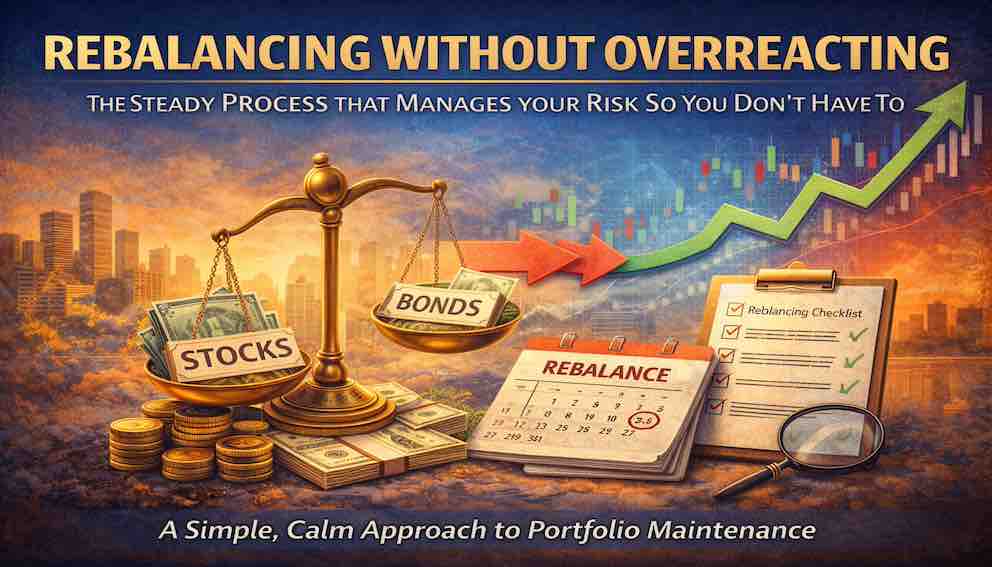
Rebalancing Without Overreacting: The Steady Process That Manages Your Risk So You Don't Have To
Rebalancing is a fundamental but often misunderstood practice. This tutorial explains why it exists not to boost returns, but to enforce the risk discipline you chose for yourself. You will learn how to execute it through simple, unemotional rules, the hidden psychological benefits it provides during market chaos, and the crucial pitfalls that turn it from a discipline into a detriment. By the end, you’ll see rebalancing not as a chore, but as a quiet system that protects your future self from your present emotions.
Introduction: Rebalancing as a Quiet but Powerful Habit
When people think about investing, they usually imagine choosing great stocks, finding the next big opportunity, or deciding when to buy and sell. Far fewer people spend time thinking about what happens after they have already built a portfolio. Yet for long-term investors, what you do after you invest often matters just as much as what you buy in the first place.
Rebalancing is one of those behind-the-scenes habits that rarely gets attention because it is not exciting, flashy, or dramatic. It does not promise to make you rich overnight. It does not rely on secret formulas or special insights. Instead, rebalancing is a simple, repeatable process that keeps your portfolio aligned with your original plan.
At its core, rebalancing means bringing your portfolio back to its intended mix of assets after market movements have pushed it away from that mix. If you started with 60 percent stocks and 40 percent bonds, rebalancing means periodically adjusting your holdings so that you return to roughly 60/40 again.
This tutorial explores why rebalancing enforces discipline, how simple rule-based approaches can remove guesswork, and how to avoid the common trap of emotional tinkering. The goal is not to make you trade more often. The goal is to help you stay steady, thoughtful, and aligned with your long-term intentions.
The Core Principle: You Chose a Risk Level. Rebalancing Enforces It.
Before we discuss "how," we must be crystal clear on the "why." Rebalancing is not a tool for market timing or return maximization. Its primary and powerful purpose is risk management.
When you built your portfolio, you made a profound personal decision: "This specific mix of stocks and bonds reflects my goals, timeline, and tolerance for volatility." This is your target allocation—your chosen level of financial risk and comfort.
Markets, however, are indifferent to your comfort. When stocks surge for years, they can balloon from 60% of your portfolio to 70% or 80%. Without lifting a finger, you have inadvertently become a much more aggressive investor than you intended. You are now exposed to more potential volatility and loss, not because you deliberately chose to, but because you did nothing.
Rebalancing is the corrective action. It is the process of selling a portion of the assets that have outperformed (bringing their weight back down) and using the proceeds to buy more of the assets that have underperformed (bringing their weight back up). The result? You systematically return to your chosen risk level.
A Story in Numbers: Drift and Correction
Let’s say your "comfortable garden" is a 60% Stock / 40% Bond portfolio with $100,000.
- Year 1 (The Plan): $60,000 in Stocks, $40,000 in Bonds.
- Year 5 (After a Bull Market): Stocks have grown to $90,000. Bonds have grown modestly to $45,000. Your total is now $135,000—a great outcome!
- The Hidden Drift: Your allocation is no longer 60/40. It’s now 67% Stocks / 33% Bonds. You are taking more risk than you signed up for.
Rebalancing asks you to do something that feels counterintuitive: sell $10,500 of your winning stocks and buy $10,500 more of your lagging bonds. This brings your portfolio back to the 60/40 balance ($81,000 Stocks / $54,000 Bonds).
You didn't predict the future. You pruned the overgrowth and fed the undergrowth, restoring your garden's intended design.
The Behavioral Engine: Rebalancing Automates "Buy Low, Sell High"
The genius of rebalancing is that it mechanizes the oldest, wisest, and emotionally hardest investment adage: Buy Low, Sell High.
Human instinct does the opposite. We want to buy more of what's going up (greed) and sell what's going down (fear). Rebalancing forces the opposite behavior in a rule-based way.
- It Makes You Sell High: When an asset class (like stocks) becomes a larger portion of your portfolio because its price has risen, rebalancing dictates trimming it. You are systematically taking profits from areas that have become expensive relative to your plan.
- It Makes You Buy Low: When an asset class (like bonds, or stocks in a crash) becomes a smaller portion because its price has fallen or stagnated, rebalancing dictates adding to it. You are systematically buying more of what the market is currently neglecting or fearing.
This is not market timing. It is process timing. You are not acting because you think stocks will fall tomorrow; you are acting because your predetermined rule tells you your risk profile is out of alignment. This transforms a emotionally charged decision into a mechanical one.
The Two Simple Paths: Calendar vs. Threshold
There are two primary, rule-based methods. The best one is the one you will actually follow.
1. Calendar-Based Rebalancing: Simplicity Through Routine
Calendar-based rebalancing means reviewing and adjusting your portfolio at fixed intervals, such as once per year or once every six months.
How It Works
You choose a specific time schedule, for example:
- Every January
- Every June and December
- On the anniversary of opening your account
At that time, you compare your current allocations to your target allocations and make adjustments if needed.
Example
You decide to rebalance once per year.
Each January, you:
- Look at your portfolio.
- Compare current percentages to your targets.
- Sell or buy assets to restore balance.
You do not rebalance in March because markets are volatile.
You do not rebalance in October because of scary headlines.
You rebalance because January arrived.
Why Calendar Rebalancing Works
Calendar rebalancing works because it is predictable and easy to remember. It reduces decision fatigue. It prevents constant monitoring.
It also limits overtrading, because you only act at predetermined times.
Potential Downsides
Calendar rebalancing does not respond immediately to large market moves. If a major shift happens shortly after your scheduled review, you may wait many months before adjusting.
For many long-term investors, this delay is not a serious problem. The simplicity often outweighs the lack of precision.
2. Threshold-Based Rebalancing: Adjusting When Deviations Become Meaningful
Threshold-based rebalancing means you rebalance when an asset allocation drifts beyond a certain percentage from its target.
How It Works
You choose a tolerance band, such as plus or minus 5 percentage points.
If your target is:
- Stocks: 60%
- Bonds: 40%
You might set thresholds:
- Rebalance if stocks go above 65% or below 55%.
- Rebalance if bonds go above 45% or below 35%.
Example
Your portfolio drifts to:
- Stocks: 66%
- Bonds: 34%
Because stocks have exceeded your 65% upper limit, you rebalance.
Why Threshold Rebalancing Works
This approach responds to meaningful changes in risk rather than to the calendar.
If markets are calm, you may go long periods without rebalancing.
If markets are volatile, you may rebalance more often.
Potential Downsides
Threshold rebalancing requires more monitoring. It can feel more complex. Without discipline, it can tempt investors into checking their portfolios too frequently.
A Practical Blend: Many successful long-term investors use a hybrid: "I will check my portfolio quarterly, but only rebalance if an asset class is 5% or more off target." This combines the regularity of the calendar with the responsiveness of the threshold.
Combining Calendar and Threshold Methods
Many investors use a hybrid approach:
They check their portfolio on a regular schedule, such as once per year, and only rebalance if allocations have moved beyond certain thresholds.
This combination offers structure without excessive activity.
The Critical Pitfalls: When "Rebalancing" Becomes Harmful
This is where many investors go astray. Rebalancing is a discipline, but it can be corrupted into its opposite: disguised market timing.
Pitfall 1: Emotional Tinkering (The "This Time Is Different" Trap)
This occurs when you use "rebalancing" as an excuse to act on a feeling.
- What it sounds like: "Stocks have had a huge run; they feel too high. I'm going to change my target to 50/50 before I rebalance." Or, "Bonds are getting killed by rising rates; I should just sell them all."
- Why it's harmful: You are no longer maintaining a plan. You are reacting to recent performance and altering your long-term strategy based on short-term fear or greed. You are likely to sell what's about to do well and buy what's about to do poorly.
Pitfall 2: The Illusion of Precision
Rebalancing is not about mathematical purity. A 61/39 portfolio is functionally identical to a 60/40 portfolio. Obsessively correcting tiny drifts leads to unnecessary trading, costs, and stress. Your target is a range of comfort, not a single, sacred number.
Pitfall 3: Ignoring the Real Cost
While modern brokerages have low fees, taxes matter. Selling assets in a taxable account can trigger capital gains taxes. A key sophistication is to rebalance with cash flow first. Use new contributions to buy underweight assets. In retirement, cover expenses by selling from overweight assets. This rebalances without creating a taxable event.
Your Rebalancing Policy: The One-Page Peace Treaty
The ultimate defense against these pitfalls is a Written Rebalancing Policy. This is a one-page document that commits your future, emotional self to the rational plan of your current, calm self.
Your policy should answer:
- What are my target allocations? (e.g., 60% Global Stocks, 40% Bonds)
- What is my rebalancing method? (Calendar, Threshold, or Hybrid)
- What are my specific rules? (e.g., "Annually on January 15th," or "If any allocation drifts >5% from target")
- How will I execute? (e.g., "I will use new contributions first to avoid taxable sales.")
Having this document turns rebalancing from a question ("Should I?") into a simple instruction ("My policy says I must.").
The Quiet Psychological Reward
Beyond risk management, rebalancing offers a profound psychological gift: constructive action in the face of chaos.
During a market crash, when panic screams "SELL EVERYTHING!", your rebalancing policy calmly states: "Our stocks are below target. It is time to buy." This transforms a moment of helpless anxiety into an act of disciplined courage. It doesn't guarantee an immediate rebound, but it ensures you are acting on logic, not fear.
Conversely, during a manic bull market, when greed whispers "Double down on winners!", your policy states: "Our stocks are above target. It is time to trim and diversify." This instills humility and prevents overconfidence.
Conclusion: The Stewardship of Your Future
Rebalancing is the quiet, ongoing stewardship of your financial future. It is the acknowledgment that while you cannot control the markets, you can—and must—control your portfolio's alignment with your goals.
You are not a speculator trying to outguess every gust of wind. You are a gardener, tending to a long-term landscape. You have a design. Rebalancing is the simple, periodic work of weeding and pruning that keeps that design intact, season after season, year after year, so that decades from now, the garden flourishes as you always envisioned.
The most successful investors are not those who make the most exciting moves, but those who have the discipline to follow their own wise, boring plan. Rebalancing is the heartbeat of that discipline.
About Swati Sharma
Lead Editor at MyEyze, Economist & Finance Research WriterSwati Sharma is an economist with a Bachelor’s degree in Economics (Honours), CIPD Level 5 certification, and an MBA, and over 18 years of experience across management consulting, investment, and technology organizations. She specializes in research-driven financial education, focusing on economics, markets, and investor behavior, with a passion for making complex financial concepts clear, accurate, and accessible to a broad audience.
Disclaimer
This article is for educational purposes only and should not be interpreted as financial advice. Readers should consult a qualified financial professional before making investment decisions. Assistance from AI-powered generative tools was taken to format and improve language flow. While we strive for accuracy, this content may contain errors or omissions and should be independently verified.