
Tutorial Categories
Last Updated: February 9, 2026 at 20:30
Managing Cash as an Investment Strategy: Why Holding 'Dry Powder' Creates a Long-Term Advantage
While conventional wisdom says cash is an idle mistake, sophisticated investors see it as a strategic asset called 'dry powder.' This tutorial explains the logic of this approach, showing how cash creates flexibility, reduces panic, and can position you to buy during market dislocations. However, its practical benefits are nuanced: it's best evaluated in terms of risk management and resilience rather than guaranteed outperformance, as overcoming the long-term drag of cash and the immense psychological challenge of deploying it requires deep discipline. It’s a powerful, often misunderstood tool that can be valuable for specific investors, but it is not a universal path to higher returns.
Introduction: The 'Dry Powder' Mindset
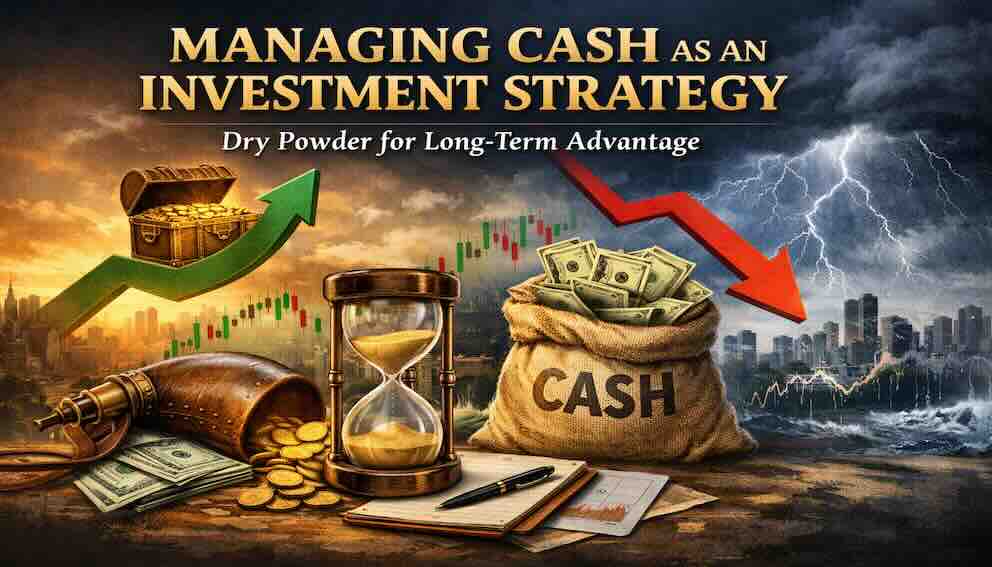
For centuries, soldiers knew a fundamental rule of survival: before a battle, you must keep your gunpowder dry. On the field, a soldier whose powder was wet from rain or sweat was defenseless—his musket useless at the very moment he needed it most. His entire fate depended on the small, deliberate reserve of dry powder he had kept safe and ready in a sealed horn.
Many investors enter the markets with a mindset that guarantees they will, metaphorically, enter every battle with wet powder. They operate on a single command: all capital must be invested at all times. Every dollar must be "working," with cash viewed as a form of failure—a wasted, unproductive resource. This belief is reinforced by common advice like "cash is trash" and "time in the market beats timing the market." In a relentless bull market, this approach feels brilliant. The soldier is firing constantly, and every shot seems to hit its mark.
But markets, like weather, are cyclical. Storms always arrive. When they do—when prices fall sharply, fear dominates, and true opportunities emerge—the fully-invested investor finds their powder is wet. Their capital is already committed, often to assets now falling in value. They have no reserve to deploy. They are reduced to a passive spectator or, worse, a forced seller, liquidating holdings at a loss just to meet their own needs.
This tutorial is about adopting the dry powder mindset. We will explore why sophisticated investors view a cash reserve not as a failure to act, but as the ultimate form of financial preparedness. "Dry powder" is cash held in disciplined reserve, not out of fear, but out of strategic patience. It is what allows you to act with clarity and force when others are paralyzed, transforming market chaos from a personal threat into a strategic opportunity. We will move slowly through the mechanics of this choice, weighing its costs against its profound benefits, to understand how to wield cash not as an inert asset, but as a tool for long-term advantage.
The Nature of True Optionality
Cash as a Claim on Future Choice
To understand cash, we must first understand what it truly represents. A share of stock is a fractional claim on a company's future earnings. A bond is a claim on future interest and principal payments. Cash is a claim on future choice.
When you hold cash, you are not holding "nothing." You are holding a unique financial instrument that grants you the unilateral right—but not the obligation—to convert it into any other asset, at any time, at the prevailing market price. This right, known in finance as optionality, has immense value, though its price tag is invisible on a brokerage statement.
Consider a story of two homeowners, Sam and Taylor, who live on a street where houses rarely go up for sale.
- Sam spends every spare dollar on lavish, permanent renovations. His home is beautiful, but his savings are zero.
- Taylor lives comfortably but maintains a substantial emergency fund.
One day, their neighbor, facing a sudden move, must sell their nearly identical home in a hurry—at a 40% discount. Sam can only watch, his capital locked in granite countertops and hardwood floors. Taylor can write a check that afternoon. Taylor's cash was not idle; it was a standing offer to buy a specific future opportunity, an offer that paid off spectacularly when the opportunity arrived.
In investing, the "house next door" might be a quality business trading at a panic price, a dislocated bond, or a private opportunity. The principle is identical: cash is the capacity to say "yes" without needing to sell something else first, often at a disadvantage.
Now that we understand what cash represents conceptually, we can examine the most common and forceful objection to holding it.
The Trade-Offs and Realities of Holding Cash
The Double-Edged Sword: Opportunity Cost vs. Opportunity Value
The primary argument against holding cash is the blunt force of opportunity cost—the return you forgo by not being fully invested. During a bull market, this cost feels painfully real. If the market rises 15% and your cash earns a modest return, you have ostensibly "lost" the difference. This math is simple, compelling, and incomplete.
It fails to account for opportunity value—the enhanced return you can earn by having capital available when exceptional, high-conviction opportunities emerge. The true calculus of cash balances these two forces over a full market cycle, not a single rising year.
Let's follow this through with our homeowners, Sam and Taylor, but now as investors with $100,000 portfolios over a three-year cycle.
Year 1 (The Bull Run):
- Sam (100% Stocks): Invests all $100k. Market rises 20%. Portfolio: $120,000.
- Taylor (70% Stocks / 30% Cash): Invests $70k, holds $30k cash. The stocks rise to $84,000. Cash holds steady. Total: $114,000.
- Sam is winning. The opportunity cost of Taylor's cash is clear.
Year 2 (The Bear Market):
A crisis hits. The market falls 35%.
- Sam: His $120,000 falls to $78,000. He has no capital to respond.
- Taylor: Her $84,000 in stocks falls to $54,600. Her $30,000 cash is untouched. Total: $84,600.
- She now uses half her cash ($15,000) to buy stocks at depressed prices.
Year 3 (The Recovery):
Markets recover, rising 50% from the bear market lows.
- Sam: His $78,000 grows to $117,000.
- Taylor: Her $54,600 in "old" stocks grows to $81,900. The $15,000 she bought at the bottom grows to $22,500. Her remaining $15,000 in cash is still cash. Total: $119,400.
Result: Over this specific cycle, Taylor's strategic cash reserve allowed her to nearly match Sam's final wealth. This example illustrates the concept of opportunity value—it shows the math can work. In reality, outcomes vary widely based on the severity and duration of market cycles, the timing of deployment, and the assets purchased. The edge is not guaranteed; the true, more reliable benefit is the reduced volatility and emotional control the cash provided Taylor throughout the journey.
The Long-Term Drag and Empirical Realities
While the stylized example above is directionally correct, the practical, long-term headwinds are significant and must be acknowledged.
The Persistent Drag: In long secular bull markets—like much of the period from 2010 to 2021—the opportunity cost of holding cash is severe and persistent. The "dry powder" investor can underperform for years, even a decade, paying a heavy price for optionality they may never use. Many academic studies and simulations show that, over very long 20-30 year periods, a simple "buy-and-hold" equity portfolio often outperforms strategies that maintain persistent cash holdings, even those guided by valuation metrics.
The Execution Challenge: The strategy demands unusual discipline on two painful fronts: the stamina to hold cash and underperform during booms, and the courage to deploy it aggressively during busts when fear is highest. Many investors who intend to hold dry powder end up with permanent "cash drag," as they never find a pitch attractive enough to justify swinging.
The Nuanced Benefit: Therefore, the primary advantage for most investors is not guaranteed outperformance. It is risk-adjusted improvement: the potential for similar long-term results but with significantly lower portfolio volatility, smaller maximum drawdowns, and—critically—the psychological resilience to stay invested. This is especially valuable for those nearing or in retirement.
A Note on the Current Environment: The calculus changes with interest rates. In a high-rate period (like 2023-2025), where cash in Treasury bills can earn 4-5%, the "drag" is substantially lower than in the near-zero rate era of 2010-2021, making strategic cash a more palatable tactical holding.
The Silent Cost: Inflation and the Price of Optionality
Holding cash, however, is not free. Even in calm economic environments, inflation quietly erodes its purchasing power. This is a guaranteed, long-term drag.
This reality is crucial because it clarifies what cash is not meant to do. Cash is not designed to be a long-term wealth compounder. Stocks, businesses, and productive assets fill that role. Cash exists for a different purpose: to prevent forced mistakes and to enable rare, high-quality decisions.
In this sense, inflation is the price you pay for flexibility. Just as you pay an insurance premium to protect your home, you accept inflation as the premium for maintaining optionality in your portfolio.
The essential distinction is this: Cash does not compound. But cash deployed into deeply undervalued assets accelerates compounding. It is a compounding catalyst, not a compounding engine.
The Behavioral and Strategic Dimensions
The Psychological Anchor: Cash as Emotional Ballast
The numbers tell one story; the human experience tells another. Market declines are not spreadsheets—they are feelings of dread, headlines of catastrophe, and the visceral fear of loss.
Holding a strategic cash reserve fundamentally alters this psychological landscape. It re-frames a market downturn from a purely threatening event into a potential hunting ground.
Consider the difference in internal monologue:
- The Fully-Invested Investor (in a crash): "Everything I have is shrinking. I'm losing. I need to stop the bleeding. Maybe I should sell."
- The Investor with Dry Powder: "Part of my portfolio is down, as expected in times like these. But another part—my cash—is stable. Its purpose is being realized. Now I can look for what's on sale."
This shift is not semantic; it is behavioral armor. Cash provides the emotional stability to execute a long-term plan when short-term emotions scream for you to abandon it. It turns patience from a passive state of waiting into an active state of readiness.
When Cash Is Strategic vs. When It Is Idle: A Critical Distinction
Not all cash is created equal. The difference lies in intent and framework.
Strategic Cash (Dry Powder) is:
- Intentional: A deliberate allocation within an overall investment plan.
- Deployable: Held with clear guidelines for when and how it will be used.
- Patient: Can be held for years, waiting for the right pitch. Its idleness is its active function.
Idle Cash is:
- Accidental: The residual balance in a brokerage account, or money perpetually "waiting for the perfect moment" without a defined strategy.
- Fear-Based: Held out of paralysis or a vague sense of impending doom, not a tactical plan.
- Costly: Truly wasteful, as it incurs opportunity cost and inflation without the offsetting potential for future opportunity value.
The Distinction: Market Timing vs. Valuation Sensitivity
A common confusion is that holding strategic cash is an attempt to "time the market." This requires a clarifying distinction:
- Market Timing is the attempt to predict the short-term, often random, movements of the market. It's a forecast-based endeavor.
- Valuation Sensitivity is a long-term discipline of adjusting one's aggressiveness based on the attractiveness of prices. When assets are generally expensive, you become more conservative. When they are cheap, you become more aggressive. Strategic cash is the tool of valuation sensitivity, not market timing.
The former is about predicting the unpredictable. The latter is about responding rationally to observable data.
Practical Implementation and Alternatives
How Time Horizon Shapes the Role of Cash
The appropriate amount of strategic cash is not universal. It depends heavily on where an investor is in life and how they rely on their portfolio.
A young investor with stable income and decades ahead can tolerate deeper drawdowns. Their greatest asset is future earning power, which functions like an invisible cash stream. For them, a smaller strategic cash allocation (e.g., 5-10%) often makes sense.
An older investor approaching retirement faces a different reality. Large portfolio declines can permanently impair lifestyle if withdrawals must continue during downturns. For this investor, cash plays a larger stabilizing and liquidity role, often warranting a larger allocation (e.g., 15-20%).
Neither approach is superior in isolation. Each is appropriate within its context. Cash, like every other asset, should be sized according to personal circumstances rather than abstract ideals.
A Framework for Integrating Strategic Cash
How do you make this practical? It begins by rejecting the binary of "all in" or "all out."
1. Establish a Baseline Range: Decide on a strategic cash range that fits your time horizon and temperament (e.g., 5% to 15% of your portfolio). This is your permanent dry powder reserve.
2. Let It Breathe with the Cycle: Your cash allocation can be dynamic within this range.
- In euphoric, high-valuation markets, you might let cash build to the top of your range by directing new savings there and taking profits from appreciated assets.
- In fearful, low-valuation markets, you might deploy down to your minimum, buying with discipline.
3. Define Your Triggers (To Avoid Paralysis): A strategic reserve is useless if fear stops you from using it. Write down simple, rules-based triggers in advance:
- "I will deploy 1/3 of my cash reserve if the overall market (e.g., S&P 500) declines by 20% from its high."
- "I will use cash to buy shares of Company X if it drops below my calculated fair value."
This systemizes your response, turning crisis into process.
Alternatives and Counterpoints
It's important to recognize that holding plain cash is not the only path to resilience, and it is not the right path for everyone.
Alternatives to Plain Cash: Some investors seek optionality with less drag through:
- High-Quality Bonds or Low-Volatility Stocks: These can provide some ballast and relative stability during downturns, though they don't offer the pure purchasing power of cash.
- Staged Deployment Plans: Committing to investing a lump sum over 6-12 months regardless of price (Dollar-Cost Averaging) is a simpler behavioral protocol that manages regret.
The Powerful Simplicity of Buy-and-Hold: For the vast majority of investors, a perpetual buy-and-hold strategy in low-cost index funds has been historically difficult to beat. It requires almost no market judgment, minimizes taxes and costs, and has delivered excellent long-term results with far less emotional strain and complexity. For many, this is the optimal path; the "dry powder" approach is a conscious choice to accept more complexity in pursuit of specific behavioral or risk-adjusted benefits.
Lessons from the Masters
The Historical Echo
This is not a theoretical exercise. The most successful investors in history continue to use cash as their primary strategic weapon, but the scale and context have evolved dramatically into the present day.
Warren Buffett's Berkshire Hathaway has methodically built its cash and Treasury bill holdings to a record $382 billion as of the end of 2025. This unprecedented sum is more than double the company's previous peak. While he has famously said it's "better to have [cash] burning a hole in your pocket than investing in things that don't make sense," this growing mountain also serves a dual purpose: it reflects a disciplined aversion to overpaying in what he may view as an expensive market, and it provides immense flexibility for his successor, Greg Abel, to pursue major opportunities or share buybacks. The pile is not static; it is the ammunition for historic deals during crises, a principle proven in 2008 and 2020, and now poised for whatever comes next.
Seth Klarman of the Baupost Group remains the archetype of patience, building his legendary track record on a foundation of often holding significant cash—sometimes 30-50% for extended periods—while waiting for what he calls "the fat pitch." This philosophy of extreme selectivity, where capital is deployed only when the odds are overwhelmingly favorable, continues to define his approach.
Their combined success underscores the central thesis: Losing money is worse than missing an opportunity. Strategic cash is the ultimate defense against the former and the ultimate enabler of the latter. Yet, their level of skill, conviction, and access to deal flow is extraordinarily rare; for most, attempting to emulate their specific cash levels without their rigorous process and patience is more likely a path to long-term underperformance.
Conclusion: The Disciplined Choice
We have journeyed through a different way of seeing. Cash is not the empty space in your portfolio; it is the loaded spring. It is not the enemy of growth; it is the guardian of rational choice.
Managing cash as a strategy means embracing a more nuanced rhythm than "always on." It is a sophisticated tool that offers profound psychological benefits and can improve the quality of your investment journey—reducing panic and providing agency. However, its quantitative benefit in terms of raw return is not guaranteed and is historically difficult to achieve consistently. It demands a high degree of self-knowledge, discipline, and tolerance for complexity.
In the end, the goal is not to hoard cash, but to understand its unique power and severe trade-offs. In an investing world obsessed with action, the strategic, deliberate, and patient holding of cash may be a powerful choice for some. But it is a choice that comes with its own costs and demands, one that should be made not because it sounds clever, but because it deeply aligns with your individual temperament, goals, and willingness to execute a difficult plan over decades.
About Swati Sharma
Lead Editor at MyEyze, Economist & Finance Research WriterSwati Sharma is an economist with a Bachelor’s degree in Economics (Honours), CIPD Level 5 certification, and an MBA, and over 18 years of experience across management consulting, investment, and technology organizations. She specializes in research-driven financial education, focusing on economics, markets, and investor behavior, with a passion for making complex financial concepts clear, accurate, and accessible to a broad audience.
Disclaimer
This article is for educational purposes only and should not be interpreted as financial advice. Readers should consult a qualified financial professional before making investment decisions. Assistance from AI-powered generative tools was taken to format and improve language flow. While we strive for accuracy, this content may contain errors or omissions and should be independently verified.