
Tutorial Categories
Last Updated: February 11, 2026 at 10:30
Value Investing Explained: How to Find Undervalued Stocks and Buy with a Margin of Safety
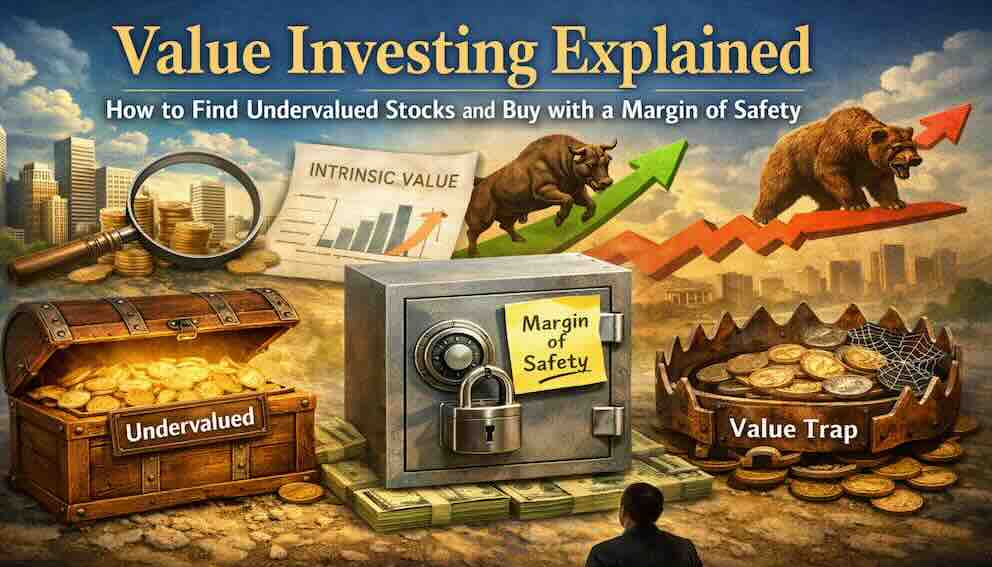
Value investing is the disciplined practice of buying businesses for less than they are truly worth, not because they are merely cheap, but because they are genuinely undervalued. This tutorial explains how to distinguish a value trap from a true bargain, how to conservatively estimate a business's intrinsic value, and why the "margin of safety" is your essential buffer against error. You will learn why patience is the real currency of this strategy, why it falls in and out of favor in painful cycles, and how to build a practical, step-by-step framework that connects to the core principles of your entire investing journey. By the end, you'll understand that value investing is less about being the smartest analyst and more about being the most patient, disciplined steward of your capital.
Introduction: The Wisdom of Not Overpaying
Imagine two people interested in buying a local, family-owned bakery. The first, swept up in its popularity, offers the full asking price during a neighborhood food festival. The second spends weeks observing: counting customers at different hours, reviewing supplier costs, and tasting every pastry. She concludes the bakery's steady, reliable cash flow makes it worth a certain amount. She then makes an offer significantly lower than that, knowing the owners are retiring soon and may be motivated to sell.
Value investing is the financial expression of this second buyer's approach. It is the disciplined pursuit of buying a share of a business at a significant discount to its intrinsic value—what it is truly worth based on its ability to generate cash over time. This discount is your margin of safety, a concept so central that Benjamin Graham called it "the cornerstone of investment success." It is not about predicting the future perfectly; it is about building a buffer so that you can be wrong and still not lose.
This tutorial will guide you through this thoughtful, often counterintuitive process. We will learn to separate a dangerous "value trap" from a true bargain, estimate value conservatively, understand the non-negotiable role of patience, and see why this strategy's periods of frustration are the very source of its long-term opportunity.
Cheap vs. Undervalued: The Critical Difference
The most common and costly error is confusing a low price with good value. A stock trading at $5 can be ruinously expensive if the business is failing, while one at $500 can be a profound bargain if its future profits are vast and secure.
A business does not become attractive simply because it is statistically cheap. The business itself must still be capable of surviving and producing cash in the future. Value investing is not about buying broken companies at low prices; it is about buying enduring businesses when pessimism temporarily clouds judgment.
What "Cheap" Often Looks Like (The Value Trap):
- Declining businesses with fading moats: A once-dominant retailer slowly losing to e-commerce.
- Cyclical companies at peak earnings: A commodity producer trading at a low P/E ratio just before prices collapse.
- Companies burdened by debt: High leverage amplifies risk during downturns.
- "Cheap for a reason" stories: Businesses with broken models that never recover.
What "Undervalued" Truly Is:
A stock becomes undervalued when its market price falls meaningfully below a conservative estimate of the business's intrinsic worth. This gap usually exists because of temporary headwinds, widespread pessimism, or a misunderstood story—not a permanent decline. The business retains its fundamental strengths: a durable competitive advantage, a strong balance sheet, and the ability to generate cash.
A low multiple is not an investment thesis. It is a question that demands an answer: "Why is this so cheap, and is that reason temporary or permanent?"
Intrinsic Value: Estimating the Invisible Worth
Intrinsic value is not a single, precise number you find in a spreadsheet. As one practitioner notes, "Intrinsic value moves... businesses aren't tables. They're living systems whose value changes as facts change". It is a range of reasonable value based on fundamental factors like assets, earnings power, and competitive position.
The goal is to answer one core question: "If I owned this entire business privately, what would I rationally pay for it today, considering all the cash it will likely generate over its lifetime?"
A Simple Numerical Walkthrough
Imagine a stable company, "Steady Utility Co.," that earns $10 per share. You analyze its history, competitive position, and industry, concluding these earnings can reasonably continue for many years with modest, inflation-like growth. For such a predictable business, you might decide that a fair valuation is 15 times its earnings. This gives you an intrinsic value estimate of $150 per share ($10 earnings × 15).
This $150 is not a guaranteed price target. It is your conservative estimate of what the business is worth as an ongoing concern. The next step is to apply discipline to the price you are willing to pay.
Investors use several methods to build this estimate, such as asset value, earnings power value, or discounted cash flow (DCF). The margin of safety exists precisely because any estimate is an imperfect judgment call, not a scientific fact.
The Margin of Safety: Your Financial and Psychological Buffer
The margin of safety is the difference between your conservative estimate of intrinsic value and the price you pay. It is your insurance policy against analytical error, bad luck, and an uncertain future.
Mathematically, it's expressed as: (Intrinsic Value - Market Price) / Intrinsic Value. Returning to our example: if you estimate Steady Utility Co. is worth $150 per share, insisting on a 40% margin of safety means your maximum buy price is $90 ($150 × 0.6). You deliberately create distance between what something is worth and what you pay.
Psychologically, its power is even greater. A true margin of safety provides the emotional fortitude to hold through market downturns without panic. You can watch a stock fall 40% and think, "I bought it at a 50% discount to value; the market's fear is creating a larger opportunity, not a threat." This transforms volatility from a source of stress into a test of your discipline, a principle that aligns directly with the calm stewardship encouraged in our tutorial on managing cash and dry powder.
Time as a Secondary Margin of Safety
Margin of safety is not only price-based. Time itself becomes a protective buffer. When you own a business that consistently generates cash and reinvests wisely, each passing year increases the value you have already received. Even if your original valuation was slightly optimistic, long-term compounding can compensate. This is why, as discussed in our lesson on position sizing, owning a reasonably sized piece of such a business for decades is a powerful strategy.
Patience: The Real Edge and Its Real Cost
Value investing is a strategy of delayed recognition by design. The market can ignore undervalued stocks for years before price converges with value.
Why patience is so hard:
- Long Underperformance: During growth-driven bull markets, value portfolios can lag for years, making you feel foolish.
- Narrative Dominance: Exciting "story stocks" dominate headlines, while boring value picks are ignored.
- Boredom & Doubt: Inactivity feels like a lack of progress.
The Emotional Reality of Being Early
In practice, patience rarely feels calm or noble. It often feels like isolation. You may sit with a portfolio of quiet, dull businesses while headlines celebrate soaring technology stocks. You may begin to wonder whether you are missing something obvious, or whether your approach is simply outdated. These moments are not signs that value investing is broken. They are the exact moments the strategy requires the discipline we built in our tutorial on knowing when to sell—the discipline to hold a rational thesis against emotional pressure.
The historical reality is that value has experienced long droughts followed by powerful recoveries. The core insight is stark: the price of superior long-term returns is often years of looking wrong. Your edge doesn't come from faster analysis, but from a longer time horizon and greater emotional stamina than the market.
Why Value Cycles In and Out of Favor
Understanding that value investing moves in cycles is crucial for maintaining commitment during tough stretches. These cycles are driven by a few core forces:
- Sentiment & Narratives: Growth stories are exciting; value stories about cash flow and assets are often seen as boring.
- Interest Rates: In higher-rate environments, the value of a company's near-term cash flows becomes more attractive relative to the distant promises of growth stocks.
- Mean Reversion: Extremely high profit margins and valuations eventually compress, while depressed ones tend to expand.
- Behavioral Crowding: Capital chases recent performance, overpaying for what's popular and neglecting what's out of favor, which itself creates the next opportunity.
The cycle is not predictable in timing, but its existence is reliable. As Seth Klarman noted, "Out-of-favor securities may be undervalued; popular securities almost never are". Cycles are not the enemy of the value investor; they are the mechanism that creates the mispricings the strategy exploits.
A Practical, 7-Step Framework for Modern Value Investing
To move from philosophy to practice, here is a sustainable, step-by-step framework.
- Define Your Circle of Competence: Focus on businesses and industries you understand deeply. Complexity is not your friend.
- Estimate Intrinsic Value Conservatively: Use multiple methods to establish a range of value. Use pessimistic assumptions to find the low end of that range.
- Demand a Specific Margin of Safety: Decide on your required discount (e.g., 30-50%). Only buy if the market price falls below your conservative value estimate by that amount.
- Size Positions Intelligently: Even with a margin of safety, never let a single idea risk your financial survival. Apply the position sizing discipline to ensure no single "bargain" can become a catastrophe.
- Be Willing to Hold Cash: When no ideas meet your strict criteria, hold "dry powder." This patience is active strategy, not inactivity.
- Have Clear Sell Criteria: Your sell decision should be as rules-based as your buy decision. Sell if the thesis breaks, if the price reaches fair value, or if you find a significantly better opportunity.
- Accept Long Periods of Underperformance: Set realistic expectations. This strategy wins over decades, not quarters.
Common Misconceptions and One Final Example
Clearing the Air:
- Value investing is not only for old companies. It is a principle that can be applied to any business where you can reasonably estimate its value.
- It does not require predicting recessions. It requires identifying when a company's price implies an unrealistically gloomy future.
- It does not mean avoiding growth. It means not overpaying for it.
An Extended Scenario: The Dented but Durable Brand
Consider "Reliable Appliance Co.," a maker of washers and dryers. A new competitor enters with flashy, cheaper models. For two quarters, Reliable's sales dip. Panicked headlines declare the brand "dead," and the stock plunges 40%.
A value investor analyzes beyond the headline. They see Reliable still has the best repair ratings, a loyal commercial customer base, a rock-solid debt-free balance sheet, and the financial strength to fight back. They estimate its intrinsic value at $50 per share. The market, in its fear, offers shares at $30—a 40% margin of safety.
The investor buys. It takes 18 months. Reliable fights back with a campaign emphasizing durability. The competitor's products earn poor reviews. Earnings recover. Gradually, the stock price drifts toward $50. The return came not from timing the bottom, but from the closing of a gap between price and value that was always there, just obscured by fear.
Conclusion: The Virtue of Paying Less
Value investing, at its heart, is a philosophy of humility and discipline. It admits that the future is uncertain, our analysis will be flawed, and market emotions are unpredictable. Its power lies not in overcoming these truths, but in designing a process—centered on the margin of safety—that respects them.
We have seen that true investing begins with a radical shift: from asking "What is the price?" to asking "What is it worth, and am I paying meaningfully less?" This process of distinguishing cheap from undervalued, insisting on a margin of safety, and stewarding your capital with patience ties together the threads of our entire series.
In a world obsessed with speed, certainty, and chasing what's hot, the quiet, stubborn refusal to overpay may be the most durable edge an investor can possess. It is the practice of being a thoughtful business owner in a market full of transient traders, and that is a posture that builds lasting wealth.
About Swati Sharma
Lead Editor at MyEyze, Economist & Finance Research WriterSwati Sharma is an economist with a Bachelor’s degree in Economics (Honours), CIPD Level 5 certification, and an MBA, and over 18 years of experience across management consulting, investment, and technology organizations. She specializes in research-driven financial education, focusing on economics, markets, and investor behavior, with a passion for making complex financial concepts clear, accurate, and accessible to a broad audience.
Disclaimer
This article is for educational purposes only and should not be interpreted as financial advice. Readers should consult a qualified financial professional before making investment decisions. Assistance from AI-powered generative tools was taken to format and improve language flow. While we strive for accuracy, this content may contain errors or omissions and should be independently verified.