
Tutorial Categories
Last Updated: February 9, 2026 at 20:30
Index Investing Explained: The Quiet Revolution in Financial Stewardship
Index investing is often described as simple, but simple does not mean shallow, careless, or unintelligent. This tutorial explains why passive investing has become the backbone of successful long-term portfolios around the world, supported by decades of academic research and real-world performance data. You will learn why indexing works, which misconceptions deserve to be retired, and in what situations passive strategies consistently outperform active management. By the end, you will see that index investing is not about doing nothing—it is about making one of the most deliberate financial decisions an investor can make.
Introduction: The Most Important Choice You Won't See
Imagine two gardeners. The first spends every weekend in a flurry of activity—pruning this, fertilizing that, constantly searching for the single plant that will become a champion. The second gardener works differently. She focuses first on the fundamentals: enriching the soil, establishing a reliable watering system, and selecting a diverse array of seeds suited to the climate. Then she steps back, allowing the entire garden to grow.
Our instinct is to admire the first gardener’s dedication. It feels like hard work should produce the best results. Yet, over decades, which garden is truly more resilient, more productive, and less prone to a single failed plant ruining the whole season? The second. Her success comes not from picking individual winners, but from cultivating the entire system in which growth can reliably occur.
Index investing is the financial expression of this counterintuitive wisdom. It is not a "set it and forget it" abdication. It is a profound, deliberate choice to own the entire market ecosystem—thereby ensuring you capture its long-term growth—rather than spending a lifetime attempting, and often failing, to identify its few champion performers in advance.
The Core Premise: Owning the Orchard, Not Picking the Apples
At its heart, index investing means owning a small piece of every company in a defined segment of the market through a single fund. When you buy a total stock market index fund, you are not betting on Apple over Microsoft, or Tesla over Ford. You are buying a microscopic share of all publicly-traded companies. Your returns are not tied to the fate of a few stories, but to the collective profit growth of global business over time.
This idea rests on a foundational, humbling acceptance: The market is smarter than any single person. It is the aggregated intelligence, greed, fear, and analysis of millions of investors, all with access to the same news, financial reports, and data. By the time you or a professional manager have an "insight," it is almost certainly already reflected in the stock's price. Trying to consistently outsmart this collective intelligence is a game that very, very few win over the long run.
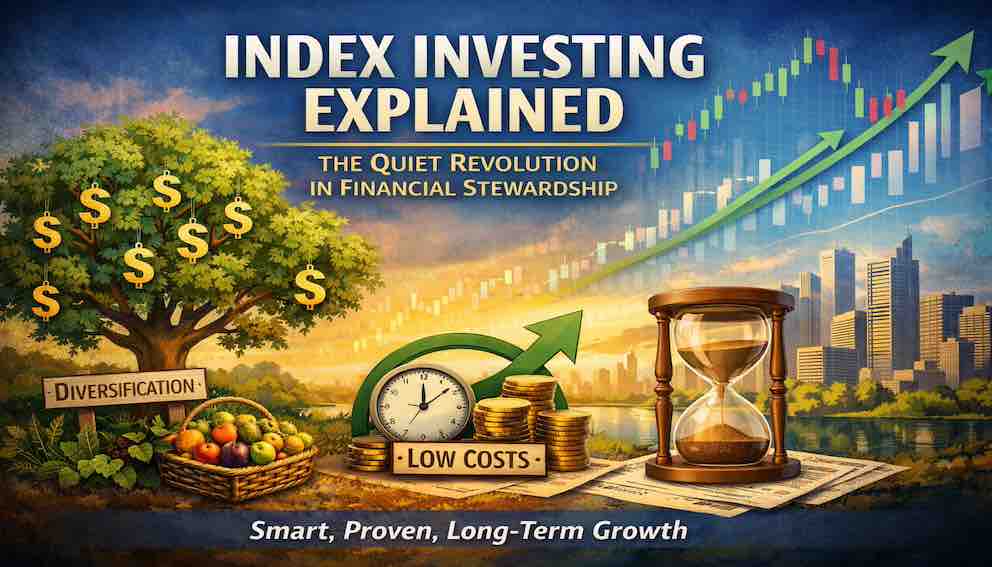
Indexing chooses not to play that game. Instead, it asks a different question: "If I can't reliably beat the market, how can I ensure I reliably get the market return?" The answer lies in a powerful, three-part formula: Diversification + Low Cost + Time.
The Three Pillars of the Indexing Advantage
1. The Unbeatable Math of the "Zero-Sum Game"
Before costs, investing is a zero-sum game. For every investor who outperforms the market, another must underperform it. This is simple arithmetic—all investors collectively are the market.
Now, introduce the real-world costs of active investing: management fees (often 1% per year or more), frequent trading commissions, and the tax drag from realizing gains. These costs create a persistent handicap. Actively managed funds, as a group, must therefore underperform the market average by the amount of these costs.
Index funds, with their automated, rules-based approach, have minuscule costs—often less than 0.10% per year. By minimizing this handicap, they are mathematically positioned to beat the majority of active managers over time. This isn't a theory; it's the inevitable outcome of the arithmetic.
2. The Relentless Power of Cost Compounding
A 1% annual fee sounds trivial. Over an investing lifetime, it is a fortune.
Consider two investors, Alex and Sam, each starting with $10,000.
- Alex invests in a low-cost index fund with a 0.04% fee.
- Sam chooses an active fund with a 1.04% fee.
Assuming the underlying investments both return 7% annually before fees, here’s the difference after 40 years:
- Alex's Portfolio: ~$135,000
- Sam's Portfolio: ~$95,000
That $40,000 difference—four times the original investment—was not lost to bad stock picks. It was quietly transferred from Sam's future to the fund company's bottom line, year after year, through fees. Indexing's primary defense is this ruthless defense of your own capital.
3. The Behavioral Bailout: A System That Protects You From Yourself
Perhaps the greatest unsung benefit of indexing is psychological. It is a pre-commitment device against your own worst instincts. When you own the entire market, you are immune to the fear of "picking the wrong stock." During a crash, while news headlines scream about failing companies, your index fund is simultaneously buying more of every surviving company at low prices, automatically. It turns market panic from a threat into a systematic, mechanical process of buying low.
The active investor must constantly decide: "Is this the right time to sell? Is this stock still good?" The index investor has one decision, made in calm times: "I will own the market." This eliminates countless opportunities for fear, greed, and regret to sabotage a plan.
The Evidence That Confirms the Theory
This mathematical and behavioral logic isn't theoretical. For decades, independent scorecards like the SPIVA (S&P Indices Versus Active) reports and Morningstar's Active/Passive Barometer have measured its real-world results.
Their conclusions, across market cycles, are remarkably consistent. Over 10- and 15-year periods, roughly 80% to 90% of actively managed U.S. stock funds fail to beat their benchmark index. Over 20 years, the failure rate climbs even higher.
Perhaps more telling is the lack of persistence. Funds that outperform in one three- or five-year period rarely remain top performers in the next. In many categories, fewer than 5% of funds consistently stay in the top quartile. This reveals a critical truth: identifying tomorrow's winning fund based on yesterday's performance is closer to luck than skill.
The data does not say skill is impossible. It demonstrates that costs reliably overwhelm skill, and that identifying skillful managers in advance is a losing game for the vast majority of investors.
Confronting the Myths: Is Indexing Too Good to Be True?
Given its advantages, why doesn't everyone index? Powerful narratives stand in the way.
Myth: "Indexing is settling for average."
Reality: It is mathematically securing above-average results after costs. More importantly, we must reconsider what "average" means. Historically, the broad U.S. stock market has delivered long-term returns of about 9-10% per year. At that rate, money roughly doubles every seven to eight years. A single dollar invested in early adulthood can compound into sixteen or thirty-two dollars over a working lifetime. "Average" market returns, when given enough time, produce extraordinary outcomes.
Myth: "It won't work in the next crash/a bear market."
Reality: An index fund will faithfully track the market down and back up. The question is not whether it falls, but whether you have the discipline to hold it. History shows most active managers also fall in crashes, and many fail to fully participate in the recovery, having moved to cash at the wrong time.
Myth: "It creates bubbles and distorts markets."
Reality: Over 70% of daily trading volume is still driven by active decisions, setting prices. Index funds are passengers in the car, not the drivers. Bubbles—from Dutch tulips to the dot-com era—predate index funds by centuries. They are a feature of human psychology, not portfolio structure.
Myth: "You need active management for the 'inefficient' parts of the market."
Reality: Even in less-covered areas like small-cap stocks, the majority of active managers still fail to beat their benchmarks after fees. The hurdle of cost is universal.
A Fair Question: When Can Active Management Add Value?
An honest discussion must acknowledge there are narrow pockets where active management has shown somewhat higher success rates. In certain bond markets—like high-yield or municipal bonds—skilled credit analysis can sometimes add value. In very small, illiquid, or frontier markets, informational advantages might exist.
However, two crucial truths temper this. First, even in these areas, the majority of active managers still underperform after fees. Second, identifying the specific manager who will succeed in the future remains a formidable challenge. For the overwhelming majority of investors building a lifetime portfolio, these narrow, uncertain possibilities do not outweigh the reliability, simplicity, and cost-effectiveness of broad-market indexing.
The Thoughtful Indexer's Guide: From Philosophy to Practice
Choosing to index is the first step. Implementing it thoughtfully is the next. This is where "passive" becomes an active strategy.
1. Define Your "Market": Your portfolio should reflect your investment universe. A simple, robust foundation might be:
- A Total U.S. Stock Market fund (your home soil).
- A Total International Stock Market fund (global diversification).
- A Total Bond Market fund (for stability and income).
2. Engineer Your Balance (Asset Allocation): This is your single most important decision—what percentage goes to stocks (for growth) versus bonds (for stability). This should be based on your time horizon and personal tolerance for volatility, not market forecasts.
3. Embrace the Boring Mechanics:
- Automate Contributions: Set up regular, automatic investments. This is dollar-cost averaging in practice.
- Rebalance Calmly: Once a year, adjust your portfolio back to your target allocation. This forces you to "sell high" and "buy low" systematically.
- Optimize for Taxes: Hold bond funds in tax-advantaged accounts (like IRAs) when possible, as their interest is taxed as ordinary income.
This structure is simple, but it is the opposite of careless. It is a deliberate system designed to capture long-term growth with minimal friction and behavioral error.
Your Passive Investing Audit
Before you conclude, run this quick checklist to transform the philosophy into a concrete plan:
- ✅ Own Broad Index Funds: Are my core holdings diversified across thousands of companies?
- ✅ Minimize Costs: Are my fund expense ratios below 0.15%?
- ✅ Check My Mix: Is my stock/bond allocation aligned with my risk tolerance and time horizon?
- ✅ Automate: Do I invest automatically from each paycheck?
- ✅ Plan to Rebalance: Do I have a simple, annual calendar reminder to rebalance?
- ✅ Commit to Staying: Can I commit to staying invested through inevitable downturns?
Conclusion: The Stewardship of Surrender
Index investing represents a paradoxical form of empowerment. It is the empowerment that comes from surrendering the illusion of control.
We surrender the belief that we can outsmart millions of other investors.
We surrender the high costs that fund luxury offices and marketing budgets.
We surrender the emotional rollercoaster of betting on individual corporate stories.
In return, we gain control over what actually matters: our costs, our behavior, our time horizon, and our odds. We gain the near-certainty that we will capture the long-term growth of capitalism itself, which has been profoundly resilient.
The index investor is not passive. They are a steward. They have carefully built a system aligned with evidence, insulated from noise, and built to endure. Their work is not in picking stocks, but in stewarding the patience, discipline, and humility to let that system work, decade after decade. In a world of constant financial noise, that quiet discipline is the most active—and most powerful—choice of all.
About Swati Sharma
Lead Editor at MyEyze, Economist & Finance Research WriterSwati Sharma is an economist with a Bachelor’s degree in Economics (Honours), CIPD Level 5 certification, and an MBA, and over 18 years of experience across management consulting, investment, and technology organizations. She specializes in research-driven financial education, focusing on economics, markets, and investor behavior, with a passion for making complex financial concepts clear, accurate, and accessible to a broad audience.
Disclaimer
This article is for educational purposes only and should not be interpreted as financial advice. Readers should consult a qualified financial professional before making investment decisions. Assistance from AI-powered generative tools was taken to format and improve language flow. While we strive for accuracy, this content may contain errors or omissions and should be independently verified.