
Tutorial Categories
Last Updated: February 2, 2026 at 10:30
Learning from Market History: Why Human Behavior Repeats - Investing Wisdom Series
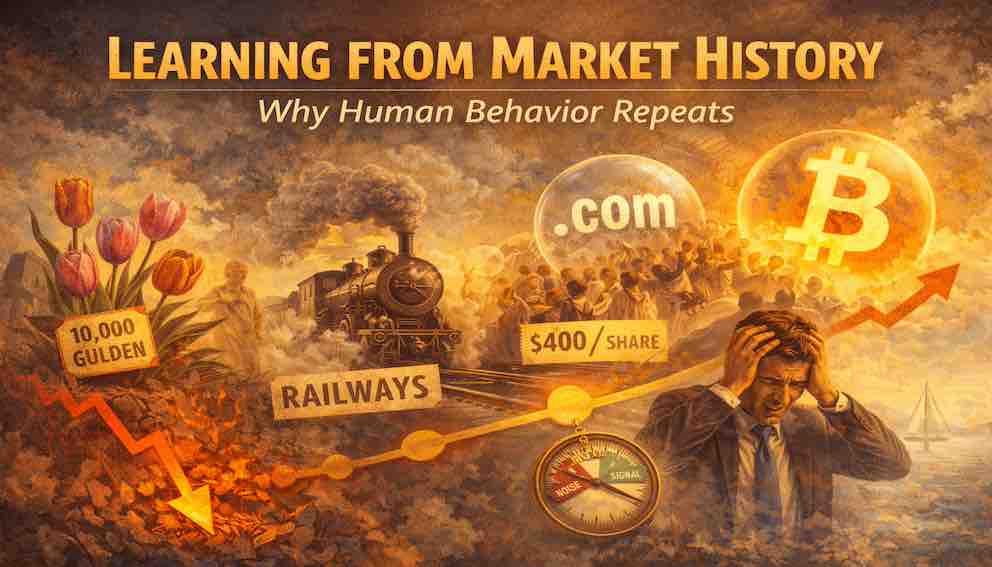
Markets may seem like new landscapes each time, but history repeatedly shows that human behavior drives financial bubbles and crashes in surprisingly similar ways. From the frenzy over tulips in the 1600s, to the railway mania of the 1800s, the Dotcom bubble of the late 1990s, and the modern surge in cryptocurrencies, the underlying psychology remains constant. This tutorial explores why emotions like greed, fear of missing out, and herd behavior repeat across generations, and why technological innovation often acts as a trigger for timeless patterns. By studying these events, we gain perspective, recognize recurring mistakes, and cultivate the discipline needed for long-term investing success.
Introduction: The Two Investors Who Saw the Same World Differently
In the summer of 1929, the stock market soared to dazzling heights. Two men observed the same booming landscape. One was a celebrated economist who declared stocks had reached a "permanently high plateau." The other was financier Bernard Baruch, who quietly sold his holdings for cash. Months later, the market crashed. The first man was ruined; Baruch preserved his wealth.
Their difference wasn't intelligence or access to secret data. It was pattern recognition. Baruch saw a familiar, dangerous sequence playing out—one that history had revealed time and again.
This is the true, practical power of market history. It's not about memorizing dates. It's about learning to see the recurring psychological and structural patterns beneath the surface of every "new" boom and bust. This tutorial will give you that lens, turning history from a subject into a shield.
The Five-Stage Pattern of Every Financial Mania
Booms and busts feel chaotic in the moment, but with historical hindsight, a clear, repeatable pattern emerges. Think of it not as a crystal ball, but as a diagnostic checklist for market fragility. Here are the five stages, visible across centuries.
Stage 1: Credit Explosion – The Fuel of Every Bubble
Every systemic mania is built on a foundation of easy money. This is the oxygen that allows speculation to burn out of control.
- Historical Example (Tulip Mania, 1630s): While not modern margin lending, the frenzy was fueled by a form of credit—buyers could purchase bulbs with a small down payment and pay the rest later. This leverage detached price from any rational value.
- Historical Example (The 1920s): The Roaring Twenties boom was powered by rampant margin lending, allowing ordinary people to buy stocks with just 10% down.
- The Lesson: When borrowing to invest becomes exceptionally easy and cheap, it’s a classic sign that speculative fuel is being poured on the fire.
Stage 2: The Concentration Trap – "This Time It's Different"
Risk becomes dangerously focused on a single, "can't-lose" narrative or asset class. The market's gains depend on a narrowing set of winners, creating immense fragility.
- Historical Example (Dotcom Bubble, 1999): Portfolios became concentrated in unprofitable tech stocks. The narrative was that old metrics like profits were obsolete. The Concentration Trap was in tech-only investments.
- Historical Example (Tulip Mania): Speculation wasn't on all flowers, but hyper-focused on specific, rare "breaker" tulip bulbs, which became status symbols divorced from their botanical value.
- The Lesson: Extreme market concentration is a warning sign. If one sector or asset class wobbles, the entire over-leveraged structure can shake.
Stage 3: The "Smart Money" Exit – The Invisible Transfer of Risk
Informed insiders and institutional investors begin quietly reducing their exposure. This stage involves a massive, often unnoticed, transfer of risk from those who see the pattern to those enthralled by the story.
- Historical Example (1929): Bernard Baruch is the classic case, selling his stocks months before the crash, later stating, "I began to liquidate stocks I didn't want to be caught with when the storm broke."
- Historical Example (Cryptocurrency, 2017): Many early Bitcoin adopters and miners began selling significant portions of their holdings in the months leading to the December 2017 peak, locking in fortunes while new retail investors rushed in.
- The Lesson: You won't see headlines announcing "Smart Money is Leaving." But soaring insider selling activity is a tangible data point that the most informed players are getting cautious.
Stage 4: The Liquidity Illusion – The Oxygen Gets Thin
Markets feel deep and liquid—until suddenly they aren't. The system's ability to easily buy and sell at stable prices weakens, often due to rising interest rates or credit tightening, well before the public panic.
- Historical Example (2008 Financial Crisis): In the years before the crash, complex mortgage securities were treated as highly liquid. When doubt set in, that liquidity vanished overnight, turning assets into untradable liabilities.
- Historical Example (Railway Mania, 1840s): Financing for hundreds of proposed railway lines dried up as Bank of England interest rates rose and capital became scarce, popping the bubble.
- The Lesson: Markets are most fragile when everyone assumes they can exit easily. When central banks start draining liquidity (raising rates), the stage is being set.
Stage 5: The Trigger Event – The Spark That Ignites the Tinderbox
This is the unpredictable headline—a bank failure, a geopolitical event, a fraud revelation. The critical insight is that the trigger doesn't cause the crash; it simply ignites the tinderbox of fragility built in Stages 1-4.
- Historical Example (1929): The trigger was the collapse of the Hatry Group in the UK, a relatively minor corporate fraud case that shattered confidence and triggered margin calls across the Atlantic.
- Historical Example (2008): The failure of Lehman Brothers was the spark that ignited the global panic, but the fuel was the years of bad mortgage debt and excessive leverage that preceded it.
- The Lesson: Don't fixate on predicting the spark. Focus on recognizing when the forest is dry, overgrown, and full of tinder. The spark itself is irrelevant.
A Global Pattern: Japan's "Bubble Economy"
This isn't just Western history. Japan's late-1980s "Bubble Economy" perfectly traces the five stages: massive credit expansion (Stage 1) led to insane concentration in real estate and stocks (Stage 2). As the Bank of Japan tightened monetary policy (Stage 4), the bubble deflated, with the 1990 Gulf War serving as a final trigger (Stage 5). The pattern is universal.
Your Historical Wisdom Toolkit: From Knowledge to Action
Understanding this pattern is useless unless it changes your behavior. Here’s how to apply it.
1. Filter the Signal from the Noise
When you hear a new, thrilling investment narrative ("AI will change everything!"), consciously separate the technological noise from the psychological signal. Ask: "Is this story driving Greed, FOMO, and herd behavior?" If yes, you've identified the timeless pattern, not a unique opportunity.
2. Diagnose, Don't Predict
Use the five-stage sequence as a checklist. You don't need to know the trigger (Stage 5). If you observe a Credit Explosion, extreme Concentration, and signs of Smart Money Exits, you know the market environment is inherently fragile. This knowledge alone prevents overconfidence.
3. Conduct an Emotional Self-Check
History's patterns play out through your psychology. Build the habit of noticing your own emotional triggers in real time. Do you feel a rush of excitement reading a bullish headline? A jolt of panic refreshing your portfolio value? That visceral feeling is the ancient force of greed or fear in action. Acknowledging it creates a crucial pause between impulse and decision.
4. Pre-Commit to Your Rules
Write down your personal investment principles now, in a calm moment. History proves we abandon our best plans at emotional extremes. A written rule—"I will never let one sector exceed 25% of my portfolio" —is a contract with your future, clearer self.
Conclusion: Your Unshakeable Advantage
The most profound lesson from market history is not that events repeat, but that human emotions do. Booms will feel irrefutable, and busts will feel endless. Your advantage lies in recognizing that you have seen this psychological movie before. By internalizing the five-stage pattern, you graduate from being an actor swept up in the market's emotional play to becoming its astute director.
You can watch the scenes of greed and fear unfold, not with a thrill or a shudder, but with the calm recognition of a well-studied plot. This informed detachment is not indifference; it is the source of true discipline, the foundation of rational decision-making, and the bedrock of all lasting investment success.
At the same time, history is a guide, not a blueprint for overtrading. Knowing the pattern should not tempt you into abandoning your long-term objectives or chasing every short-term signal. The wisdom of market history works best when paired with patience, a clear investment plan, and rules that protect your capital and focus. In a world engineered to provoke immediate reactions, this balance—between awareness of history and adherence to long-term discipline—is your most powerful tool for preserving not just wealth, but clarity, composure, and confidence through every market cycle.
About Swati Sharma
Lead Editor at MyEyze, Economist & Finance Research WriterSwati Sharma is an economist with a Bachelor’s degree in Economics (Honours), CIPD Level 5 certification, and an MBA, and over 18 years of experience across management consulting, investment, and technology organizations. She specializes in research-driven financial education, focusing on economics, markets, and investor behavior, with a passion for making complex financial concepts clear, accurate, and accessible to a broad audience.
Disclaimer
This article is for educational purposes only and should not be interpreted as financial advice. Readers should consult a qualified financial professional before making investment decisions. Assistance from AI-powered generative tools was taken to format and improve language flow. While we strive for accuracy, this content may contain errors or omissions and should be independently verified.