Tutorial Categories
Last Updated: February 2, 2026 at 10:30
Why Ignoring Financial News Is Often the Smartest Investing Decision - Investing Wisdom Series
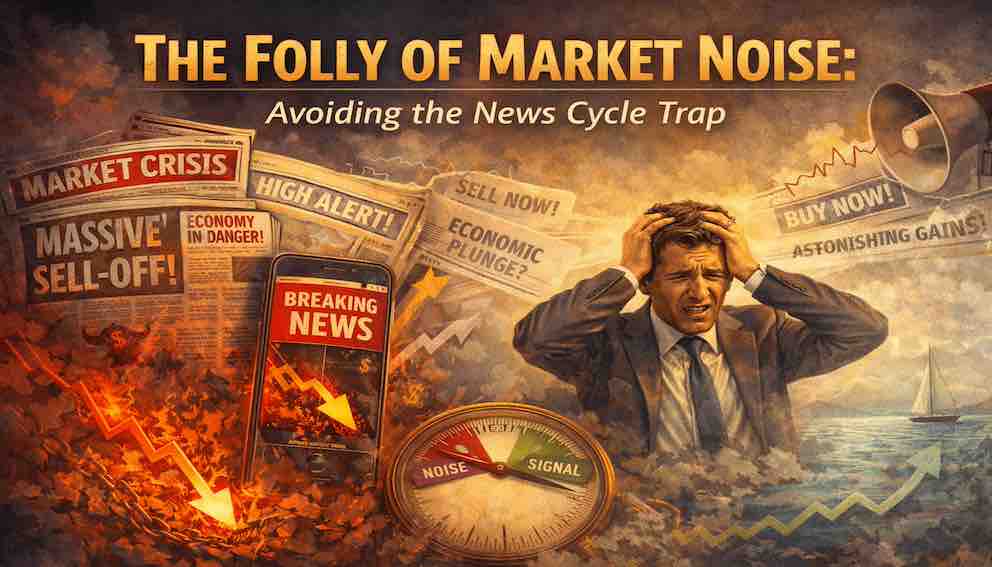
Every day, markets are wrapped in a constant stream of breaking news, urgent alerts, and confident predictions that promise to explain what prices are doing and what will happen next. This tutorial explores why financial headlines are designed to provoke emotional reactions rather than improve long-term decision-making, and how short-term market noise drowns out the signals that actually matter to investors. We will examine the misalignment between media incentives and investor goals, using real-world examples to show how news consumption quietly undermines discipline. Finally, we will develop a set of practical and realistic “news diet” rules that help investors stay informed without becoming reactive, anxious, or distracted from long-term success.
A Tale of Two Headlines: March 2020
On March 16, 2020, as global markets were in freefall, two headlines appeared simultaneously on major financial platforms:
Headline A (Morning): "Fed Slashes Rates to Zero, Launches Massive Stimulus—Markets Poised for Rebound"
Headline B (Afternoon): "Stimulus Fails to Calm Markets: Dow Plunges 12% in Worst Day Since 1987"
An investor reading both experienced whiplash. The "news" hadn't changed—the Fed's action was known. What changed was the market's emotional reaction to that same information. Both headlines were factually accurate. Both were professionally written. Together, they created perfect confusion.
This isn't an exception; it's the daily reality of financial media. We begin this tutorial with a counterintuitive proposition: The more "informed" you try to be about daily market movements, the less clearly you'll see what actually matters for long-term success. This isn't about ignorance, but about developing something far more valuable: selective attention.
The Attention Economy's Most Reliable Product: Anxiety
To understand financial noise, we must first understand its engine: the attention economy. Financial media organizations aren't compensated for your portfolio returns in 2040. They're compensated for your clicks, views, and engagement today. Their success metrics are immediate; yours are decades away.
This creates a fundamental incentive misalignment. What captures attention? Certainty in uncertain times. Urgency in calm moments. Novelty in repetitive cycles. A headline that reads "Markets Fluctuate Within Normal Bounds" may be true, but it dies in obscurity. "MARKETS TUMBLE AS FEAR GRIPS INVESTORS" generates the adrenaline that drives engagement.
The psychologist Daniel Kahneman identified our brain's "availability heuristic"—we judge probability by how easily examples come to mind. Financial media exploits this mercilessly. By constantly presenting vivid, alarming possibilities (recession! crash! bubble!), it makes rare events feel imminent and normal volatility feel dangerous. You're not becoming more informed; you're being conditioned to feel perpetual unease.
The Narrative Fallacy: How News Creates Stories From Randomness
On October 19, 1987—Black Monday—the Dow Jones fell 22.6% in a single day. To this day, no consensus explanation exists. Proposed causes included computerized trading, portfolio insurance, overvaluation, and even a storm in London. Newspapers and television needed a story, so they selected the most compelling narrative from many possibilities.
This is the narrative fallacy—our brain's tendency to weave disconnected facts into coherent stories. Financial media doesn't just report this tendency; it actively feeds it. Every market movement must have a cause; every cause must fit a storyline.
Consider a more recent example: The Inflation Narrative Shift of 2021-2022.
April 2021 Headline: "Fed Chair Powell: Inflation Spike is 'Transitory'"
November 2021 Headline: "Inflation Proves Sticky, 'Transitory' Narrative Falters"
June 2022 Headline: "Inflation Entrenched, Worst in 40 Years"
An investor following this narrative rollercoaster experienced three completely different realities about the same economic phenomenon. Each headline was professionally justified. Each created a sense of new, decisive understanding. Yet someone who simply ignored all three and focused on their long-term allocation would likely have achieved better results with far less stress.
Signal vs. Noise: Learning to See the Forest, Not Just the Falling Trees
The core skill in navigating financial information is distinguishing signal from noise.
NOISE is what dominates headlines:
- Daily price movements
- Earnings beats/misses by a few cents
- Analyst upgrades/downgrades
- Political tweets about markets
- Speculation about Fed meetings weeks away
- "What this move means for your portfolio tomorrow"
SIGNAL is what actually drives long-term returns:
- A company's return on invested capital over 5+ years
- Changes in industry competitive structure
- Demographic and technological shifts measured in decades
- Valuation relative to long-term averages
- Management quality and capital allocation discipline
Let's make this concrete with Apple Inc.
Noise (2022-2023):
- "Apple misses Q4 revenue estimates by $1.2B"
- "Apple supplier reports production delays"
- "Analyst cuts price target amid iPhone demand concerns"
- "Apple shares drop 3% on broader tech selloff"
Signal (2003-2023):
- Transformation from computer company to ecosystem
- Consistently high gross margins (40%+ range)
- $100B+ returned to shareholders annually via buybacks/dividends
- Leadership in consumer loyalty and brand strength
The investor who reacted to every noise item would have made dozens of trades, each accompanied by stress. The investor who focused on the signal items—Apple's durable competitive advantages—simply held through volatility and participated in a 50,000% return over two decades.
The Periscope Principle: Why Frequent Surfacing Clouds Your Vision
Imagine you're a submarine captain during wartime. Your survival depends on understanding the ocean's patterns, currents, and depths. How often should you surface and look around? Constantly? You'd be detected and destroyed. Never? You'd run aground.
The wise captain surfaces periodically, deliberately, and with clear purpose—to get their bearings, then return to depth.
Your relationship with financial information should follow this Periscope Principle. Constant surfacing (checking prices, reading alerts) exposes you to every wave and weather change, creating the illusion that storms are permanent. Staying at depth with periodic, planned surfacings allows you to navigate toward your destination with minimal distraction.
Building Your Cognitive Immune System: A Practical Framework
Developing resistance to financial noise isn't about willpower; it's about building systems. Think of these as practices for your cognitive immune system.
1. The Tiered Information Diet
- Tier 1 (Daily/Weekly): Avoid completely. Breaking news, market commentary, analyst price targets, most financial television.
- Tier 2 (Monthly): Consume selectively. Long-form business analysis, earnings call transcripts (not summaries), industry deep dives.
- Tier 3 (Quarterly/Annually): Engage deeply. Annual reports, economic trend analyses, portfolio review against long-term goals.
2. The Source Filtration Test
Before adding any source to your information diet, ask:
- Does this source benefit from my frequent attention? (If yes, beware)
- Does it acknowledge uncertainty and complexity? (Good sign)
- Does it discuss time horizons longer than 3 months? (Essential)
- Does it make me feel anxious or curious? (Anxiety = noise; curiosity = potential signal)
3. The 72-Hour Headline Test
When you encounter an "urgent" market story, apply this rule: If this information won't matter in 72 hours, it doesn't matter now. Most earnings surprises, geopolitical reactions, and economic data points fail this test spectacularly.
The Liberating Result: From Anxiety to Agency
There is a profound psychological shift that occurs when you implement these filters. The constant background anxiety of "what am I missing?" dissipates. It's replaced by a quiet confidence that comes from knowing you're missing exactly what you should be missing—the daily drama that has no bearing on your decade-long journey.
This isn't disengagement. It's strategic engagement. You're not ignoring information; you're being ruthlessly selective about what information deserves your finite attention and emotional energy.
The Ultimate Irony and Your Quiet Advantage
Here lies the ultimate irony of financial media: The more immersed you become in daily market narratives, the less prepared you are for what actually matters. You become expert at explaining yesterday's movements but blind to tomorrow's opportunities. You develop opinions about everything and conviction about nothing.
Your quiet advantage comes from reversing this equation. By deliberately ignoring 95% of financial information, you create the mental space to understand the 5% that actually matters—the slow, fundamental forces that create and compound wealth over time.
The most successful investors throughout history haven't been those with the most information, but those with the best information filters. They understood that in a world drowning in data, the scarcest resource isn't more input, but the wisdom to know what to ignore.
Your journey toward investment wisdom therefore begins with a simple but radical act: learning not to listen. Not out of ignorance, but out of the profound understanding that true clarity often emerges not from adding more voices to the conversation, but from having the courage to sit quietly with your own well-reasoned thoughts while the world shouts constantly about things that, in the long run, don't really matter at all.
That quiet space—between the noise of the market and the wisdom of your plan—is where enduring wealth is built. Not with excitement, but with calm. Not with more information, but with better understanding. Not by reacting to everything, but by responding thoughtfully to what truly counts.
About Swati Sharma
Lead Editor at MyEyze, Economist & Finance Research WriterSwati Sharma is an economist with a Bachelor’s degree in Economics (Honours), CIPD Level 5 certification, and an MBA, and over 18 years of experience across management consulting, investment, and technology organizations. She specializes in research-driven financial education, focusing on economics, markets, and investor behavior, with a passion for making complex financial concepts clear, accurate, and accessible to a broad audience.
Disclaimer
This article is for educational purposes only and should not be interpreted as financial advice. Readers should consult a qualified financial professional before making investment decisions. Assistance from AI-powered generative tools was taken to format and improve language flow. While we strive for accuracy, this content may contain errors or omissions and should be independently verified.