
Tutorial Categories
Last Updated: January 25, 2026 at 10:30
From Coordination to Extraction: The History of Debt - World Financial History Series
Long before coins were stamped, before banks held deposits, and before markets set prices, societies faced a quiet but persistent problem: how do you exchange across time without tearing the social fabric apart? How do you allow people to act today based on promises that will only be fulfilled tomorrow? Debt emerged as the answer. Not as finance, but as coordination.
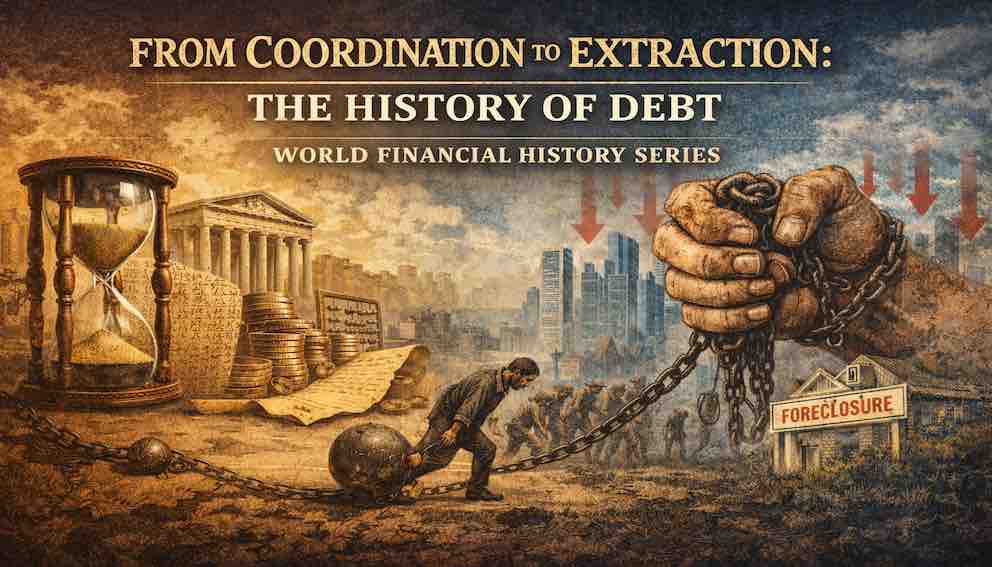
Across ancient Mesopotamia, Rome, medieval Europe, and into the modern world, debt solved a simple but unavoidable problem: people often had to act before outcomes were known. Fields were planted months before harvest. Labor was offered long before wages were paid. Protection was extended before tribute could be gathered. In its early form, debt made this uncertainty manageable. It allowed societies to move forward without waiting for perfect information. Trouble began when these obligations lingered after circumstances changed — when a failed harvest, a war, or plain bad luck turned a short-term promise into a lifelong burden. At that point, debt stopped helping people move forward together and instead began trapping them in fixed positions. This tutorial explains how that shift happens, why it has disrupted societies for thousands of years, and how the same tension still shapes the world today.
Credit as the Earliest System of Economic Coordination
A student postpones adulthood because loan payments leave no room to stumble.
A government cuts essential spending because creditors must be paid first.
A family does everything right, meets every obligation, and still never quite feels secure.
At first glance, these situations seem unrelated. But they are all expressions of the same ancient arrangement: a promise made in the past that still governs the present, even after its original purpose has faded.
This is not a modern invention. It is one of the oldest problems societies have faced.
Long before coins circulated or banks existed, communities had to solve a difficult coordination challenge: how to organize work, protection, and production when effort and reward were separated by time. Crops took months to grow. Labor was needed before goods existed. Protection had to be offered before tribute could be collected. Someone always had to go first.
Debt emerged as the solution to that timing problem. It allowed societies to move forward without waiting for certainty. It aligned effort today with repayment tomorrow. In its earliest form, debt was not about profit or pricing — it was about trust, memory, and mutual obligation.
In other words, debt did not begin as finance. It began as coordination.
But this balance is fragile. When monetary systems weaken or growth slows, debt contracts tend to become more rigid, not more flexible. Promises harden just as circumstances deteriorate. When that happens, debt stops helping people coordinate across time and starts extracting value from those who can least afford to give it. That shift — from coordination to extraction — is where instability begins.
Why Credit Appears Before Money Matures
Money solves a very specific problem:
“How can two strangers trade right now without trusting each other?”
Credit solves a different one:
“How can people trade across time when payment comes later?”
In early societies, production and consumption were rarely simultaneous. Grain was planted months before harvest. Labor was provided before output existed. Protection was extended before tribute could be collected.
Someone always had to go first.
That first step created imbalance — and imbalance required coordination. Credit filled that role.
Early Historical Examples
Across civilizations, credit systems appeared long before mature money:
- Sumer (c. 3000 BCE): Temples advanced grain to farmers before planting season. Repayment came after harvest. These obligations were recorded on clay tablets — among humanity’s earliest written records.
- Ancient Egypt: Grain loans followed the Nile’s flood cycle. Repayment depended on nature’s timing, not precise calculation.
- Zhou China: Obligations tied families to land and service long before coinage spread widely.
- Early India: Debt shaped occupation and social structure before standardized money existed.
In every case, credit came first because time demanded it.
At this stage, debt was not primarily numerical. It was social.
Who owed whom mattered more than how much.
Reputation mattered more than interest.
Memory mattered more than accounting.
A Concrete Turn from Coordination to Extraction
A clay tablet recovered from the city of Ur, dated to around 2000 BCE, records a farmer’s obligation of 150 silas of barley, advanced before planting and due after harvest, with interest. It is mundane, administrative, and utterly ordinary — one of thousands like it. These records show debt functioning as the economy’s connective tissue, allowing planting, labor, and survival to proceed before certainty existed. But centuries later, in the late Roman Republic, the same logic hardened.
Laws such as nexum allowed creditors to seize defaulting debtors as bonded laborers, converting financial failure directly into personal subjugation. The mechanism had not changed — a promise across time — but its social limits had. What began as coordination had crossed a line and become extraction.
Credit and Money as Coordination Tools
Money and credit both help people cooperate, but they do so in different ways. Money settles an exchange immediately. Once payment is made, neither side owes anything more. The relationship ends, and everyone moves on.
Credit keeps the relationship open. It allows exchange to happen even when payment must wait. Instead of closing the transaction, it stretches it across time. That stretch only works if people believe the promise at the center of it will hold.
For credit to function smoothly, three things must remain true. The promise must be usable beyond the original transaction — it must be transferable or acceptable elsewhere. It must remain reliable over time — people must believe it will actually be honored. And it must be broadly recognized — others must be willing to treat it as real, whether as collateral, repayment, or obligation.
When those conditions are met, credit expands what a society can do. Businesses invest before profits arrive. Households smooth income shocks. Governments fund long projects. Activity moves forward even under uncertainty.
When those conditions weaken, coordination starts to fail in specific, observable ways. Credit becomes harder to obtain. Terms become stricter. Penalties increase. People stop taking risks, not because opportunities disappear, but because the cost of being wrong becomes too high. At that stage, debt is no longer helping people bridge time — it is narrowing their options. This shift often appears long before defaults or crises, revealing stress in the system even when the numbers still look stable.
Early Debt Was Moral Before It Was Financial
As societies expanded, personal memory could no longer track obligations. Central institutions stepped in.
In Mesopotamia, temples and palaces kept debt records. These institutions were not neutral. They blended religion, law, and political authority. Debt enforcement reflected social hierarchy.
A merchant who defaulted might lose reputation.
A peasant who defaulted might lose land, family members, or freedom.
Classical Greece
In Athens, unpaid debts led to widespread debt slavery. Citizens were sold abroad to satisfy creditors.
In the 6th century BCE, Solon canceled debts, freed debt slaves, and banned loans secured on personal freedom. This was not charity. It was survival.
Debt had stopped coordinating exchange and started destroying citizenship.
Why Jubilees Existed
A jubilee was a deliberate reset of debt obligations. In several ancient societies, rulers periodically canceled personal debts, returned land to original families, and freed people who had fallen into debt bondage. These resets were not symbolic celebrations. They were practical interventions designed to keep societies functioning.
Over time, debt naturally accumulates. Bad harvests, illness, war, or simple misfortune push households into arrears. Interest compounds. Land concentrates in fewer hands. If left unchecked, this process turns a broad population of producers into a narrow class of creditors and a growing mass of dependents.
Jubilees existed to stop that process before it became irreversible. By clearing debts, societies restored productive capacity, prevented permanent underclasses, and reduced the risk of revolt. Most importantly, jubilees protected the legitimacy of authority. A system that enforces debts without limit eventually loses the consent of those expected to obey it.
In modern terms, jubilees were not acts of generosity. They were early forms of crisis management — an acknowledgment that debt, if allowed to run without social limits, undermines the very order it is meant to support.
Debt accumulates faster than most societies can absorb.
Bad harvests, war, illness, or simple misfortune push households into arrears. Interest compounds. Land concentrates. Productive capacity shrinks.
Ancient societies encountered this repeatedly — and responded deliberately.
Examples Across Civilizations
- Mesopotamia: Kings regularly declared debt cancellations, restoring land and wiping personal obligations.
- Ancient Israel: The Jubilee returned land and forgave debts every 50 years.
- Imperial China: Dynasties canceled tax arrears after floods and wars to prevent revolt.
These were not moral gestures. They were stabilization mechanisms.
They preserved productive capacity, prevented permanent underclasses, and restored the legitimacy of authority. Debt systems survived because limits existed.
What Happens When Debt Loses Its Moral Limits
When limits disappear, enforcement hardens.
The historical pattern is consistent:
- Roman Republic: Small farmers lost land to creditors. Large estates expanded. Soldiers became landless. Political violence followed.
- Medieval Europe: Harsh enforcement after crop failures triggered repeated peasant revolts.
- Early modern Spain: Sovereign defaults were frequent — not because silver was scarce, but because enforcement became politically impossible.
At this stage, debt enters a specific failure mode.
Debt Peonage
Debt peonage describes a condition in which people remain productive and compliant, yet are unable to escape their obligations no matter how consistently they pay. The defining feature is not default. It is permanence. Debt no longer bridges a temporary gap between effort and reward; it becomes a long-term constraint that absorbs future income without offering a realistic path to release.
This condition develops slowly. A borrower takes on debt to manage a setback — a bad harvest, a job loss, an emergency expense. The original loan is meant to be temporary. But high interest, fees, and penalties mean that repayment mostly services the obligation itself rather than reducing it. Even when payments are made on time, the borrower’s position does not materially improve. Compliance sustains the system, but it does not restore mobility.
History shows this pattern clearly. In the Roman Republic, laws such as nexum allowed creditors to seize the bodies and labor of defaulting debtors. Financial failure translated directly into personal subordination. After the American Civil War, sharecropping and crop-lien systems tied families to land through advance credit for tools and supplies. Debts were routinely rolled over at unfavorable terms, ensuring that labor continued while freedom did not.
Modern economies reproduce the same structure in subtler ways. In the United Kingdom, prior to tighter regulation, segments of the payday lending industry extended short-term loans at extremely high effective interest rates. Borrowers often used these loans not to invest or build, but to cover basic expenses between paychecks. Because repayment schedules were short and costs high, many borrowers rolled loans over repeatedly. Income continued to flow toward repayment, yet the underlying financial position remained unchanged. The borrower worked, paid, and complied — but could not exit.
In each case, the mechanism is the same. Debt ceases to coordinate productive activity and instead extracts value from future effort. The system may appear stable on paper — contracts are enforced, payments are collected — but social and economic flexibility erodes. Debt peonage marks the point at which obligation becomes a structural feature of life rather than a temporary tool. Historically, systems that reach this stage do not resolve quietly. They require reform, forgiveness, or rupture.
What History Has Taught Us (Again and Again)
Across different eras, cultures, and technologies, debt systems tend to fail in remarkably similar ways. The surface details change, but the underlying dynamics repeat. Three patterns appear so consistently that they function as early warning signs rather than historical curiosities.
1. Debt Grows Faster Than Income
Debt expands according to contractual rules. Income grows according to human limits. This mismatch lies at the heart of many debt crises.
In agrarian societies, rents and obligations often rose faster than crop yields. A farmer could only produce so much from the land, but debts accumulated regardless of weather, health, or war. In modern economies, the same dynamic appears through compounding interest. Loans grow automatically over time, while wages and productivity increase slowly and unevenly.
As a result, a growing share of income is devoted to servicing past obligations rather than improving future capacity. Households work more just to stand still. States raise taxes or cut spending to meet existing commitments. Over time, debt stops funding growth and starts absorbing it. This does not immediately cause collapse, but it steadily reduces resilience.
The implication is simple but often ignored: when obligations rise faster than the ability to pay them, stress is accumulating even if defaults have not yet appeared.
2. Enforcement Tightens Late in the Cycle
As repayment becomes harder, systems rarely respond by loosening terms. Instead, they tend to enforce more strictly.
Historically, this has taken familiar forms: debtor prisons, land seizure, bonded labor, harsh bankruptcy laws, and social stigma attached to failure. These measures are often justified as necessary to preserve discipline or fairness. In practice, they usually appear when repayment capacity is already weakening.
This shift is an important behavioral signal. When a system relies increasingly on punishment to extract payment, it suggests that voluntary compliance is no longer sufficient. Legitimacy begins to be replaced by force. The rules become more rigid just as reality becomes more fragile.
Such tightening does not restore long-term stability. It may increase collections in the short term, but it also deepens resentment and reduces future productive capacity. Historically, this phase often precedes unrest, reform, or rupture.
3. Behavior Changes Before Collapse
Debt systems rarely fail suddenly. They fray first through behavior.
Before formal default or open revolt, people begin adapting quietly. Payments are delayed. Obligations are renegotiated informally. Barter, favors, and alternative arrangements reappear. Parallel systems emerge to work around rules that no longer feel workable.
These behaviors are visible in the late Roman Empire, where tax avoidance and informal exchange spread as burdens increased. They appear in late imperial China, where local arrangements replaced official obligations during fiscal strain. They also appear in modern crises, long before balance sheets force recognition.
The key implication is that stress shows up in actions before it appears in statistics. When people change how they interact with a debt system, they are signaling that it no longer coordinates activity effectively. By the time defaults make headlines, the breakdown has already been underway.
Why This Matters
History does not fail debt systems through surprise. It does so through accumulation. Obligations grow quietly. Enforcement hardens gradually. Behavior adapts long before institutions admit stress.
Understanding these patterns does not predict outcomes. It allows diagnosis. And in debt systems, diagnosis always comes before disruption.
What History Has Not Fully Integrated
Despite thousands of years of experience, societies tend to repeat the same misunderstandings about debt. These are not failures of intelligence or morality. They are failures of integration — lessons learned locally and temporarily, but not carried forward as systems grow more complex.
Debt Cannot Be Fully Abstracted
Early debt systems were personal and visible. People knew who owed whom. Obligations were embedded in social relationships, customs, and expectations. Because of this, debt could be adjusted when circumstances changed. A bad harvest, illness, or war did not automatically turn a temporary obligation into a permanent sentence.
Modern systems treat debt differently. Obligations are standardized, anonymized, and enforced through technical rules. This allows debt to scale across millions of people and institutions. Loans can be bought, sold, bundled, and enforced without personal knowledge of the borrower.
That abstraction is powerful, but it comes at a cost. When debt is treated purely as a technical contract, it becomes less responsive to reality. Flexibility disappears just when it is most needed. Systems gain efficiency, but lose the ability to adapt to human limits. History shows that when abstraction goes too far, coordination gives way to rigidity.
Legal Power Is Not Legitimacy
States often assume that if debt can be enforced legally, it can be enforced indefinitely. History suggests otherwise.
In late eighteenth-century France, the monarchy possessed the legal authority to tax, borrow, and compel payment. What it lacked was public acceptance. As obligations mounted and enforcement tightened, legitimacy eroded. The result was not fiscal adjustment, but political collapse.
Imperial Russia followed a similar path. The state retained formal control over taxation and debt enforcement, yet popular acceptance had already fractured. Legal power remained intact until it suddenly did not.
The lesson is not that enforcement is unnecessary. It is that enforcement alone cannot sustain a system. When large segments of society no longer accept the fairness or feasibility of obligations, authority weakens — even if the laws remain unchanged.
Complexity Masks Fragility
Debt systems often grow more complex in response to stress. New instruments are created. Old obligations are restructured. Layers of rules and intermediaries accumulate.
This has been true for centuries. Medieval tally sticks, early government annuities, and modern derivatives all served the same purpose: to manage and distribute obligations more efficiently. Complexity can delay recognition of problems by spreading risk and obscuring exposure.
But complexity does not remove underlying limits. It postpones confrontation rather than resolving it. When conditions deteriorate far enough, the structure fails anyway — often in ways that surprise those who believed complexity had made the system safer.
History’s lesson here is consistent: complexity can hide fragility, but it cannot eliminate it.
The Implication
What history shows is not ignorance, but repetition. Societies repeatedly overestimate how far debt can be abstracted, how long enforcement can substitute for legitimacy, and how much complexity can protect against human and political limits.
These misunderstandings do not cause immediate failure. They allow systems to function longer than expected. But they also ensure that when limits are reached, adjustment is abrupt rather than gradual.
Repeating Debt Failure Modes
Across history, debt does not fail in random ways. It fails in familiar patterns, tied to who is borrowing, why they are borrowing, and what happens when repayment outpaces reality. The details change from era to era, but the structure remains strikingly consistent.
Agrarian Debt: From Obligation to Land Loss to Revolt
In agricultural societies, debt often began as a way to survive uncertainty. Farmers borrowed seed after a bad harvest or tools during hard seasons, expecting to repay when conditions improved. At first, this kind of credit kept communities functioning.
The problem arose when bad years stacked up. Missed payments turned into lost land. Small farmers became tenants or laborers on fields their families had once owned. As more land concentrated in fewer hands, the social balance broke.
This pattern appears repeatedly — in ancient Mesopotamia, in the Roman Republic, and throughout medieval Europe. When large portions of the population lost both property and autonomy to debt, revolt was not an accident. It was a predictable response to extraction replacing cooperation.
War Finance: From Emergency Borrowing to Political Constraint
States often turned to debt in moments of crisis, especially war. Borrowing allowed governments to mobilize armies quickly without immediate taxation. In the short term, this made survival possible.
Over time, however, war debts accumulated faster than revenues. Creditors gained leverage over state policy. Tax systems were redesigned to prioritize repayment. Political decisions narrowed, shaped less by public need than by fiscal obligation.
Spain, France, and Britain each followed versions of this path. In some cases, the result was imperial decline. In others, domestic upheaval. The key pattern is this: emergency borrowing gradually hardened into permanent constraint, reshaping sovereignty itself.
Household Debt: From Opportunity to Immobility to Backlash
In industrial and modern economies, the primary debt burden shifted from land and states to households. Credit promised access — education, housing, mobility. For a time, it delivered.
But when wages stagnated and costs rose, debt stopped enabling movement and started enforcing stasis. Families met their obligations and still fell behind. Risk was pushed downward onto individuals least able to absorb it.
As mobility slowed, frustration grew. Social trust weakened. Political backlash followed. This pattern has repeated from the industrial age to the present, even though the instruments have changed.
The Throughline
Different eras. Different institutions. Different language.
But the same structure persists: debt begins as a tool for coordination, then hardens into a mechanism of extraction. When too many people experience debt not as opportunity but as confinement, systems do not self-correct quietly. They are corrected by force, reform, or collapse.
Modern Echoes: A Diagnostic Lens
To diagnose a society’s debt health, ask:
Is debt funding future production — education, housing, business?
Or is it extracting rent from existing position — speculation, leverage, high-interest consumption?
The balance reveals whether debt is coordinating growth or extracting value.
Modern restructurings, inflation, and forbearance are functional equivalents of jubilees. The language has changed. The purpose has not.
The Root Problem: Time Mismatch
Debt fails when repayment timelines exceed human lifespans, political mandates, or social patience. This mismatch is universal.
Credit as Social Memory — Then and Now
Early debt was visible and personal. Modern debt is institutional and opaque.
This allows scale — but when memory is outsourced to algorithms, empathy is replaced by amortization schedules.
When Debt Stops Coordinating and Starts Extracting
Debt systems fail when they no longer enable future production and instead harvest past vulnerability. That transition point is the same in ancient and modern systems.
Investor Insight: Debt as a Social Contract
Debt is enforceable only within tolerance.
Capacity is not the same as willingness.
Behavior shifts before default.
History does not offer forecasts.
It offers diagnostic patterns.
And the most enduring pattern is this: debt is a social contract. It breaks when it is treated as a purely financial one.
This chapter has intentionally avoided interest. Once societies begin pricing time explicitly, the moral and financial dynamics change in fundamental ways — and that is where the next chapter begins.
About Swati Sharma
Lead Editor at MyEyze, Economist & Finance Research WriterSwati Sharma is an economist with a Bachelor’s degree in Economics (Honours), CIPD Level 5 certification, and an MBA, and over 18 years of experience across management consulting, investment, and technology organizations. She specializes in research-driven financial education, focusing on economics, markets, and investor behavior, with a passion for making complex financial concepts clear, accurate, and accessible to a broad audience.
Disclaimer
This article is for educational purposes only and should not be interpreted as financial advice. Readers should consult a qualified financial professional before making investment decisions. Assistance from AI-powered generative tools was taken to format and improve language flow. While we strive for accuracy, this content may contain errors or omissions and should be independently verified.