Tutorial Categories
Last Updated: January 25, 2026 at 10:30
The Cost of Time: Why Interest Changes Debt - World Financial History Series
Debt allows people to use resources before they have fully earned them, bridging the gap between present need and future production. In every debt relationship, one party gives up control of resources now, while another promises to return value later, relying on shared uncertainty about the future and agreed rules to make that promise credible. Interest changes this arrangement by assigning a price to waiting, so that time itself increases what is owed even when nothing else happens. Across history, societies have depended on lending but have repeatedly resisted the idea that time alone should generate income. This unease reflects a clear understanding that once time is priced, debt shifts from a tool of coordination into a mechanism that redistributes power and shapes behavior over the long run.
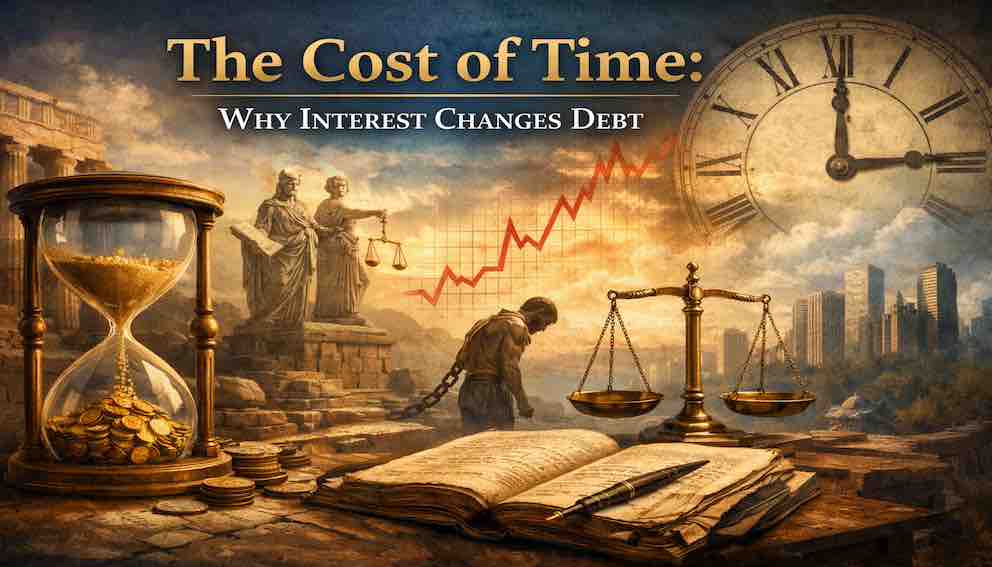
Let’s begin with a simple idea, one that people have understood for thousands of years: sometimes, you need help today that you can’t pay for until tomorrow.
Imagine a farmer in ancient times. The season for planting arrives, but he has no seed. A neighbor has seed to spare. The neighbor can say, “Take this seed now. Plant it. When you harvest your crop, give me back the same amount of seed you borrowed.”
This is the purest form of debt. It’s a bridge across time. It solves a problem: the farmer can plant today, and the neighbor gets his seed back later. Nothing is created by the waiting itself, but the waiting is necessary. The debt is a tool of cooperation.
Now, let’s change one thing in our story. What if the neighbor says, “Take this seed now. When harvest comes, I want you to give me back my seed… plus a little extra.”
That “little extra” is interest. And with that small change, the entire nature of the agreement shifts. It is no longer just about returning what was borrowed. It’s about paying a fee for the time that passed in between.
For most of human history, people have been deeply uneasy about this fee. They have accepted borrowing and lending, but they have repeatedly questioned, regulated, and often outright banned charging for time. This isn’t because our ancestors were bad at math or didn’t understand business. It’s because they understood, in their bones, what happens when you put a price on waiting. It changes people. It changes power. It changes societies.
This is the story of that unease. It’s a story that repeats itself across empires and religions, from clay tablets in Mesopotamia to the debates in our own time. It’s not a story of finance, but of human relationships under the pressure of time.
The Old Rules: When Time Was Shared, Not Sold
Long before banks or complex contracts, people lent to each other. These early debts acknowledged time, but they handled it with care and clear limits.
Take the earliest civilizations, like ancient Mesopotamia. A farmer would borrow a bushel of barley at planting. Everyone understood he would repay it after the harvest. The calendar was set by the sun and the seasons, not by a moneylender. And crucially, if the harvest failed—if flood or drought or war destroyed the crops—the ruler would often declare a clean slate. Debts would be wiped away. Why? Because the failure wasn’t the farmer’s fault; it was shared bad luck. Time, in this view, was a shared risk, not a private asset to be sold.
We see a similar idea in the ancient laws of the Israelites. The rules were clear: you could lend to your neighbor in a time of need, but you could not charge him interest. The purpose was to prevent a good deed from turning into a trap. If a family had a bad year and borrowed to eat, interest would make the hole they were in even deeper. Next year, they wouldn’t just owe the food—they’d owe more. The law sought to keep debt as a lifeline, not a chain.
These weren’t naive rules. They were practical wisdom. They recognized that when debt grows automatically with time, it can quietly turn cooperation into control, and neighbors into masters and servants.
The Turning Point: When Time Became a Commodity
So, what changes? When does this careful system of shared time break down?
It often starts with commerce, not cruelty. Think of ancient Athens. A merchant wants to fund a risky sea voyage to trade goods across the Mediterranean. He needs a large sum of silver. A wealthy citizen provides it. This isn’t a loan between neighbors; it’s a business deal between strangers. The ship could sink, pirates could attack, the market could crash. The lender is taking a real gamble. Charging interest here makes sense to everyone. It’s a price for the very real risk of total loss.
But this is the critical distinction we must understand: Pricing risk feels legitimate; pricing waiting feels different. The lender in Athens was being paid for the chance he might lose everything. He was being paid for an uncertain outcome.
But take away that risk. Imagine a safe, sure loan to a trusted borrower. Even in this case, charging a fee for the mere passage of days feels like a different kind of transaction. It’s not compensation for a hazard; it’s a toll for crossing the bridge of time itself. This is where the deepest unease begins. When the element of risk disappears, all that’s left is a charge for the ticking clock, and this is what societies have struggled with for millennia.
Once this idea—that even safe, waiting time has a price—is accepted in commerce, it’s hard to stop it from spreading into everyday life. The tool designed for risky trade between strangers starts to be used between people who know each other very well. When a farmer borrows seed from a neighbor, the risk of a bad harvest is real. But now, the charge isn't just for the risk of crop failure; it’s also for the waiting period between planting and harvest. The price of time is now added to the price of risk.
This is when the three quiet revolutions happen:
First, time gets a meter. Without interest, a debt lasts “until the harvest” or “until the ship returns.” It’s tied to an event. With interest, time is sliced into uniform pieces—months, years. Each piece has a cost. A late payment isn’t just late; it’s mathematically heavier. The calendar, not the condition of the borrower, becomes the boss.
Second, debt starts growing on its own. This is the most unsettling part. With interest, the amount owed increases even if nothing else changes. No new seed is planted. No extra work is done. The mere passing of days and nights makes the number bigger. It’s as if the seed, left alone in the barn, quietly multiplied.
History shows us what this looks like. In 14th-century England, court records tell of peasants who borrowed small sums. Through compound interest—where you pay interest on the unpaid interest—these debts doubled and tripled in just a few years. Men lost their family farms not because they were lazy, but because the math of time ran faster than the growth of their crops. This kind of quiet, automated extraction fueled massive social unrest, like the Peasants’ Revolt of 1381.
Third, power tilts. Interest rewards the one thing that is not distributed equally: the ability to wait. The person with a surplus can sit back and watch their claim grow. The person in need must pay for the time required to get back on their feet. Over generations, this doesn’t just transfer money; it hardens social class. Patience becomes an inherited advantage.
The Endless Search for a Workaround
Faced with these consequences, societies didn’t just give up. They fought back with rules, and then watched as human ingenuity found ways around them.
For centuries in medieval Europe, the Church forbade “usury”—charging interest. But people still needed to borrow, and lenders still wanted a return. So, they got creative. They invented contracts that looked like rent or profit-sharing agreements. You wouldn’t charge interest on a loan of silver. Instead, you might “buy” a share of a farmer’s future harvest for a price below its value. The economic effect was similar, but it danced around the religious law.
In the Islamic world, which also prohibits interest, a different system evolved. You couldn’t charge for money sitting idle, but you could share in the profit of a venture. If you provided the capital for a trader to buy goods, you could agree to split the profit when those goods were sold. The reward was tied to a real outcome, not just the ticking of a clock.
These weren’t just sneaky loopholes. They were serious, thoughtful attempts to get the benefits of lending—the ability to start a business, build a ship, plant a crop—without unleashing the socially destructive power of time-for-sale.
Why It Still Feels Wrong Today
You might think these are old, settled debates. But the ancient unease about interest never really went away. It just changed its clothes.
Think about the public anger toward “payday” loans with astronomical interest rates. The outrage isn’t just about the number. It’s about the feeling that these loans trap people in a cycle where time itself is the enemy. The debt grows faster than their paycheck.
Or consider the global confusion when central banks introduced “negative interest rates.” The idea that you would pay a bank to hold your money, or that a bank would pay you to take a loan, felt bizarre and unnatural to millions. It violated a deep-seated rule: waiting should be rewarded, not punished. The public reaction proved that our instincts about the price of time are still very much alive.
And this leads us to the quietest, most profound change of all. In the modern world, our financial system has fully embraced this cycle. The goal is often not to help someone end their debt, but to help them manage it forever. We’ve shifted from a system that aimed for resolution—paying off the loan and being free—to one built on servicing—making perpetual payments. Courts don't adjudicate the fairness of the debt; they enforce the contract. Banks don't offer jubilees; they offer refinancing plans that stretch the obligation further into the future. For households with mortgages and student loans, and for governments with sovereign bonds, debt is no longer a temporary bridge. For many, it has become a permanent feature of the landscape, a standing condition of life that is continuously serviced but never truly resolved.
The Lesson in the Cycle
What can we learn from this long, repeating story? History doesn’t give us an answer on whether interest is “good” or “evil.” It shows us something more useful: a pattern, a cycle that societies seem to go through again and again.
First, we accept interest as a practical tool for trade and growth.
Then, we experience its extractive power, as debts compound and inequality hardens.
Next, we revolt, creating moral rules and strict laws to ban or cage it.
Finally, we innovate, designing new financial tools to get the job done while technically following the rules… until the cycle begins anew.
The cycle persists because the core problem is unsolvable. Lending is essential for an economy to function. It lets ideas become businesses and lets people survive hard times. But attaching a self-expanding price tag to time introduces a force that, left unchecked, can tear apart the very community that makes repayment possible.
This is the ultimate constraint. An interest-based system doesn’t fail simply when the numbers get too big. It fails when enough people decide it is no longer legitimate—when they resist, find workarounds, or demand political change. The math can work on paper forever. But a system that prices time must also maintain a fragile, essential belief: that the price is fair, and that the waiting is worth the cost.
Our ancient farmer, standing at the edge of his field with borrowed seed, is at the heart of this eternal tension. The bridge of debt is what allows him to work. The question his society must always answer is: what is the fair toll for crossing that bridge? And when does the toll become so high that it claims not just a portion of his harvest, but the field itself?
History’s clear message is that when a society forgets to ask that question, the answer eventually arrives not in a ledger, but in crisis, conflict, and the hard, painful work of rebuilding trust. The price of waiting, it turns out, is a debt that every generation must reckon with anew.
About Swati Sharma
Lead Editor at MyEyze, Economist & Finance Research WriterSwati Sharma is an economist with a Bachelor’s degree in Economics (Honours), CIPD Level 5 certification, and an MBA, and over 18 years of experience across management consulting, investment, and technology organizations. She specializes in research-driven financial education, focusing on economics, markets, and investor behavior, with a passion for making complex financial concepts clear, accurate, and accessible to a broad audience.
Disclaimer
This article is for educational purposes only and should not be interpreted as financial advice. Readers should consult a qualified financial professional before making investment decisions. Assistance from AI-powered generative tools was taken to format and improve language flow. While we strive for accuracy, this content may contain errors or omissions and should be independently verified.