
Tutorial Categories
Last Updated: January 25, 2026 at 10:30
The Promise in the Vault: A Story of Trust, Time, and the Unstable Heart of Banking - World Financial History Series
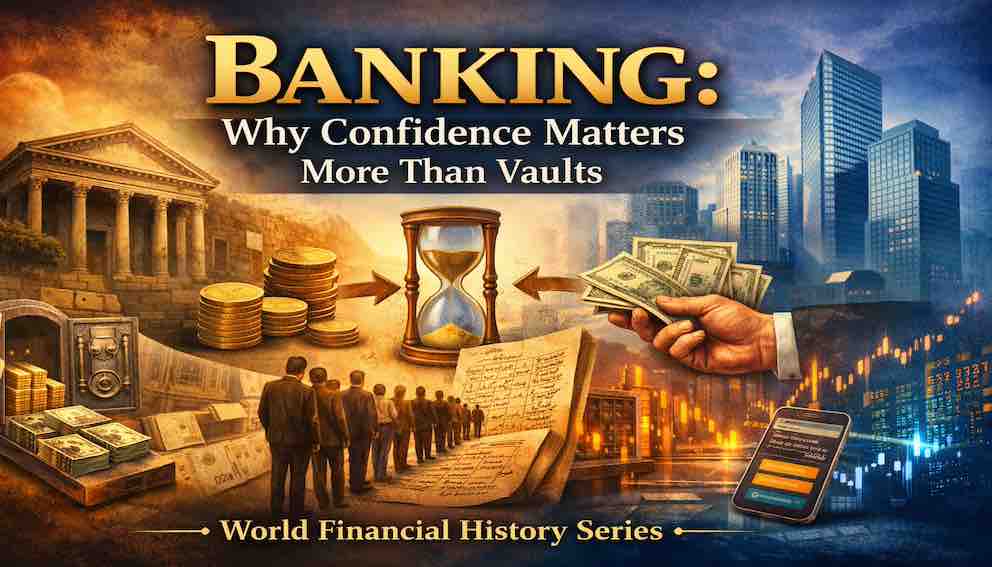
Banking is not a system of vaults filled with cash. Banking is a system designed to move money across time. When an individual deposits money in a bank, the bank does not merely store that money. The bank promises that the depositor can access funds on demand, while simultaneously using those same funds to finance loans that will only return cash in the future. This structure is known as fractional reserve banking. It expands credit and increases economic activity by allowing the same unit of money to support multiple transactions over time. However, this structure also makes banks fundamentally dependent on confidence. When many depositors demand access to their money at the same time, even a bank whose assets exceed its liabilities can fail. The failure occurs because the bank’s assets are tied up in loans that cannot be converted into cash quickly. For this reason, bank runs are not accidents, irrational panics, or moral failures. They are predictable coordination failures that emerge from the basic design of banking itself.
Let's start with something you know. You put money in a bank. You trust it will be there when you need it. This seems simple. It feels like storing grain in a barn or gold in a chest.
But here is the secret at the heart of all modern banking: it isn't.
The moment your money enters a bank, it begins a journey through time. The bank makes you a promise: "You can have this back whenever you ask." But almost in the same breath, it makes another promise to someone else: "You can have this money now to build a business or buy a home, and you can pay it back later."
A bank is not a vault. A bank is a time machine.
It takes your "today" and lends it to someone else's "tomorrow." This beautiful, fragile trick is what builds our world. It funds farms, factories, and homes. But its weakness is written into its design. A bank can only keep its promise to you if not everyone asks for their promise to be kept at once. The entire system rests on a shared, silent agreement: we will not all knock on the door at the same time.
This is the story of that agreement. It's a story that begins in ancient temples and leads directly to the digits in your bank app. It explains why banks can seem rock-solid one day and vanish the next, not through crime or stupidity, but through the simple, relentless logic of time.
Part I: The Seed of the Idea – Not Vaults, but Ledgers
Long before there were bankers in suits, there were scribes with clay tablets. In the bustling cities of ancient Mesopotamia, merchants faced a practical problem. They traded grain, silver, and goods across vast distances. Carrying heavy silver or perishable grain was risky and slow.
The solution emerged in the most secure places they knew: the temples and palaces. These were the ancient world's fortresses, backed by the authority of gods and kings. A merchant could deposit a sack of silver at the temple in Ur. In return, he received a clay tablet—a receipt. This tablet didn't just say he had silver; it was his silver. He could use it to pay a supplier in another city by handing over the tablet. The supplier would take it back to the temple to claim the silver.
Nothing physically moved in the vault. Only the name on the ledger changed.
This was the first, quiet revolution: money became information. Trust shifted from the weight of the metal to the integrity of the record and the institution keeping it. The "bank" wasn't a storehouse of value; it was a coordinator of promises.
Part II: The Fateful Leap – From Storing Money to Lending Time
For centuries, these institutions mostly just moved money around. But then, someone had a second, world-changing idea.
Look at all this silver and grain sitting still, they thought. What if we could use it?
In medieval Italy, trade exploded. Merchants in Florence needed to fund risky voyages to Alexandria for spices. They turned to wealthy families—the Medicis, the Bardis—who had become experts in moving money across borders with letters of credit.
A merchant would say, "I need gold here to buy wool in England, but I'll only have silver there when I sell it in Venice six months from now." The banking family would advance the gold, for a fee. To do this, they used the deposits other merchants had left with them for safekeeping.
This was the leap. The banker stopped being just a guardian of deposits. He became a magician of time. He took "short-term" money (a deposit that could be asked for any day) and turned it into "long-term" money (a loan that would only be repaid months later).
This magic has a technical name: fractional reserve banking. It means only a fraction of the deposits are kept in reserve. The rest are lent out into the future. It is the engine of the modern world. It turns stagnant pools of savings into flowing rivers of capital that build roads, schools, and startups.
But every magic trick has a vulnerability. This one's weakness is a question of timing.
Part III: The Inherent Crack – When "Later" Becomes "Now"
The system works on a gentle, unspoken rhythm. Every day, some people deposit money, and some people withdraw it. It balances out. The bank only needs enough cash on hand for the daily flow.
But what if the rhythm breaks? What if, one day, everyone who put money in wants to take it out?
This is a bank run. It is not a myth. It is a mathematical certainty waiting in the wings of every banking system in history.
Let’s break down why it’s so devastating with a simple story.
The Tale of Two Banks:
- Bank A (The Safe): This bank just stores money. For every $100 deposited, it has $100 in its vault. It's perfectly safe, but it does nothing. It doesn't build any homes. It's a closet, not an engine.
- Bank B (The Engine): This bank uses fractional reserve magic. For every $100 deposited, it keeps $10 in the vault and lends $90 to a carpenter to build a workshop. The workshop won't be profitable for a year.
Now, imagine a rumor starts. It doesn't have to be true. It just has to be believable. The rumor says Bank B is in trouble.
If you are a depositor at Bank A (The Safe), you hear the rumor and shrug. "So what? My money is right there in the vault. I can see it."
If you are a depositor at Bank B (The Engine), you face a terrifying logic puzzle:
- I know the bank lent most of my money to the carpenter.
- I know the carpenter can't pay it back today.
- If other people believe the rumor and get in line before me, they'll take the $10 that's in the vault.
- If I wait, there will be nothing left for me when I get to the front of the line.
What is the rational thing to do?
The rational thing is to run. To get to the bank faster than your neighbors.
And because every single depositor is thinking the exact same thing, they create the very disaster they fear. The bank may be perfectly "solvent"—the carpenter's workshop may be worth far more than the loan—but it is not "liquid." It has value, but not right now cash. It dies not from a lack of wealth, but from a lack of time.
Here, we must name the two demons that haunt every bank. Solvency is a question of long-term value: do the bank's assets (like loans and buildings) exceed what it owes? Liquidity is a question of immediate cash: can it pay its bills today? A bank run is the ultimate proof that liquidity can kill a solvent bank. You can be rich on paper and bankrupt on the sidewalk because you cannot turn your wealth into cash fast enough.
This is not a panic. It is a coordination failure. It's like a crowd trying to exit a theater through a single door. If everyone files out calmly, all is well. If everyone fears being trapped and rushes at once, people get hurt—even though the door was always big enough.
Part IV: The Whisper Before the Run
History shows us that total collapses like this rarely happen out of a clear blue sky. Long before the crowd gathers outside the bank, the mood inside the financial system begins to shift.
People don't suddenly lose trust; they slowly shorten their horizons. They start asking, "What can I get back this week?" instead of, "What will this earn me next year?" Savers might shift their money from long-term savings accounts into easily accessible checking accounts. Businesses might start demanding faster payments from customers and hoarding a little more cash themselves. Banks might quietly become more picky about who they lend to. This is the financial system's version of a flock of birds suddenly going silent before a storm. The behavior changes long before the headline crisis hits.
Part V: History's Echo – The Pattern Repeats
This story is not a hypothetical. It is the recurring soundtrack of financial history.
- Florence, 1340s: The great Bardi and Peruzzi banks didn't fail because they were poorly run. They failed because their biggest "asset" was a loan to the King of England, who decided not to pay it back. When depositors realized the banks' wealth was tied up in a king's broken promise, they asked for their money back. The banks had wealth, but not cash. They collapsed. This was a landmark lesson: a bank's stability is only as strong as the promise of its biggest borrower. It marked the beginning of the deep, dangerous marriage between private banking and sovereign finance. When a government's credibility weakens, the banks that hold its debt are holding a ticking clock, not a safe asset.
- America, 1857: Banks failed during the autumn harvest not because of a scandal, but because of the seasons. Farmers needed physical cash to pay workers and ship grain. The sudden, predictable demand for cash overwhelmed banks that had lent it out for longer-term railroad projects. The system seized up because of a calendar.
- The World, 2008: The "run" didn't happen at teller windows. It happened in the shadowy, digital world where big institutions lend to each other overnight. When trust evaporated, this market froze in hours. Institutions like Lehman Brothers weren't necessarily out of value; they were out of time and out of friends willing to lend for even one more day.
The technology changes—from clay tablets to blockchain. The scale changes—from a city-state to the global economy. But the core drama never changes: a system built on the promise of "tomorrow" can be broken by a collective demand for "today."
Part VI: The Patches on the Crack
For centuries, societies watched this play repeat and decided they had to do something. They couldn't change the fundamental design of banking, but they tried to reinforce the door before the next crowd rushed it.
They created deposit insurance, promising that even if the bank failed, small savers would get their money back. This calmed household nerves but did nothing for the giant institutions that lend to each other. They wrote regulations, telling banks to keep more cash on hand and make safer loans. This made the system sturdier but could never eliminate the basic mismatch between short-term deposits and long-term loans. Most importantly, they established the central bank as a "lender of last resort." Its job was to lend cash freely in a crisis, acting as the one friend who would always answer the phone at 3 a.m. when everyone else had hung up.
These patches changed the game. They made classic bank runs rarer. But they didn't change the rules. They simply moved the risk around and changed who had to answer the final, desperate call for cash. The state, through its central bank, became the ultimate backstop, tying the fate of the banking system directly to the credibility of the government itself. Guarantees could buy time, but they could not buy certainty.
Conclusion: The Unbreakable Paradox
So, what have we learned from this long history?
We have learned that banking is humanity's most powerful tool for building the future. By moving money across time, it turns our collective patience into bridges, vaccines, and homes.
But we have also learned that this tool is built on a paradox. Its greatest strength is also its fatal flaw. The very act of lending tomorrow's promise to finance today's project makes the system vulnerable to a sudden loss of faith in tomorrow.
If we think back to the three simple questions that test any monetary system—Can it move? Will it last? Will it be accepted?—a bank run is the ultimate failure of the third. The money hasn't vanished. Its long-term value might be intact. But in that moment of collective doubt, it is no longer accepted without hesitation. The shared belief that the door will open evaporates, and the system freezes.
A bank is not made of marble walls and steel vaults. Its true foundation is something far more fragile and powerful: a shared story. The story that the doors will open, that the ledger is honest, and that tomorrow will come. When that story is believed, the time machine hums quietly, building our world. When that story is questioned, the machine stops with a sudden, shocking silence.
The history of banking, therefore, is not a history of money. It is a history of trust. And the next chapter in our story is about what happens when that private trust repeatedly fails—and who is forced to step in to try and write a more permanent, public ending.
About Swati Sharma
Lead Editor at MyEyze, Economist & Finance Research WriterSwati Sharma is an economist with a Bachelor’s degree in Economics (Honours), CIPD Level 5 certification, and an MBA, and over 18 years of experience across management consulting, investment, and technology organizations. She specializes in research-driven financial education, focusing on economics, markets, and investor behavior, with a passion for making complex financial concepts clear, accurate, and accessible to a broad audience.
Disclaimer
This article is for educational purposes only and should not be interpreted as financial advice. Readers should consult a qualified financial professional before making investment decisions. Assistance from AI-powered generative tools was taken to format and improve language flow. While we strive for accuracy, this content may contain errors or omissions and should be independently verified.